

Dana said it once, and she said it well.
She told Marcus that when he takes work calls through dinner she ends up eating alone at a table with two people at it, and she asked for the phone in the other room until the plates were cleared. He agreed. It was a good conversation. Nobody raised their voice, nobody cried, nobody brought up 2019.
Eleven days later the phone was back on the table.
Setting boundaries in relationships rarely fails at the first conversation. It fails at the second one, the one nobody scripts, where the thing you already asked for quietly stops happening and you have to choose between saying it again or letting it slide. Say it again and you feel like a nag. Let it slide and you have just taught the relationship that the boundary was a mood.
That fork is what this article is about. Not the announcement. The eleventh day.
The advice stops exactly where the problem starts
Read the top results on this topic and you will find the same shape: know your limits, use an "I" statement, communicate clearly, be consistent. All of it true. All of it ends at the moment you open your mouth, as though the hard part were the sentence.
The hard part is what happens after the sentence lands and nothing changes.
Here is the trap waiting there. When a request goes unmet, the natural move is to make it again, louder or sadder or more often. Researchers named that loop decades ago: the demand-withdraw pattern, where one partner makes a complaint or a request for change and the other avoids or withdraws from the discussion, apparently to dodge the argument or the change itself. [1]
That loop is one of the most reliably measured patterns in relationship science. A meta-analysis pooling 74 studies and 14,255 people found demand-withdraw associated with worse outcomes overall at r = .36, and its strongest link was with relationship outcomes specifically, at r = .423. [2] Paul Schrodt, who led that analysis, put the reason it survives so plainly it stings: "Partners get locked in this pattern, largely because they each see the other as the cause. Both partners see the other as the problem." [3]
So the repeat does not work. And this is not a young-couples finding you can wave off. Researchers at Berkeley observed 127 middle-aged and older long-term married couples discussing an area of conflict at three points across 13 years, and found avoidance behavior climbing over that stretch while every other demand and withdraw behavior held steady. [4] Twenty years of marriage does not dissolve the loop. It practices it.
A boundary is a decision about you, not a rule for them
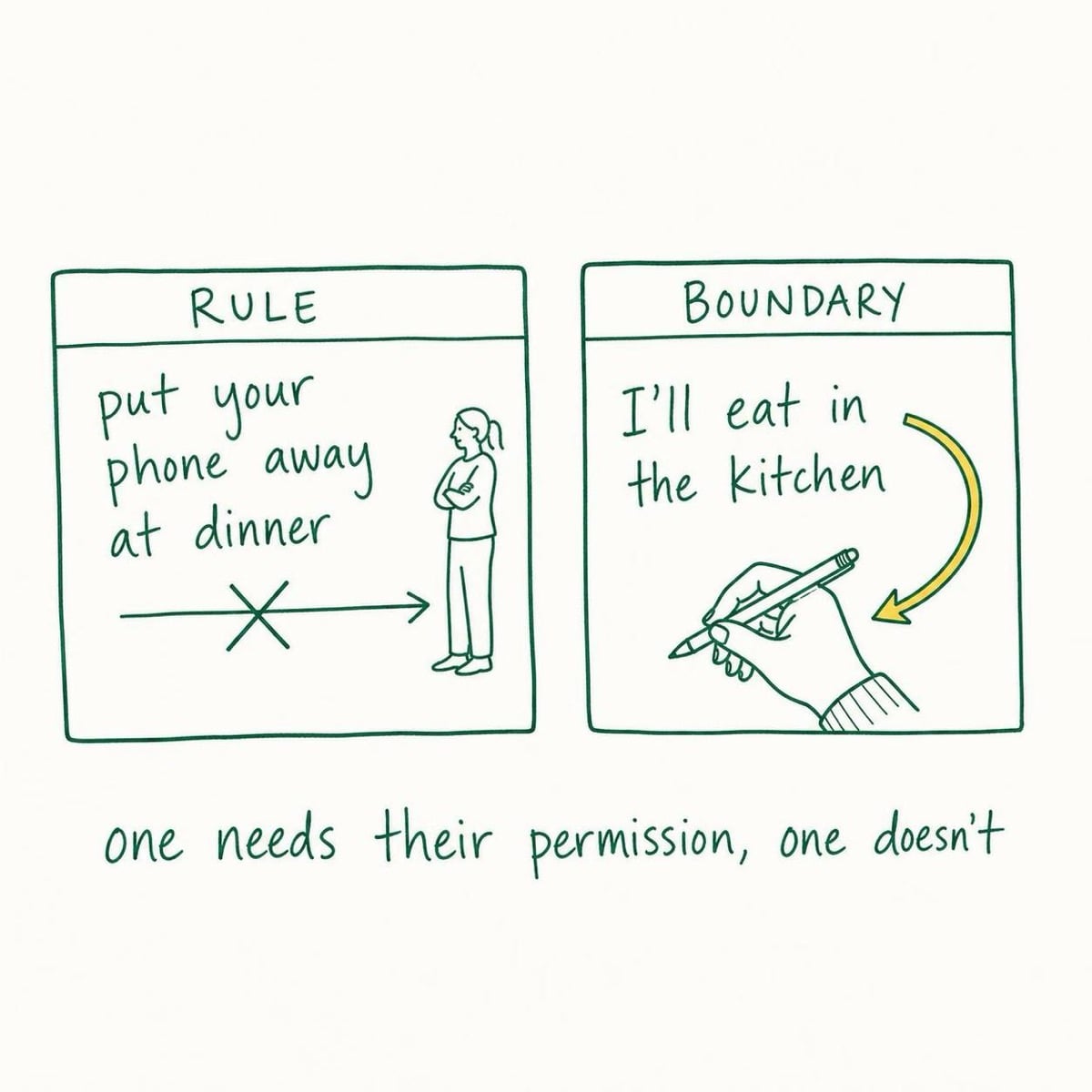
Here is the reframe the ranking pages skip. A boundary is a decision about what you will do, not an instruction about what someone else must stop doing. "Put your phone away at dinner" is a rule. "I'm going to eat in the kitchen when the phone's at the table" is a boundary. The first one needs Marcus to cooperate. The second one does not need anyone's permission, which is precisely why it holds.
Most of what gets called boundary-setting is rule-setting with softer vocabulary. And rules aimed at another adult have a measured cost.
Self-determination theory has spent forty years on the difference between supporting someone's autonomy and pressuring their behavior. The review that laid it out for close relationships states the finding cleanly: "greater autonomy overall is translated into greater openness and flexibility in relationships, whereas feeling more controlled or pressured overall is related to greater distancing and avoidance in relationships as well as more negative consequences for personal functioning." [5]
The size of that cost has been estimated. In a path analysis of 624 married adults, perceived behavioral control from a partner, meaning limits and restrictions placed on what the person does, carried a total effect of beta = -.52 on marital adjustment. Most of that ran indirectly: the controlled partner read the restriction as rejection, and the rejection did the damage. [6]
Watch the backfire happen day by day and it gets more specific. Across three daily diary studies of couples working on health changes, pressuring control from a partner predicted reactant responses the same day and the next: doing the opposite of what the partner wanted, and hiding the behavior. Negotiated, positive control predicted the actual behavior and better mood. [7]
Concealment. That is what a rule buys you. Not compliance, concealment.
The flip side has a payoff you can measure with a cuff. Following 187 couples over two years with blood pressure taken at three points, perceiving autonomy support from a partner tracked with lower diastolic blood pressure over time, and the effect ran through how the couple handled conflict. [8] Giving that support, not just receiving it, predicted the giver's own experience of the relationship. [9]
None of this means you go silent and absorb everything. It means the load-bearing half of a boundary is your own next move, and the announcement is just the courtesy of telling them first. If the general shape of this is new to you, our guide to building and keeping healthy personal boundaries covers the foundations, and there is a real case that boundaries make a marriage better rather than colder.
Say it once, in the format that survives being heard
How you open decides most of it. Sybil Carrere and John Gottman videotaped 124 newlywed couples discussing an ongoing area of conflict, coded the emotion second by second, and followed them for six years. Marital outcome across that whole stretch was predictable from the first three minutes alone, for husbands and wives both. [10]
The operational difference is small enough to use tonight. Couples heading for trouble opened with a global criticism of character, "you're lazy and never do anything around here." The others opened with a specific complaint about an event, "you didn't take the trash out last night." [11]
One honest note, since you have probably seen "94% accuracy" attached to this research. A 2001 review of all 15 divorce-prediction studies found that none of the general-population ones cross-validated their prediction equations, and that accuracy falls once you do. [12] A related study of 130 newlyweds reported 83% accuracy for divorce and stability using the original sample. [13] Treat the numbers as directional. Treat the opening line as real.
Three parts, in this order, and then stop talking:
- The specific event. Not a pattern, not a character. One thing that happened.
- The effect on you. One sentence. No case file.
- What you will do. Present tense, your behavior, no ultimatum voice.
Part three is where almost everyone substitutes a request. Notice the swap when you make it.
Four things worth saying, word for word
These are the situations that actually come up between 40 and 60, when a partner, teenagers or grown kids, and aging parents are all making claims on the same person. More than half of Americans in their 40s (54%) and over a third of those in their 50s (36%) have a parent 65 or older while raising a child or supporting a grown one. [14] Among adults in their 40s and 50s with both an older parent and a grown child, 55% are the emotional support for both generations at once. [15]
Use these as skeletons, not scripts to recite. The wording matters less than the shape.
The phone at dinner. "When the phone's on the table during dinner, I end up eating by myself. I'd rather have you. So from now on, if it's out, I'm going to take my plate to the kitchen and we'll catch up after."
The in-laws and the holidays. "Four days at your parents' is more than I can do this year. I'm booking two nights and driving back Sunday. You should stay as long as you want, and I mean that."
Money and a grown kid. "I'm glad to help with the deposit. I'm not able to cover the monthly rent, so I'm not going to. If cash gets tight in March, call me and we'll look at the budget together, but the answer on rent is going to be the same."
A parent who calls six times a day. "Mom, I want to talk every day. I'm going to call you at seven, and during the workday I'm going to let it go to voicemail unless it's an emergency."
Read the last clause of each. Not one of them tells the other person what they must do. Each one tells them what the speaker is going to do, which means none of them can be refused. This is also why they land softer than "you need to stop calling me at work," even though they are firmer.
If saying any of that out loud makes your stomach drop, the problem underneath is usually not vocabulary. The reflex to manage other people's feelings before your own is doing the work, which we broke down in how to stop people pleasing, and the guilt that shows up afterward is worth understanding before it talks you out of the next one.
The second time: decide now, not then
Now the eleventh day. The phone is on the table again, dinner is on the plates, and you have about two seconds to respond before the moment closes and you eat in silence resenting it.
Do not plan to handle it in that moment. Nobody handles anything in that moment.
Decide the response in advance, in a specific if-then form: if this exact thing happens, then I do this exact thing. Psychologist Peter Gollwitzer named these implementation intentions, and the distinction he draws is the whole trick. A goal intention names the end state you want. An if-then plan specifies when and where you will act and how you will do it. [16]
A meta-analysis of 94 independent tests found forming one produced a medium-to-large effect on goal attainment, d = .65, on top of simply holding the intention. [17] That was 2006 and rested on about 8,000 participants. The 2025 replication ran 642 independent tests and found effects between d = .27 and d = .66, larger when the plan used a genuine if-then format, when motivation was high, and when the plan had been rehearsed. [18]
It also works when the thing you are managing is your own reaction, which is the actual obstacle here. Across 29 tests, if-then plans beat merely holding an emotion-control goal such as "I will not get upset" by d+ = 0.53. [19]
So write the second half before you need it:
- If the phone is on the table when we sit down, then I take my plate to the kitchen, without a speech.
- If the trip conversation reopens, then I repeat my two nights and change the subject once.
- If the rent question comes back in March, then I say "the answer on rent is the same" and offer the budget conversation again.
- If the workday calls start again, then I let them go to voicemail and call at seven as promised.
Three features make those hold. They are boring. They contain no punishment. And they require nothing from the other person, which means there is nothing for them to refuse, argue with, or forget.
Dana went to the kitchen twice. There was no scene either time. The third dinner, the phone stayed in the bedroom, and neither of them said a word about it. That is what enforcement actually looks like when it works, and it is why it never makes it into the articles: it is too quiet to write down.
Expect it to feel worse before it feels better. The first time you follow through, the room gets cold and you will be sure you have made everything worse. You have made it clear. Those feel identical for about a week.
When it is not a boundary problem
Run one test before you use any of this. Does your boundary describe your behavior or theirs? "I'm going to bed at ten" is a boundary. "You need to be home by ten" is a rule, and if you find yourself writing rules for another adult's whereabouts, phone, friendships or money, the conversation you need is a different one. Controlling patterns in a relationship do not get fixed with better wording, and the research above says pressure produces hiding, not change.
The reverse case matters more. If following through on a small, reasonable limit gets you punished, monitored, or frightened, that is not a boundary problem and no script in this article is built for it. Read what leaving a toxic relationship actually involves, and talk to someone outside the relationship before your next move.
And if the boundary is fine but the conversations keep detonating, the repair is upstream of boundaries entirely: resolving conflict without hurting each other and building assertive communication both do more work than another announcement will. The same three-part shape holds at work, where the stakes are different but the mechanics are identical, which we covered in setting boundaries at work.
Pick the eleventh day, not the first conversation
You probably already know which limit you need. You have said it before, possibly more than once, and it dissolved somewhere around day nine.
So skip the announcement this week. Take the one that keeps collapsing, and write the second half: if the specific thing happens again, then I do the specific thing. One sentence, on paper, before you need it. Tell them once in the three-part format if they have not heard it, then say nothing further and let your own behavior carry it.
The boundary was never the sentence. It was always what you did on the eleventh day.


