
You know which habits would change things. The walk. The earlier bedtime. The weekly money check. The hour of focused work before the inbox swallows the day. You have known for a while. You have started most of them, more than once. And the pattern is always the same: it holds for about nine days, then a sick kid, a work crunch, or one bad night of sleep knocks it over, and you never quite get back on.
This is the frustrating part of building consistent habits in midlife. It is not that you do not know what to do. It is that you know exactly what to do and still cannot make it stick, across everything that matters at once. The routine you built last spring is already gone. The calm you meant to create keeps getting postponed to a quieter week that never arrives, and some weeks it tips over into feeling stuck in a rut entirely.
You are not lazy. You are not broken. You are running last decade's playbook in a decade that plays by different rules.
Why Habits Get Harder After 40, Not Easier
Habits get harder in midlife because the load goes up exactly when your spare capacity goes down. You are often caring for children and aging parents at the same time, hitting peak career demands, and managing a body that recovers slower than it did at 30. Research on midlife and mental health describes this directly: people in their 40s and 50s are frequently "sandwiched" between competing duties, and all of it "can reduce time, motivation, and energy to change or maintain healthy behaviors." [1]
So when a habit collapses on a chaotic Tuesday, that is not a character flaw showing up. That is a predictable result of role strain, which researchers define as the incompatibility of time, energy, and resources across the many roles you are holding at once. [2]
The deck really is stacked differently now. A 2026 cross-national study found today's midlife adults in the US report more loneliness, more depression, and worse memory than the same age group a generation ago, driven less by lifestyle choices than by "juggling work, finances, family, and health amid weakening social supports." [3] The advice you keep trying to follow was mostly written for someone with more slack than you have.
The Real Problem Is Not Motivation
Here is the reframe that changes everything: you are building habits for your best day, in a decade defined by your worst days. The problem was never motivation, and it was never the so-called 21-day rule. The problem is that any habit which depends on willpower or a good mood will lose to a tired Tuesday every single time, and in midlife you have a lot of tired Tuesdays. Most advice treats this as a motivation versus discipline contest. It is neither.
There is a mechanism behind this. Under chronic stress, the brain shifts decision-making away from slow, deliberate reasoning toward fast, reactive habit. As one model of stress and decision-making puts it, "when under stress, fast and effortless heuristics may dominate over slow and demanding deliberation." [4] Translation: on your hardest days, the days you most need the new habit, your brain is least equipped to choose it on purpose. It reaches for the old default instead.
That is why consistency in midlife is an engineering problem, not a discipline problem. You do not need more grit. You need a habit small enough and automatic enough to survive a bad day without your willpower in the room.
It also helps to drop the deadline anxiety. The most cited real-world study on habit formation tracked people for 12 weeks and found it took a median of 66 days to make a behavior automatic, with a range from 18 to 254 days. [5] Two things follow from that. It takes longer than the internet promised. And missing a single day did not reset anyone's progress. Consistency over time beats perfection in any given week, which is the whole truth of how habit formation actually works.
A System for Consistency, Not a Burst of Discipline
If willpower is the wrong engine, what works? Four principles, built to run on your worst day, not your best. The point of all four is the same: stop relying on motivation and start relying on structure. Calm discipline, not burnout hustle.
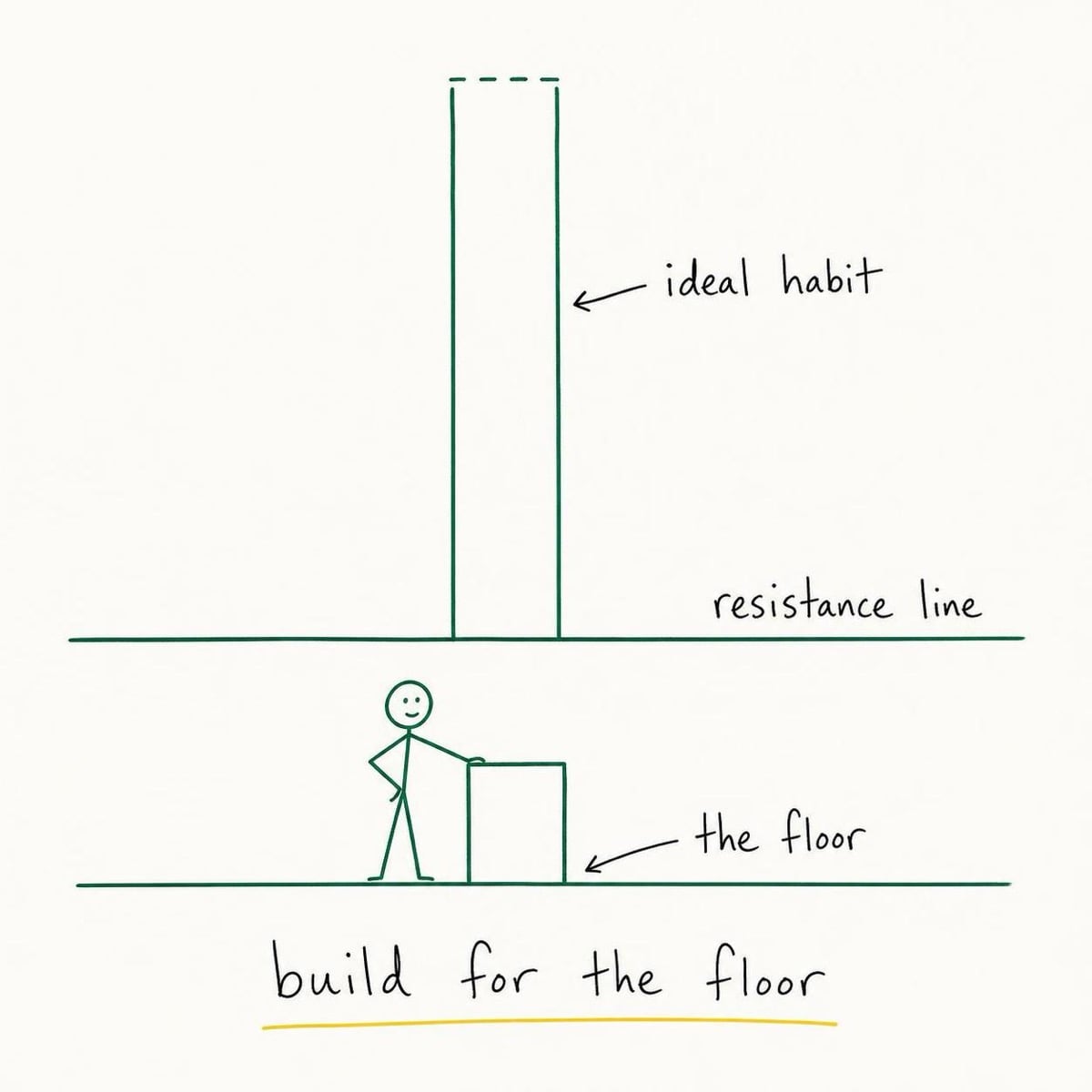
Shrink it below the resistance line. Make the habit so small it feels almost silly to skip. Not "work out for an hour," but "put on the shoes and step outside." BJ Fogg, who runs Stanford's Behavior Design Lab, argues that habits wire in through emotion, not raw repetition: "it's not a function of repetition, it's a function of emotion." [6] A tiny habit you finish leaves you feeling capable, and that feeling is what makes you come back. A big habit you fail at teaches you to dread it. Define a "floor" version of each habit, the two-minute one you will still do when everything is on fire.
Anchor it to a cue, not to a time or a mood. Intentions alone are weak. Decades of research show that goal intentions explain only about 28% of the variance in whether people actually act. [7] What closes that gap is an if-then plan that ties the new behavior to something you already do: "after I pour my morning coffee, I step outside for a short walk." A meta-analysis of 94 studies found these if-then plans reliably increase follow-through, and the effect is strongest exactly when distraction, fatigue, and competing demands are high. [8] That is your life. Attach the habit to an anchor and you stop needing to remember or feel like it. This is also the real fix for the gap between knowing what to do and actually doing it.
Protect the recovery: never miss twice. A missed day is not the problem. What you do the day after a miss is the whole game. Relapse research found that whether a lapse becomes a collapse depends on "that person's explicit cognitive and emotional responses to lapsing," not the lapse itself. [9] Self-blame is what ends habits, not the gap. So build one rule into the system: you are allowed to miss once, never twice in a row. Missing Thursday is data. Missing Friday too is a decision. We have written about this elsewhere as a recovery loop: the measure of discipline in midlife is not your streak length, it is how fast you come back after a miss.
Let identity follow the reps. You do not need to become a disciplined person before you act. It runs the other way. Self-perception research shows people infer who they are from watching their own behavior: "through the perception of our own frequently performed behaviors, we may infer that these are important to us and may thus be part of who we are." [10] Do the small thing enough times and you start to see yourself as someone who does it, which is what makes it durable. [11]
And do not start five of these at once. Rebuild one system at a time, in the right order. Pick the domain that is hurting most, get one keystone habit holding there, then let that win fund the next one. If you have ever wondered how to stay consistent past the first enthusiastic week, this sequencing is the answer.
What This Looks Like on a Real Week
Here is the system in practice. Priya is 49, a consultant with two teenagers and a mother whose appointments now land on her calendar. Her old plan was a 5am routine with journaling, a workout, and meal prep. It worked for about a week, three separate times, then died. She read that as proof she "just isn't consistent."
She rebuilt it differently, closer to a daily routine designed for a real midlife schedule. One domain first: health. One keystone habit: a 10-minute walk. The cue: after her first coffee, not a clock time. The floor: on a brutal day, just step outside for two minutes. That is it. Nothing else changes yet.
Week one, she walks four days. Thursday her mother has a clinic visit and the walk does not happen. The old Priya would have written off the week. The new rule says walk Friday, no exceptions, because the cost of missing twice is a dead habit. She walks Friday. By week nine the walk is automatic, the thing she does without negotiating with herself, which is roughly what the 66-day research would predict.
Only then does she add the next system: a five-minute money check, anchored to Sunday morning coffee. This is the part most people skip. Stacking domains slowly works because progress itself is fuel. A study of 12,000 workday diaries found that the single biggest driver of good days was simply "making progress in meaningful work," small wins compounding day over day. [12] Priya is not white-knuckling five habits. She is letting one stuck-the-landing habit pay for the next.
A year in, she is not a different person who finally found willpower. She is the same person running a system that does not depend on it.
But I Have Tried Small Habits Before
Fair. Plenty of people try "just do a little" and still fizzle, and there are usually three reasons, none of which is a flaw in the idea of building good habits. The habit was not anchored to an existing cue, so it relied on remembering. Or you started several at once, so the load was the same overwhelm in smaller packaging. Or you treated one miss as a verdict on your character and quit instead of restarting the next day.
The other objection is time, and it is the easiest to answer. The floor version of a habit takes two minutes. You are not promising to walk for an hour, you are protecting the cue and the identity. The duration grows on its own once the behavior is automatic. The two minutes is not the goal. It is the hinge the rest swings on.
The One Thing to Do Today
Pick the single life domain that is hurting most right now: health, money, work, or your relationships. Choose one keystone habit inside it. Shrink it to a two-minute floor. Anchor it to something you already do every day. Then write down the one rule that matters: miss once if you must, never twice.
That is the whole start. Not a new app, not a 5am overhaul, not a personality transplant. One small habit, engineered to survive your worst day, in one domain, this week. This is what a midlife reset actually looks like up close: not a dramatic clean slate, but one system rebuilt at a time.
You know what to do. The work now is making it stick. You are not behind. You are at the rebuild.