

You typed "starting over at 50" into the search bar at some hour you would not admit to. Maybe a marriage ended. Maybe the job did. Maybe nothing dramatic happened at all, the kids just left, the house went quiet, and you looked up one morning to find that the life you built no longer fits the person living in it. From the outside you look fine. Accomplished, even. Inside it feels like you are standing at the bottom of a hill you already climbed once, being told to climb it again, with less time and worse knees.
Here is the first thing worth saying plainly. Starting over at 50 is not the rare tragedy the phrase makes it sound like. It is one of the most common turning points there is, and almost nobody talks about it honestly. This article is the honest version.
What "Starting Over at 50" Actually Feels Like
Starting over at 50 rarely arrives as a clean fresh start. It arrives as a pile of things breaking at once: a routine that fell apart, a body that stopped cooperating, money that did not compound the way the plan promised, a career that plateaued, a relationship that went quiet. You are not confused about what to do. You have read the books and run the diets and made the plans. The problem is that everything that needs attention is asking for it at the same time, and you have run out of the one resource you used to have in surplus, which was the feeling that there was plenty of time to fix it later.
That is the real weight. Not a lack of knowledge. A lack of slack. When you were 28, a bad year was a detour. At 50, a bad year feels like it costs something you cannot earn back. So the search for "starting over at 50" is rarely about ideas. It is about permission, and about a way to begin that does not require pretending you are 28 again.
Why It Feels Harder to Start Over at 50
It feels harder to start over at 50 because the stakes are real and the runway feels short, not because you have lost the ability to change. You are carrying obligations a younger person did not have: a mortgage, maybe aging parents, maybe kids still depending on you, a reputation, a standard of living you do not want to lose. Change at 50 happens in a fully loaded life, not an empty one. That is a genuine difference, and most "just reinvent yourself" advice ignores it completely.
There is also the quiet math you do at 2 a.m. The sense that you have fewer attempts left. Psychologists call the thing driving that feeling time horizon, and it cuts both ways. Laura Carstensen's research found that as the runway feels shorter, people get sharper about what actually matters and let go of what never did [1]. The same pressure that keeps you up at night is also the thing that makes a 50-year-old's priorities clearer than a 30-year-old's. You have probably already noticed you tolerate far less nonsense than you used to. That is not bitterness. That is data compressing into judgment.
The exhaustion is real too. If the routines keep falling apart before they stick, that is usually a sign you are starting from depletion, not laziness. Most people trying to start over are running on broken sleep and borrowed energy, which is its own problem to solve first. We wrote about why you have no energy and the sleep habits worth rebuilding early because almost every "I cannot stay consistent" story starts there.
You're Not Starting Over. You're at the Rebuild.
Here is the reframe that changes the whole project: you are not starting over. Starting over implies you are back at zero, that the last 30 years were a wash, that the slate is blank. None of that is true. You are standing on a foundation you spent decades pouring: skills, relationships, scar tissue, taste, the ability to read a room, the hard-won knowledge of what is not worth your time. What feels like starting over is a rebuild. Same foundation. New structure. That distinction is not word games. It changes where you start and how fast you expect to move.
Look at what you actually kept. The idea that your mind is past its peak at 50 is folk wisdom, not science. A study of 48,537 people found that different mental abilities peak at wildly different ages, and the ones built on accumulated knowledge, vocabulary, comprehension, judgment, keep climbing into your 40s, 50s, and beyond [2]. The raw processing speed of a 22-year-old is real. So is the fact that you can now see in five minutes what used to take you five years. That trade is not a downgrade.
And the timing is better than it feels. Across roughly 500,000 people, life satisfaction follows a U-shape that bottoms out in the late 40s and early 50s, then climbs for decades after [3]. If you feel like you are at the low point, you may be reading the data correctly. The low point is not the cliff. It is the floor you push off from. You are not behind. You are at the rebuild.
How to Rebuild Your Life at 50, One System at a Time
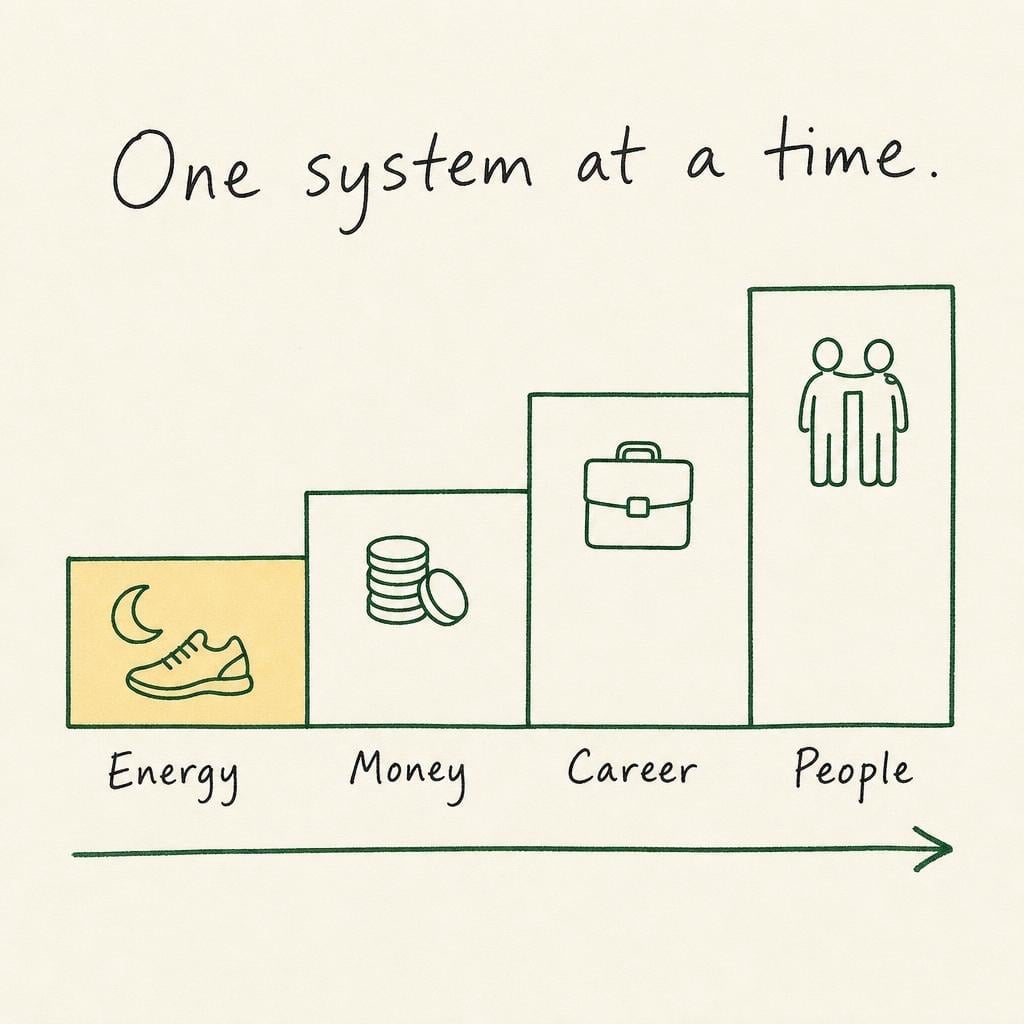
The way to rebuild your life at 50 is to stop trying to fix everything at once and rebuild one system at a time, in the right order. The overwhelm you feel is not a character flaw. It is the predictable result of running five renovations simultaneously: health, money, work, relationships, and the sense of who you are. No one can hold that. The people who actually come out the other side do something that looks almost too modest. They pick one domain, stabilize it, and let the win pay for the next one.
Four things make that work.
Inventory what already stands. Before you tear anything down, write down what is load-bearing and still solid. The career skills that transfer. The relationships that held. The two or three habits you never lost. Most people starting over at 50 catalogue only the damage. Spend an hour cataloguing the assets. You will start from a higher floor than the 2 a.m. version of you believes.
Pick the keystone domain first. One system, chosen because fixing it makes the others easier. For most people it is energy: sleep, movement, food, the boring physical base that everything else runs on. Fix that and you have more in the tank for the hard career and money decisions. Wendy Wood's work on habits explains why this cascades, roughly 43% of daily behavior runs on autopilot through context, so one stable routine quietly drags other behaviors into line without fresh willpower each time [4]. This is the same logic behind habit stacking and the psychology of how habits actually form.
Give it the real amount of time. The number that matters is not 21 days. When researchers tracked people forming a new habit in normal life, the median time to automaticity was 66 days, with a wide range depending on the person and the behavior [5]. Plan for two to three months per system, not two weeks. And note the part everyone misses: missing a single day did not break the habit. Consistency, not perfection, is what builds the thing. If staying consistent is where you always fall off, that problem has its own playbook.
Run on discipline, not motivation. The burst of resolve you feel around a milestone birthday is real and useful, but do not build on it. The fresh start effect explains how birthdays and new years can increase aspirational behavior without guaranteeing that it lasts. The 50th-birthday surge is the match. The system is the fire. If you have ever wondered why discipline beats motivation every time, this is the mechanism. Calm discipline, not burnout hustle, is what holds when the surge is gone.
There is a quieter ingredient under all four: believing you can actually do it. Albert Bandura spent a career showing that self-efficacy, your belief in your own capacity to follow through, predicts whether you start, how hard you push, and how long you last when it gets hard [6]. The fastest way to build that belief is not a pep talk. It is one small system you actually keep for a month. Proof beats affirmation.
What Starting Over at 50 Looks Like in Practice
In practice, starting over at 50 looks far less dramatic than the phrase suggests. It is not selling the house and moving to Portugal in week one. It is a 52-year-old, recently divorced, picking one thing, sleep, and protecting it for eight weeks before touching anything else. Concrete beats heroic. Here is a composite of the pattern we see again and again in the goals people actually write down when they decide to rebuild.
Take a version we will call Dana, 52, a finance manager whose marriage ended last year. The honest inventory at the start was a wall of problems: 25 pounds up, no real savings plan, a career that stalled at the same title for six years, a social life that evaporated with the marriage. The version of Dana who tries to fix all four in January is the version who quits by February. That is not weakness. That is physics.
So she did not. Weeks one through eight: one system, sleep and a 20-minute morning walk, nothing else. Not because the other problems did not matter, but because she had no fuel to fight them yet. By week six the walk was automatic, the kind of thing she did before she had decided to. Weeks nine through sixteen, with energy back in the tank, she pointed it at money: a real number for the month, automatic transfers, one hard look at the spending. Only around month five did she touch the career question, the one that felt biggest at 2 a.m. and turned out to need the most rest and cash in reserve before she could think about it clearly.
A year in, nothing about Dana's life looked like a movie montage. But the weight was down, the savings were real, and the career conversation she had been avoiding for three years finally happened, from a position of strength instead of panic. That is what the rebuild looks like. Boring, sequenced, and it holds. If you want to see the full five-domain version of this, we mapped it in what a midlife reset actually involves, and the willpower side of it in self-discipline at midlife.
"But My Situation Is Different"
Maybe it is. Three objections come up almost every time, and they deserve real answers, not pep talks.
"It is too late." It is not, and you have already seen the evidence: the abilities that compound are still compounding, and the satisfaction curve is on your side after 50. What is actually true is that you have less margin for wasted years, which is an argument for starting the rebuild now, not for skipping it.
"I am starting over at 50 with no money." Then money is likely your keystone or your second domain, not an excuse to skip the rest. Starting over broke is harder, not impossible, and the sequence matters even more when resources are thin: stabilize energy so you can earn and decide well, then attack the financial base deliberately. The order protects you from making a scared decision you cannot afford.
"I have tried before and it never sticks." That is the most useful objection, because it is usually true and it usually has the same cause: you tried to change everything at once and ran out of fuel. One system at a time is the specific fix for "it never sticks." If the deeper issue is that nothing feels like it means anything anymore, that is a different and real problem, worth reading how to find purpose and, if it is sharper than that, how to navigate an existential crisis or what a midlife crisis actually is.
Where to Start This Week
Do one thing this week. Not five. Open a note and write two lists: what is still standing in your life, and the single system that, if it were stable, would make the others easier. That second list has one item on it. That item is where you start. Protect it for eight weeks before you let anything else onto the page.
You do not need a new life. You need the next right system, built calmly, on the foundation you already have. You are not starting over. You are at the rebuild. Begin there.


