

You are 50, or close to it. And the question keeps circling back, usually late at night or on a slow Sunday: is this it? The career still pays, the marriage is fine, the body mostly works, the money is mostly handled. But somewhere along the way the whole thing stopped feeling like yours. You have started reading about reinventing yourself at 50, half-hoping someone hands you a blank slate. A clean break. A new person.
Here is what nobody tells you up front. That blank slate is the wrong goal. It is also the reason most attempts at reinventing yourself at 50 stall before they start. You do not need to become someone new. You have 30 years of skill, judgment, and hard-won pattern recognition sitting right there, and the work is to put it to a different use, not to throw it away and begin from nothing.
You are not at zero. You never were.
Is 50 Too Late to Reinvent Yourself?
No, 50 is not too late, and the research points the other direction. Career changes and identity shifts in your 50s are increasingly common and often produce positive emotional outcomes for those with the resources to support the move, because you bring decades of human capital and sharper judgment to the new role. [1] The disadvantage you are imagining is mostly a story, not a fact.
The "too late" feeling has a specific source, and it is worth naming. People assume well-being keeps sliding downhill with age, so a change at 50 feels like swimming against a current. The data says the opposite. Life satisfaction tends to dip in midlife and then recover into a documented upswing after 50, a U-shaped curve that shows up across countries and life dimensions. [2] You are not arriving late to the party. You are arriving at the part of the curve that bends back up.
There is an emotional dividend too. As people move past midlife, they get measurably better at regulating emotion and focusing on what matters, which is exactly the wiring a reinvention demands. [3] The version of you trying to change at 50 is calmer and clearer than the version that would have tried at 30. That is an asset. Treat it like one. If you are weighing a specific move, our look at career change at 50 covers the work side in more depth.
Why "Feeling Lost in Your 50s" Is Normal, Not a Breakdown
Feeling lost in your 50s is normal, and it is usually a signal of a transition, not a defect. It tends to show up when the roles that defined you for two decades (the title, the parent-of-young-kids identity, the provider script) start to loosen, and the next version has not arrived yet. That gap feels like being lost. It is closer to standing between two rooms. The disorientation is the change starting, not your life falling apart.
This is the territory people label a midlife crisis, and the word does more harm than good. "Crisis" implies something broke. What is usually happening is quieter: the identity you built no longer maps onto the life you are actually living. The pattern looks different for men in midlife and for women at this stage, but the root is the same. A role expired and you have not yet decided what replaces it.
You have probably tried to think your way out of this. Made a list of what you want. Read the reinvention articles. Maybe took a personality test that told you something you already knew. And none of it moved you, because the lostness is not a thinking problem you can solve at a desk. It is a sign that a chapter ended faster than you were ready for.
The trap is treating that feeling as proof you need to detonate everything. Buy the convertible, quit the job, blow up the routine. That is the blank-slate fantasy again, and it almost always overshoots. Feeling lost is information. It is telling you which part of your identity has gone stale, not that the whole structure needs demolishing. If you have been feeling stuck in your career specifically, that is one room going dim, not the whole house.
The Reframe: Reinvention Is Redeployment, Not a Reset
Here is the shift that changes everything. Reinventing yourself at 50 is not erasing who you are and installing someone new. It is redeploying who you already are into a different shape. The expertise, the relationships, the way you read a room, the things you are quietly excellent at: none of that gets deleted. It gets pointed somewhere it fits better. Reinvention at this age is becoming more aligned with your own values and strengths, not less like yourself. [4]
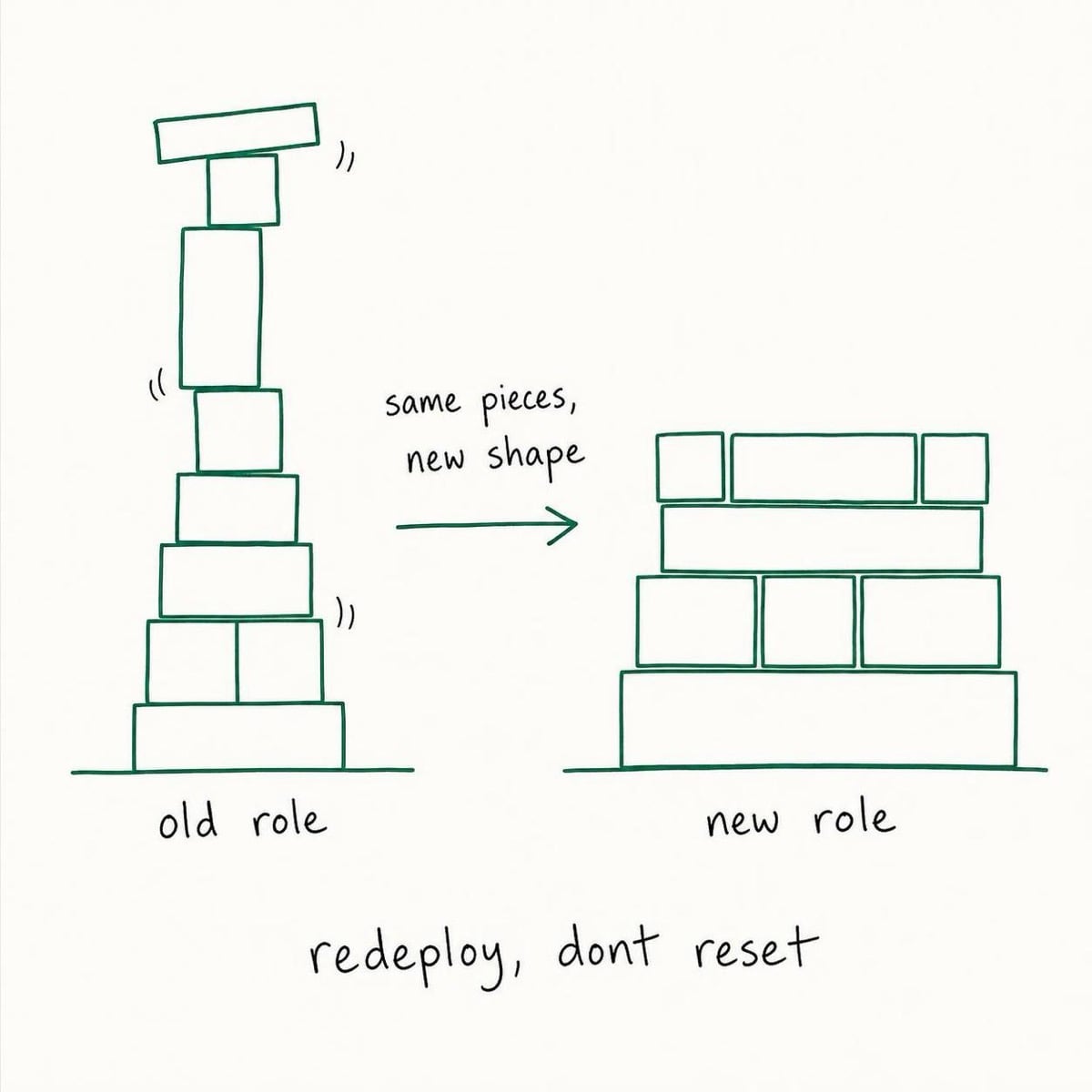
Think about what "starting from zero" actually implies. It implies your three decades of experience are worthless in the next chapter. They are not. Research on career reinvention is blunt about this: the work is not starting over, it is re-deploying existing expertise by experimenting with new activities, building new networks, and slowly rewriting the story you tell about yourself. [5] The most durable reinventions build on roughly 40 to 50 percent overlap with what you already know. [6] The other half is new. The half you keep is the half that makes it survivable.
This is why the dramatic-overhaul version fails. A blank slate gives you nothing to stand on. Redeployment gives you a foundation and a direction. Same person, different deployment. So when you picture reinventing yourself at 50, stop picturing a stranger walking out the door. Picture the same person, pointed at something that fits. That is the whole reframe, and it is the difference between starting over at 50 feeling like a free-fall and feeling like a controlled move. This is also where a woman reinventing herself at 50 and a man at the same stage tend to share the same real obstacle: not capability, but the false belief that the past has to be left behind for the next chapter to count.
How to Reinvent Yourself at 50: One Identity Shift at a Time
The method is sequencing, not overhaul. You reinvent yourself at 50 by choosing one identity shift, running small experiments to test it, and letting that win fund the next domain, rather than rebuilding work, health, money, and family all at once. Identity-based change works best when you act from the person you are becoming through small repeated behaviors, not by force of willpower in a single dramatic leap. [7] Calm discipline, not a burnout sprint.
Start by naming the four domains honestly. Work, health, money, family. Most people at 50 feel scattered across all four because all four shifted at once: the career plateaued, the body changed, the retirement runway got real, the kids stopped needing you the same way. The instinct is to fix everything. Don't. Pick the one domain where a shift would change the most, and start only there.
Run experiments, not declarations. You do not figure out who you are becoming by thinking harder. You figure it out by doing small things and watching what fits. Professional identity is reshaped through action and sense-making, not through a single decision made in your head. [8] If you think you want to coach, coach one person this month. If you want to write, publish one piece. Small, real, low-stakes tests beat a grand pronouncement you cannot walk back.
Lead with the asset, not the gap. Decades of experience are the primary thing you bring, not a liability to apologize for. [9] Before you sign up for a degree you may not need, ask what 40 percent of your current skill already transfers. A finance lead moving into nonprofit work is not starting over. She is redeploying judgment about money into a place that uses it differently.
Pace it like the experts do. Deliberate reinvention beats dramatic reinvention. Test the market, build proof through small projects, lean on your network instead of credentials, and give it time. [10] This is how to reinvent yourself professionally at 50 without setting fire to the income you still need.
Then sequence the next domain. Once one shift is holding (the new work pattern is real, or the body habit is automatic, or the money system runs itself), let that win fund the next. Multi-domain reinvention across work, health, money, and family is feasible, but it works when it is managed in sequence, not attempted all at once. [11] This is also the answer to how to make a life plan that does not collapse under its own ambition: one system, in the right order. The deeper system for sequencing all five domains lives in our guide to the midlife reset.
What This Looks Like on a Real Year
Here is redeployment in practice. Anika is 52, a hospital operations manager who spent 25 years making complicated systems run. The title still fit on paper. Inside, she felt finished with it, and "feeling lost in my 50s" was the phrase she used out loud for the first time at her sister's birthday. Her first instinct was the blank slate: quit, retrain as a therapist, start completely over. Two years of school, a brand-new field, nothing of her old life carried forward.
She did the redeployment version instead. One domain first: work. One identity shift: from running operations inside a hospital to advising small clinics on how to run theirs. Same skill, new shape. The experiment was small. She helped one clinic reorganize its scheduling, unpaid, on two Saturdays. It worked, and it told her more than two years of school would have.
She did not quit her job that month. She tested the market quietly, built proof through three small projects, and used her existing network of clinic directors instead of a fresh credential. By month nine she had paying clients on the side. Only then did she touch the second domain: a walk-after-dinner habit she had abandoned a dozen times, this time anchored to the dog instead of willpower, the kind of daily routine built for a real midlife schedule.
A year in, Anika is not a different person who finally found courage. She is the same operations brain, redeployed, plus one body habit that finally stuck. The reinvention worked because she never tried to become a stranger. The same logic holds for reinventing yourself at 55 or 60, where the case for redeploying experience over starting from scratch is even stronger.
But My Situation Is Different
Maybe you think your field is gone, your energy is lower, or you have less runway than you would like. Fair. But the redeployment logic holds harder, not softer, the older you get. Experience is a competitive advantage in any role that rewards mature judgment, and the U-curve of well-being is on your side after 50. [3]
The two honest objections are time and energy, and sequencing answers both. You are not overhauling four domains in parallel, which is what actually drains you. You are running one small experiment in one domain, on the capacity you already have. The reinvention-yourself checklist people search for is shorter than they expect: name the four domains, pick one, run a small test, lead with what transfers, then sequence the next. That is it. You do not need more time. You need a smaller first move. And the calmer emotional regulation that arrives after 50 is the thing that lets you stay consistent with the change once you start.
The One Move to Make This Week
Name the four domains on one page: work, health, money, family. Mark the one where a shift would change the most right now. Then design a single small experiment inside it, the kind you could run this week without quitting anything or announcing anything. One person to coach. One piece to write. One clinic to help. One walk after dinner.
That is how reinventing yourself at 50 actually begins. Not with a blank slate, not with a dramatic clean break, but with one experiment that redeploys something you are already good at. You are not behind, and you are not starting from nothing. You are at the part of the curve that bends back up, with three decades of material to work with. The question was never whether you can become someone new. It is which version of who you already are gets to come forward next.


