

Week three is where it always breaks. You know what a good day is supposed to look like: move your body, eat real food, do the deep work before the inbox eats it, be present with the people at home, sleep enough to do it again. You have read the lists. You have started the 5am routine, maybe twice. And it holds right up until a Wednesday when you wake on four broken hours and a meeting nobody warned you about, and by mid-afternoon the whole plan is gone.
Here is what nobody puts in those lists. Search "daily routine for 40 year old woman" and you get the same template every time, and it keeps collapsing in real life, rarely because you lack discipline. The daily routine for a 40 year old woman those listicles hand you assumes a body and a calendar you no longer have. The energy you had at 30 was spread evenly across the day. At 45 it is not. The mornings can be sharp and the afternoons can drop out from under you, and a perimenopausal night can erase tomorrow before it starts.
So the fix is not more willpower on your part. The routine itself was built for a decade you have already left, on the assumption that every hour of the day carries the same charge. It does not, and that single wrong assumption is why the plan keeps collapsing.
Why Your Old Daily Routine Stopped Working at 40
A daily routine stops working in your 40s because your energy is no longer flat across the day and your schedule carries more weight than it used to. Hormonal shifts in perimenopause disrupt sleep for a large share of women, which flattens the morning and deepens the afternoon dip. Add the second-shift load of work plus caring for kids and parents, and the old plan (do everything, in order, by willpower) breaks against a body and a calendar that have both changed.
Sleep is where this starts. Perimenopause affects an estimated 80 to 90 percent of women, and sleep disturbance is one of its most common effects, driven directly by fluctuating estrogen and progesterone disrupting circadian rhythm. [1] Harvard's Apple Women's Health Study tracked participants through this window and found 60 percent showed more wake-after-sleep-onset in the 18 months before menopause, with 84 percent of those tracking sleep reporting changes they tied to the transition. [2]
This is not a small group of unlucky people. Among nearly 50,000 women, sleep disturbance was reported by 38 to 61 percent and tracked independently with worse quality of life. [3] That is the real backdrop to 40 year old woman body changes most lists skip. The advice you keep trying to follow assumes a steady tank of energy you simply do not have every day.
Stop Adding Tasks. Start Placing Them.
The fix is not a longer to-do list. It is putting the right kind of task in the right slot of the day. In your mid-40s, energy arrives in a curve, not a flat line: usually highest in the morning, dipping in the early afternoon, recoverable in the early evening. A daily routine that works at this age matches the demand of each task to the energy of the hour. Hard thinking goes where the energy is. Low-stakes admin goes where it is not. You stop fighting your biology and start scheduling around it.
There is real science under this. Performance is not constant through the day, and aligning cognitive work to your individual peak hours measurably improves both reaction time and accuracy. [4] The same logic runs through eating: meal timing, not just meal content, drives results, and earlier eating windows align better with how your body actually processes food. [5]
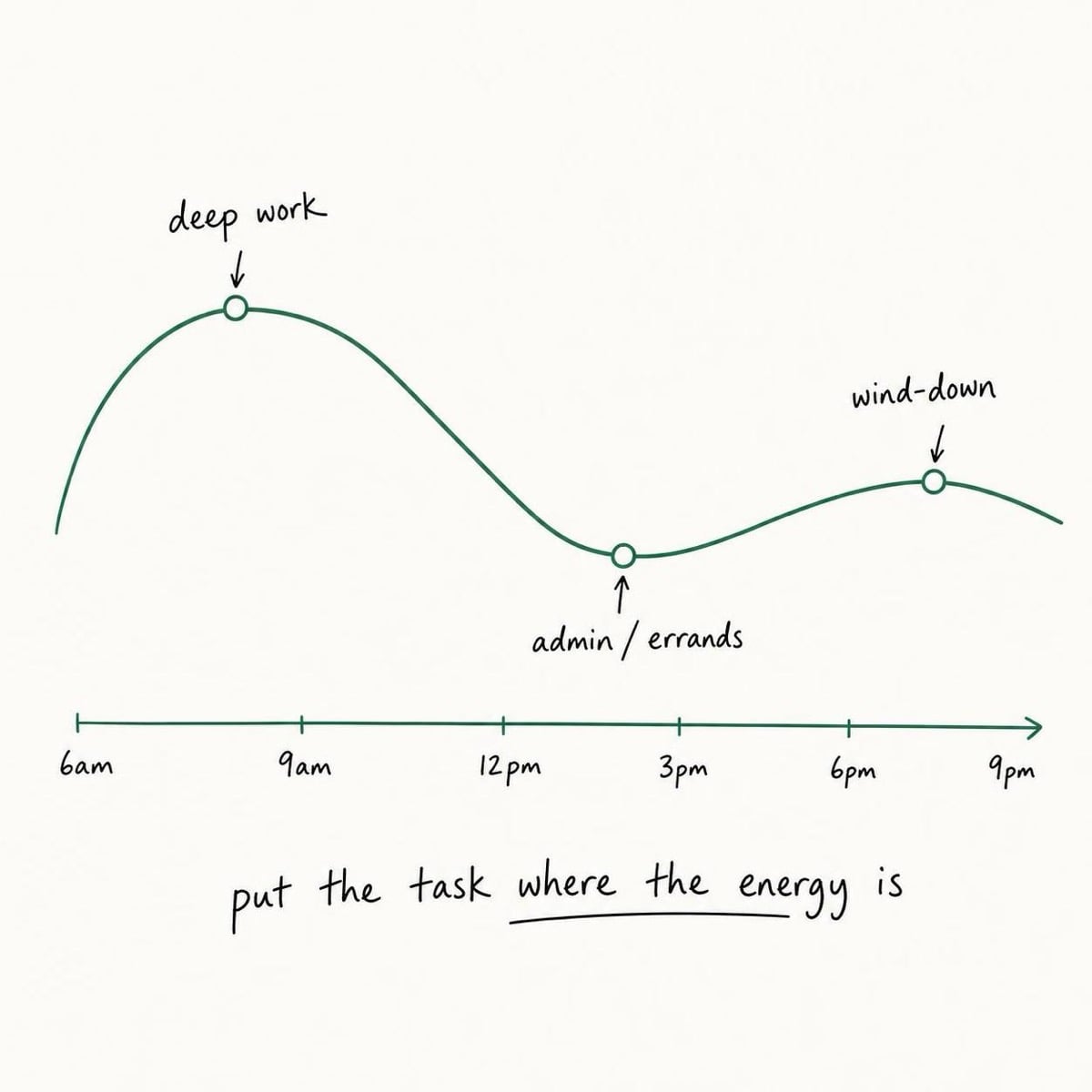
So the reframe is simple, and it changes everything. What you keep calling a willpower failure is really a scheduling error. You have been trying to do your hardest things in your lowest-energy windows, then blaming yourself when they do not get done. Move the work, not the willpower. This is the same principle behind any good daily routine, just tuned to a body that no longer runs flat. The best daily routine for a 40 year old woman, and for a woman over 50 whose curve has shifted again, is not the one with the most items. It is the one where each item sits in the right hour.
The Energy-Sequenced Daily Routine, Slot by Slot
An energy-sequenced routine has four slots, each matched to where your energy actually sits. Protect a short morning floor when energy is highest. Batch your deepest work before the early-afternoon dip. Move admin and family logistics into the low-energy window where they belong. Then guard a wind-down that defends sleep, because sleep is the one input everything else compounds on. The goal is not to do more. It is to stop spending peak hours on tasks that do not need them.
Protect a Non-Negotiable Morning Floor
Your morning is your highest-energy, lowest-interruption window, so it gets the things that matter most and cost the least time. Set a floor, not a marathon: use the floor method, the smallest version that still counts on your worst day. Three pieces: ten minutes of movement, protein at breakfast, and ten minutes on one personal goal before the day's demands arrive. That is it. What makes the floor hold is not its size but its cue. Wendy Wood's research is blunt about this. Habits run on context cues, not motivation, and "perception of context cues directly activates the habitual response." [6] Anchor the movement to "after I start the coffee," and you stop needing to feel like it. This is the logic of habit stacking: bolt the new behavior onto one you already do without thinking. It is also where a light morning routine that actually fits a real schedule beats the heroic version you keep abandoning.
Batch Deep Work Before the Afternoon Dip
The hours before roughly 1 or 2pm are when your brain is sharpest, so that is where the hard thinking goes: the strategic work, the difficult conversation, the project that needs a clear head. Protect this block the way you would protect a meeting with someone important, because aligning demanding work to your peak hours is one of the few levers that reliably improves output. [7] If you eat lunch, keep it earlier and protein-forward, since meal regularity itself is a strong driver of how you feel in the afternoon. [8] One thing women over 40 should keep in this window: strength work, ideally a few days a week, because building muscle in your 40s is absolutely still possible and it protects the energy curve itself.
Put Admin and Logistics in the Low-Energy Window
The early-afternoon dip is when most people try to push through important work and lose. Stop. This is the slot for the shallow stuff: email, errands, the family calendar, appointments, the small fires. None of it needs a sharp brain, and doing it here frees your peak hours for things that do. Batch it into one block instead of letting it leak across the day. This is the quiet engine of work-life balance for women in their 40s: not doing more, but refusing to spend your best hours on tasks that any tired version of you could finish. A timed admin block also makes a clean handoff into the evening, so the low-energy hours have a shape instead of a slow bleed.
Guard the Wind-Down That Defends Sleep
The last slot of the day decides the quality of the next one. Sleep is the keystone habit here, the single behavior that makes the other three slots possible. Multidimensional sleep health (regularity, duration, efficiency) is robustly tied to better cognitive function across adulthood. [9] The good news is that even modest changes pay. A four-week sleep-extension protocol in habitual short sleepers added about 47 minutes a night and cut daytime sleepiness. [10] Build a short, fixed wind-down: same rough time, lights down, screens parked, a healthy sleep habit or two you repeat nightly. And when perimenopause is wrecking your sleep, the first-line fix is behavioral, not a fight you out-discipline: cognitive behavioral therapy for insomnia is the recommended starting point. [11]
A Real Tuesday on the Energy-Sequenced Plan
Here is the system on an ordinary, imperfect day. Elena is 46, a project lead with a 12 year old, a teenager, and a father whose cardiology appointments now live on her phone. Her old routine was a 5am block of journaling, a full workout, and meal prep. It held for nine days, twice, then a bad night killed it and she decided she "wasn't a routine person."
The rebuilt version is placed, not piled. After her first coffee she walks ten minutes and eats eggs, her morning floor. From 9 to 12 she guards her deep-work block for the one project that needs her sharp. The 1 to 3pm dip, which used to be where she failed at "important" tasks, is now her admin block: email, her father's scheduling, the school forms, a healthy eating schedule for the week pinned to the fridge in fifteen low-energy minutes. Evening has a fixed wind-down by 10.
Then Tuesday goes wrong. A hot flash at 3am, four hours of broken sleep, a surprise meeting at noon. The old Elena would have written off the whole day. The new plan only asks for the floor: two minutes outside instead of ten, the wind-down still happening on time so tomorrow is protected. She does not run the full routine. She protects the one task that never gets cut. That is the difference between a routine that survives a perimenopausal bad night and one that does not.
A year of this is not a personality transplant. It is the same woman, running a day that fits her energy instead of fighting it. The compounding is real, too: small concurrent improvements in sleep, movement, and food add measurable years of healthier life. [12]
But You Have Tried Routines Before
Fair. Most women over 40 have started a dozen routines, so the skepticism is earned. The usual failure is not the idea, it is the build. A daily routine for a 40 year old woman fails for predictable reasons, not because something is wrong with you. A routine collapses when it ignores your energy curve (hard work jammed into the afternoon dip), when it runs on willpower instead of a cue, or when one bad night is treated as proof you cannot do it. Placement, anchoring, and a floor fix all three, which is most of how you stay consistent with goals past the first eager week.
The time objection answers itself. The floor version of each slot is minutes, not hours: ten minutes of movement, a protein breakfast, ten minutes on one goal. You are not adding a second job. You are moving what you already do into the hour where it actually works, then defending one wind-down so the next day starts from rest instead of debt. Habits form through repetition in context, not through a perfect first week. [13] Miss a day and you have lost nothing, as long as you do not miss twice.
Your First Step Today
Do not rebuild the whole day. Pick one slot. Map your own energy first: when are you sharpest, when do you crash, when do you settle in the evening. Then place one thing correctly. Move your hardest task into your peak hour, or move your admin out of it. Protect a ten-minute morning floor anchored to your coffee. Or guard a single fixed wind-down to defend tonight's sleep.
One slot, placed right, this week. Not five new habits, not a 5am overhaul, not more discipline. The daily routine for a 40 year old woman that finally holds is the one sequenced around the energy you actually have, not the energy you wish you had. Get one slot fitting your real curve, and the next one gets easier, because you are working with your biology now instead of against it. That is what a midlife reset looks like up close: not a clean-slate overhaul, but one slot of the day, rebuilt to fit you. Place that one slot right this week, and the routine stops being something you restart every January and starts being the shape your days already take.


