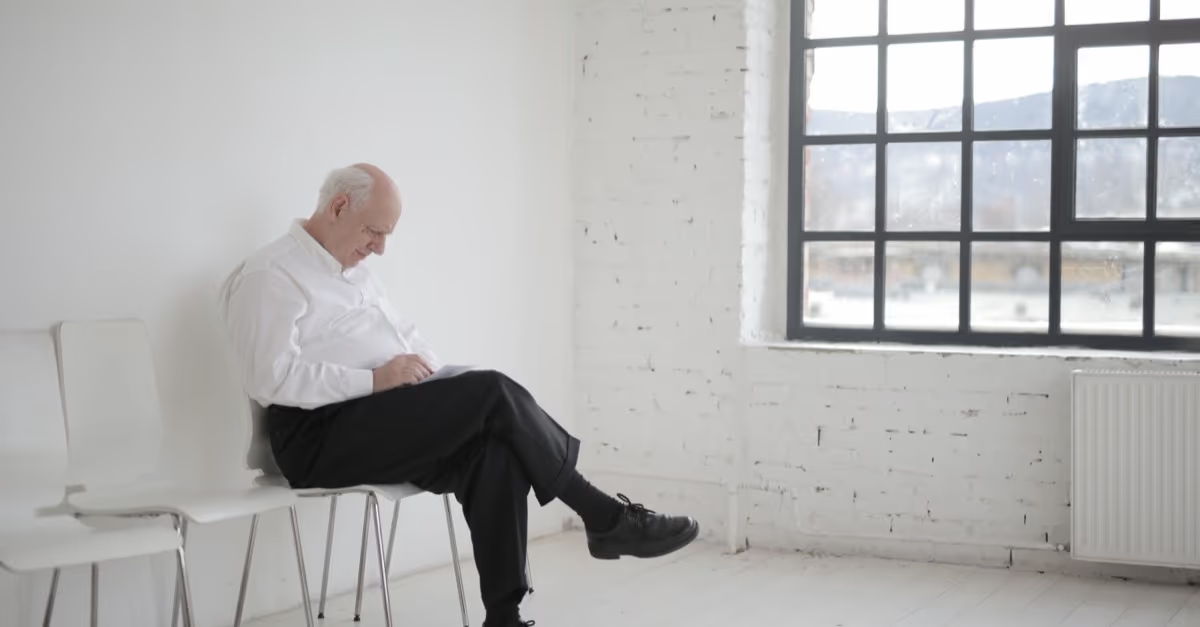

You used to stare out the train window. You used to stand in the checkout line with nothing to do but stand there. You used to lie in bed for ten minutes before sleep with no input at all, just your own mind running. When did that stop?
Not on a date you could name. It leaked out of your life one filled gap at a time. The red light. The elevator. The ninety seconds the kettle takes. The first conscious minute of the morning, now spent on a screen six inches from your face. Every one of those used to be empty. Now none of them are.
Here is the uncomfortable possibility, especially if you are in your forties or fifties and trying to get several parts of your life back on track at once. You did not lose your discipline. You lost your boredom. And boredom, it turns out, was doing some of your most important work.
Why Boredom Is Good for You
For almost all of human history, boredom was not a problem to solve. It was the state your brain dropped into the moment nothing else demanded it, and in that state it did some of its heaviest lifting.
Neuroscientists have a name for the machinery that switches on. Marcus Raichle and colleagues at Washington University described a "default mode" of brain function: a network of regions that goes quiet when you focus on a task and lights up the instant you stop [1]. The default mode network is not your brain idling. It is your brain doing the work it can only do when you leave it alone.
What work? In Raichle's review, the default mode network is where you run self-referential thought, replay autobiographical memory, imagine other people's minds, and picture your own future. Read that list again with a rebuild in mind. Consolidating what you have learned. Understanding the people you live with. Constructing a version of yourself that does not exist yet. That is not a break from the work of changing your life. That is the work.
So when we ask why boredom is good for you, the honest answer is that "boredom" is just the feeling attached to your brain finally getting a turn at its own maintenance.
What Your Brain Actually Does When You're Bored
Three things happen in that quiet, and each one matters more than it looks.
It files your memories. We spend roughly half our waking hours in "offline" states, mind-wandering, daydreaming, the gap between things, and those states are when newly formed memories get consolidated. A few minutes of quiet rest after learning something can lock it in about as well as a night of sleep [2]. The brain treats empty time as a feature. We have been treating it as a bug to patch with content.
It makes you more creative. When researchers bored people on purpose, having them copy numbers out of a phone book, and then asked them to invent uses for a plastic cup, the bored group produced more creative answers, and the ones freest to daydream produced the most [3]. Boredom is not the opposite of creativity. It is the runway.
It solves the problems you are stuck on. People who did an undemanding task that let their minds wander solved 41% more of the creative problems they had been stuck on, beating both hard concentration and plain rest [4]. The answer you cannot force at your desk often arrives in the shower, on the walk, in the line, precisely because your mind was loose enough to find it.
Bored, wandering, half-checked-out. That is the state your best thinking about your own life comes from. It is the state a feed is engineered to never let you reach.
Why This Matters When You're Rebuilding After 40
Here is the part that matters if you are 48 and trying to fix your health, your money, your work, and your home life at the same time.
The most common thing we hear from people in this spot is some version of: I know what to do. I just cannot make it stick. You have read the books. You could write the plan in your sleep. The plan is not the problem.
But a rebuild across several areas of life is not a checklist. It is an integration problem. Which thing first. What trades off against what. What you actually want by sixty, not what you said you wanted at thirty. That integration happens in exactly the network that only runs when you are doing nothing: the one that handles your sense of self and your imagined future.
So look at the loop you are actually in. The gap between knowing and doing is not only a discipline gap. Part of it is that you never reach the quiet where the knowing turns into a decision you can feel. You fill the bus ride. You fill the shower thought with a podcast. You fill the lull after dinner with a feed. The mental room where a 49-year-old would sit with "what am I doing with the back half of this" never gets booked, because something is always already in it.
We will own this take: a lot of what looks like a motivation problem in midlife is a vacancy problem. There is no empty room left for the rebuild to be planned in. If the routines keep falling apart before they stick, the missing ingredient is often not more effort but more quiet.
What the Feed Actually Took
It is worth being specific about what got replaced, because "use your phone less" is useless advice and you know it.
The feed did not take an hour-long block you would notice and miss. It took the seams. The two-minute and five-minute gaps that used to stitch your day together and gave your mind somewhere to wander. One 2026 survey put the average American at 186 phone checks a day, about one every five waking minutes [5]. Treat the exact number loosely. The shape is the point: a check every few minutes means there is no gap long enough for your mind to drift anywhere on its own.
And drifting is the mechanism, not a side effect. Bertrand Russell saw the trap coming in 1932, when he wrote that "immense harm is caused by the belief that work is virtuous" [6]. Almost a century later we found the harm under a brain scanner. The feeling that you should always be doing something is exactly what keeps you from the state where your hardest decisions get made.
There is a quieter cost too. When the gaps are gone, you stop noticing the things the gaps used to surface: the call you owe someone, the resentment you have been sitting on, the fact that you are tired in a way sleep is not fixing. If you have been running on empty for months without quite knowing why, part of the reason may be that you never give yourself a quiet minute long enough to notice.
How to Get Bored Again, on Purpose
This is not a pitch for a dopamine detox or throwing your phone in a drawer for a weekend. Those are willpower stunts, and willpower stunts are the thing that already broke on you.
It is a smaller, more durable move: put a few empty seams back into the day on purpose, and protect them the way you would protect a meeting. Rebuild one system at a time, in the right order, and make this the first one, because it is the system that lets you decide the order of everything else.
Four that hold up in a real midlife schedule:
- Pick one daily gap and leave it empty. The commute, the walk to the car, the first coffee. Not "meditate." Just do not fill it. Let your mind go where it goes. That gap is where next week's decision quietly assembles itself.
- Make the first ten minutes input-free. Phone stays face-down and out of reach until you have been awake long enough to have one thought that started inside your own head.
- Take the walk without the podcast. Once a day, go somewhere on foot with nothing in your ears. This is the mind-wandering research turned into a habit: an easy activity that frees the mind to roam.
- Keep a notebook for what surfaces. When you stop feeding the gaps, the gaps start handing things back. Catch it on paper before the next notification buries it.
None of this is about doing more. It is the opposite. You are subtracting input so the part of you that runs the rebuild can come back online.
You do not need more information about your life. You are working hard and not seeing it stick, and another tactic will not change that. You need a few minutes a day where you are bored enough to hear yourself think. Give yourself that, and the rebuild stops being a list you cannot start and becomes something you actually decide.