

You're somewhere in your late 40s. On paper, the life is built. The career, the marriage or the divorce you survived, the kids who need you less and less, the house that finally feels settled. And still, some morning around 6 a.m., you catch yourself staring at the coffee maker thinking: is this it? Not a breakdown. Not a diagnosis. Just a low, persistent hum that the life you spent twenty years assembling no longer fits the person standing inside it. You're not sad exactly. You're restless, foggy, quietly furious at nothing you can name.
Then you look it up. You type "midlife crisis female" and brace for something that sounds like you. What comes back is a wall of clinical checklists, a menopause explainer, a Reddit thread of women venting, and an AI summary that hedges. Somebody's affair. A red convertible. Symptoms to "manage." None of it names the actual thing: the sense that you have outgrown your own life and have no idea what to do with that.
This Is Not Vanity, and It Is Not Just Hormones
Here is what makes this particular stretch so disorienting. The people around you keep offering the wrong explanation. It gets waved off as a phase, or hormones, or a woman being dramatic about turning 50. So you start to distrust your own read on it. You tell yourself you should be grateful, that other people have real problems, that this restlessness is a luxury you have not earned the right to feel.
You have probably already tried the usual fixes. A new haircut. A weekend away. Throwing yourself harder into work, or into the kids, or into a project that was supposed to feel like yours. Maybe a therapist, maybe a bottle of wine that turned into three nights a week. And none of it touched the hum, because none of it was aimed at the real thing. The restlessness is not a character flaw and it is not a symptom to suppress. That restlessness is information. Your life is telling you something has shifted, and the harder you work to ignore it, the louder it gets.
What Is Actually Happening Is a Re-Architecture, Not a Crisis
A female midlife crisis is rarely a crisis and rarely about what the cliche says it is about. It is the moment the life you built stops matching the person you have quietly become. The kids need less of you, the career has either peaked or gone stale, the body is changing, and the identity you organized everything around, the mother, the achiever, the fixer, no longer fills the whole day. That gap isn't a malfunction. It's an opening.
Start with the fact that most of what you have read about the "midlife crisis" is oversold. When researcher Elaine Wethington studied a national sample of American adults, about 26 percent said they had had a midlife crisis, but when they described what they actually meant, more than half were pointing at ordinary hard events, a divorce, a job loss, an illness, not aging itself. [1] A later peer-reviewed synthesis put the rate of a genuine, developmental midlife crisis at closer to 10 to 20 percent of adults. [2] The dramatic, life-detonating version is the exception, not the rule.
What is common is the dip. Across more than half a million people in the US and Europe, economists found that life satisfaction follows a U-shape over the lifespan, sliding to its lowest point in the late 40s before climbing again. [3] Longitudinal data landed on almost the same number, a minimum around age 47. [4] So the flatness you feel isn't proof your life went wrong. It's the bottom of a curve that, for most people, bends back up. The question isn't how to survive a crisis. It's what you build on the way back up.
The Calm Way Through: Rebuild One System at a Time
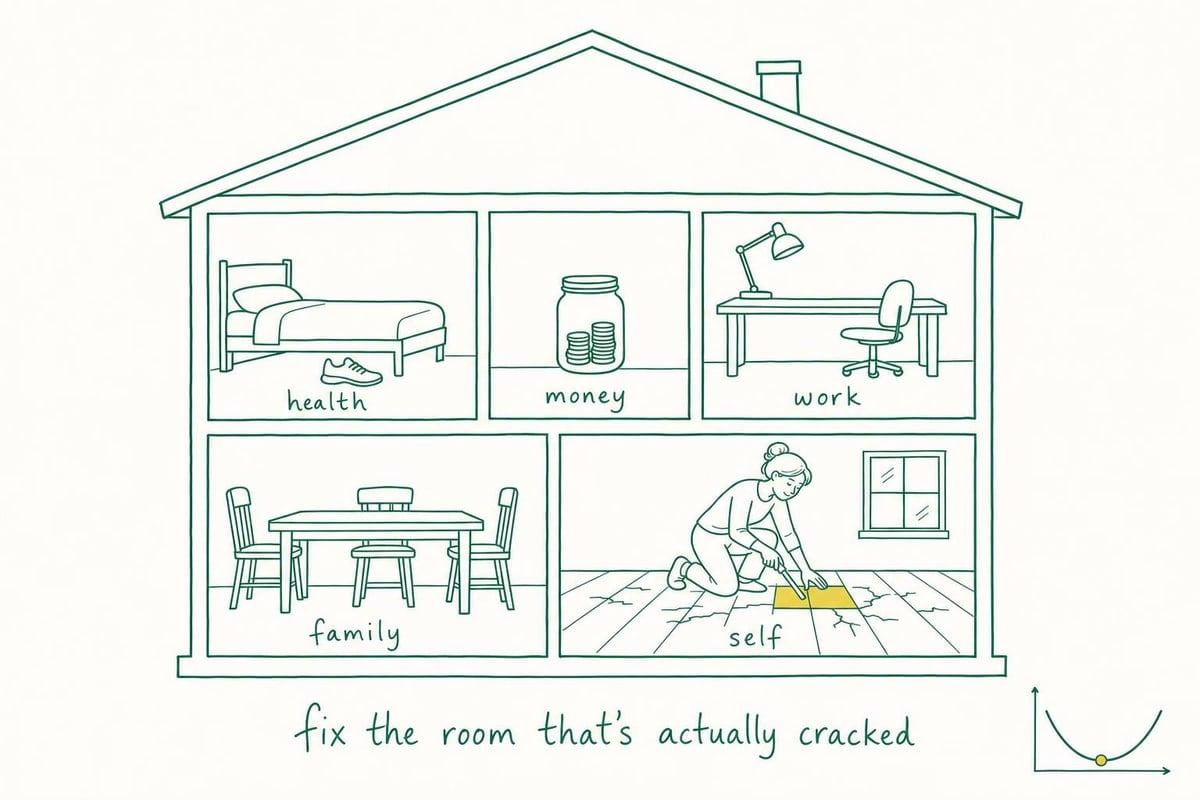
The way out isn't a grand reinvention or a blown-up life. It's a sequenced rebuild: figure out which part of your life is actually cracked, separate what is biological from what is situational, then repair one system at a time instead of trying to fix everything at once. Most women stall here because the restlessness feels like one giant problem. It isn't. It's usually four or five smaller ones stacked on top of each other, and they come apart when you name them separately.
Name the domain that is actually breaking. "My whole life feels off" is not something you can act on. "I have not slept properly in eight months," "I have no friendship that is just mine," and "I have not been asked my opinion at work in two years" are. Health, money, career, relationships, and your own sense of self tend to wobble together in midlife, which is why it feels like everything at once. Pick the one that, if it got better, would make the others easier to face. That is where you start. If naming it feels impossible because the whole thing is a fog, feeling lost in your 40s walks through how to find the first thread to pull.
Separate the biological from the situational, and get the biology checked. Timing matters here. Perimenopause, the transition to menopause, usually starts in a woman's mid to late 40s and lasts about four years on average. [5] That overlap is not a coincidence. Sleep disruption, mood swings, brain fog, and a flattened libido can be hormonal, situational, or both, and you cannot rebuild a life on top of a body you have not had checked. So this is the one piece we will not hand you a routine for: if the physical symptoms are real, see a clinician and rule out the medical causes first. We write about the life patterns around midlife. We do not diagnose or treat what needs a doctor. Once the biology is accounted for, the situational rebuild is yours to run.
Rebuild the floor before the ceiling. The instinct in a low period is to reach for a dramatic upgrade: the new career, the big move, the reinvention. Skip it for now. Rebuild the boring floor first, the sleep, the one daily anchor, the single boundary you keep. A working floor makes every bigger decision clearer, and it holds on the days motivation does not show up. This is the difference between calm discipline and burnout hustle, and it is the whole reason consistent habits in midlife matter more now than they did at 30. When a day falls apart, and it will, you want a system that lets you restart the next morning instead of one more thing to feel like you failed at, which is exactly what the self-discipline recovery loop is built for.
Point the rebuild at something beyond yourself. The psychologist Erik Erikson called the central task of midlife "generativity versus stagnation," the pull to build, mentor, or create something that outlasts you. [6] When that drive has nowhere to go, it curdles into the exact restlessness you are feeling. Give it a direction, work that means something, a person you help, a thing you make, and the hum tends to quiet. This is often where reinventing yourself at 50 and the wider work of finding purpose in midlife start to click into place.
What This Looks Like When a Real Woman Does It
The four moves sound tidy on a page. Here is the messier shape of them in two real-enough lives.
Dana hit it at 47. Marketing director, two teenagers, a marriage that was fine in the way a room is fine when nobody has opened the windows in years. She described it as "being furious at a life I chose." Her instinct was to blow it up: quit the job, maybe the marriage. Instead she named the actual cracked room, which turned out not to be the marriage at all. It was sleep and the total absence of anything that was hers. She saw a doctor about the 3 a.m. wake-ups, which were partly perimenopausal. Then she rebuilt one floor: a 30-minute morning walk, alone, before the house woke up. That was it for two months. The walk did not fix her life. It gave her a stable place to stand while she looked at the rest of it clearly, and from there the harder conversations got easier, not scarier.
Carla, 52, came at it from the other side. Her kids were gone, her divorce four years behind her, and the days had gone shapeless. Her version of the crisis was not too much life pulling at her. It was too little. She kept waiting for a lightning-bolt sense of purpose to strike. It never did. What worked was the opposite of a grand plan: she picked one small generative thing, tutoring reading at the library two afternoons a week, and let it grow. Eighteen months on she runs the volunteer program. She did not find her purpose. She built it, one afternoon at a time. If your own version is closer to Carla's empty calendar than Dana's overloaded one, starting over at 50 maps that particular terrain.
Notice what neither of them did. Neither detonated the whole life. Neither waited to feel motivated. And neither treated the restlessness as a problem to medicate away. As for how long it lasts, there is no fixed clock, but the women who move through it fastest are the ones who stop trying to fix everything and start rebuilding one room. The women who stay stuck for years are usually the ones still waiting for the feeling to pass on its own.
But It Might Be Too Late, and It Might Just Be My Marriage
Two honest objections, because you are probably holding both. The first is that it's too late to change anything real at your age. It isn't. The U-shaped curve turns back up precisely because people in their 50s and 60s report rising satisfaction, and much of that comes from finally building a life that fits. The second half of the curve isn't a consolation prize. It's the payoff for the work you do now. The version of this that scares you, throwing away everything and starting from zero, is not what a calm rebuild asks of you. It asks you to repair, in order, from a foundation you already have. That is what a midlife reset actually is.
The second objection is trickier, because midlife restlessness very often shows up first as marriage doubt. Worth knowing: women initiate roughly 69 percent of divorces, a pattern that has held for decades. [7] Sometimes the marriage really is the cracked room. But often it's just the loudest thing in a house where the real problem is that you've disappeared inside every role except your own. Rebuild the floor, get the biology checked, give the restlessness a direction, and then look at the marriage with a clear head. The decision you make from a rebuilt foundation is a very different decision from the one you make at 3 a.m. in the fog.
Where to Start Tomorrow
Pick the one room that is most obviously cracked, and do the smallest repair you can hold for a week. Not the reinvention. The 20-minute walk, the doctor's appointment you have been postponing, the one evening that belongs only to you.
Restlessness in midlife isn't a sign your life went wrong. It's a signal that you're ready to build the next version, and you already have twenty years of material to build it from. You're not behind. You're at the rebuild.