

You finish a full workday, answer your teenager's school message, pick up a prescription for your father, and call the insurance company from the grocery-store parking lot. At 9:40 p.m., someone tells you to make time for self-care.
The advice is not wrong. It is just too small for the load.
Caregiving can spread into work, sleep, money, marriage, parenting, and your own health until no single task looks impossible but the whole week does. You may still be handling every appointment and bill. You may also be snapping at the person you love, forgetting routine details, or feeling nothing when another request arrives.
That pattern deserves attention, not a character judgment. What is caregiver burnout? It is a useful name for cumulative depletion under sustained care demands. It is not a diagnosis you can confirm from an online checklist, and it is not proof that you have stopped caring.
If you might hurt yourself or someone else, cannot keep yourself or the person in your care safe, or face an immediate emergency, call local emergency services. In the US, call or text 988 or use the 988 Suicide & Crisis Lifeline.
What is caregiver burnout?
Caregiver burnout is a pattern of physical, emotional, and mental depletion linked to sustained caregiving demands and too little support, control, or recovery. It may show up as exhaustion, detachment, irritability, dread, mistakes, or reduced ability to manage daily life. The term describes an experience, not a standalone medical diagnosis. Similar symptoms can also come from depression, sleep disorders, medication effects, or other health problems that need professional assessment.
A peer-reviewed framework for informal caregiving treats burnout as the result of interacting conditions: the care setting, the caregiver's resources, the surrounding environment, how demands are appraised, and the relationship itself. It does not reduce the problem to weak resilience. [1]
Burnout research also has a real boundary. A 2023 review in BMJ argued that, after decades of study, no valid clinical diagnosis for burnout has been established. That does not make the distress imaginary. It means a label should not replace an evaluation when symptoms persist, worsen, or interfere with safety and daily functioning. [2]
The scale matters. AARP and the National Alliance for Caregiving estimated that 63 million US adults, nearly one in four, provided ongoing care to an adult or child with a medical condition or disability in 2025. That is not a caregiver-burnout rate. It shows how many households carry work that often stays invisible. [3]
Caregiver stress, burnout, and compassion fatigue are not interchangeable
Caregiver stress is the immediate strain of care demands. Burnout describes cumulative depletion when high demands continue without enough resources or recovery. Compassion fatigue and secondary traumatic stress focus more on the impact of repeated exposure to another person's suffering. Depression is a clinical condition, not a stronger word for burnout. These experiences can overlap, and research has not drawn a clean border that lets a checklist sort them safely.
Research in physicians found overlap among burnout, compassion fatigue, and secondary traumatic stress, plus unresolved boundaries between burnout and depression. The sample was professional, not unpaid family caregivers, so the concepts do not transfer perfectly. To answer what is caregiver burnout in practice, use the distinction for direction, not diagnosis. [4]
- Stress can rise around a difficult week and ease when the demand passes.
- Burnout language fits better when depletion has accumulated and normal recovery no longer resets you.
- Compassion-fatigue language points toward distress tied to witnessing pain, trauma, or decline.
- Depression, anxiety, sleep problems, and medical causes require assessment by a qualified professional rather than self-sorting from an article.
You do not need the perfect label before asking for help. If low mood, hopelessness, panic, sleep disruption, pain, substance use, or difficulty functioning persists or worsens, contact a health or mental-health professional. A commentary on suicide in family caregivers also warns that suicidal thoughts can occur in this population and that access to specialty care can be difficult. [5]
The problem is capacity, not commitment
Caregiver burnout is often treated as a coping failure: meditate better, exercise more, stay positive, take a bath. Those actions may feel good, but they do not answer the larger question. Has the care load exceeded the time, money, knowledge, backup, and recovery available? When capacity is the bottleneck, another self-care assignment can become one more task you are failing to finish.
This is especially sharp in midlife. You may be coordinating a parent's care while raising a child, protecting a career, and watching retirement costs move closer. A national study of sandwich-generation caregivers described financial strain from child-rearing costs, elder-care expenses, and employment opportunity costs. It did not prove that every sandwich caregiver burns out. It shows why the pressure is not a private attitude problem. [6]
The reframe is blunt:
Do not ask how to tolerate the same care load more gracefully. Ask which part of the load can be made safer, clearer, smaller, shared, or professionally supported.
That question turns guilt into an operating decision. A life audit can show where caregiving is pulling down health, work, money, and relationships at the same time. Do not use it to make a longer repair list. Use it to find the load-bearing point.
Use Care Load Triage before adding another coping task
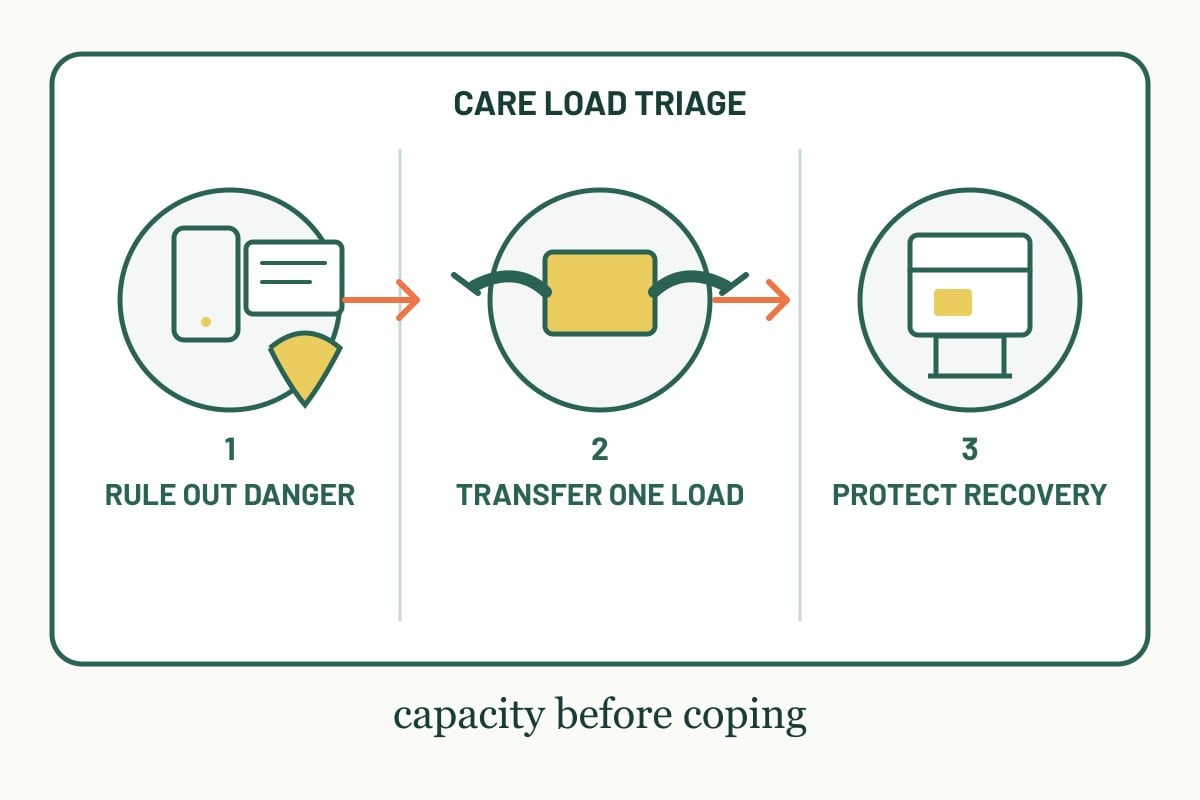
Care Load Triage is a three-part editorial tool: rule out immediate danger and persistent health concerns, transfer or simplify one load-bearing responsibility, and protect one realistic recovery block. It is not a validated treatment and does not promise recovery. Its job is narrower. It helps you stop treating every demand as equally urgent and choose one change that reduces pressure within the next 48 hours.
1. Rule out danger and health concerns
Start with safety. Can you and the person receiving care get through the next 24 hours safely? Are medications, food, mobility, supervision, transport, and urgent appointments covered? Are exhaustion or distress making driving, lifting, medication management, or conflict unsafe?
If the answer may be no, seek qualified help now. Call emergency services for immediate danger. For persistent symptoms or declining ability to function, contact your doctor or a mental-health professional. Do not assume every symptom belongs to caregiver burnout. Our guide to healthy sleep habits can support a routine, but it cannot rule out a sleep disorder or another medical cause.
2. Transfer one load-bearing task
“Let me know if you need anything” is kind but unusable. Convert help into an owned task with a scope and time:
- “Can you drive Dad to Thursday's appointment and bring the medication list?”
- “Can you handle the insurer call and email me the reference number by Friday?”
- “Can you stay from 2 to 5 on Saturday while I leave the house?”
- “Can you research two meal-delivery options that meet these restrictions?”
A systematic review of reviews found that structured, multicomponent support for dementia caregivers may help maintain psychological health. The studies varied, most focused on dementia care, and no single task transfer works for everyone. [7]
If family help is unavailable, the Eldercare Locator connects US families with local aging services. The ARCH National Respite Locator lists respite resources, while No Wrong Door points toward state access systems for long-term services and supports. Availability, eligibility, cost, and wait times vary. A listing is a lead, not a guarantee.
3. Protect one recovery block
A recovery block is not whatever time remains after everyone else is settled. Give it an owner, a start, an end, and coverage. Twenty minutes behind a closed door may be realistic. So may a two-hour walk, a therapy appointment, sleep while someone else monitors the phone, or one evening without care administration.
Protecting time will not repair an impossible care arrangement by itself. It can create enough distance to notice what needs to change. Treat the block as a floor, not a streak; our guide to consistent habits in midlife explains why a minimum that survives hard days matters. The peer-reviewed CARE framework for clinicians organizes caregiver support around caregiver well-being, advance planning, respite, and education. It is a framework, not proof that a fixed sequence produces recovery. [8]
Notice the signs before care becomes impossible
If you searched what is caregiver burnout because one rough day scared you, look for change across several parts of life instead of scoring a checklist. Notice what is becoming frequent, worsening, or unsafe: exhaustion that rest does not shift, dread before routine care, irritability, emotional distance, forgotten steps, missed work, isolation, or losing interest beyond the care role. Record the pattern, then share it with someone qualified to assess it.
Look across four areas:
- Body: sleep disruption, headaches, pain, appetite changes, frequent illness, or exhaustion.
- Thinking: forgotten instructions, trouble planning, repeated mistakes, or feeling unable to make ordinary decisions.
- Emotion and connection: dread, anger, numbness, guilt, hopelessness, withdrawal, or no interest in things outside care.
- Care operations: missed medications, unsafe lifting, neglected bills, cancelled appointments, driving while too tired, or escalating conflict.
These signs do not prove caregiver burnout. Some require medical attention because the same pattern can reflect depression, anxiety, sleep disorders, medication effects, or physical illness. Our broader burnout recovery guide explains why rest alone is not a complete operating change. If the care arrangement itself is unsafe, changing the arrangement comes before perfecting a routine.
Generic burnout recovery stages can help explain why energy, attention, and caring may not return together, but caregiver burnout has no validated universal four-stage model. One four-phase study followed 46 caregivers through end-of-life care and bereavement. That context-specific model is not a general burnout ladder or a recovery clock. [9]
What a 48-hour load reset can look like
A 48-hour load reset does not solve caregiver burnout. It replaces one vague promise to “take better care of yourself” with evidence about capacity. In two days, identify the riskiest gap, give one task a new owner or a smaller scope, and schedule one covered recovery block. The result may be modest. That is fine. You are testing whether pressure can move, not proving that everything is fixed.
Lisa, 49, manages a team, helps her father after a stroke, and still has a teenager at home. She keeps missing lunch, then spends Sunday catching up on insurance paperwork. When her brother asks what he can do, she says, “Nothing. I've got it.”
On Tuesday, Lisa writes every recurring care task on one page and circles the three with consequences if missed. Medication pickup is covered. Transport is not. Insurer calls consume hours but are rarely urgent.
She asks her brother to own Thursday transport for the next month, including the wheelchair and appointment notes. She moves insurer calls into one 45-minute Friday block. Her recovery block is not a spa day. It is Wednesday dinner with her phone on her brother's table.
Neil, 52, has no sibling nearby. His first transfer is different. He calls Eldercare Locator, asks his father's clinic whether a social worker or care manager is available, and asks his employer one precise question about schedule flexibility. He also uses a script from our guide to setting boundaries in relationships: “I can handle the pharmacy today. I cannot also cover the evening visit.”
Neither plan proves recovery. Both expose the next constraint. Lisa learns whether her brother will reliably own transport. Neil learns which formal support doors exist and where the gaps remain.
What if no one else will help?
When no one else will help, do not turn the lack of support into proof that you must become limitless. Separate unwilling relatives from unavailable services, unaffordable services, and tasks that actually require you. Document the gaps. Ask clinicians, social workers, aging or disability navigators, employers, schools, faith communities, or local agencies one concrete question at a time. Some doors will close. The map still matters.
If asking makes you automatically soften the request until it disappears, these people-pleasing scripts can help you pause before agreeing to more. If work and care keep colliding, work-life balance after 40 offers a broader way to price the tradeoffs.
Rural access, cost, family conflict, a loved one's refusal, or complex care may keep the load high. A better morning routine will not erase a structural shortage.
Return to the triage:
- What becomes dangerous if nothing changes this week?
- Which task needs skill, and which only needs a reliable owner?
- Which request can be made with a date, duration, and definition of done?
- Which professional or public system has not yet seen the full gap?
That is calm discipline, not burnout hustle.
Make one load-reducing move today
Knowing what is caregiver burnout helps you choose the first move without redesigning your life. Write down the one task creating the most risk or repeated pressure this week. Decide whether it needs professional assessment, a new owner, a smaller scope, or a protected time. Then make one call or send one precise request. You know what to do. Let someone or something else carry one part of it.
You do not have to prove your love by making your own capacity invisible.


