
Dana turns 48 on Sunday. By Monday morning, she has a new notebook and four promises: walk every day, apply for a better job, fix the household budget, and bring back family dinner.
The page looks clean. Her life is not.
The work deadline still lands Thursday. Her mother still needs a ride to a medical appointment. The water heater still makes that noise. By Wednesday, one walk has disappeared and the job search has become another tab she feels guilty about closing.
This is where the fresh start effect gets misunderstood. A birthday, Monday, or new month can make change feel newly possible. That lift is real enough to use. But a date cannot carry four broken systems on its back.
Contrarian take: a clean date can become procrastination with better stationery. If you keep waiting for January, your birthday, or the next quiet Monday, you are not planning a change. You are shopping for a feeling.
The better move is to treat the landmark as a handoff. Let the date open the door, then put one structure under the next step before life walks back in.
Why a fresh date feels more powerful than Tuesday
The fresh start effect is the increase in aspirational behavior that can follow a meaningful time marker. New weeks, months, years, semesters, holidays, school breaks, and birthdays can divide life into a “before” and an “after.” That boundary makes an old miss feel less like a verdict on the person acting today. It does not erase earlier decisions; it changes how the next action is framed.
Hengchen Dai, Katherine Milkman, and Jason Riis named the pattern after studying three sets of real behavior: Google searches related to dieting, university gym attendance, and goal commitments on stickK. Each rose after some temporal landmarks. The researchers proposed two possible mechanisms. A landmark can place past imperfections in a previous mental period, and it can pull attention up from daily details to the shape of a life. [1]
Five later laboratory experiments sharpened one mechanism: landmarks increased goal-initiation intentions when they signaled a new beginning, and meaningful, identity-relevant, or rare dates carried more force than ordinary dates. The experiments measured initial intention, not months of adherence. [2]
The studies do not prove that every birthday motivates every person or that a gym visit after New Year’s Day becomes a lasting routine. A randomized trial later tested birthday and New Year framing in medication reminders across five mailing conditions. The fresh-start language did not improve reminder effectiveness or adherence. [3]
A temporal landmark works like a scorekeeper changing periods. The points remain, but the next possession can change. What happens after the line depends on what you place there.
If your line marks a wider midlife change, a life audit can show what is actually off before you declare the whole life broken. A midlife reset then works best as a choice about order, not a dramatic rejection of everything built so far.
A fresh start opens a window; it does not carry the weight
A fresh date can increase your willingness to begin. It does not decide when you will act, remove the obstacle in the room, or create a smaller version for a bad day. The fresh start effect is a window for better decisions. Treat it as the change system itself, and you ask a short burst of meaning to do structural work. The landmark supplies attention, while the plan decides where that attention goes next.
This distinction matters because intention and action are different jobs.
A meta-analysis by Peter Gollwitzer and Paschal Sheeran examined 94 independent tests of implementation intentions, plans that state when, where, and how someone will act. Across the studies, those plans produced a medium-to-large average effect on goal attainment, reported as d = 0.65. [4]
Useful. Not magic.
The same evidence does not say an if-then line guarantees action. Goals differ. Homes differ. Energy, money, health, work, and available help differ. Plan quality matters too.
A later systematic review of 13 randomized trials on adult physical activity found a smaller pooled effect, 0.25 with a 95% confidence interval from 0.05 to 0.45, in the subgroup that received reinforcement of its implementation intentions. The participants and interventions varied widely. The honest conclusion is not “planning always works.” It is that concrete planning can improve the odds, and reinforcement may matter. [5]
The reframe is simple: a fresh start is a handoff moment. It separates you from the old score long enough to place one better structure underneath the next week.
LifeHack already has a guide to making a fresh start without throwing away your life. The fresh start effect explains why the line feels powerful. The next question is more practical: what should receive the handoff?
Use the Fresh Start Handoff before the date loses its shine
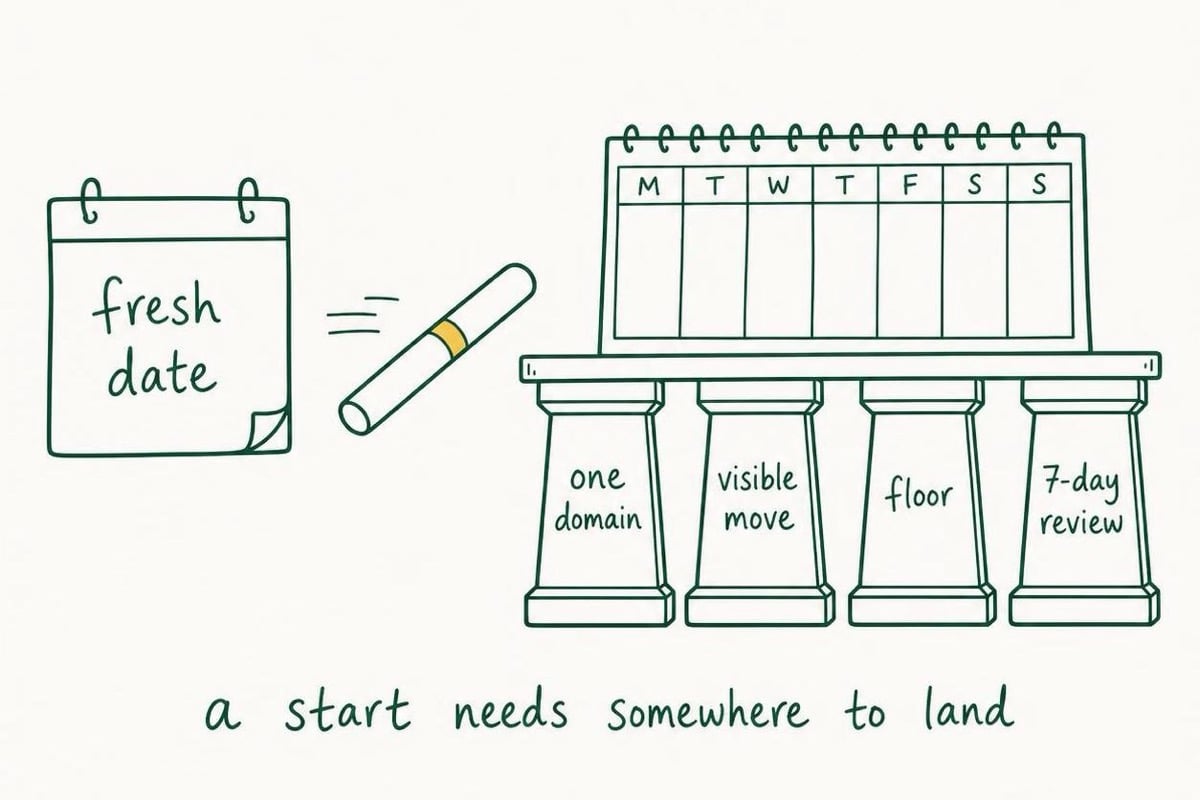
The Fresh Start Handoff has four moves: choose one domain, make one visible move, build a floor, and schedule a review. The sequence transfers meaning from the landmark to ordinary behavior. “Within 24 hours” and “review in seven days” are operating rules for this framework, not scientific thresholds. The date supplies attention; the handoff decides how that attention survives a crowded week.
1. Choose one domain
Pick health, work, money, relationship, or recovery. One.
Dana’s first plan failed before Monday because every part of life demanded a restart. Four goals meant four environments to change, four sets of friction, and four opportunities to call the week a failure. Her birthday gave each promise emotional weight. It did not give her four extra evenings.
Choosing one domain is not saying the others do not matter. It is choosing which repair makes the next repair easier.
If the stuck point is not action but direction, life planning in your 50s offers a wider map. If purpose is the missing piece, use the questions in finding purpose in midlife. Do not turn either exercise into five simultaneous projects.
Dana chose health, specifically an evening walk. Not weight loss. Not “get fit.” A repeatable action she could see.
2. Make one visible move within 24 hours
A visible move changes something outside your head.
Put the walking shoes by the door. Book the appointment. Cancel the unused subscription and move that amount into savings. Ask for the meeting. Put Tuesday’s family dinner on the shared calendar and tell everyone the time.
Dana set a 6:15pm walk for Monday and placed her shoes beside the dog’s leash. The 24-hour rule kept the birthday from turning into a speech she gave herself. Again, no study says 24 hours is a special behavioral threshold. We use it because a start needs a short bridge from meaning to evidence.
One field experiment shows why specificity matters. Researchers randomly assigned 3,272 eligible employees at a utility company to a normal vaccination reminder, a reminder asking them to write a date, or one asking for a date and time. The control group’s vaccination rate was 33.1%. Writing only a date added 1.5 percentage points, a non-significant change. Writing a date and time added 4.2 percentage points. [6]
A calendar entry is not destiny. But “Monday at 6:15” gives the intention somewhere to land.
3. Build the floor before the ideal
The floor is the version that fits the crowded week, not the ambitious week.
Dana wanted a 40-minute walk. Her floor became ten minutes to the end of the block and back. The ideal could grow later. The floor protected the handoff when the deadline ran late or her mother called.
This is where many fresh starts become fragile. The plan gets sized for the person making it: rested, hopeful, looking at a clean page. The person running it is tired on Thursday.
Life rebuild, not life hack. A floor respects the life already in motion. The full method for this sits in consistent habits in midlife, where consistency is treated as a design problem rather than a character test. And if the plan still requires a daily argument with yourself, discipline and consistency starts one step earlier by removing repeated decisions.
4. Set a seven-day review
Schedule the review when you make the plan. Dana chose Friday at 4:30pm.
The question is not, “Was I perfect?” Ask four plainer questions:
- Did the visible move happen?
- Did the floor fit the worst normal day?
- What friction appeared twice?
- Should the action stay, shrink, move, or leave?
Seven days is not a habit-formation promise. It is a decision checkpoint while the week is still legible.
A 12-week study followed 96 volunteers who chose one daily behavior, with 82 providing enough data for analysis. One missed opportunity had little impact on later automaticity; repeated omissions could accumulate. That does not validate a seven-day rule. It argues against treating one miss as a full reset. [7]
Dana walked three times. Tuesday disappeared into a work call. Thursday became a pharmacy run. She did not buy a new notebook or move the restart to next month. She moved the Monday and Wednesday walks to 6:30, kept Saturday morning, and put the work phone in a drawer ten minutes before leaving.
That is progress without theater.
What the fresh start effect looks like in a full midlife week
A useful fresh start is modest enough to survive contact with work, family, health, and money. Dana’s birthday supplied the line. Her walk, ten-minute floor, and Friday review supplied the structure. The result was not a new identity by Tuesday. It was a week that produced evidence she could use. The point is not to feel renewed; it is to leave the week with a usable result.
Now take Marcus, 51. A reorganization at work leaves him with a new manager and a chance to stop spending every evening cleaning up the team’s unfinished tasks.
His Fresh Start Handoff is concrete:
- One domain: work.
- Visible move: a 25-minute planning block at 8:35am, immediately after the daily stand-up.
- Floor: write the day’s one decision and one task to decline.
- Review: Friday at 3:30pm, checking which interruptions returned twice.
The landmark is not his birthday. It is a role change. The original fresh-start research includes calendar boundaries, holidays, school breaks, and birthdays. It does not prove that every job change produces the effect. Marcus is using the transition deliberately, not claiming a law of psychology.
Notice what he does not do. He does not rebuild his marriage, exercise plan, retirement savings, and career in the same week. Those pressures still exist. His work-life balance after 40 will improve only if the work boundary survives a hard Tuesday, not because a reorganization felt symbolic on Monday.
The same restraint applies to starting over at 50. Starting over does not require erasing what came before. The best temporal landmark separates you from a failed pattern without separating you from your assets, relationships, and earned experience.
Watch for the reset trap
The reset trap begins when starting feels more rewarding than reviewing. You keep changing dates, tools, and declarations while refusing to study the handoff that failed. A fresh start then becomes avoidance: no result can judge you because every attempt is still new. Review is the test: if you never examine the failed handoff, each new beginning protects the same old friction from honest scrutiny again.
Three signs give it away.
You wait for a cleaner date. The next month, quarter, birthday, or Monday always looks better than tomorrow. An ordinary Tuesday is less inspiring, which can make it a better test. Fewer hopes are attached to it.
You restart several domains at once. Life-wide plans feel serious because they are large. They are often less serious because no single action becomes load-bearing.
You throw away useful structure after one bad week. The walking shoes worked, but the time did not. Keep the shoes. Move the time. A review protects what still stands.
What are signs you need a fresh start? Repeated friction may tell you a system needs a new boundary: a job role changed, a caregiving load grew, a routine no longer fits your body, or a financial assumption stopped being true. Those are reasons to reassess. They are not automatic reasons to discard the whole life.
This is the emotional difference between a reset and an escape. A reset faces the evidence. An escape keeps replacing the page.
Build the handoff now
Take 15 minutes. Write down the landmark you are using. Circle one domain. Name one visible move for the next 24 hours. Shrink it to a floor that fits your crowded day. Then schedule a seven-day review. You are not promising a new life; you are giving tomorrow one clear instruction and Friday one useful question to answer honestly once.
That is enough.
A date can open the door. Give the start somewhere to land.