

A note before you read on. Burnout is exhaustion from prolonged occupational stress, recognized by the World Health Organization as an occupational phenomenon, not a medical condition. [1] It is not clinical depression, generalized anxiety, or chronic fatigue syndrome, though it can co-exist with all three. If you have persistent low mood, suicidal ideation, sleep that does not restore after 2 to 3 weeks of rest, or physical symptoms that do not resolve, please see a clinician before applying recovery protocols. For mental health crisis in the US, dial 988. What follows is for the much more common case: depletion that responds to operating-mode design.
What Burnout Recovery Actually Is (And Why "Just Rest" Doesn't Work)
Burnout recovery is not rest. It is not a vacation. It is not a different job. It is the operating mode you switch into, and the four things you do every week until your nervous system trusts you again. If you are searching for this, you are in one of two states. Either you are currently burned out and need to know what to do this week, or you are past it and you are not doing this again. The protocol is mostly the same. The difference is whether you start with rescue or with design.
"Just rest" fails because burnout is not a sleep debt. The WHO defines it as a syndrome from chronic workplace stress with three signs: depletion, mental distance from work, and reduced effectiveness. [2] Sleep heals exhaustion. It does not undo the chronic loading pattern that produced the exhaustion. People take a two-week holiday, feel better on day 10, return to the same inputs, and crash again by week three. The vacation did its job. The operating mode did not change.
Christina Maslach's research on burnout, the basis for the standard Maslach Burnout Inventory used in clinical and organizational settings, frames recovery the same way: change the chronic mismatch between person and job, not the symptom. [3] The six mismatch domains she names: workload, control, reward, community, fairness, values. None of them are fixed by sleeping more.
The shift we are after is from "wait until I feel rested" to "design a week the recovered version of me would already be running." That design has four operations. Before we get there, two PAA-shaped detours, because most people land here mid-search and want the named frameworks.
What Are the 12 Stages of Burnout?
The 12 stages of burnout come from Herbert Freudenberger, the psychologist who coined the term in 1974, and Gail North, who later mapped the progression with him. [4] The stages are: 1) the compulsion to prove oneself, 2) working harder, 3) neglecting needs, 4) displacement of conflicts, 5) revision of values, 6) denial of emerging problems, 7) withdrawal, 8) odd behavioral changes, 9) depersonalization, 10) inner emptiness, 11) depression, 12) burnout syndrome (full collapse).
The 12 stages are useful as a published framework, not as a diagnostic. Real progression is messier. People skip stages, oscillate, or live for years at stage 6 or 7. Where this matters for recovery: stage matters for protocol. If you are at stage 2 or 3 (working harder, neglecting needs), the rebuild is small and behavioral. You can defend one block per day this week. If you are at stage 9 or beyond (depersonalization, inner emptiness), the work is larger and clinical involvement is appropriate. Most readers searching for burnout recovery are in the 4 to 7 zone: not collapsed, but not operating well. And the way down is not the way back: the stages of burnout recovery run in their own order, marked by which capacity has returned rather than by weeks elapsed.
Score yourself honestly. The stage tells you whether you are designing a week or asking for help.
Can You Ever Fully Recover From Burnout?
Yes, but recovery is a permanent change in operating mode, not a return to who you were before. This is the bimodal hinge of the whole article. If you are reading this in crisis, the answer is yes, you can recover. If you are reading this from the other side, the answer is also yes, and this is the mode you live in from now on.
The research on burnout recovery time is thinner than people assume. Sustained recovery, measured by Maslach Burnout Inventory scores returning to non-burnout ranges and holding, takes most studies 12 to 18 months once the underlying load pattern changes. [5] Without the load change, people relapse. With it, the protective benefit shows up around month 6 and stabilizes through month 18.
What "fully recover" does not mean: returning to a 60-hour week with the same intensity and tolerance you had at 30. The body has changed. The cortisol curve has changed. The recovery floor is higher. People who insist on the old version of themselves relapse the fastest. People who build the new version, the one with defended blocks and a real recovery floor, hold.
From our work with LifeHack engaged users: post-burnout operators who installed the defended-block + recovery-floor pattern at midlife reported sustained recovery 18 months later. This is pattern, not controlled study. It matches the published literature on which structural changes hold.
The 4 Weekly Operations That Compound Recovery
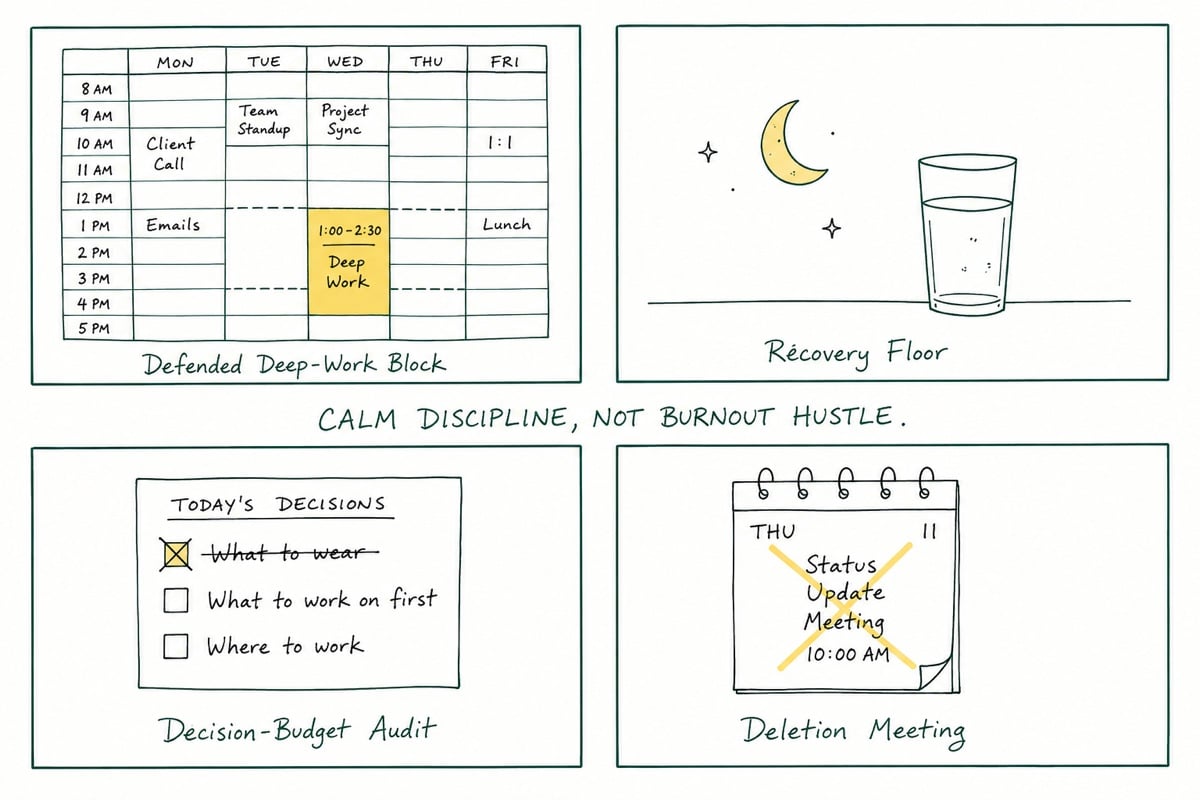
Here is the operating mode. Four operations, run weekly, that move the load pattern in the direction recovery actually needs. None of them require quitting. None of them require a sabbatical. Most require less time than the meeting you are currently dreading.
1. One defended deep-work block per day. 90 to 120 minutes, calendar-blocked, phone in another room, doing the one piece of work that matters most that day. Not email. Not Slack triage. The piece that, if it shipped, would make the day count. Cal Newport calls this "deep work" and argues the modern office actively prevents it. [6] For burnout recovery, the defended block is not about productivity. It is about restoring a felt sense of agency. You decide what gets the best 90 minutes. Everything else fights for the rest.
2. Recovery floor before output. Sleep target, one short walk, one meal at a table without a screen, one hour off the phone before bed. These are the floor. If the floor is not held, the defended block does not work. The week starts with non-negotiable recovery inputs and adds output on top. Most burnout recoveries fail because people invert this: they try to output first and recover with whatever is left. There is never anything left.
3. Weekly decision-budget audit. Saturday morning, 15 minutes. List every recurring decision you are currently making (what to wear, what to eat for breakfast, which Slack to answer first, which meeting to attend). Cross out the ones a competent version of you could have decided once and run on autopilot. The point is not minimalism. It is reserving the limited daily decision budget for the work that actually matters. Roy Baumeister's research on decision fatigue, while contested in detail, holds at the practical level: the more low-stakes decisions you make, the worse your high-stakes ones get. [7]
4. The deletion meeting. Once a week, 30 minutes. Look at the calendar for the next two weeks. Find one recurring meeting, one optional commitment, or one ongoing project that does not serve the rebuild. Delete it or hand it off. Not "reschedule." Delete. If you cannot delete one thing per week, your calendar is running you. This is the operation most burned-out operators skip, because it requires saying no to something already on the books.
Four operations. Roughly four hours a week of explicit time. Compounding because the defended block trains agency, the recovery floor restores capacity, the audit reduces fatigue, and the deletion meeting reverses the loading pattern. The "compound" word is not metaphor: week 1 is uncomfortable, week 6 starts to feel different, month 6 is a different operating system.
Calm discipline, not burnout hustle.
What Is the 42 Rule for Burnout?
The 42 rule is shorthand for a simple time-budget: 8 hours of work, 8 hours of sleep, 8 hours for everything else equals 24 hours in a day. It started in nineteenth-century labor movements ("eight hours for what we will") and has cycled through wellness and HR content as a recovery heuristic. [8]
The 42 rule works for hourly workers with discrete shifts. It does not work for midlife operators whose work bleeds into evenings, whose sleep gets disrupted by aging parents or teenagers, and whose "8 hours for everything else" actually contains caregiving, household management, and the slow restoration of a body that no longer recovers at 30-year-old rates. The honest reframe for our cohort: defend the deep-work block (the 90 to 120 minutes that count), hold the recovery floor (sleep, walk, screen-off hour), and stop scoring your day against a 24-hour ledger. The hours are not the variable. The protected blocks are.
What Is the 30-30 Rule for Burnout?
The 30-30 rule is take a 30-second recovery break every 30 minutes of focused work. It is a Pomodoro-flavored micro-recovery pattern, popular in burnout-prevention guides because it requires no structural change and feels good to start. [9]
Useful for: active burnout state, when 90-minute blocks feel impossible and any sustained focus triggers the depletion response. The 30-30 rule resets the nervous system briefly without demanding much. Use it for the first few weeks of recovery as a stabilizer.
Less useful for: chronic post-burnout design. Once the defended block returns, the 30-30 micro-rhythm is overhead, not help. Graduate out of it as the recovery floor stabilizes. Recovery tools that were rescue equipment in week 2 become drag in month 4.
How to Recover From Burnout While Still Working
Most midlife operators cannot quit. Mortgage, kids, healthcare, the specific situation that means leaving the job is not the move this quarter. The good news is the four operations above are designed for that case. None of them require a sabbatical. They require a renegotiation of where your best 90 minutes go and what you stop saying yes to.
Three practical adjustments for the while-still-working case.
Anchor the defended block to your highest-energy hour. For most people that is the first 90 minutes after waking. Move it before the first meeting, before email, before Slack. Anika at 47 ran her recovery from a senior healthcare role by blocking 6:30 to 8:00 AM at home for the one project she actually cared about. She lost no client time. She gained a new operating mode within six weeks.
Renegotiate two things per quarter, not ten. Pick two recurring commitments to step out of. Tell your manager (or yourself, if you are the manager) which two. The instinct is to fix everything; the move is to fix two things every 90 days and let the compounding do the rest. A year of two-per-quarter is eight structural changes, which is a different job.
Treat the job as one Aspect, not the whole life. If the job is the source of the burnout AND you cannot leave it this year, the rebuild has to happen in the other Aspects, not just the one that is breaking. Sleep, relationships, money structure, identity work outside the job: these are the leverage points when work itself is locked. If the job is unfixable structurally and the rebuild has stalled, the next conversation is about whether the rebuild needs a broader life change, not just a recovery routine.
The Post-Hustle Northstar: What Changes When You Stop Trading Hours for Outcomes
Hustle was the loan. Midlife is the repayment. The 20s and 30s strategy of trading hours for outcomes works because the body subsidizes it. The cortisol curve is forgiving, sleep restores quickly, the metabolic cost is hidden. By the 40s, the subsidy stops. The loan becomes visible.
The post-hustle operating mode trades a different currency: focus and structure for outcomes, not hours. Same outcomes, often better outcomes, on roughly half the time, if you defend the right block and delete the right meetings. The first three months of running this mode feel slower. They are not. Month 6 onward, the gap between this mode and the old hours-for-outcomes mode widens fast.
What changes structurally:
- You stop measuring weeks in hours and start measuring them in defended blocks completed.
- The recovery floor is no longer a reward for hard work. It is the floor.
- You decide what to delete before you decide what to add.
- The annual goal stops being "ship more." It becomes "ship the few that matter while holding the floor."
This is the operating mode that holds for the next 20 years. Not just until the next deadline. Life rebuild, not life hack. If the rebuild is broader than burnout recovery, the 5-domain midlife reset sits on top of this mode and runs the same way.
Frequently Asked Questions
How long does burnout recovery take?
The active rescue phase, where the worst symptoms (exhaustion, cynicism, reduced effectiveness) stop getting worse, is usually 4 to 8 weeks once the operating mode changes. Full structural recovery, measured by Maslach Burnout Inventory scores returning to non-burnout ranges and holding, takes 12 to 18 months in published studies. [10] The mistake most people make is calling it "recovered" at month 2 and reverting to the old load. Give it the full 18.
Is burnout the same as depression?
No. Burnout is occupational, situational, and tied to a specific work-life mismatch. Depression is clinical, often biological, and present across contexts. The two overlap and can co-occur, but they are not the same condition and they are not treated the same way. If your low mood, anhedonia, or fatigue persists after a structural change in workload, talk to a clinician. Cleveland Clinic has a useful plain-language explainer on the distinction. [11]
Can I recover from burnout without changing jobs?
Yes, in most cases, if you can change the loading pattern inside the current job. The four weekly operations above are designed for that. Cases where a job change is part of the recovery: when the source of the chronic mismatch is the job itself (the role, the manager, the values gap), and renegotiating two commitments per quarter has not moved any of the Maslach mismatch domains after 6 months. At that point, the rebuild is broader than burnout and the conversation widens.
Will I be the same person after burnout?
No. The recovered version is structurally different, with a higher recovery floor, less tolerance for low-meaning input, and a sharper signal for when to stop. Most people who do the rebuild well describe the change as "I would not go back even if I could." That is the operating-mode change holding. Mental Health America has a helpful resource on identity shifts during recovery. [12]
What about supplements, ice baths, or biohacking protocols for burnout?
Layer two, at best. The structural operating-mode change is layer one. Adding cold plunges to a calendar that has not changed is a more expensive form of the same loading pattern. Once the four operations are running and the recovery floor is stable, optional layers (strength training, sleep hygiene upgrades, blood work, contemplative practice) compound nicely. Skipping to them first is the most common reason burnout recoveries stall.
Start With One Defended Block This Week
You do not need a sabbatical. You do not need a different job. You need one defended 90-minute block this week, held against everything that wants it. Calendar it. Phone in another room. Door closed. Do the one piece of work that matters. The recovery starts there, in the smallest unit of the new operating mode, before any of the larger structural conversations.
The post-hustle operating mode is built one defended block at a time, one recovery floor at a time, one deleted meeting at a time. Most people quit before week 6 because the early weeks feel slower than the burnout did. They are not slower; they are differently loaded. By month 6 the difference is obvious. By month 18 the old operating mode looks expensive in a way it never did before.


