

It is 9:40 on a Wednesday. A board deck is due at noon, your mother's MRI results come back at two, and the text your 14-year-old sent at 9:15 is still unread because you have not had thirty free seconds to open it. Nothing on that list can wait. Nothing can move to next week. This is the shape of an ordinary day now, and no calendar trick was ever built for it.
Everything peaked at the same time. That's the part nobody warned you about. Work life balance after 40 used to sound like a problem for later: more time for the gym, more dinners at home, once things settled down. Things did not settle down. The job got bigger, the kids got more complicated, your parents started calling about doctors instead of holidays, and the retirement math got loud. It stopped being a negotiation and became a load you carry every single day, with nothing left to set down.
You've read the balance articles. Block your calendar. Say no more. Find the 50/50. None of it survives a week like the one you're in right now, where three domains spike on the same afternoon and there's no fourth hand free to catch the rest. The advice is not wrong so much as outmatched. It was written for a life with slack, and your 40s ran the slack out.
Why Work Life Balance After 40 Feels Impossible
Work life balance after 40 feels impossible because, for the first time, every demand in your life peaks simultaneously instead of taking turns. A national study of the sandwich generation found that millions of adults in their 40s and 50s provide care to both an aging parent and a child at the same time, on top of paid work. [1] This isn't a time-management gap. It's a collision.
Researchers measured what that collision actually costs in hours. The caregiving load alone for sandwiched adults runs from 11 to 60 hours a week, clustering around 20, and that's before your actual job. [2] Twenty hidden hours. No wonder the calendar tricks don't work. You can't optimize your way out of a week that has more required hours than it physically contains.
And the toll is not just on the clock. Sandwich-generation adults are twice as likely to report financial strain and significantly more likely to report clinically relevant depressive symptoms than people caring in only one direction. [3] So the squeeze hits work, family, money, and your own health at the same time. That's the four-domain problem nobody put on the brochure for your 40s. If you've felt stuck in a rut without a single dramatic cause, this is usually why.
Search "work life balance after 40 reddit" and you'll find thread after thread of the same confession: capable people who hit 45 and quietly stopped sleeping, stopped exercising, stopped doing the money review, because something had to give and those were the things with no one to answer to. The pattern is so consistent it has a name in the research. The middle-aged sandwich generation faces time-management strain, physical exhaustion, and caregiver burnout, often with limited help from siblings or services. [4] The squeeze is not a sign you chose wrong. It's the structural shape of this decade.
You Are Not Bad at Balance. The Math Changed.
The reason your old approach stopped working is simple: balance used to mean trading time between two things, and now it means holding four things up at once with no slack to redistribute. In your 30s you could rob Peter to pay Paul. Skip the gym to hit a deadline, claw it back Saturday. After 40, Peter, Paul, your parents, and your portfolio all need paying in the same week, and there is no Saturday left to claw anything back from.
This is what makes midlife different from any earlier stage, and why the advice that worked at 30 quietly fails now. The classic move was subtraction: drop something to make room. But look at your four domains. Work pays the mortgage. Health is the engine that runs everything else. Money is a clock you can't stop. Family and aging parents are not optional and not negotiable. You cannot subtract a domain. They're all load-bearing now.
So the question changes. It stops being "how do I split my time fairly?" and becomes "how do I keep all four standing when I cannot drop any of them?" The professionals who handle this well are not better at heroic re-prioritization. Sustainability research is blunt about why pushing harder backfires in this decade: the question that matters is not whether you can do something once, but whether you can sustain it for years, which means building around energy management instead of exertion. [5] The people who hold it together aren't pushing harder. They've stopped trying to balance and started defending a floor. And the thing the floor is defended against has a name: hustle culture, the belief that work should absorb whatever time is left, which set the terms most of us accepted in our twenties and thirties.
This is not a women's problem or a men's problem, though the load lands differently. Work life balance strategies for women over 40 often carry an extra layer of caregiving expectation, which is why so much of the advice aimed at women in this stage centers on permission to put their own floor first. The mechanism underneath is the same for everyone in the collision years: you cannot out-discipline four simultaneous peaks. You can only decide, in advance and in calm, what the minimum is.
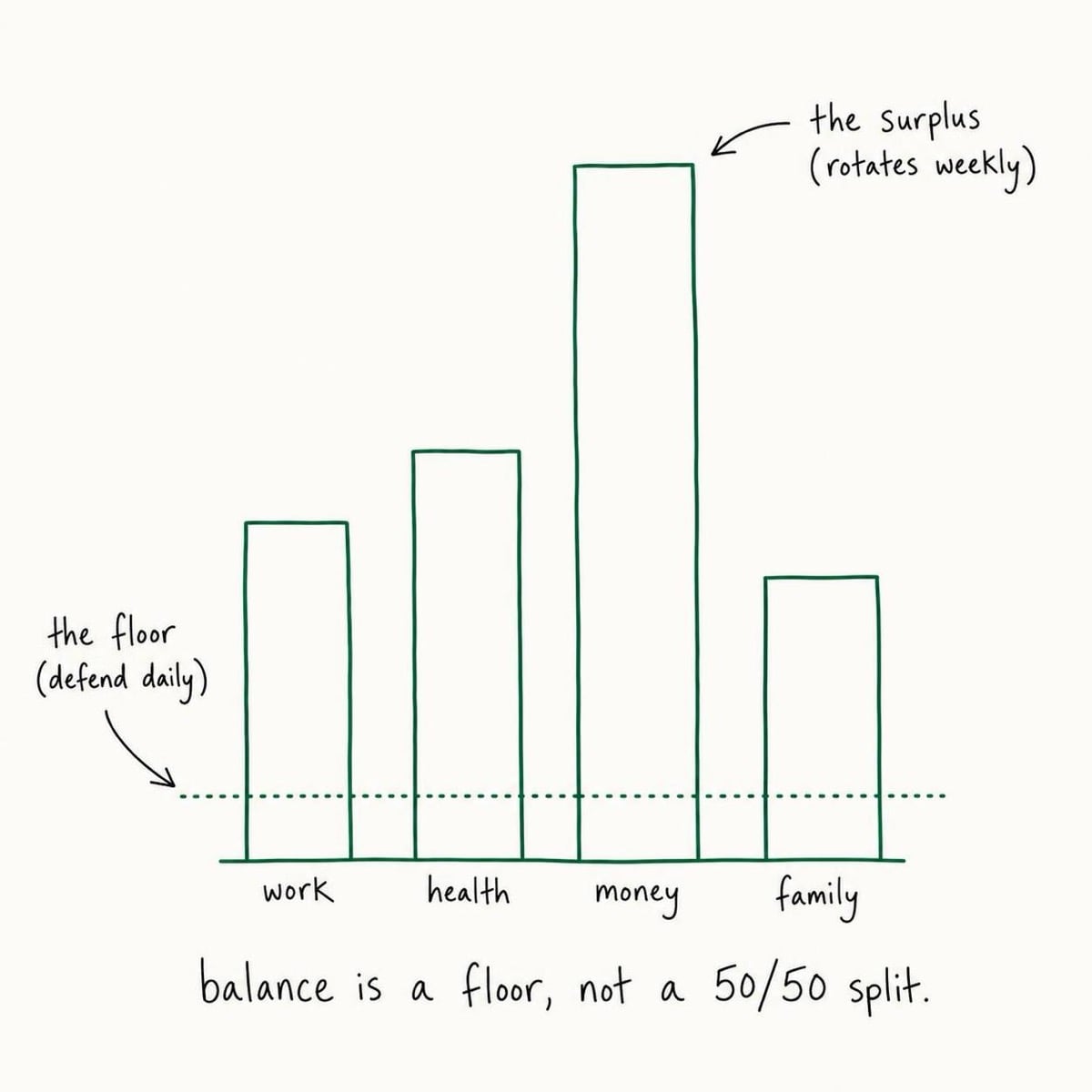
Stop Chasing 50/50. Build a Daily Floor Instead.
A daily floor is a minimum, non-negotiable action in each of your four domains, small enough that you can complete it on your worst week. Instead of asking each day to be balanced, you ask each day to clear the floor: the smallest thing that keeps work, health, money, and family from collapsing. The floor is not your ambition. It's your insurance. On a great week you do far more. On a brutal week, the floor is all you owe, and clearing it is enough.
This reframe matters because what actually predicts work-life balance is not how evenly you split your hours. It's boundary control: your sense of being able to decide when, where, and how work and the rest of life touch each other. A study on work-life conflict found boundary control is more predictive of balance and wellbeing than any time-split or equal distribution. [6] You feel out of balance not because the hours are uneven. You feel it because the demands cross your lines whenever they want. Slow living protects one edge inside that demanding week by deciding what gets the minute and what waits. Slow living protects one edge inside that demanding week by deciding what gets the minute and what waits.
Higher boundary control is tied to lower work-family conflict, less psychological strain, and more satisfaction with balance, especially when you feel autonomy over your own time and space. [7] Even flexibility doesn't save you without it: at midlife, job autonomy alone doesn't prevent burnout unless you also control when work enters your personal life. [8]
A floor is how you take that control without a heroic personality. You're not negotiating boundaries fresh in the moment, when you're tired and guilty and the demand is loud. You decided in advance what the minimum is. Setting boundaries at work after 40 stops being a confrontation and becomes a default you already chose. The same logic the research points to: pre-deciding your limits before demands arrive cuts in-the-moment guilt and makes the boundary actually hold. [9] This is calm discipline, not the burnout version. And it works precisely because it asks nothing of your willpower on the day you have none.
There's one more piece. Balance over a week is not the same as balance in a day, and that distinction is your relief. Work-life integration thinking treats balance as a cycle that shifts week to week based on what's loud, not an equal split you owe every single day. [10] So you protect the floor daily, and you let one domain get the surplus this week. The walk every day; the deep career push this month; your father's care the week of the surgery. If the difference between integration and balance ever confused you, this is it in practice.
What a Defended Floor Looks Like on a Hard Week
Here's the floor running in a real life. Anika is 51, a regional ops director with a 14-year-old, a 9-year-old, and a father two years into Parkinson's. Her old version of balance was a color-coded calendar that assumed every week was average. No week was average. Each collapse felt like personal proof she couldn't hold it together.
She rebuilt it as a floor across four domains, written down once. Work: protect the first 60 minutes for the one task that moves the week, before any inbox. Health: a 10-minute walk after lunch, and lights out by 10:30, even when, because protecting sleep is the one input that quietly props up every other domain. Money: a five-minute money check anchored to Sunday coffee, the kind of small money habit that compounds without drama. Family: phone in a drawer from 6 to 7:30 for dinner, no exceptions. Four minimums. None heroic.
Then the surplus rule: each week, one domain gets the extra. The week of her father's neurology appointment, family gets it, and work runs on the floor only, guilt-free, because the floor is enough to hold work in place. The week of the budget cycle, work gets the surplus and her walk stays at the bare 10 minutes. She isn't balancing. She's defending four floors and rotating one spotlight.
This holds because small consistent actions embedded in your existing routine build durable change far better than heroic bursts. [11] Anchoring each minimum to something she already does, the lunch, the Sunday coffee, the family dinner, is why they survive chaos. Routine-based cues beat clock-based willpower; one randomized trial found anchoring new behaviors to existing daily routines is what makes them stick. [12] A year in, Anika doesn't feel balanced in the brochure sense. She feels held. Nothing has collapsed in months. That's the win that was actually available. If you want the full version of this, it's the same logic as a daily routine built for a real 40-something schedule.
Notice what the floor protects against. The classic midlife failure is not dropping one ball. It's the cascade: a bad week at work eats sleep, lost sleep eats patience at home, a tense home eats focus at work, and three weeks later all four domains are down at once and you don't know which fell first. The floor is a circuit breaker. Each minimum is small enough to hold even while another domain takes the surplus, so a hard stretch in one place can't drag the others down with it. That's the difference between staying consistent across your whole life and the all-or-nothing swing most people live in after 40.
But Your Job Won't Let You Set Boundaries Like That
The honest answer: a floor is built precisely for the job that won't cooperate. You don't need your employer's permission to protect a 10-minute walk or to silence your phone at dinner. The floor is the minimum that survives a non-cooperative environment, not a fantasy of a calm one. Extended work availability does raise conflict and harm health, but research is clear that your own boundary-management style and self-regulation soften the damage even when the job stays demanding. [13]
The second objection: you don't have time for one more system. But the floor isn't another thing to do. It's permission to do less on hard days without guilt. The minimums total maybe 30 minutes, and they replace the exhausting daily renegotiation of what matters. You're not adding load. You're deciding once so you stop deciding under pressure. That decision is the relief, and it's the same skill behind any durable boundary you actually keep.
And the deeper objection, the one that keeps people stuck: the imbalance is the job itself, so until you change careers nothing else matters. Sometimes that's true. A career change at 40 or 45 can be the right move, and 40 is not too old to make it; two decades of judgment transfer with you. But here's the trap. People put work life balance after 40 on hold for the someday-pivot, let health and family slide in the meantime, and arrive at the new job already depleted. The floor is what keeps the other three domains alive while you plan the move, so you make the change from a steady base, not a desperate one.
The One Thing to Do Today
Pick your four domains: work, health, money, family. For each, write down the single smallest action that, if you did only that, would keep the domain from sliding. A 10-minute walk. The first hour for one real task. A five-minute money look. A phone-free dinner. That's your floor. Then anchor each one to something you already do daily so it doesn't depend on remembering or feeling like it.
That's the start. Not a calendar overhaul, not a heroic 5am reinvention, not the perfect 50/50 you've been chasing since you turned 40. Four minimums you can clear on your worst week. Defend the floor first. The surplus can wait for the week that has room. Work life balance after 40 was never a split to find. It's a floor to hold, and you already know what belongs on it. The load isn't going to shrink. But a floor you can clear on your worst week stops it from deciding whether you sleep, whether dinner happens, whether the money gets a look. Same weight. You just stop dropping it.


