

Somebody asked you for something on Tuesday. You said yes before you had checked anything.
Not because you wanted to. Because two seconds passed, something had to come out of your mouth, and yes is what your mouth does.
You can stop people pleasing without rebuilding your self-esteem first. The behavior is not a character flaw, it is a fast automatic answer that fires in the gap between a request and your reply, before you have priced what you just agreed to. That gap is where the fix goes. Not a year of inner work: one line you wrote down in advance, ready before the question finishes.
Here is what makes this specific to your forties and fifties rather than your twenties. The calendar those yeses land on already carries a team, a parent's appointments, a kid who needs collecting, and the one project of your own that keeps sliding. Pew Research found that 54% of Americans in their 40s have a parent aged 65 or older while also raising a child under 18 or supporting an adult one. [1]
So no, you do not have a year. You have a Tuesday.
What people pleasing actually is, and what it is not
People pleasing is not a diagnosis. Medical News Today puts it plainly: "'People pleaser' is not a medical diagnosis or a personality trait that psychologists measure." [2] What psychologists do measure sits right next to it. The APA defines sociotropy as "the tendency to place an inordinate value on relationships over personal independence." [3] Vicki Helgeson and Heidi Fritz named a second one, unmitigated communion: a focus on others to the exclusion of the self, which tracks psychological distress while ordinary warmth does not. [4]
Read their scale and you will recognize the room you live in. Item four of the nine-item Unmitigated Communion Scale: "I can't say no when someone asks me for help." [5]
You have plenty of company. In a YouGov survey of 1,122 US adults in August 2024, 48% described themselves as people pleasers, and 52% said they very often or somewhat often feel they cannot say no when someone asks for something. [6] One self-report question on an opt-in panel, so read it as self-identification, not a clinical count.
The part worth taking seriously is the cost. Dana Crowley Jack's Silencing the Self Scale measures exactly this, through items like "I try to bury my feelings when I think they will cause trouble in my close relationship(s)." [7] In 304 nonsmoking women aged 40 to 60, higher scores on that scale went with greater odds of carotid plaque, holding after adjustment for the usual cardiovascular risks, for depression, and for health behaviors. [8] Women only and cross-sectional, so an association, not a cause. Still a fairly literal answer to where the swallowed words go.
The problem is not your self-esteem. It is your response time.
Every ranking article on this topic sends you inward: examine your worth, trace your childhood, learn that you deserve to have needs. Fine work, and slow. It also misses where the behavior happens. The yes is not a position you hold about yourself. It is a response that fires faster than judgment arrives, which is why you can believe all of this and still hear yourself agreeing.
Peter Gollwitzer put the mechanism in one line thirty years ago: "Goal pursuit is often thwarted simply because the critical stimulus is captured by a habitual response." [9] The request is the stimulus. Your yes got there first.
What beats a fast response is not a stronger intention. It is a pre-written one. Gollwitzer and Paschal Sheeran's meta-analysis of 94 studies found if-then plans had a medium-to-large effect on reaching goals, d = .65, and the effect on preventing derailment by an interfering response was larger still at d = .77. [10] Read that second number again, because it is the one that matters here. If-then plans are not only a tool for starting things. They are better at stopping an automatic response than at launching a new one.
Why do they work at reflex speed? Because you hand the steering over. Marieke Adriaanse and colleagues describe an if-then plan as delegating control "from the self to the specified situational cue." [11] The request itself pulls the trigger. Same speed as the yes, different words.
Angela Duckworth, Tamar Gendler and James Gross go further: "rules and plans formulated well in advance of encounters with temptation may trump situational strategies deployed in later cycles of impulse generation." Their own worked example is a scripted refusal to a spouse. [12]
So the target is not your childhood and not your worth. It is four sentences, written on a Sunday, deployed on a Tuesday.
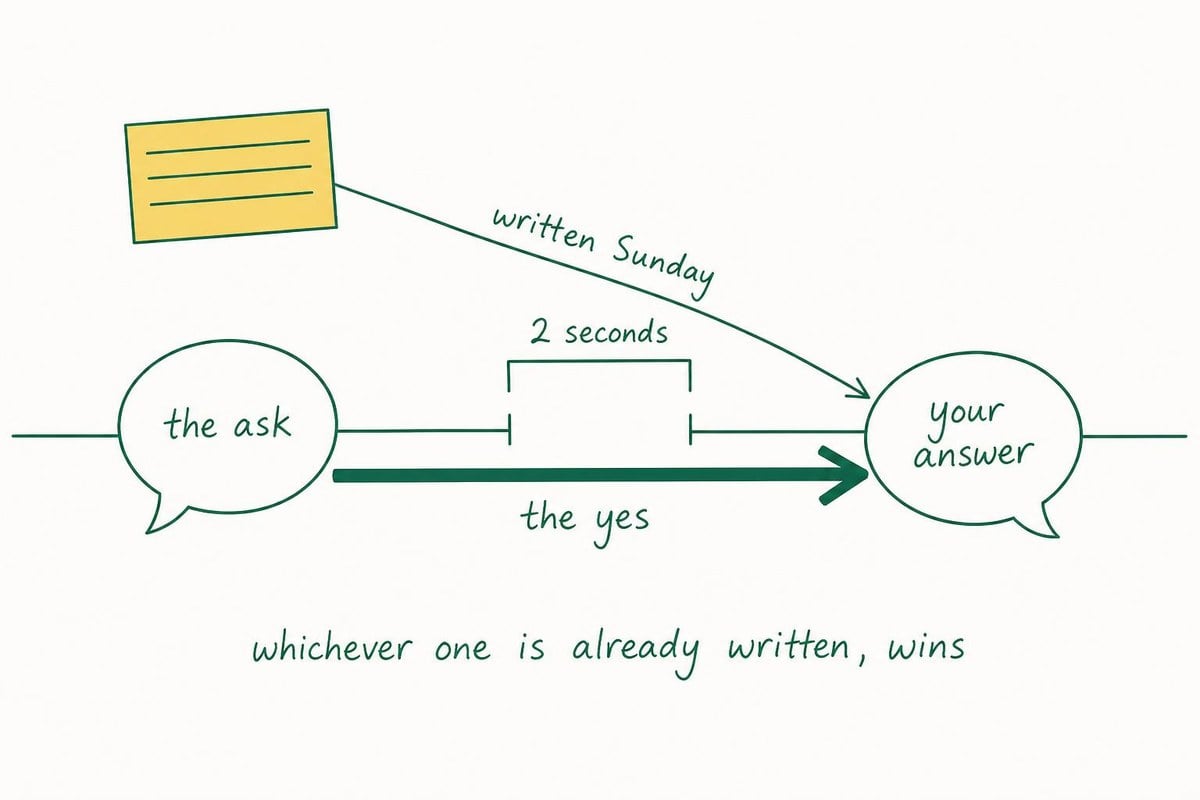
Both prices are wrong, which is why the fast yes feels safe
Your reflex is not irrational. It is running two calculations, and both come out wrong in the same direction: refusing looks more expensive than it is, and agreeing looks cheaper than it is.
Take the first one. Jingyi Lu and colleagues ran seven studies with 2,132 participants, plus four more with 1,470, across hypothetical, real-life and incentivized settings. "The results from seven studies (N = 2,132) and four supplementary studies (N = 1,470) showed that rejecters overestimated these negative consequences." [13] Julian Givi and Colleen Kirk found the same asymmetry for invitations: invitees predicted fallout at 2.77 on the scale while inviters actually reported 2.24. [14] In a pilot for that work, 77% of people admitted accepting an invitation to something they did not want to attend, out of worry about the consequences of declining. [15]
The gap is real but modest, and Givi is explicit that declining everything does erode relationships. The claim is narrower: one no costs less than your gut quotes you.
Meanwhile the person asking cannot see any of this. Vanessa Bohns, who has spent two decades on it, names the blind spot from the other side: "when we are the ones doing the asking, my research shows that we underestimate how difficult it is for people to say no to us." [16] Your boss is not squeezing you. She has no idea she is applying pressure, which means your yes is not information she asked for.
Now the second miscalculation, the one that shreds a calendar. Across seven experiments, Gal Zauberman and John Lynch found that "in general, people expect slack for time to be greater in the future than in the present." [17] A yes for October is charged against an October with room in it. October never has room in it. Add the planning fallacy, where people "typically overestimate how much they can accomplish in a given time period," [18] and the job turns out bigger than the version you agreed to.
Two mispriced numbers, one automatic answer. The reflex is doing arithmetic with the wrong figures, which is also why being busy and being productive stopped matching years ago.
Four scripts for the two seconds before you answer
You need lines that fire on the cue instead of on your willpower, so write them once and reuse them. Four cover almost everything: a hold, a clean refusal, a bounded yes, and a way out of the yeses already on the books. Say each one aloud this week, so the words live in your mouth rather than on a list.
1. The hold: buy the two seconds back
"Let me check what's already on that week and come back to you by tomorrow morning."
That is the whole line. It is not a no, which is why it survives contact with your nervous system, and it separates the moment you learn about a decision from the moment you make it. Alex Imas and colleagues found across three studies that "people make less myopic, present-focused decisions when information about a choice and the opportunity to make it are separated by a waiting period." [19] Money and effort choices, not favors, so read it as the principle.
One condition: name the time you will reply, and reply then. A hold you never close is just a slower yes.
2. The clean no, never the maybe
"I can't take that on. Thanks for thinking of me."
Two sentences, no reason. And here is where we part company with almost every article on this subject, each of which will coach you to soften it into a maybe. Across six experiments, five preregistered, Givi, Kirk and colleagues found that "invitees often overestimate the likelihood that an inviter would prefer a 'maybe' response over a direct 'no.'" People feel more disrespected by the hedge. [20]
The hedge you use to be kind is the move that lands worst. Your "let me see if I can make it work" leaves them planning around a person who is not coming.
Skip the explanation too. A reason invites negotiation of the reason. That holds double with friends and family, where the ask arrives wrapped in history.
3. The bounded yes, for when you actually want in
"I can do the first part, not the presentation. Two hours, Thursday morning."
Half of what gets called people pleasing is not the yes, it is the unlimited yes. Naming the piece and the hours converts an open tap into a defined job, and it gives the other person something more useful than your goodwill: a plan they can build on.
Motive is what separates this from the reflex, and the tell is easy to check. Before you answer, ask yourself what happens if you say no. If the answer is a plan, you are helping. If the answer is a picture of their disappointed face, you are not helping, you are dodging, and what you agree to next will be shaped by the dodge rather than by the work.
4. The unwind, for the yes you already gave
"I said yes to this in March and I've got it wrong. I can finish through the end of the month and then I need to hand it over."
Most of the load crushing you now got agreed to months ago by someone who thought October had space. One clean sentence of ownership, one end date, one offer to make the handover easy. No apology tour.
This hurts more than refusing something new, and it buys back more hours than any new boundary will, which is worth an audit of what is actually on your plate.
These four scripts are built for requests. Boundaries with your partner work differently, because the same limit comes back next week and the sentence alone will not hold it.
What this looks like on an ordinary Tuesday
Ellen, 49, manages a five-person claims team. Her old Tuesday: a colleague catches her at the coffee machine, asks her to sit in on a client call she has nothing to do with, and she is agreeing before he finishes the sentence. Her new Tuesday: "Let me check what's on that afternoon, I'll message you by four." At 3:50 she messages. "Can't do it, sorry." Six words, and the ninety seconds afterwards felt worse than the call would have.
Six weeks in, she has stopped rehearsing. The scripts feel theatrical for a month and then they are simply how you talk, the way any repeated behavior stops needing a decision.
Wes, 52, runs a two-truck landscaping business and had the opposite problem: his yes was fine, his limits were missing. Every job crept. So he stopped saying "sure, I can look at that" and started saying "I can take the front beds this month, not the drainage." One customer went elsewhere. Revenue held, and his Saturdays came back.
Neither of them worked on their self-worth. Both wrote four sentences down, Ellen in her phone, Wes on the back of an invoice left on the dash of the truck.
The change shows up in your calendar first and in how you feel much later, which is the reverse of what the inner-work version promises, and closer to how rebuilding anything in midlife actually goes.
"Won't this just make me the difficult one?"
Less than you fear, and not zero. The refusal research says the damage you are picturing is inflated, but one real cost is worth naming, and it is not evenly distributed. Melissa Williams and Larissa Tiedens pooled 63 likability effects and found dominant behavior does cost women likability relative to men, "although the overall effect is small, d = -0.19," with a larger penalty on hireability, d = -0.58, and no gender difference at all in perceived competence. [21] That measured explicit dominance, which is louder than "I can't take that on." It is still why the scripts above are short and warm rather than assertive-sounding.
Expect the reflex to argue. Thomas Webb and colleagues found if-then plans reduced the pull of an established habit, but "the effect of forming implementation intentions was smaller among participants who possessed strong habits as compared to participants who had weaker habits." [22] Thirty years of practice at yes is a strong habit. Start on low-stakes asks, from people whose opinion costs you nothing, and let the hard ones wait until the words are automatic.
If it feels less like habit and more like fear, the assertiveness work in the FAQ below has a track record. And if you are already past tired, running yourself to a standstill has a recovery sequence of its own.
Start with the next request that isn't urgent
Not your boss. Not your mother. The next low-stakes ask that lands in your inbox this week, from someone whose approval you can afford to lose.
Use the hold. "Let me check and come back to you by tomorrow." Then tomorrow, use the clean no. Write down what actually happened, because your forecast is the thing you are retraining. Do that four times and the two-second window stops belonging to the reflex.
Ellen got her Thursday afternoons back before she felt any different about herself. That order works better anyway, and it is the same order that fixes a week where the productive hours and the busy ones stopped matching.
Frequently Asked Questions
What is the root cause of people-pleasing?
The best-measured driver is parental conditional regard, affection that arrives when you comply and cools when you do not. A meta-analysis of 31 samples and 11,404 participants tied it to contingent self-esteem at r = .29, and the strongest effect of all showed up in the prosocial domain, r = .40. Here is the uncomfortable part: the warm version does more of this than the harsh one. Conditional positive regard produced a bigger introjection effect, r = .33, than conditional negative regard at r = .20. It was often the parents who beamed when you were helpful.
What kind of childhood trauma causes people-pleasing?
You cannot reliably work backwards from today's behavior to a specific childhood event. Across 16 studies and 25,471 participants, adult recall of childhood maltreatment and documented records agreed at kappa = 0.19, worst of all for emotional abuse and neglect, and the authors concluded the two measures "cannot be used interchangeably." Recalled childhood submissiveness does correlate with adult shame at r = 0.47 and depression at r = 0.39. Real, moderate, not a diagnosis of your history.
Is people-pleasing the same as the fawn response?
No, and the fawn response is a coinage rather than a clinical category. Therapist Pete Walker introduced it in a 2003 article: "I have named it the fawn response...the fourth 'f' in the fight/flight/ freeze/fawn repertoire of instinctive responses to trauma." A 2025 peer-reviewed review using the term concedes these responses have been "conceptualized and measured" unevenly across studies. Useful language for a pattern. Not evidence about what happened to you.
How do you stop people pleasing without being rude?
Keep the refusal short and the warmth intact, and skip the reason. "I can't take that on, thanks for thinking of me" reads as respectful because it is final, while a hedged maybe leaves people planning around you. This is trainable: in a randomized trial of 210 adults, an eight-week self-help assertiveness program produced between-group effect sizes of 0.95 to 1.73 on adaptive assertiveness against a waitlist, holding at one-year follow-up, and it includes a chapter on saying no. A meta-analysis of 12 trials with 503 participants put the reduction in social anxiety at g = 0.62. If you want the generic frame first, start with what a personal boundary is and how to set one.


