

The goals form is due Friday. You have done this before: four bullets that sound responsible, a manager who skims them once, and a quarter that buries them by week three.
The problem is not ambition. Those goals were never built to survive an ordinary Tuesday, when a customer escalates, someone resigns, and the thing you promised in January turns out to need a budget nobody approved. Most smart goals examples for work fail in the same place: grammatically correct, operationally empty. No starting number, no named owner, no day of the week attached.
Below are ten smart goals examples for work you can copy, each with a starting number, a metric someone else can check, a date and a check day. The two sections after them cover the parts no example list includes: the trigger, and what you do when the week goes sideways.
What a SMART goal for work actually is
A SMART goal for work is an objective written precisely enough that a colleague could check it without asking what you meant. It states a measurable change from a known starting point, a target that is realistic given your actual resources, a reason the business cares, and a date. The acronym is a test of the sentence. It does not tell you whether the goal was worth setting.
The letters have drifted, and the drift matters. George Doran introduced SMART in Management Review in November 1981 as Specific, Measurable, Assignable, Realistic and Time-related, written for managers setting objectives inside a company. [1] The version on your company's form probably reads Achievable and Relevant. One practitioner history of the acronym explains the substitution as a change in who the goal is for: Doran was assigning work to other people, and most of us now write our own. [2] That is a practitioner account, not a documented paper trail.
Reclaim the A that got dropped. On a shared goal the name is the whole argument, and "we will improve onboarding" is a sentence four people can nod at and nobody owns.
10 SMART goals examples for work
Good work goals share a shape: a starting number you can point to, a metric someone else could verify, a date, and a standing time to check it. These ten cover individual output, managing people, team delivery, customer service, sales, skills, process, review evidence, visibility and workload. Swap in your own numbers and add the trigger from step 5 when you adopt one.
1. Report quality (individual contributor) Vague: Improve the quality of my monthly reporting. SMART: Cut the client report from an average of four revision rounds in Q3 to two or fewer by December 31, counted as tracked-change rounds in the shared file. Check: Friday, 4pm, after the week's draft goes out.
2. Managing people Vague: Be a more available manager. SMART: Hold a 30-minute one-on-one with each of my six reports every two weeks from October 1 to December 19, missing no more than two sessions in total, verified on my calendar. Check: Monday morning, when the week gets built.
3. Team delivery (a shared goal) Vague: Get on top of the backlog. SMART: Reduce open handoff tickets from 18 to fewer than 8 by November 30, with each of the four engineers closing two per week. Owner: me, reported on the Monday board. Check: Monday standup, ticket count read aloud.
4. Customer service Vague: Respond to customers faster. SMART: Raise first-reply resolution on tier-one tickets from 46 percent in August to 60 percent by December 31, measured in the helpdesk weekly report. Check: Thursday, with the report open.
5. Sales Vague: Build a stronger pipeline. SMART: Book eight qualified discovery calls a month through Q4, up from five a month in Q3, by holding 90 minutes for outreach on Tuesday and Thursday mornings. Check: Friday, counted in the CRM.
6. Professional development Vague: Get better at data analysis. SMART: Complete the four-module SQL course and ship one query that replaces a manual report by February 28, studying 45 minutes on Monday, Wednesday and Saturday mornings. Check: Saturday, modules done versus planned.
7. Process improvement Vague: Make month-end less painful. SMART: Cut the month-end close from nine working days to six by the March close, automating one of the three slowest reconciliations each month. Check: First Monday after each close.
8. Review evidence (the goal about your goals) Vague: Keep better track of my accomplishments. SMART: Write two sentences of evidence against each of my goals every Friday, so the April self-evaluation draws on 26 dated entries instead of memory. Check: Friday, 4:30pm, same document every week.
9. Visibility Vague: Communicate more with my director. SMART: Send a five-bullet Friday note covering shipped, blocked and decisions needed, every week through Q4, missing no more than two. Check: The note is the check.
10. Workload Vague: Get my calendar under control. SMART: Reduce recurring meetings from 22 hours a week in September to under 15 by December 1, by declining or delegating every standing meeting where I hold no decision. Check: Monday, hours totaled in the calendar view.
Notice what none of them says: increase, improve, streamline. A goal without a starting number cannot be missed, and our working rule is that a target nobody can miss is a sentence rather than a commitment. If several of yours compete for the same hours, how to prioritize is the problem underneath this one, and feeling underwater at work is usually a calendar problem wearing a goals problem's clothes.
The five parts that make those examples work
Five parts separate a work goal that moves from one that sits on a form: a baseline you can look up, a metric someone else could verify, a date that is not the default quarter-end, a trigger naming when and where the first action happens, and a check day. Every example above carries four of the five. The trigger is the line you add when you adopt one, and step 5 shows how to write it.
The five-part shape is LifeHack's own checklist, not an industry standard, and no single study validates it as a package. Each part earns its place from a separate finding.
A baseline. Four revision rounds. 46 percent. 22 hours. Without the before number, the after number is decoration, and the review becomes an argument about whether anything improved.
A metric someone else could verify. Locke and Latham's 35-year review of goal-setting research reports that specific and difficult goals consistently produce higher performance than telling people to do their best, with goal commitment, feedback, ability and task complexity setting the boundaries on that effect. [3] Read those moderators as operating conditions. On complex work, where you still have to find the method, a harder number on its own does less than the headline suggests.
A date that is not December 31. Quarter-end dates cluster because forms ask for them, which is why they stop meaning anything.
A trigger: when and where the first action happens. This is the part example lists skip. Across 94 independent tests, forming an if-then plan that specifies when, where and how you will act had a medium to large effect on goal attainment, d = 0.65. [4] Those studies pool many behaviors and populations, mostly outside the workplace, so take the mechanism rather than the number: "Tuesday 9am, before email, outreach block" beats "prioritize outreach."
A check day. A meta-analysis of 138 randomized studies covering 19,951 participants found that prompting people to monitor progress toward a goal raised attainment, with a pooled effect of d = 0.40, and larger effects when the outcome was reported or made public and when the information was physically recorded. [5] That is why every example names a day and a place to write the number. A goal you review only when you remember it tends to get reviewed on the weeks it is going well.
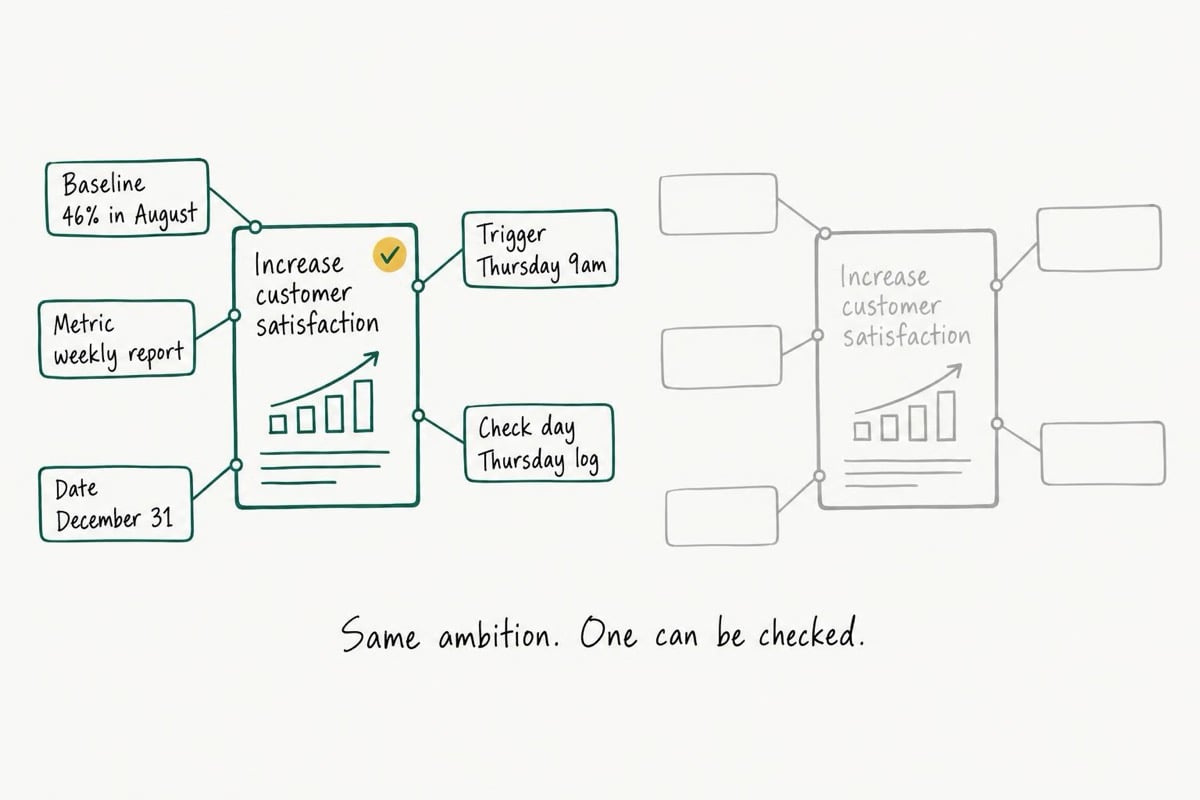
Turn your own objective into one of these in ten minutes
To turn a vague objective into a SMART goal for work, write the vague version down, look up the baseline in the tool that already holds it, set the target against the quarter you will actually have, name the owner, write the trigger as a when-then, and pick the check day. That is ten minutes for one goal. If you want the wider view of sequencing several of them, our goal planning strategies guide covers the layer above this one.
- Write the vague version first. "Get better at delegating" is a real intention and a useful starting point.
- Find the baseline. Open the tool that already holds the number: the helpdesk report, the CRM, last quarter's close calendar. A number you looked up is one you can defend in the review.
- Set the target against your actual quarter, not your best one. Count the weeks you lose to holidays, hiring or a known launch. A target built on thirteen clean weeks is one you will probably miss in a quarter that has nine.
- Name the owner. If the sentence starts with "we," write which part is yours.
- Write the trigger as a when-then. "When the Monday board closes, then I log the ticket count." Pick a slot that already exists rather than inventing one, which is where time blocking does the unglamorous work.
- Pick the check day and the place the number gets written. Same day, same document, every week.
If you have five goals to write, do the first properly today and schedule the rest. One goal with a baseline and a check day gives you something to act on next week; four tidy sentences give you something to reread next quarter, which is closer to the reason most goals quietly fail than discipline is.
The review version and the version you actually run
Write two versions of every work goal. The review version goes on the form: assignable, dated, tied to a number the business already tracks, and written for a reader who will spend ninety seconds on it. The running version lives where you work, and carries the trigger, the check day and the log with the weekly number in it. Same goal, two readers. Collapsing them into one document is why goal season feels like theatre.
Take the form version seriously anyway. Gallup reports that 14 percent of employees strongly agree that the performance reviews they receive inspire them to improve, though the published figure carries no stated sample or sampling frame, so read it as a signal rather than a precise estimate. [6] It is still the record read when a promotion or reorg is decided. Keep the running version in one place with the last eight weeks visible, and let the form version summarize it.
Keep the acronym in proportion while you do it. A narrative review of SMART goals in physical activity promotion concluded that the acronym is not based on scientific theory, is not consistent with empirical evidence, is applied inconsistently, and is not used as originally intended. [7] That critique is about one domain and does not mean SMART is useless at work. It means the acronym is a formatting checklist for a sentence, and the behavior change comes from the baseline, the trigger and the check day, not the letters.
When the quarter blows up
When a quarter breaks, a work goal usually dies one of three ways: quietly abandoned, heroically defended until the team burns out, or renegotiated in January when it no longer matters. The fourth option has to be written before the trouble arrives. Give every goal a floor version, the smallest result that still counts, and a rule for resuming the check after a missed week.
Consider a hypothetical. Dana manages support and owns example four, first-reply resolution from 46 to 60 percent by December 31. In week six, two of her five agents resign within ten days of each other and the goal is unreachable. This is where the floor version earns its place. Dana's floor: hold 46 percent, do not let it slide, and keep the Thursday check running even when the number is flat.
The check day is the part that can survive a bad month. A metric you are still looking at is one you can restart in November; one you stopped opening in October gets rewritten from scratch in February. Naming the floor before the quarter breaks also spares you the negotiation with yourself, which is the same move as the recovery loop that keeps discipline from collapsing after a missed week.
Resist the urge to raise the target to compensate. With two people down, the honest move is a learning target: what the team works out about triage this quarter, rather than a number nobody can reach. For anyone rebuilding several areas of life at once, the recovery rule matters more than the target, which is the same reason staying consistent turns on what you do after a missed week rather than on how the plan looked in week one.
Two numbers to check before Friday
Before Friday, open your current goals and count two things: how many have a starting number you could look up today, and how many have a day of the week attached. Not a deadline, a check day. If the first count is zero, that is the ten minutes to spend this week, because everything else depends on the baseline. Goals without a check day turn up at the next review unchanged, and still manage to be a surprise.
Neither count proves anything on its own. What they tell you is which of your goals is operable this week and which is still a sentence, and that is the line between smart goals examples for work that stay on a form and ones that change a week. Fix the baseline and the check day on one goal and let the rest wait until the form is due. If yours are a competing-hours problem rather than a wording problem, long-term versus short-term goals is the better starting point, and for targets outside work our examples of personal SMART goals covers the non-work half of the question.


