

Starting over after divorce at 50 can make an ordinary Tuesday feel strangely unfamiliar. The mortgage login changed. Dinner is for one. Friends do not know whether to invite both of you. Your work still expects the competent version of you, while sleep, money, home, family, and identity all seem to need decisions at once.
The pressure to “make a fresh start” arrives quickly. New apartment. New body. New social life. Maybe a new career. It sounds hopeful until the whole list becomes another demand.
You do not need to reinvent everything while the floor is still moving.
A steadier order is possible: protect the practical floor, rebuild a week you can trust, then test who you want to become through small, reversible choices. Grief can run beside that work. It does not have to finish before you pay a bill, ask for help, or take a walk.
If you are in immediate danger, contact local emergency services. If a partner or former partner frightens, monitors, threatens, or controls you, the National Domestic Violence Hotline offers confidential safety planning by phone, chat, or text. Do not announce a plan or try couples counseling when safety is uncertain. For a mental-health, suicide, or substance-use crisis in the US, call or text 988 or use the 988 Lifeline. Neither service replaces local legal advice.
Starting over after divorce at 50 means rebuilding in layers
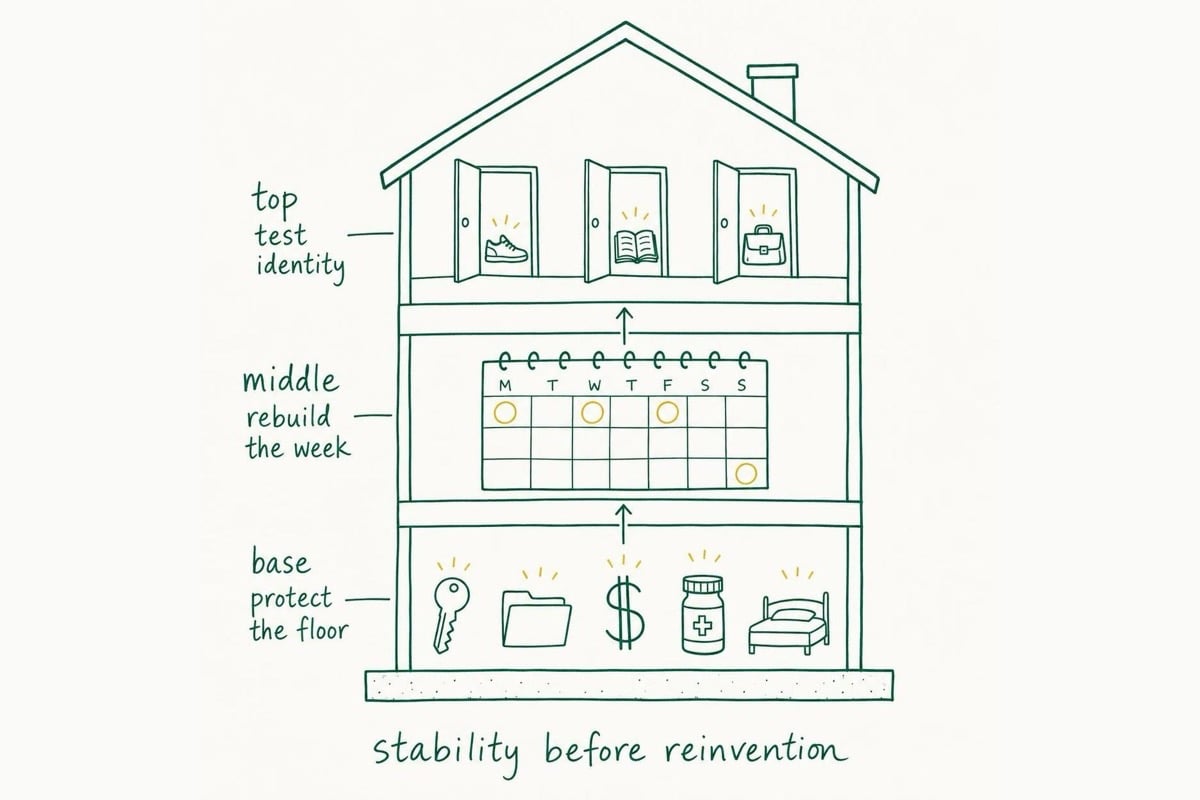
Starting over after divorce at 50 works better as a layered rebuild than as one dramatic reinvention. First protect the floor: safety, housing, cash access, legal deadlines, insurance, medication, and sleep. Then rebuild a workable week with a few reliable anchors. Only after that do you test larger identity choices about work, home, friendship, love, and purpose. Stabilization is not surrender. It creates room for better decisions.
Call this Stability Before Reinvention. It applies the Full Life Framework to health, family, work, money, purpose, and leisure while protecting the time, energy, and decision capacity used to rebuild them. This is an editorial application, not a proven intervention. Our broader guide to starting over at 50 treats change as a rebuild from an existing foundation.
The three layers reduce risk, give necessary actions a predictable place, and let you explore what fits before another permanent commitment. The sequence matters more than speed.
Why trying to reinvent everything at once backfires
All-at-once reinvention asks your most stressed mind to make the largest number of high-stakes choices. Research does not show that stress ruins every decision. A systematic review found inconsistent effects across 18 studies, with differences appearing more often in uncertain economic tasks than in hypothetical everyday ones. A separate meta-analysis found that acute stress can disrupt parts of executive control, depending on the task and timing. Smaller decisions are a safeguard, not a verdict on your ability.
Uncertain decisions compete for limited attention.
This is where the fresh-start fantasy becomes expensive. A new city, relationship, or job could be right. Each also changes several variables while the practical floor is still moving.
Use three labels before acting:
- Urgent: delay creates a safety, legal, housing, health, or financial risk.
- Reversible: you can try it for 30 days without closing a door.
- Identity-level: it changes where you live, how you earn, whom you trust, or what you commit to for years.
Handle urgent items first. Use reversible tests to gather information. Give identity-level decisions enough advice, sleep, and distance to become actual choices rather than exits from pain.
Use a life audit to see the wider domains, not to make another repair list tonight.
Step 1: Protect the floor
Protecting the floor means securing the parts of life where delay can create lasting harm: personal safety, stable housing, access to money and documents, legal deadlines, health coverage, prescriptions, joint debts, and reliable sleep. This is triage, not a complete financial or legal plan. Put each open issue into one of four columns: urgent, this month, needs a professional, or can wait. Then work only from the first three.
Money deserves sober attention. A US longitudinal study of divorce at age 50 or older found average declines in standard of living of 45% for women and 21% for men, measured by income-to-needs ratio. Wealth fell by roughly half for both groups. Those are model-based averages, not your forecast, and the study cannot prove divorce alone caused every change. They do show why money belongs near the front of the sequence. [3]
Start with facts:
- Download current statements for accounts you can lawfully access.
- List every name attached to an account, title, loan, lease, policy, or bill.
- Map one bare month of required expenses.
- Record every legal, enrollment, tax, and payment deadline.
- Put property, support, pension, tax, beneficiary, and retirement-account questions in the professional column.
A divorce decree does not automatically end responsibility to a creditor on a joint account. Removing a name from a title also does not remove a borrower from a mortgage or auto loan, according to the Consumer Financial Protection Bureau. [4]
If you are starting over after divorce at 50 with little cash, begin with safety, document access, deadlines, and the bare-month map. The Legal Services Corporation finder can locate funded civil legal-aid organizations by city or address. Eligibility and family-law services vary, and a listing does not guarantee representation. A qualified local family-law professional, tax professional, or financial adviser can address your facts. This article cannot.
Later, life planning in your 50s can reconnect money with health, work, family, and time.
Step 2: Rebuild a week you can trust
A trustworthy week does not require a perfect routine. It needs four anchors: one block for divorce and household administration, one action that protects your body, one reliable person you can contact honestly, and one period when recovery is allowed to be unproductive. Put each anchor at a specific time. The aim is not to fill the new space. It is to stop every necessary task from arriving as a fresh decision.
An anchor can be modest:
- Tuesday at 6 p.m.: 45 minutes for forms, statements, and questions.
- After lunch: a 15-minute walk or the movement your clinician says is appropriate.
- Thursday evening: a call with one friend who can listen without taking over.
- Sunday morning: two hours with no divorce admin, dating profile, or self-improvement project.
This is where an if-then plan helps. “If it is Tuesday at 6, then I open the divorce folder for 45 minutes” gives an action a cue and a boundary. In a meta-analysis of 29 experimental studies involving 1,636 participants in clinical and analogue mental-health samples, implementation intentions improved goal attainment. The effect was large after one extreme outlier was removed, but it does not promise the same result for divorce recovery. It supports the format, not the outcome. [5]
Do not make sleep another score. Use these healthy sleep habits, and talk with a health professional if sleep loss persists or disrupts daily functioning.
Give your reliable person one job: listen for 20 minutes, join an appointment, compare two housing options, or check that a form was sent. If asking feels selfish, people-pleasing habits may be turning support into a debt you think you must repay immediately.
You know what to do. Let the week hold some of it for you.
Step 3: Test the person you are becoming
Identity after divorce is better tested than declared. Instead of deciding who the “new you” must be, run one small, reversible experiment for 30 days. Try a class, change one room, reconnect with one friend, volunteer twice, explore a role, or spend a Saturday somewhere you chose. Keep the experiment small enough that a disappointing result becomes information, not another collapse. Your next identity can be assembled from evidence.
A prospective study of 109 divorcing adults found that people rated as more self-compassionate when discussing their separation also reported less emotional intrusion at the start and up to nine months later. The study was observational. It does not prove that self-compassion causes recovery, but it supports dropping the courtroom voice you may be using against yourself. [6]
Self-compassion here is not “everything I do is fine.” It sounds more like this:
This is hard. Some choices will be clumsy. I can correct a choice without turning it into a character judgment.
Use that sentence when an experiment disappoints you. Janet, 52, signs up for a Saturday hiking group and hates the group, the pace, and the forced introductions. The experiment did not fail. It ruled out one version of the future.
Glen, 54, moves the dining table on his first weekend alone, then moves it back. That is useful too. Reversibility gives preference a chance to speak without demanding a permanent identity.
If the larger question is purpose, start with finding purpose in midlife, not a promise to become a completely different person by next spring. And if an ex-partner remains controlling or frightening, identity experiments wait. Read the safety guidance in our article about leaving a toxic relationship and contact a specialist service from a safe device.
What the first month can look like
The first month is not a deadline for feeling better. It is enough time to reduce a little uncertainty. Week one can expose urgent risks. Week two can give admin and health actions a home. Week three can add one precise request for support. Week four can review what still carries risk and choose one reversible identity experiment. Progress means the next decision is clearer, not that the divorce feels finished.
Here is how Janet might use the sequence.
Week one: She makes the four-column floor inventory. A retirement-account question moves into “needs a professional.” A lapsed auto-pay moves into “urgent.” Choosing a new city moves into “can wait.” She books one legal consultation rather than spending six evenings searching conflicting answers.
Week two: She creates a Tuesday admin block, a short walk after lunch, a Thursday call with her sister, and a protected Sunday morning. She misses the first walk. Nothing restarts. The next lunch is another cue. Our guide to consistent habits in midlife explains why a floor beats a streak when life is unstable.
Week three: She asks her sister to take notes at a housing appointment, then changes one account password she is authorized to control. She makes no dramatic declaration.
Week four: She reviews the inventory. The urgent column is shorter. Two professional questions remain open. She chooses one identity experiment: four Saturday mornings in a ceramics studio. The class may become a practice, a friendship, or nothing. Any answer is useful.
For Glen, the risk may be isolation, the support request a weekly breakfast, and the identity test one meal he likes. The order still protects how he learns what fits.
When progress feels slower than it should
There is no verified clock for emotional or financial recovery after divorce. A two-year study of 308 people after long marriages found several adjustment patterns, from resilience to enduring difficulty, rather than one normal path. Financial recovery depends on income, housing, assets, debt, support, retirement timing, health, and local law. Compare your present with your own risk and functioning, not someone else's month count.
That answer matters if you still love your former partner. Affection does not settle whether a relationship was workable, safe, or repairable. Nor does missing someone require contact today. Let repeated behavior, agreements, safety, professional advice, and your own values carry more weight than one intense evening.
Do not use the framework to postpone help. If low mood, panic, sleep loss, substance use, or inability to handle daily tasks persists or worsens, contact a qualified mental-health professional. If you are in crisis, use 988. If safety is uncertain, use the National Domestic Violence Hotline or a local specialist from a safe device.
Do not use busyness to avoid grief. The goal is not old-style work-life balance, only enough structure to keep one painful domain from knocking down the others.
Make one floor-protecting move today
One floor-protecting action is enough for today. Download a statement. Write down a deadline. Refill a prescription. Ask one qualified professional a precise question. Tell one reliable person what kind of help would reduce uncertainty this week. Then stop. Starting over after divorce at 50 does not require a performance of courage. It requires a safer next decision, followed by another when you have the facts.
Protect the floor before you redesign the house.


