

Why Menopause Sleep Problems Feel Different From Ordinary Bad Sleep
Menopause sleep problems show up at both ends of the night: harder to fall asleep, and harder to stay asleep. In the Study of Women's Health Across the Nation, which followed 3,045 women who were 42 to 52 at enrollment, the odds of both kinds of trouble rose across the menopausal transition [1]. The nights repeat. Nothing else in your life has changed. That combination is the tell, and it is why generic sleep advice bounces off.
For plenty of women the staying-asleep half is the louder one, and it has a familiar shape. Asleep by eleven without much trouble. Awake at 2:40, damp, kicking the covers off and then pulling them back. Awake again at 4:15. Up at six anyway, because work does not care.
By Thursday you are short with people you love and rereading the same email four times. A secondary analysis of ten years of that same cohort found insomnia symptoms in 31% of women in early perimenopause in the first year, rising to 39% by year ten, and in 32% of women in late perimenopause rising to 48% [2]. Those are self-reported symptoms occurring at least three times a week, not diagnosed insomnia, and they move around by stage and year. Still, you are not the outlier you feel like at 3 a.m.
And you have started to dread the bed itself. That part is new, and it matters more than any supplement on your counter.
Why the Usual Natural Remedies Keep Failing You
Natural remedies for broken midlife sleep usually fail because they arrive as a list of eight options with no order, no mechanism, and no grading of the evidence. Melatonin is the clearest example. Pooled across four randomized trials in menopausal women, the effect on sleep quality was not statistically significant [3]. That means uncertain, not disproven, which is not what the label on the box suggests.
Valerian is not in better shape. An umbrella review in 2024 pulled together eight systematic reviews of valerian for sleep disturbance and judged the evidence weak or inconclusive, with no evidence of efficacy for insomnia [4].
So you try one, give it two weeks, feel nothing, and quietly decide the problem is you. It isn't. You were handed a shelf and told to guess, which is a poor way to treat menopause insomnia, a problem with at least three separate causes.
Menopause Sleep Problems Are a Wake-Up Pattern, Not One Problem
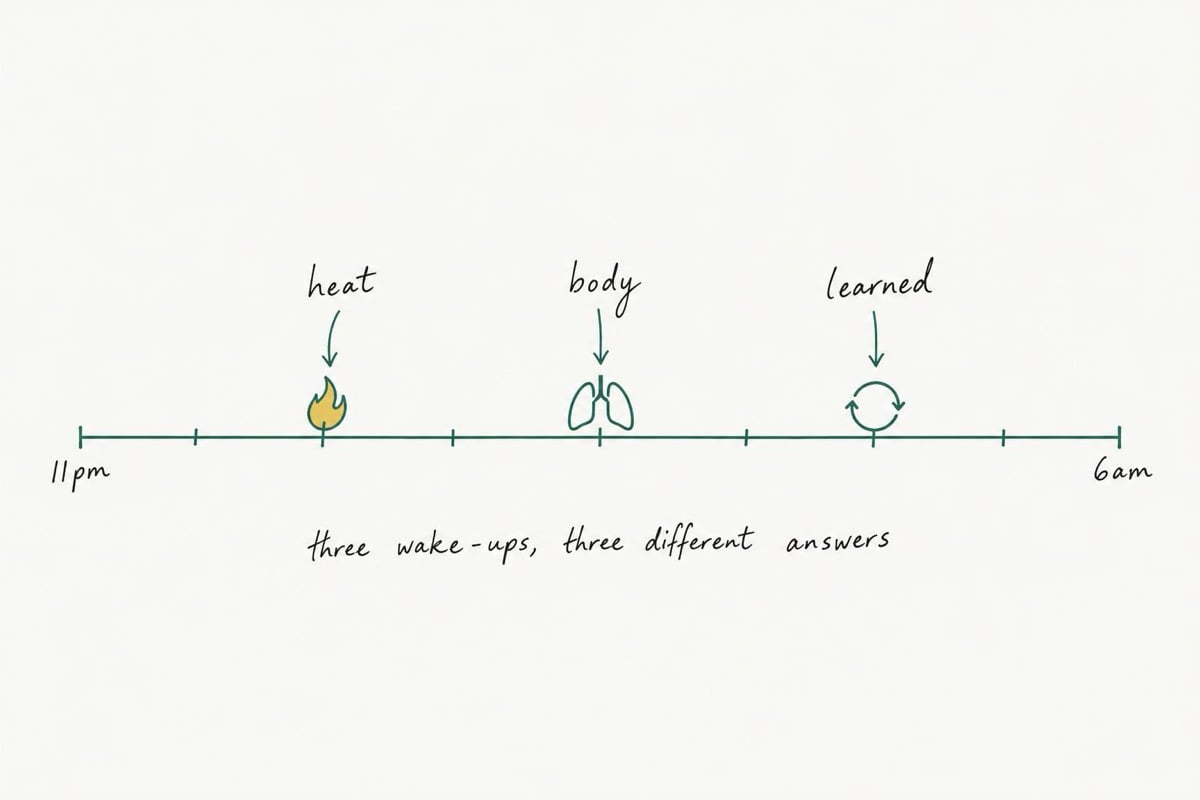
Menopause sleep problems are not one problem. They are at least three different wake-up patterns wearing the same symptom: heat-driven waking, body-driven waking from something like disordered breathing, and learned waking that outlives the flashes. A remedy aimed at one pattern does little for the other two. Working out which pattern owns most of your nights is what turns a remedy list into a decision.
Heat-driven waking is the one everybody pictures, and it is real. In 168 midlife women monitored with actigraphy, 78% of objectively recorded nocturnal hot flashes coincided with a wake episode, and women were far more likely to be awake in the five minutes after a flash than in the minutes before it [5]. Concurrence is not proof that every awakening starts with a flash, but the link is hard to argue with.
Body-driven waking is the pattern that gets missed. In the Sleep in Midlife Women Study, the adjusted apnea-hypopnea index was about 31% higher after menopause than before it [6]. That is a measure of breathing events, not a count of new apnea diagnoses. What makes it worth knowing is how it presents: women with obstructive sleep apnea often show up in primary care reporting insomnia, fatigue and low mood rather than snoring, which is one reason the condition goes undiagnosed in women [7].
Learned waking explains why some women are still awake at 3 a.m. two years after the flashes faded. The bed became the place where you lie there doing arithmetic about tomorrow. That is not a hormone problem anymore, and it is the pattern with the best-evidenced non-drug treatment behind it.
Sorting the nights into these three groups is our own organizing device, not a clinical classification, and real weeks mix them. It is useful anyway, because each group points at a different next step.
Natural Remedies, Ranked by the Evidence Behind Them
Ranked by the strength of the evidence behind them, the natural remedies for menopause sleep problems fall in this order: cognitive behavioral therapy for insomnia first, regular exercise second, supplements a distant third. In a randomized trial of 106 midlife women with frequent hot flashes and insomnia, telephone-delivered CBT-I improved insomnia severity by about 5.2 points more than a menopause-education control at eight weeks, and the gains held at 24 weeks [8]. No supplement has evidence in that range.
The ranking is ours. The evidence under each tier is not.
First: CBT-I, which is a treatment, not a tip
CBT-I is a short structured course of behavior change, usually four to eight sessions, delivered by a clinician, a trained therapist, or a guided digital program. It works on the mechanics: one wake time you hold every day, time in bed cut back to roughly the sleep you are actually getting, getting up instead of lying there awake, and dismantling the 3 a.m. thought loop.
It is also what professional guidance points to first. The American College of Physicians recommends CBT-I as the initial treatment for all adults with chronic insomnia, a strong recommendation on moderate-quality evidence, with medication as a shared decision if CBT-I alone does not work [9]. That guideline covers adults with chronic insomnia in general rather than menopause specifically. The trial above is the closer match: its participants were midlife women with frequent hot flashes and insomnia.
One caution that matters. The American Academy of Sleep Medicine recommends the full multicomponent version of CBT-I and suggests against sleep hygiene as a stand-alone treatment [10]. So the tidy list of dark-room, no-screens, no-late-coffee habits you already follow is not the treatment. It is the floor. If you want the other floor items, our guide to fixing a broken sleep schedule and the notes on foods that keep you awake at night cover them properly.
Second: exercise, with an honest effect size
Pooled individual-participant data across four MsFLASH trials found exercise reduced Insomnia Severity Index scores by 2.1 points relative to control, while CBT-I produced the largest effect at 5.2 points [11]. Two points is a real improvement and a modest one. Worth doing, not worth expecting it to carry the whole load.
Keeping the movement going through a bad month is the harder part, and the recovery loop we use for midlife consistency is built for exactly that.
Third: supplements, with their evidence attached
We are not giving doses, and we are not recommending any of these. Here is what the evidence says, which is what the remedy lists leave out.
- Melatonin. Not statistically significant for sleep quality across four trials in menopausal women, as above. Uncertain, not disproven.
- Black cohosh. One small placebo-controlled trial with 42 completers reported a mean 15.8% reduction in time spent awake after falling asleep [12]. One small trial is a signal, not a green light.
- Soy isoflavones. A 2018 systematic review of herbal medicine for peri- and postmenopausal sleep found six soy sleep trials, only two of which contributed data to its pooled estimate. The reviewers judged the evidence inadequate to draw conclusions, particularly for soy [13].
- Valerian. Weak or inconclusive across eight systematic reviews, with no evidence of efficacy for insomnia, as above.
Supplements interact with medications and with each other, so run any of them past your clinician or pharmacist first. If you want the general-purpose version of this territory, we have separate pieces on natural sleep aids and vitamins and minerals linked to sleep.
A note on the cool-bedroom advice
Almost every article on this subject tells you to cool the bedroom, and we could not find controlled evidence that room temperature treats menopausal insomnia. What we did find is a sense of the scale involved: in one controlled study in healthy adults, warming the skin of the trunk and upper legs by less than a degree Celsius shortened sleep-onset latency by about three minutes [14]. That study was not about menopause and not about cooling, so it neither backs the advice nor refutes it. Absence of good evidence is not the same as evidence against. Keep the fan and the breathable bedding, because a night sweat is less miserable when you are not trapped in flannel. Treat them as comfort rather than treatment, and do not expect a thermostat to fix a 3 a.m. thought loop.
What One Week of This Actually Looks Like
In practice, a week of this looks boring. You pick one wake time and hold it, Saturday included. Each morning you write down three things: when you woke, whether heat was involved, and whether anything about your breathing came up, from snoring your partner noticed to feeling wrecked all day. You stop adding interventions. By day five the log, not a supplement label, tells you which wake-up pattern owns your nights.
Two hypothetical readers, built to show the fork rather than drawn from anyone real.
Tricia is 49 and in early perimenopause. Her log shows four wakings in seven nights, three of them with sheets she had to change and a fan she turned on, and nothing in the breathing column. Heat-driven, clearly. Her week is not eight changes. It is one fixed wake time at 6:15, a walk most days, breathable bedding, and a note in her phone for her next appointment listing how many nights a week the flashes wake her. She is not buying anything.
Tricia's log also does something quieter. It converts "I never sleep anymore" into a sentence a clinician can work with: four nights out of seven, three with night sweats, for eleven weeks.
Marlene is 54 and two years past her last period. Flashes are mostly gone. She is still awake at 3:10, and her log shows no heat at all and a habit of lying in bed for 90 minutes composing tomorrow's to-do list. Her breathing column is not empty, though. Her husband has mentioned snoring twice, and she has been falling asleep in front of the television by eight. So her week produces two next steps, not one: ask her doctor about CBT-I for the learned pattern, and raise the snoring and the daytime sleepiness in the same appointment rather than assuming they are just tiredness. In the meantime she gets out of bed when she has been awake 20 minutes, instead of staying there teaching her brain that bed is where you think.
Both of them keep the log for one week before changing anything else. That single rule saves the usual mistake, which is starting magnesium, blackout curtains, a new pillow and a sleep app in the same week and learning nothing from any of them. If you have already watched a good plan collapse by Wednesday, the way consistent habits in midlife actually stick is worth reading alongside this.
One more thing neither of them does: treat this as a referendum on their discipline. Broken sleep in the 40s and 50s tends to arrive alongside everything else that is shifting, and we have written separately about what a female midlife crisis actually looks like and why you can feel exhausted no matter how much you sleep.
When This Needs a Clinician, Not a Remedy
Some of these nights are not remedy problems. Loud snoring, breathing that stops and starts, gasping or choking noises, and always feeling very tired during the day are all listed as main symptoms of sleep apnea by the NHS, whose advice is to see a doctor about any of them rather than work down a supplement aisle [15]. So is sleep trouble that has run at least three nights a week for three months or more, which is the frequency and duration threshold the American Academy of Sleep Medicine describes for chronic insomnia [16].
We do not diagnose anything and we do not prescribe. What we will say plainly is that "it's just menopause" is the assumption most likely to cost you a year. The apnea research above is the reason: insomnia, fatigue and low mood are exactly how sleep-disordered breathing tends to present in women.
Hormone therapy is worth raising in that appointment, and it is a decision for your clinician rather than something this article can settle. The North American Menopause Society's 2022 position statement describes hormone therapy as the most effective treatment for hot flashes and night sweats, and notes sleep improvement where the sleep disturbance is tied to those symptoms [17]. It is not a stand-alone insomnia treatment, and whether it fits you depends on an individual benefit-risk assessment. If anxiety at bedtime is the loudest part for you, our piece on sleep anxiety and insomnia is a reasonable place to start while you wait for the appointment.
Start With One Night, Not Eight Changes
Pick your wake time before you pick a remedy. Tonight, put a piece of paper by the bed and give it three columns: the hour you woke, whether heat was part of it, and anything about breathing or daytime sleepiness. Do that for seven nights, hold one wake time, and change nothing else. That is the entire first step. No purchase, no app, no new routine stacked on top of the one that already fell apart.
That log is the cheapest diagnostic tool you have, and it is what turns the natural remedies for menopause sleep problems from a shelf of guesses into a short list of two or three worth trying. It also gives your clinician something better than "I'm not sleeping."
If broken sleep is one of several things that stopped working at once, the free Life Rebuild Score will show you which area to steady first.


