

Greg is eating dinner, answering a work message, and moving his father's cardiology appointment because it conflicts with his daughter's school conference.
Nothing in that sentence is optional. That is what makes the usual slow-living advice so irritating.
He is 47. He cannot move to a cottage, quit the job, delete every app, and spend Tuesday morning making bread. He has a mortgage, a team, two teenagers, and a father who now needs a second set of ears at medical appointments. The life he has will not pause while he builds a calmer one.
Slow living is not a slower speed for every task. The choice is what gets your full attention and what has to wait. Harvard Health describes it as doing things with greater focus and purpose at the right speed, not simply doing less. [1]
That distinction gives working adults a way in. You don't need an empty calendar. You need fewer parts of life trying to occupy the same minute.
Slow living is not an empty calendar
Slow living means choosing the right pace for the thing in front of you. Some work needs speed. A family conversation does not. A genuine emergency gets an immediate response. An inbox usually does not. The academic version of this idea uses the musical phrase tempo giusto: the right tempo, fast when speed fits and slow when attention matters. [2]
The popular imagery hides that practical definition. Search for slow living and you get linen shirts, ceramic mugs, rural kitchens, and mornings with no visible obligations. Lovely. Also useless at 5:42pm when the project is late and your mother needs a ride.
A large share of people your age cannot clear the board even if they want to. A 2025 national survey of people caring for adults over 50 found an average caregiver age of 52 and an average commitment of 26 hours a week. More than one in four also cared for a child. [3] Those figures describe caregivers, not everyone in midlife. But they explain why a lifestyle built around abundant free time excludes exactly the reader who needs a workable version.
Slow living also differs from intentional living. Intentional living asks, "What deserves a place in my life?" Slow living asks, "What deserves this minute?" One chooses direction. The other controls traffic.
And traffic is the problem.
The real problem is task traffic
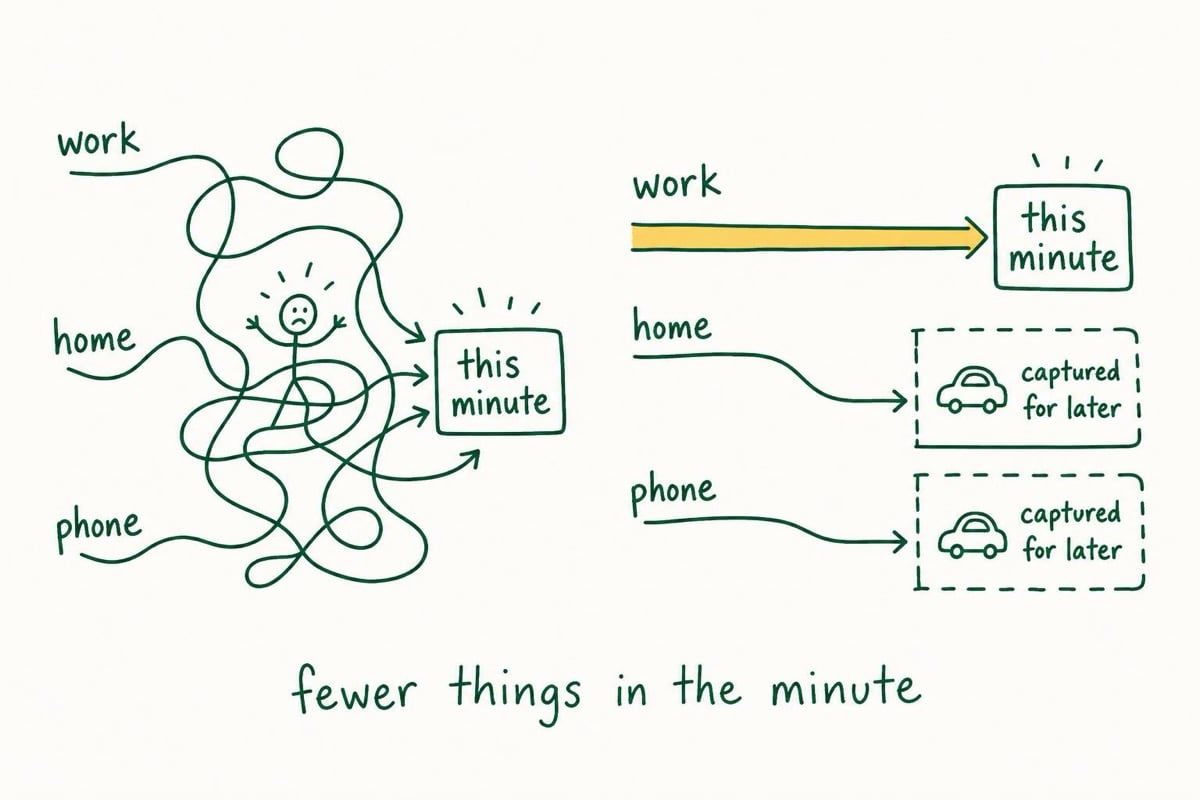
Most people try to slow down by moving the same number of obligations at a gentler speed. That fails because speed is not the main cost. Overlap is. Work, home, and the phone keep entering the same minute, so no part of life ever receives a clean turn.
We call the alternative the One-Lane Rule: one activity gets the minute. Everything else waits, gets written down, or leaves.
The rule sounds almost childish until you look at what task switching does. In one study, 20 crew members living through NASA simulation missions logged 477 real task transitions. In a second experiment, 346 participants switched from a firefighting simulation to a construction task. Across both, thoughts from the prior task carried into the next one, reducing engagement and performance. The researchers call this attention residue. [4]
Sophie Leroy's original experiments found the residue gets worse when the first task remains unfinished. Completing a task did not erase the problem in every condition, which matters because a tidy checklist is not a magic shield. [5]
The research supports a cognitive cost. It does not prove that one lane will make you peaceful, happier, or less ambitious. What it does explain is Greg's dinner. He is not doing three things at once. He is doing one thing while carrying two unfinished things in his head, then switching the foreground every 40 seconds.
A four-lane highway works because the cars move in parallel. A human mind does not. Put work, family, logistics, and messages into one minute and you have not built a highway. You have built an intersection with no lights.
Build one slow lane before you slow a life
Starting slow living does not require a new morning routine. Pick one recurring block of 30 to 60 minutes, remove one source of traffic, give the block clear edges, and leave a little space after it. One lane is a test. A redesigned life is a fantasy project until the test holds.
1. Choose the block that is being stolen
Do not start with the easiest hour. Start with the one whose loss annoys you most.
Maybe dinner keeps turning into a status meeting. Maybe Saturday breakfast disappears into errands. Maybe the first hour at work gets shredded by chat notifications, so the work that matters starts at 4pm. Choose one.
Greg chose dinner, 6:30 to 7:15pm, four nights a week. Not because family dinner solves everything. Because work had quietly occupied it for three years, and he was angry every time he surrendered it.
2. Remove one input
Slow living begins with subtraction, not a ritual.
Greg did not add breathing exercises, candles, or a gratitude journal to dinner. He put the work phone in a drawer in the hall. One input gone. His personal phone stayed because his father's care facility might call. The rule fit his real obligations instead of pretending they did not exist.
If saying no to the input feels harder than losing the block, the live problem may be people-pleasing, not time. Fix the request boundary rather than decorating the hour.
3. Give both edges a job
A lane needs an entry cue and a stop condition.
"When the plates go on the table, the work phone goes in the hall. When the kitchen is reset, the phone can come back." Concrete. Observable. No debate at 6:27pm.
Specific plans can improve follow-through in some settings. In a randomized field experiment with 3,272 employees, asking people to write a vaccination date and time increased uptake by 4.2 percentage points over the control group. A date alone produced a smaller, non-significant change. [6]
But a plan is not enough. Another field experiment asked 877 gym members to choose workout days and times for two weeks. The planning group did not visit more often than the control group. [7] A calendar entry cannot overpower a bad environment. Pair the plan with a removal, like the phone in the hall, or the old traffic returns.
4. Leave ten minutes unclaimed
Do not park another demanding task against the end of the lane. Leave ten minutes.
This is margin, not leisure. It gives your attention somewhere to settle before the next switch. Put dishes away. Walk around the block. Sit in the car before going inside. The activity matters less than the absence of a new claim.
Research on 35,375 Americans found a curved relationship between discretionary time and wellbeing: too little tracked with stress, while large amounts could also track with lower wellbeing when they reduced a sense of productive purpose. The study does not supply one ideal number for everyone. [8] The useful target is enough margin, not maximum emptiness.
What slow living looks like on a Tuesday
A Tuesday-compatible slow life still contains deadlines, grocery bags, a rescheduled appointment, and somebody asking where the charger went. The difference is not the contents. The parts stop piling into each other.
Before the One-Lane Rule, Greg's evening looked efficient from a distance. He joined a 6pm call from the car, carried it through the front door, read email during dinner, cleaned the kitchen while replaying the call, then opened the laptop because he had not heard half of it. By 9pm, work had consumed three hours without receiving one clean hour.
After the rule, the 6pm call still happened. He ended it in the driveway and wrote three loose ends on an index card before entering the house. Dinner held one lane. At 7:25pm, he reopened the card and spent 35 focused minutes closing the two items that could not wait. The third moved to Wednesday.
He did not work less that Tuesday. He worked with fewer collisions.
Carla, 51, needed a different version. Her mother's medication reminders arrive unpredictably, so a phone drawer would be reckless. She gave one contact permission to break through Do Not Disturb, left care alerts on, and silenced work. Her lane was not interruption-free. It was protected from the interruptions she could control.
That qualification matters. A system that breaks under one emergency is not a system for midlife. Build for the real floor, which is the same principle behind staying disciplined and consistent when a week goes sideways.
Use three questions to design your lane:
- What deserves the whole minute? Name the activity, not the value. "Dinner with Carla" beats "be present."
- Which input can leave? Remove one controllable source of traffic.
- What may still interrupt? Name the exception before it happens.
That is a routine. Not the photogenic kind. The kind that survives Tuesday.
Protect the edge, not the whole week
One defended edge can matter more than a generally calmer intention because recovery requires mental distance from work, not just fewer hours on a timesheet. Start with one evening or one block. Protecting an entire week invites negotiation. A named edge gives the mind a place where work reliably ends.
A meta-analysis of 91 samples and 38,124 employees found psychological detachment from work associated with less exhaustion and fatigue, better sleep, and higher life satisfaction. The links with exhaustion and fatigue were much stronger than the average link with task performance, which was only r = 0.09. [9] These studies are mostly correlational, so detachment is not a guaranteed cause. Still, the pattern tells you what the edge is for: recovery, not squeezing more output from tomorrow.
This is where slow living parts company with toxic productivity. If you protect the hour only because it will make the next hour more productive, work still owns both.
Message batching offers a useful warning too. In a Dutch financial-services company, assigned email batching reduced interruptions and briefly lowered emotional exhaustion. Work engagement did not change, the effects faded, and the setup worked best where instant replies were not expected. [10]
So do not announce that you check email twice a day if your role runs emergency operations. Set an edge your work can actually respect: no routine replies during dinner, chat closed for the first 45 minutes of the day, or one meeting-free block on Friday morning. The right boundary beats the dramatic one.
When slow living feels irresponsible
Slow living will feel irresponsible if speed has protected your income, reputation, or family for twenty years. That feeling is not proof that the old pace still works. It proves only that the old pace once had a job.
Some objections are real. Your manager may punish delayed replies. Two jobs may leave no clean evening. Care may arrive without warning. No personal framework turns structural overload into spaciousness, and we will not pretend otherwise.
In those cases, stop asking how to make the same load feel slower. Ask which load changes.
A life audit can expose the domain that is taking more than it gives. Work-life balance after 40 starts with defending a floor when equal balance is impossible. If you are already depleted, check the burnout recovery stages before turning slow living into another assignment.
The contrarian part is simple: slow living cannot be another thing you do well. The moment you track it as a streak, perfect the routine, and compare your calm to somebody else's kitchen, you have imported hustle culture into a quieter room.
Start with one lane tonight
Write four lines on a card:
- Lane: Dinner, 6:30 to 7:15pm.
- Entry cue: Plates on the table.
- Stays out: Work phone in the hall.
- Exception: Calls from Dad's care facility.
Run it once. Notice what tries to enter.
Put the card where tonight's lane begins. When the cue arrives, let one activity have the minute.