

How do you cope with a parent's death?
Coping with a parent's death takes two kinds of work, and they run on different clocks. Grief is the first: the crying in the car, the phone you still reach for on Sunday afternoon. The second is quieter. Your parent occupied real space in your week, your family, and your sense of who you are, and that space is now empty. Most advice covers the first kind and skips the second.
You handled the first two weeks, probably. You picked the readings, found the insurance policy, answered a stranger's question about an urn. People said you were holding it together, and you were, because there were decisions in front of you and decisions you know how to do.
Then the casseroles stopped. The group text went quiet. Work expected you back.
And your calendar still has a recurring reminder at 6pm on Tuesday that says "call Mom."
That is the part nobody prepares you for. Not the funeral. The Tuesday.
The hard part arrives after the admin ends
The early weeks run on adrenaline and logistics, and both run out. Clinical accounts of acute grief in adults describe shock and disbelief in the first days, agitation peaking around the second week, and low mood peaking around four to six weeks, after which the sharpest pain tends to arrive in waves set off by reminders rather than sitting on you constantly. [1]
The measured peak comes early. What shows up later is a different problem, and this part is our read rather than a research finding: the estate work thins out, the people who checked in stop checking in, and you are left with an ordinary week that has holes in it. Nothing is acutely wrong. The week simply does not work anymore.
The spread between people is wide. One study that tracked bereaved adults for 27 months after a death found most had low symptom levels throughout or climbed and then eased inside the first year, while roughly a quarter stayed high the whole time. [2] If you are still struggling at month eight while your sister seems steady, you are inside the range, not outside it.
And if you cannot hold your attention at work right now, that is expected this early, not evidence that you are failing at this.
You lost a person and a structure
The most familiar map of grief is a staircase of stages, and we have published that version too. The research that helps most here describes something different. The dual process model of bereavement, set out by Margaret Stroebe and Henk Schut, describes coping as a back-and-forth between loss-oriented work, which means confronting the death itself, and restoration-oriented work, which means handling everything the death changed: new tasks, new roles, a new identity, the plain business of daily life. People oscillate between the two, and they also take time off from both. [3]
Read that second list again. A large part of adjusting to the death of a parent is not emotional work at all. It is logistics, roles, and identity.
Now notice what people ask you. "How are you holding up?" That is the loss side, and it is the only side anyone brings up. Nobody asks what your Sunday looks like now. Nobody asks who decides about the house, or what you are supposed to write now in the box marked emergency contact.
Here is how we would break down the empty space. A parent occupies four things, and each empties out separately:
- Hours. The calls, the visits, the appointments, the driving.
- Rhythm. The Sunday phone call, the birthday, the standing Saturday lunch.
- Role. The job you held in the family: the one who handles things, the buffer, the translator between siblings.
- Identity. Being somebody's child, with a generation still above you.
That four-part split is ours, not a clinical model. We use it because it turns fog into a list you can work. The feelings part of coping with a parent's death cannot be scheduled. These four holes can.
Rebuild the week in five moves
These five moves are the restoration half of coping with a parent's death, in the order we would take them. None of them asks you to feel better first, and none of them is a substitute for grieving. Start with whichever is breaking soonest.
1. Put the paperwork in a box with a lid
Estate admin expands to fill whatever you give it, and it is seductive because it feels productive while asking nothing emotional of you. Give it two fixed blocks a week, two hours each. Outside those blocks the folder stays shut.
Know what your employer actually owes you, because the gap surprises people. Federal law in the US does not require bereavement leave at all: the FMLA covers your own serious illness and caring for a sick relative, not mourning one. Most employers offer something anyway: SHRM reported that 91% of surveyed employers provided paid bereavement leave in 2023. As of 2024, five states mandate it: California, Oregon, Illinois, Maryland and Washington. Oregon requires up to two weeks per death at employers with 25 or more workers. [4] Benefits surveys put the typical company allowance at about five days for an immediate family member. [5]
Five days does not cover a death. Negotiate the shape rather than the size: four scattered half-days over two months beat one solid week in the first fortnight, because the appointments and the bad afternoons arrive later than the funeral.
2. Write down what they occupied
Take the four holes and make them concrete, with numbers where numbers exist. Which recurring slots are now empty? What job did you do in this family, and does anyone still need it done?
If you were one of your parent's caregivers, write down your own number; it is usually larger than you remember. Calls, appointments, pharmacy runs, the driving. Whatever it came to, it ended on a day's notice. For how common that load is and what it costs, see our piece on caregiver burnout; grief and burnout can land stacked on each other, and the relief mixed into your sadness is not a betrayal.
3. Refill in the order things break
Not in order of importance. In order of failure speed.
Sleep and food usually go first, and everything else gets harder when they do. Put those back before you think about purpose. Then the empty recurring slot, because a blank Sunday at four will find its own use for you. Then the role, which takes months and at least one awkward conversation with your siblings.
4. Build a floor week, and a rule for restarting
Write down the smallest version of your week that still counts as holding: a wake time, one meal you cook, one walk, one person you talk to. That is the floor. In a bad week you do the floor and nothing else, and that counts as a win.
Then set the resume rule before you need it. When you miss, you restart at the next scheduled slot. No make-up sessions, no waiting for Monday. The floor and the resume rule are our own practice rather than a research finding, and they exist because the usual failure here is not laziness. It is one missed week turning into an abandoned routine.
5. Keep one thread on purpose
The instinct is to put the photographs away, because looking at them hurts. But keeping a connection is part of adjusting rather than a failure to move on. Research on continuing bonds describes an ongoing inner relationship with the person who died, carried through rituals, objects and memory, and finds it works as comfort when it stays internal, rather than keeping the person present as though no death happened. [6]
So choose one thread and keep it deliberately. Cook his stew when the weather turns. Leave her birthday on the calendar and do something specific that day. A ritual you chose is easier to carry than an ambush in a grocery aisle.
What the first eight weeks can look like
What follows is a hypothetical, not a reader or a client, built to show what coping with a parent's death looks like week by week.
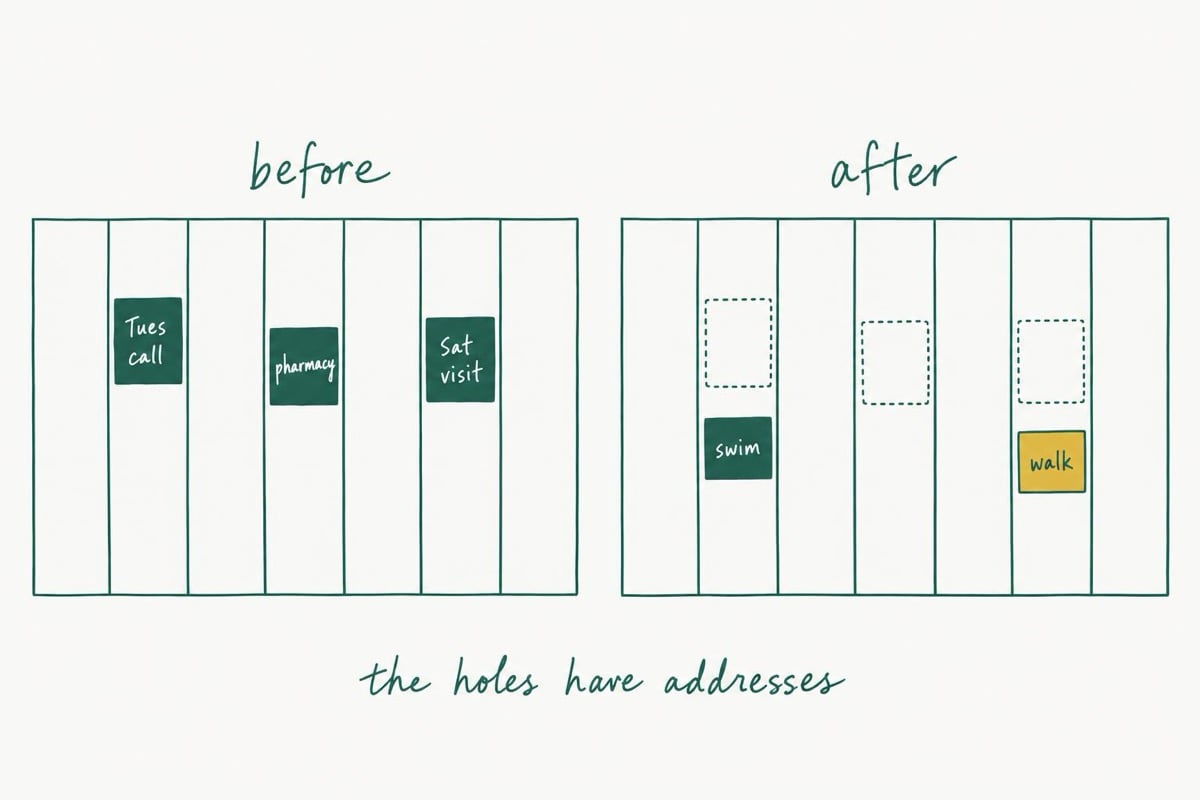
Cheryl is 52, works in hospital procurement, and her mother died in March after four years of slow decline. Her brother Dale lives three states away. For the last two of those years, Cheryl's week held a Tuesday evening phone call, a Saturday afternoon visit, and a pharmacy run on the way home: about six hours, plus the standing mental tax of being the one who noticed things.
Weeks one to three are funeral, account closures, and the house. She takes three half-days and feels competent.
Week five, she cannot concentrate, snaps at Dale about a dresser, and sleeps badly. Her Tuesday evening is empty, so she spends it scrolling listings for a house she does not want to sell.
What she does next, written down:
- The box. Estate calls move to Monday and Thursday, 7pm to 9pm. The folder stays shut otherwise.
- The inventory. Six hours. Two recurring slots. Role: the one who notices. Identity: somebody's daughter, now the oldest in the line.
- Refill, in order. Lights out at 10:30 and a standing grocery order come first. The Saturday visit slot becomes a 90-minute walk with a friend, because an empty slot takes company more easily than discipline. Tuesday at six becomes a swim class, chosen because it is loud and nothing like a hospital room.
- The floor. Up by seven, one cooked dinner, one walk, one real conversation. In the week of her mother's birthday she does the floor and nothing else, and that is the plan working rather than failing.
- The thread. Her mother's recipe box stays on the counter, and she cooks from it on the first Sunday of the month. Dale gets a photo of whatever came out.
By week eight Cheryl is not finished. She is sleeping, two anchored slots in her week belong to her, and the fights with Dale are about furniture instead of about who cared more.
Is this just scheduling your way around the grief?
It would be, if structure were all you did. Rebuilding the week processes nothing. It gives the grief somewhere to happen that is not the middle of a workday, and keeps your life from quietly shrinking while your attention is elsewhere. Both halves count, which is the dual process model's point: the loss side, the restoration side, and the swing between them.
So keep the loss side on purpose. Talk about her. Cry in the car. If you want that half as a first-person account rather than a plan, our article on working through grief was written by someone who lost both parents in the same week. If sitting still with it feels impossible, meditation for grief is one way in.
When it is more than grief
Prolonged grief disorder is a real diagnosis and a minority outcome. The DSM-5-TR criteria require at least 12 months since the death for an adult, with intense yearning or preoccupation present nearly every day for at least the past month, plus at least three symptoms from a list that includes identity disruption, disbelief, avoidance of reminders, intense emotional pain, and being unable to re-engage with activities or people. [7] Prevalence estimates move with the algorithm used: a 2024 comparison put DSM-5-TR rates at roughly 5% to 7% of bereaved adults, and about 2% at population level. [8]
Do not treat the 12-month line as a waiting room. If you cannot work, cannot eat, are drinking your way through the evenings, or are having thoughts of not being here, tell a doctor this week. In the US you can call or text 988 for the Suicide and Crisis Lifeline.
The one thing to do this week
Open your calendar and find the recurring slot that belonged to them. Tuesday at six, Sunday at four, whatever it was. Do not delete it. Put something in it this week, something that involves another person and does not require you to feel good first.
That is the whole first step. The inventory, the floor week and the thread can wait for a quieter afternoon.
If the holes run wider than one slot, and work, health and money all feel like they are drifting at once, the free Life Rebuild Score will tell you which one to rebuild first. And if this death also started you thinking about who will handle all of it for you, growing old with no family nearby is the planning version of the same problem.


