

An unhappy marriage at midlife is rarely one thing. It is usually three things stacked: pace mismatch (you are rebuilding faster or slower than your partner), identity drift (one or both of you has become someone neither of you signed up for), and chronic resentment (years of small unspoken trades that compounded into distance). Before you decide whether to stay, leave, or pause, ask which of these three is doing the most damage. The answer to one of them is usually obvious. The answer to all three is the rebuild you are not naming yet.
This is a life rebuild, not a life hack. And the marriage is often the part of it people name last.
A note before you read on. If you are experiencing domestic violence, addiction, or an untreated mental-health crisis inside your marriage, the diagnostic frame in this article does not apply. Those situations need a clinician, a crisis line, or a domestic-violence resource, not a self-directed method. If you are in the US and in crisis, dial 988 (Suicide and Crisis Lifeline). For domestic violence, call the National Domestic Violence Hotline at 1-800-799-7233. What follows is for the much more common case: a marriage that has worn down, drifted, or fallen out of sync, not one in acute danger.
Question 1: Are You and Your Partner Rebuilding at Different Paces?
Start here, because pace mismatch is the most common midlife marriage problem that gets misdiagnosed as something worse. One of you hit a wall at 47 and started changing fast: new routines, new questions, a new urgency about the years left. The other is exactly where they were, and content there. That gap is not betrayal. It is a scheduling problem disguised as an emotional one.
You cannot rebuild yourself faster than your partner can come along, and you cannot wait forever for them either. That tension is the central marriage question at midlife, and almost nobody names it out loud. Different ages, different stages, different speeds. It is the rule, not the exception.
Watch what you actually resent. If the feeling is "they are holding me back" or "I am being left behind," that is pace, not a dead marriage. Pace problems respond to an honest conversation about timelines and a willingness to move in staggered steps. The person ahead slows the visible changes; the person behind commits to one small move. You are not negotiating whether to grow. You are negotiating the speed, so the marriage does not snap under the difference.
Get this one wrong and you will spend a year treating a tempo issue like an irreconcilable one. Plenty of marriages that "ended" were really two people who never said out loud that they were on different clocks.
Question 2: Is This About the Marriage, or About Who You've Become?
Here is the quieter version of unhappy, the one that does not arrive with a fight. You have what you said you wanted. The house, the kids, the career. And you catch yourself thinking, I miss feeling like myself. Or worse, I don't recognize myself. You are often too embarrassed to say either out loud to anyone in your real life.
When that is the feeling, the marriage may not be the problem. It may be the screen you are projecting a self problem onto.
Esther Perel has spent decades on this exact knot: the conditions that build a stable long marriage (closeness, safety, predictability) are the same conditions that can quietly erase your separate self. [1] You did not lose the spark. You lost the person who used to have the spark, somewhere in two decades of being responsible. That is identity drift, and it masquerades as a marriage complaint because your partner is the most available thing to be unhappy at.
The test: imagine the marriage fixed tomorrow, everything warm and easy. Are you still restless? If yes, the work is yours first. This is where an unhappy marriage and a stalled sense of your own purpose get tangled, and untangling them is step one. A marriage rebuild that starts with you, not with them, is not selfish. It is usually the only version that holds. You cannot run a shared life on a self you have let go quiet.
Question 3: Is It Drift, Mismatch, or Chronic Resentment? Each Is a Different Rebuild
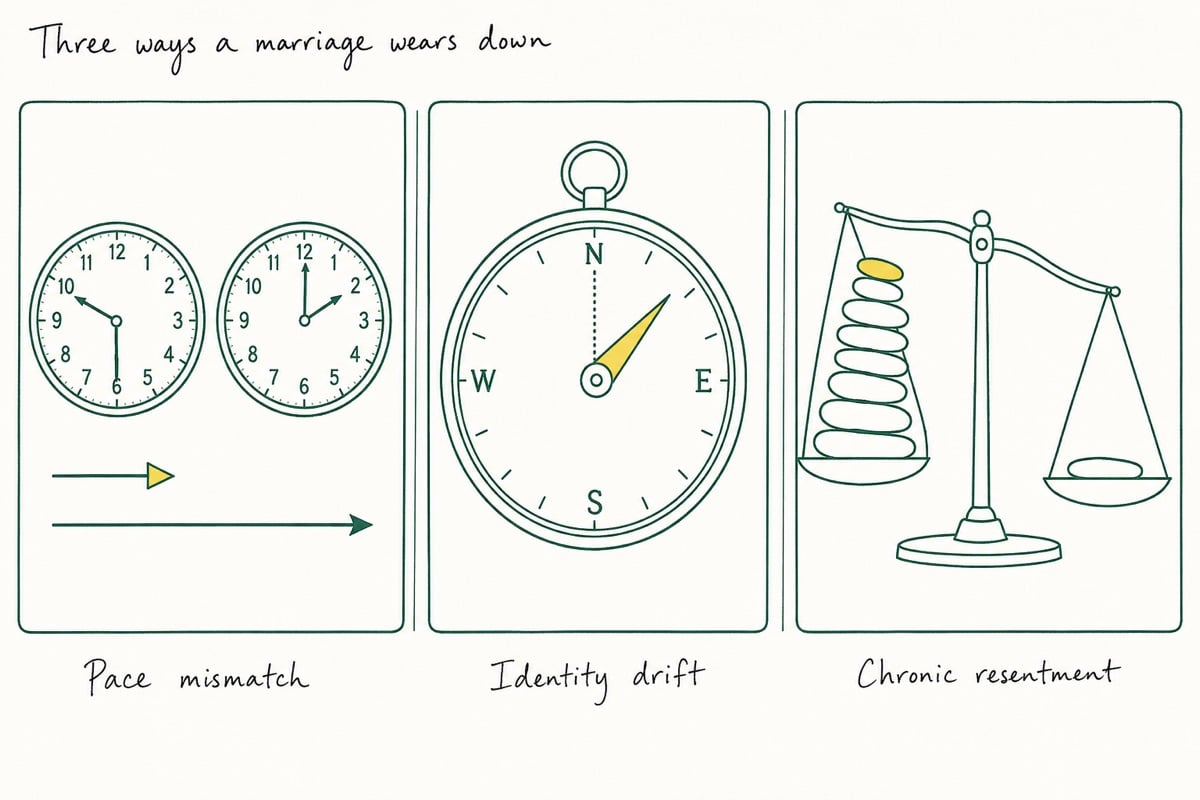
The third question sorts the first two from the one that actually corrodes. Three things wear a marriage down, and they do not respond to the same repair.
Drift is benign neglect. Two busy people stopped tending the thing and woke up roommates. Drift is the easiest to reverse, because nothing is broken, it is just untended. You feel lonely inside the marriage rather than at war.
Mismatch is the pace problem from Question 1, or a values divergence that grew over twenty years. Repairable, but only with explicit renegotiation, not more time.
Chronic resentment is the dangerous one. This is the slow accumulation of unspoken resentment: every swallowed grievance, every "it's fine" that was not fine, compounding into contempt. John Gottman's research names contempt as the single strongest predictor of divorce among what he calls the Four Horsemen (criticism, contempt, defensiveness, stonewalling). [2] At midlife these patterns are not new. They have been compounding silently for fifteen or twenty years, which is why they feel permanent. They are also the clearest of the three signs of a failing marriage.
The answer to one of these questions is usually obvious. The answer to all three is the rebuild you are not naming yet. Name which one is loudest before you do anything else, because the next move depends entirely on the answer.
What the Research Actually Predicts (Before You Decide to Stay or Leave)
People reach for the stay-or-leave decision far too early, usually before they have diagnosed which of the three problems they have. The research is clearer than the advice industry suggests, and it does not point at the door first.
Gottman and Levenson predicted marital stability with high accuracy from how couples handle conflict, not whether they have it. [3] The marker that separated stable couples was a ratio: roughly five positive interactions for every negative one during conflict. [4] Below that line, the marriage erodes. The useful part for you: a 5-to-1 ratio is something you can rebuild deliberately, and it has nothing to do with whether you still feel "in love" this week.
It also helps to know that some of your unhappiness is the calendar, not the marriage. Life satisfaction follows a U-shape across most of the world, bottoming out in the mid-40s to mid-50s before rising again. [5] You are unhappy in the exact decade most people are, married or not. That does not excuse a bad marriage. It does mean you should not hang the entire weight of a life-stage dip on your spouse and call it grounds.
So before stay-or-leave, the move is: stabilize yourself, diagnose which of the three problems is loudest, then choose the pace. Stay-or-leave is rarely the only question, and it is almost never the first one.
The 30-Minute Weekly Conversation That's Smaller Than the Decision
Whatever the diagnosis, the first action is the same, and it is much smaller than the decision you have been dreading. One protected 30-minute conversation a week. Same time, no phones, no logistics talk (the kids' schedule and the bills do not count). The agenda is two questions: what felt good this week between us, and what felt off.
This is the practice underneath every marriage repair worth the name. We call it conscious communication, and it is the thing that runs a rebuild inside a household instead of alongside it. A midlife rebuild done in private collapses. The spouse you do not loop in becomes the obstacle. The standing conversation is how you loop them in without forcing the whole stay-or-leave question onto a single dramatic night.
It works on all three problems. For drift, it is the tending. For mismatch, it is where you renegotiate the pace. For resentment, it is the slow drain valve that stops grievances from compounding into contempt. Rebuild one system at a time, in the right order, and the marriage is usually the system you stabilize before you decide anything permanent.
Inside LifeHack, the most common goal our engaged users write for their relationships is some version of "deepen communication and connection with my partner." Nearly a third of active users name a relationship goal, more than any other area of life. The unhappy marriage is not a niche problem. It is the one most people are quietly carrying while they look productive from the outside.
You're Not Behind. You're at the Rebuild.
If you have read this far, you are not in crisis. You are at the rebuild, and the rebuild lives in your house, with whoever you live with. That is harder than a clean break and also more common, because most midlife unhappiness is not a loveless marriage heading for court. It is a drifted, mismatched, or quietly resentful one that nobody has diagnosed out loud.
This is the same work as any other midlife reset: name the real problem, stabilize, then move one system at a time. The marriage is one of six areas of your life, not the whole scoreboard, and it tends to read clearer once you see it next to the others. If you only do one thing this week, set the 30-minute Sunday conversation. That is the smallest possible first move, and it is smaller than the decision you have been carrying.
Frequently Asked Questions
What to do if you are in an unhappy marriage?
What are the four behaviors that cause most divorces?
John Gottman calls them the Four Horsemen: criticism (attacking character, not the behavior), contempt (mockery, eye-rolling, disgust), defensiveness (deflecting blame), and stonewalling (shutting down and withdrawing). Contempt is the strongest single predictor of divorce. At midlife these are not sudden. They are patterns that have compounded quietly for fifteen or twenty years, which is exactly why they feel like the permanent weather of the marriage rather than a habit you can change.
What is the 3-3-3 rule in marriage?
Is it better to divorce or stay unhappily married?
This is the wrong first question, because it assumes only two options. There are usually five: rebuild the relationship as two people who have changed, separate inside the same house with explicit terms, decide nothing for 90 days while you stabilize yourself first, leave, or stay as-is. Most people skip straight to the last two. Marital quality strongly shapes overall life satisfaction in later years, which is exactly why you should diagnose before you decide. And if the marriage involves abuse, addiction, or untreated illness, this framing does not apply: if you need a therapist for this, you need a therapist. We are for the part of the rebuild that runs alongside whatever you do with a clinician, not in place of it. If you have already worked the diagnosis and the answer is clear, knowing when a marriage is over is its own honest step.


