

The stairs are where you notice it. Halfway up, the breath goes short and one knee files a complaint, and some quiet part of you does the math on how long it's been. The last time you exercised on purpose was a gym membership you let lapse sometime around your second kid, or a couch-to-5k app you deleted after week two. You know you should move more. Your doctor has said it. The back twinges have said it. And yet every time you picture starting, the picture is brutal: a treadmill that humiliates you, sore knees, that out-of-breath feeling at minute three that says you've waited too long.
So you don't start. Another month goes by. The deconditioning that scared you gets one month deeper. This is the real shape of how to start exercising at 50 after you've been sitting for two decades. Not "which workout." It's the gating fear that your body has already closed the door, and that any attempt will just prove it.
It hasn't. The door is open. You're just standing too far back to see it.
Is 50 Too Late to Start Exercising?
No, 50 is not too late, and it isn't close. The fear hiding inside "how to start exercising at 50" is usually "is it even worth trying." Federal health guidelines state plainly that "people can begin or restart physical activity at any age," and that healthy adults who build up gradually usually don't need medical clearance. [1] The "too late" feeling is a story about decline, not a fact about your body. Deconditioned at 50 is a starting line, not a verdict.
Here's what the worry usually hides. You're not afraid of exercise. You're afraid of starting at a level that exposes how far you've slipped, in front of fitter people, and failing publicly. That fear is reasonable after twenty sedentary years. It's also pointing you at the wrong starting line. The gym at full effort was never your first step. It's somewhere around step forty.
The research keeps disproving the timeline you're scared of. One study trained adults who began 59% weaker than younger controls. After six months of resistance work twice a week, that gap shrank to 38%, and the genetic signature of muscle aging itself reversed toward a younger profile. [2] Your muscle doesn't know your age. It knows whether you used it this week. That's the same reason building muscle in your 40s and 50s is not the lost cause people assume, and why movement keeps showing up in nearly every list of habits that increase longevity.
Why Starting at 50 Feels Different (And Why That's Not Your Fault)
How to start exercising at 50 feels harder than at 30 because two true things stack: your body recovers slower than it did then, and decades of sitting have lowered your baseline below where most beginner advice assumes you'll start. So the "easy" routine in the article isn't easy for you. You hit minute three winded and read it as proof you're broken. You're not broken. You're deconditioned, which is a state, not a sentence, and states change with input.
Most fitness advice is written for a 25-year-old who skipped the gym for a year. Not for someone whose last real exercise was the Clinton administration. The advice says "start light." Then "light" turns out to mean a 30-minute jog. That mismatch is why so many midlife restarts die in week one: the floor was set at someone else's height.
And the deconditioned-for-decades body has a specific feature nobody warns you about. It improves fast at the bottom. The people with the lowest baseline fitness make the biggest early gains, because there's so much room to recover. A six-month walking study of previously sedentary women found the largest improvements came from those who started with the lowest scores and the highest body weight. [3] The further back you're starting, the more dramatic your first wins. That's the opposite of the story your fear is telling. If the deeper problem is that life has drifted and the body went with it, this is one piece of starting over at 50, not a standalone fitness project.
The Real Move Is Building a Floor, Not Earning It Through Pain
Here's the reframe, and it's the whole answer to how to start exercising at 50: you don't earn fitness by suffering for it. You build a movement floor your deconditioned body can hit on its worst day, then let consistency compound. It's the same floor method that holds the rest of a midlife rebuild together, pointed at your body this time: a version small enough to survive a bad night's sleep, a sore back, and a packed Tuesday. Suffering doesn't restart a sedentary body. Repetition does, but only if the floor is low enough to clear on a bad day.
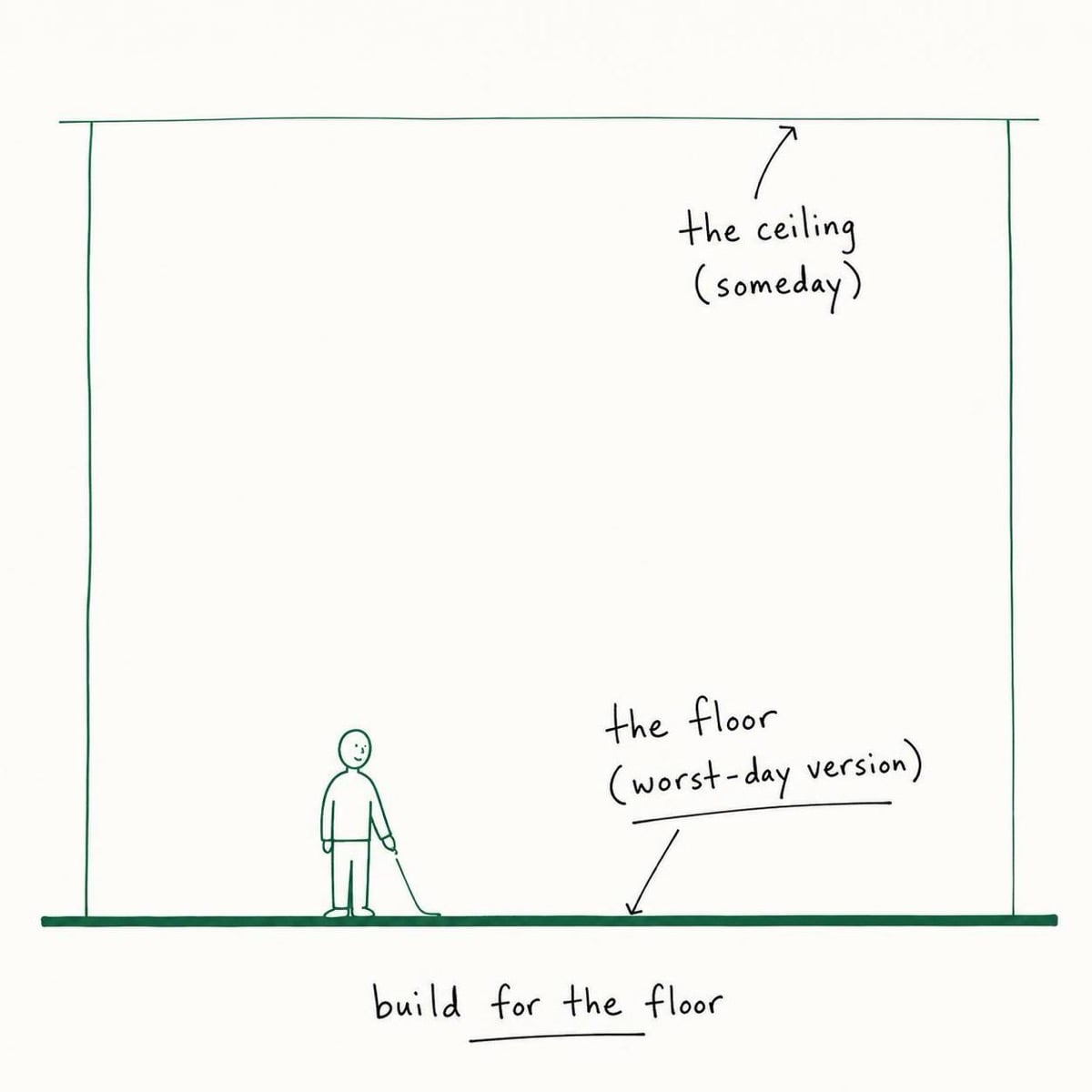
This is where the "no pain, no gain" reflex from your twenties actively hurts you. That slogan assumes a body with deep reserves. Yours is rebuilding reserves it spent years ago. Pain at this stage isn't proof of progress. It's the fastest route back to the couch, because a punishing first week guarantees there's no second week.
The floor has a sequence, and the order matters. Walk first, before any gym, before any class, before any equipment. Walking is also the rare keystone habit that quietly drags other things up with it: appetite, mood, the willingness to get to bed on time. Walking is the lowest-risk, highest-floor movement there is, and the evidence for walk-first restarts is strong: in one program, 74.5% of previously sedentary participants reached normal walking endurance for their age, with a 92% attendance rate, which tells you the floor was low enough that people actually kept showing up. [3] Attendance is the whole game. A perfect program you quit beats nothing by exactly nothing.
What Is the 3-3-3 Rule for Exercise?
There is no single official "3-3-3 rule," but the useful version is a phased walking progression you run in three blocks. A well-tested 12-week protocol does exactly this: weeks 1 to 4, add a short 15-minute walk on three days; weeks 5 to 8, build to 30 minutes on three days; weeks 9 to 12, hold roughly 30 minutes on most days. [4] Three blocks, three steps each, building in threes.
The numbers matter less than the shape: start absurdly small, raise it slowly, anchor it to days not heroics. That structure is what turns a vague "walk more" into something a deconditioned body can actually follow without negotiating with itself every morning. It is the floor logic again, just put on a calendar. You are not chasing a 30-minute walk on day one. You are building the smallest version that survives a bad week, then letting the protocol nudge it up for you so willpower never has to.
And you don't need to hit official targets to benefit. A trial of sedentary 40 to 61-year-olds doing home walking found that even people exercising below the recommended amount dropped their blood pressure by 5 to 6 mmHg and trimmed their waist by about 2.5 cm in 12 weeks. [5] Below the floor everyone tells you to clear, real things still improve. That's permission to start small and mean it. The skill underneath all of this is the unglamorous one: staying consistent with the goal long enough for the body to respond.
What the First 12 Weeks Actually Look Like
When you start exercising at 50 the right way, the first twelve weeks are quiet and almost boring, which is the sign it's working. You walk most days, keep it short, protect the cue more than the duration, and somewhere around week six the same walk stops leaving you winded. After three months you add gentle strength work twice a week, light and progressed slowly. No new identity. One small block of movement, repeated, until it's just what you do.
Picture Devon, 53, a project manager who hadn't exercised with intent since his thirties. His floor: a 10-minute walk after dinner, every day his knees allowed, with a worst-day version of just stepping out the front door for two minutes. The cue was finishing dinner, not a clock. Week one he walked five days. Week two his back flared, so he ran the two-minute floor twice and the full walk the rest. The point is he didn't quit. The floor caught him.
By week six the 10-minute walk felt like nothing, so he stretched it to 20. By week nine he was walking most days without negotiating with himself about it. Only then did he add strength, because the evidence says he should: combining aerobic walking, muscle work, and a bit of balance beats any single type, and multicomponent training cuts fall-related injury risk by about 32%. [6] He started with two short sessions: sit-to-stands from a chair, wall push-ups, a light carry around the kitchen. Bodyweight first. Joint-friendly. Progressed by feel.
The strength side is where "reshape your body at 50" stops being a magazine fantasy and becomes mechanism. Resistance training is the lever that rebuilds the muscle decades of sitting cost you. A 36-week program of personalized, gradually progressed resistance work in older adults produced large gains in grip strength, muscle mass, and walking speed, with the intensity starting low and climbing only as tolerated. [7] You don't reshape your body by punishing it. You reshape it by progressively asking a little more of it than last week, for long enough. Movement here is one domain feeding the others: more energy for work, a back that complains less, sleep that comes easier, which is why it sits inside a broader daily routine built for a real midlife schedule rather than off on its own as "the fitness goal."
This is also the right order for the whole rebuild. Don't bolt on five things at once. Get the walk holding first, let that win pay for the strength work, let the strength work make the better sleep and the steadier energy easier to reach. One system at a time, in sequence, the same way a midlife reset works across every other part of life. Movement is rarely the only thing that drifted, and it's often the most effective domain to rebuild first because it visibly feeds the rest. If you'd rather think in concrete targets, it slots cleanly into a short list of health goals you turn into daily habits.
But What About Your Knees, Your Back, and the Nerve Stuff?
The honest answer: low- to moderate-intensity exercise is one of the safest and most effective things you can do for cranky midlife joints, and in many cases it relieves pain better than the medication you'd reach for instead. In a well-known knee osteoarthritis trial, both walking and weight training reduced pain and disability, with a larger effect on pain than acetaminophen or anti-inflammatories. [8] Movement isn't the threat to your joints. Continued sitting is.
That said, two cautions are real. If you have neuropathy, numbness, or any medical condition, the floor still applies, you just clear it with your doctor first and favor low-impact, balance-supported movement (walking, water, recumbent cycling) over anything that risks an unfelt injury. Will exercise help with neuropathy? Often yes, gently, but that's a conversation for your clinician, not a blog. The other caution is ego. The injury that ends a midlife restart is almost always doing too much, too soon, not too little. Start under what you think you can handle. Your body will tell you when to add. If your knees have flat-out stopped you before, the same logic applies to other midlife restarts that feel physically gated, including the ones in reliving some of your youth after 40.
Where to Put Your First Foot
Pick the smallest walk you're sure you can do today, even on a bad day. Two minutes counts. Ten is plenty. Attach it to something you already do every day (after dinner, after your morning coffee, after you park at work) so you don't have to remember or feel motivated. Walk it once today. That's the entire instruction. Not a gym, not a plan. One short walk, attached to a cue, done once.
That single walk is the floor. Everything else, the longer walks, the strength work, the body that slowly reshapes, is just that floor repeated until it holds, then nudged up a little at a time. You spent decades teaching your body that movement was optional. It only takes one quiet, unimpressive walk to start teaching it something new. Knowing how to start exercising at 50 was never the hard part. Starting smaller than your pride wants you to is. Start there.


