

The alarm still goes off. But now there's nothing pulling on the other end. For forty years the day had a shape someone else built for you: a commute, a calendar, people who needed you by nine. Then it stops. The first few weeks feel like a held breath you finally get to let out. Then the weeks start to blur, and one afternoon you realize you can't remember what you did on Tuesday. Or whether it was Tuesday.
Nobody warns you about this part. Not the pension math, not the physical. The quiet disorientation of a day with no edges. You have the time you spent decades wishing for, and somehow it keeps slipping through your hands. That isn't a character flaw. It's what happens when the structure that carried you for a lifetime disappears in a single week and nobody hands you a new one.
You didn't get lazy. You lost your scaffolding
Here's what makes this genuinely hard, and it has nothing to do with discipline. Work wasn't just work. It was scaffolding. It gave you a wake-up time, a reason to move, a set of people, and a sense that you mattered to something, all bundled together, none of which you had to build yourself. Pull that scaffolding out and the whole day sags, even for people who spent years desperate to retire.
So you try to patch it. You fill mornings with errands that could take twenty minutes and somehow eat the whole day. You buy the gym membership and go hard for three weeks. You tell yourself you're finally going to relax, then the relaxing curdles into a restlessness you can't name by four in the afternoon. None of it sticks, because none of it replaces the thing you actually lost. You didn't lose your to-do list. You lost the frame that held your days upright.
The problem isn't too much free time. It's a day with no spine
The problem was never that you have too much free time. It's that your day lost its spine. A daily routine after 60 isn't a workout plan and it isn't a color-coded schedule. It's a small set of fixed points that hold everything else in place. Get those points right and the open hours between them turn from a void into freedom. Get them wrong, or skip them, and even a calendar full of activities feels like drifting. And if the calendar is already full of anchors and you are still bored in retirement, the missing ingredient is difficulty rather than structure.
Look at what the internet hands you when you search this. Five exercises to do every morning. The best foods for seniors. How many steps to hit. Movement matters, and we'll get to it. But that advice answers a health question when what actually emptied out was your whole day's architecture. It treats your body as the only thing that lost its routine. Your body is one room in the house. The house is the day itself.
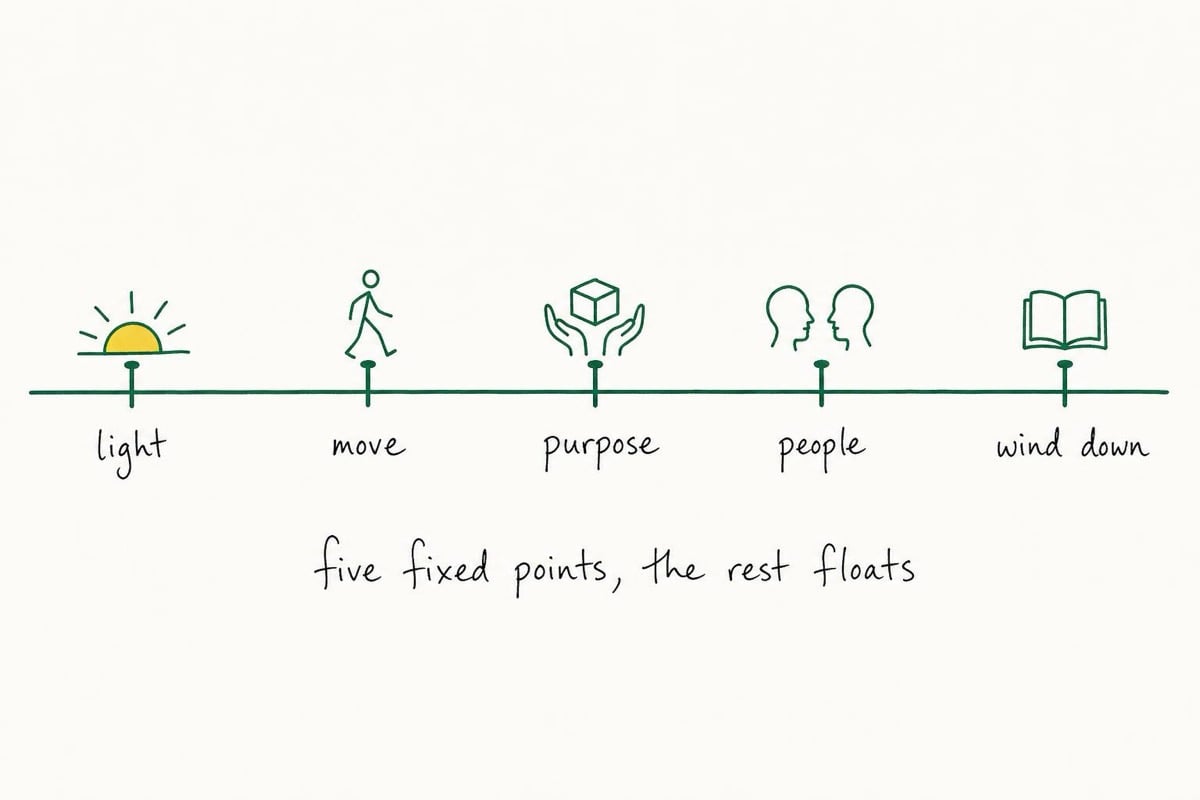
The fix isn't more activities. It's fewer, firmer ones. Think in anchors, not hours. An anchor is a fixed point that happens at roughly the same time every day, no matter what else is going on. You don't plan every minute between them. You set four or five anchors, let them hold the shape of the day, and let the rest float. That's the whole method. It sounds too simple to matter. It's the difference between a decade that feels like yours and one that evaporates.
The five anchors that hold a day together
Five anchors is enough to give any day a spine: a morning launch, one block of real movement, a reason someone is counting on you, a person you connect with, and a wind-down that closes the day. Each one rebuilds a piece of what work used to supply for free, and there were five of those supplies, which is the argument behind finding purpose in retirement. Notice that only one of them is about exercise. The other four are the ones the fitness listicles skip, and they're the ones that decide whether the years ahead feel alive.
Start the morning with light, not your phone
Your body keeps time by cues, and the strongest cue is morning light. As we age, the internal clock drifts and sleep gets lighter, which is why so many people over 60 find themselves wide awake at 3 a.m. and foggy at noon. Morning bright light pulls that clock back into line. One study of community-dwelling older adults found that morning light exposure improved their sleep, and the benefit came specifically from stabilizing their circadian rhythm. [1]
So make the first anchor concrete: wake at roughly the same time every day, and get outside within the first hour. A walk to the end of the street, coffee on the porch, ten minutes in the garden. Light, sleep-wake timing, and daily habits are the main levers that keep an older body's clock steady, and the timing is what matters most. [2] Whatever you do, don't start the day face-down in a phone. A screen an inch from your eyes is not the light your body is asking for.
Put one real block of movement in the day
You don't need the five-exercise morning routine the search results keep pushing. You need one honest block of movement most days. The clearest target comes from the World Health Organization: adults 65 and older should aim for 150 to 300 minutes of moderate activity a week, muscle-strengthening work on two or more days, and balance training on three or more days to stay steady on your feet. [3] The US CDC lands in the same place. [4]
Spread across a week, that's a brisk half-hour walk most days plus a little strength and balance work. And if the numbers feel abstract, here's a simpler one to anchor to: walking. A meta-analysis of fifteen studies found that for adults 60 and older, the risk of dying from any cause kept dropping as daily steps rose, then leveled off around 6,000 to 8,000 steps. [5] You don't need 10,000. You need to move on purpose, once a day, at a time you can count on. If you're rebuilding from a sedentary decade, start smaller and build; we walk through exactly how in how to start exercising at 50.
Give yourself a reason someone is counting on you
This is the anchor the health advice never mentions, and it may be the one that matters most. When you left work, you didn't just lose a paycheck. You lost the feeling of being needed by something outside your own front door. That feeling turns out to be load-bearing. In a study of nearly 7,000 US adults over 50, those with the lowest sense of purpose had more than twice the risk of dying over the following four years compared with those who had the strongest sense of purpose. [6]
Purpose after 60 rarely arrives as a lightning bolt. It's usually something small that someone else depends on: a grandchild you pick up on Wednesdays, a few clients you still consult for, a garden plot at the community center, a board you serve, a book you're actually going to write this time. The test is simple. Would anyone notice if you didn't show up? Build one thing into your week where the answer is yes. If you're not sure what that thing is yet, that's a real question worth sitting with, and we dig into it in how to find purpose in midlife.
See a person, most days
Work handed you people without any effort on your part. You saw the same faces daily whether you liked them or not, and that steady contact was quietly keeping you healthy. Its loss is not a small thing. Across 148 studies covering more than 300,000 people, those with strong social ties had a 50 percent greater likelihood of surviving over the follow-up period, an effect on par with quitting smoking. [7] A national report on older adults reached the same conclusion: isolation and loneliness measurably raise the risk of early death, heart disease, and dementia. [8]
So make connection an anchor, not an accident. A standing Tuesday coffee. A phone call you make every afternoon at the same time. A walking group, a class, or one of these things to do when you retire can create a recurring place where you see the same faces. The point is to remove the daily decision. Left to chance, weeks pass and you realize you've barely spoken to anyone. Put a person on the calendar and the loneliness never gets a foothold.
Close the day with a wind-down that keeps your mind sharp
The last anchor bookends the first. A day with a clear ending sleeps better than one that just trails off into late-night television. Pick a rough time the day winds down, and put something in it that engages your mind rather than numbs it. This is where reading, learning, a hobby with some challenge to it, or a real conversation earns its place. Older adults who stayed mentally engaged declined more slowly: in one long-running study, more frequent cognitive activity was tied to a meaningfully slower rate of cognitive decline. [9]
And this doesn't mean brain-training apps. It means the ordinary things: reading, playing games, doing puzzles, making something with your hands. Research on older adults found that people who did those activities had markedly lower odds of mild cognitive impairment than those who mostly watched TV. [10] A chapter a night beats another rerun. Then a consistent bedtime, so the morning launch has a fighting chance.
What an anchored day actually looks like
Take Marisol, 66, retired last year after three decades as a nurse. Her first months were a mess of good intentions and empty afternoons. Now her day has five anchors, and everything else floats around them. The same idea appears in our best retirement advice from retirees: build an ordinary Tuesday, not only a vacation plan.
She's up by 6:45 and outside with coffee by 7:15, rain or shine, because the light is what keeps her sleeping through the night. Mid-morning is her movement block: a 35-minute walk three days a week, a strength class at the senior center twice. Wednesdays and Fridays she works a half-day at a free clinic, where the staff genuinely need her and the patients know her name; that's her reason someone is counting on her. Her connection anchor is a 4 p.m. call with her sister, most days, non-negotiable. And she winds down by nine with a book, not the news.
Notice what that day is not. It's not full. There are wide-open hours between those anchors, and Marisol fills them differently every day: a museum, a nap, a long lunch, nothing at all. That's the point. The anchors aren't a cage. They're the frame that makes the free time feel like a gift instead of a void. Last month her knee flared and she skipped the walks for two weeks. The other four anchors held, so the whole structure didn't collapse. She just picked the movement back up when the knee let her. A routine you can miss a piece of and rebuild is the only kind that survives real life. If you want the bigger version of this, mapped across the whole decade ahead, we lay it out in life planning in your 50s.
Isn't a routine at 60 the opposite of freedom?
It's a fair worry. You spent your whole working life inside someone else's schedule. Why rebuild a cage now that you're finally free? Because a routine built from anchors is the opposite of a cage. A cage is when every hour is claimed by obligation. A void is when no hour is claimed by anything. Anchors sit between the two: a few fixed points, a lot of open space. Structure isn't what steals your freedom. It's what makes the free time feel like something instead of nothing. The people who thrive in this decade aren't the ones with no routine. They're the ones whose routine is light enough to bend and firm enough to hold.
Where to start this week
Don't try to build all five anchors at once. That's just the color-coded-schedule mistake in a new outfit. Pick one. The morning launch is the easiest place to begin, because it sets up everything else: a fixed wake time and ten minutes of outdoor light, every day for a week. That's it. Once it feels automatic, add the next anchor.
The decade in front of you can be the best one yet, but not by accident and not by filling it with errands. It gets good on purpose, one anchor at a time. Then go outside tomorrow morning and start with the light.


