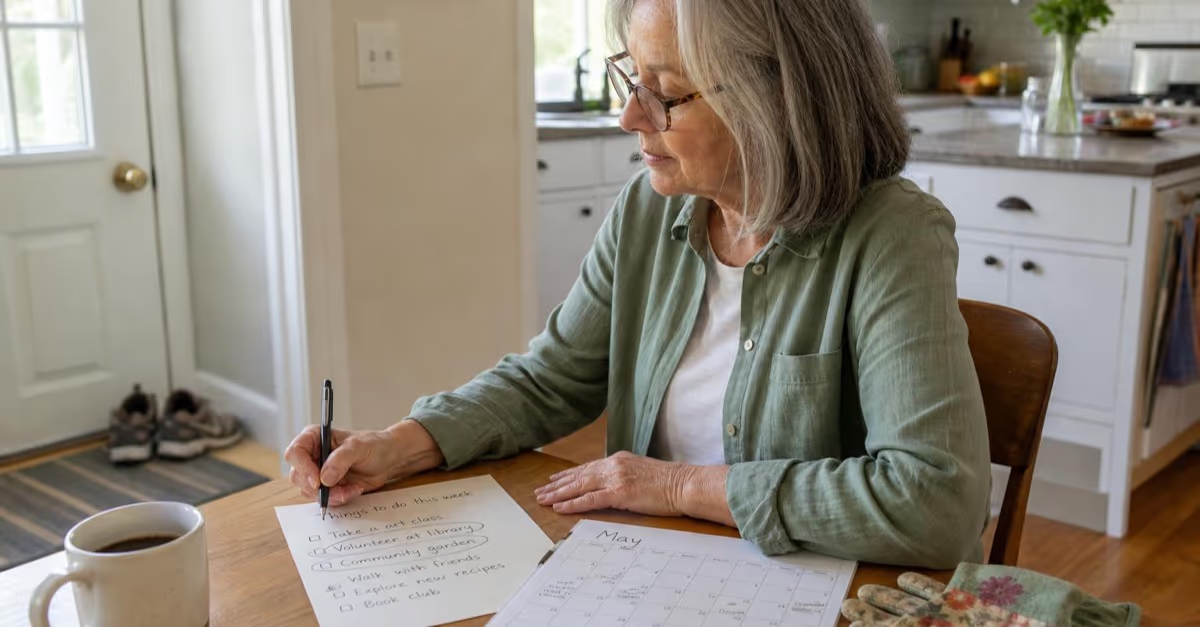
Ray's calendar is full.
Monday is the gym. Tuesday is grandson pickup. Wednesday is the woodworking group at the community center. He walks four miles most mornings, gets through two books a month, and has reorganized the garage twice this year.
He is bored anyway. And he feels like an ingrate for saying so out loud, because the man has his health, his savings and his family, and forty years ago he would have traded a kidney for this schedule.
Retirement boredom is not a shortage of things to do. It is a shortage of things that are hard enough to hold you. Researchers define boredom as the aversive experience of wanting, but being unable, to engage in satisfying activity. [1] Sit with the first half of that. The wanting is intact. What has gone missing is anything worth engaging with, and after four decades of working at the top of your ability, most of what fills a retired week sits well below it.
That is an uncomfortable thing to say to a person who just got their time back. It is also why the standard advice keeps sliding off.
Every list you have read answers the wrong question
Search "bored in retirement" and the internet hands you activities. Pickleball. A class at the community college. Volunteer somewhere. Learn an instrument. Travel while the knees hold. The lists are not wrong, and we have published one ourselves with fifty low-cost hobbies on it.
You have already tried some of them. You did not quit because the activity was unavailable. You quit because three weeks in, it stopped mattering.
Here is what the week fills with instead. As of 2019, Pew's analysis of federal time-use data found Americans 60 and older spent four hours and sixteen minutes a day in front of screens, more than half of all their leisure time. [2] A study that strapped audio recorders and accelerometers to 257 adults over 65 clocked television at about 37% of waking time, roughly 6.4 hours a day, and found those were the hours people were most sedentary and, among those living alone, the hours they were loneliest. [3]
We are not about to tell you the TV is the villain. A four-year study of 1,828 Chinese adults over 60 found frequent radio and television, alongside reading and gardening and cards, tracked with better odds of holding onto successful aging than never doing them at all. [4] Rest earns its keep, and we have argued elsewhere that boredom itself has real uses.
Six hours of screens is not a moral failure. It is what a week collapses into when nothing in it is demanding.
The reframe: peak skill, near-zero challenge
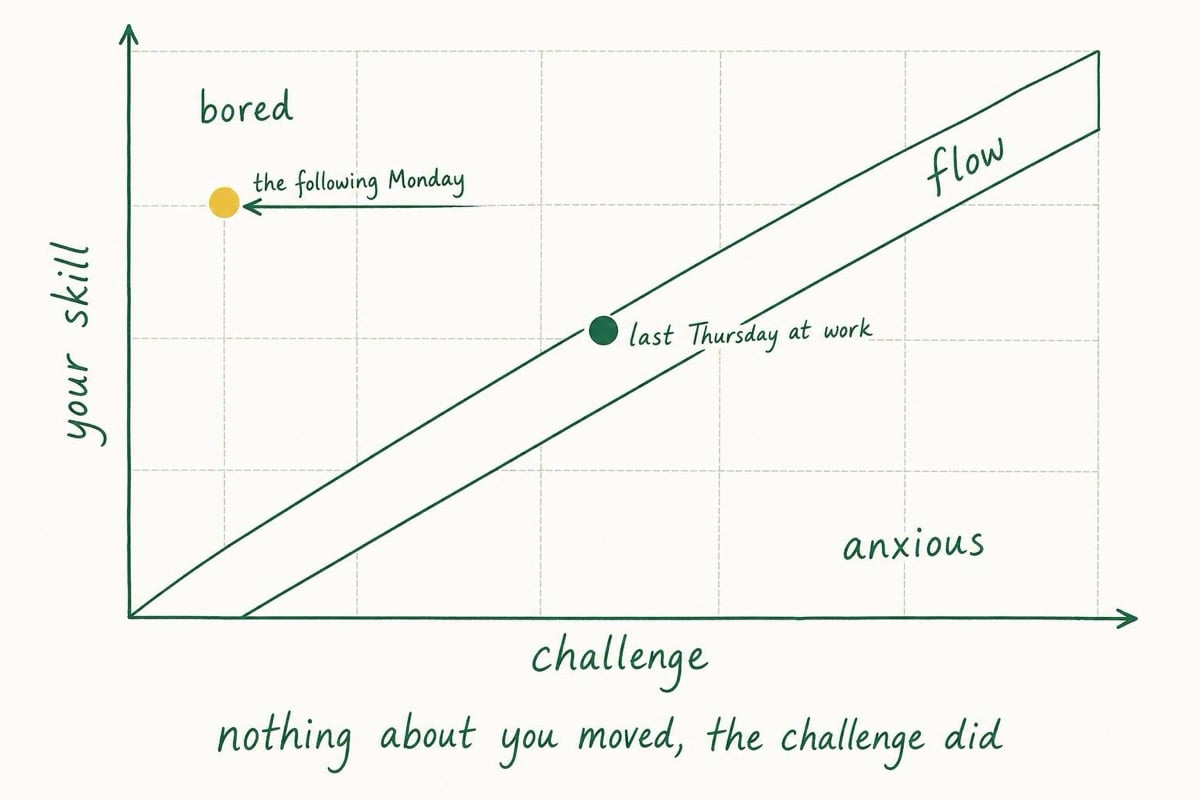
Boredom is a mismatch between your skill and the difficulty of what is in front of you, not a hole in your schedule. In the original quadrant model of flow, anxiety shows up when demands exceed skills, and boredom shows up when skills exceed demands. [5] A review of 252 flow studies found challenge-skill balance to be the most researched precondition in the entire model. [6]
Now hold that against your last day of work.
For forty years your skill ran high and so did the challenge. Deadlines you did not choose. People waiting on an answer by Thursday. A problem every quarter or so that was honestly above your current ability. Then on one Friday afternoon the challenge drops to zero and the skill stays exactly where it was.
You did not lose competence when you retired. You lost everything that required it.
James Danckert's lab at the University of Waterloo puts a sharper point on this. Boredom runs highest at both low and high perceived control, because too much control leaves nothing to push against. [7] Retirement is the most control most people will ever have over a single day of their lives. That is not an unfortunate side effect of the boredom. It is part of the engine.
Which explains why adding activities does nothing. A pickleball league you can already win. A class you could teach. A volunteer shift that asks you to fold flyers. Each one adds an hour and no difficulty at all. You are not filling the gap. You are decorating it.
Two kinds of bored, and they need different fixes
Work out which version you have before you fix anything. People who score high on boredom proneness split into two profiles: apathetic, where the person is unconcerned with what is around them, and agitated, where the person is motivated to do something meaningful and keeps failing to find satisfaction in the attempt. [8]
The agitated version is what this article is for. You want in. Nothing on offer is worth wanting. Ray is agitated bored, and the tell is that he keeps signing up for things. Six months, four new activities, four quiet exits.
The apathetic version is a different animal, and it wants a different response than a harder hobby. We come back to it near the end, and you should not skip that part.
Here is a fair warning about the evidence underneath all of this. Nobody has published a decent estimate of how many American retirees are chronically bored. The largest datasets that measure boredom in older adults are Japanese: two surveys of 5,382 people with a mean age of 82 and 4,124 with a mean age of 66, where boredom proneness correlated strongly with depressive symptoms, loneliness and quality of life. [9] Cross-sectional, so it settles no direction of cause. What it does establish is that chronic boredom after 65 is a measurable thing that travels with worse outcomes, not a character flaw you should be embarrassed to name.
Pastimes fill an afternoon. Pursuits take a decade.
Robert Stebbins spent fifty years on a distinction that has never made it into a retirement article, and it is the most useful thing in this one. He splits leisure into the casual kind, which is short-lived, pleasant and requires little or no training, and what he calls serious leisure: the systematic pursuit of an amateur, hobbyist or volunteer activity substantial enough that the participant finds a career inside it. [10]
Six qualities separate the two: the need to persevere, the availability of a leisure career, the need to put in effort to gain skill and knowledge, durable personal benefits, a unique ethos and social world, and an attractive personal and social identity. [11] The framework has an academic monograph behind it and forty years of studies using it. [12]
Run Ray's woodworking group through those six. He shows up, he cuts what the instructor cuts, he goes home. No perseverance is required because nothing is hard. There is no career in it because year three looks identical to year one. It is a pastime wearing a pursuit's clothes, which is exactly why it never touched the boredom.
The evidence for difficulty as the active ingredient is better than most people assume. In the Synapse Project, adults aged 60 to 90 spent an average of 16.51 hours a week for three months either learning to quilt, learning digital photography, or both. Episodic memory improved in those high-demand conditions relative to the control groups, who either socialized in a group doing nonintellectual activities or worked through low-demand tasks with no social contact. [13] Socializing alone did not do it. Crosswords did not do it. Learning something you were bad at did. [14]
Dose shows up in the contribution research too. Following 12,998 Americans over 50, volunteering 100 or more hours a year, against zero, predicted lower depressive symptoms, less hopelessness, less loneliness and more sense of purpose four years later. [15] Two honest caveats: the study is observational, and volunteering showed no association with life satisfaction or with diagnosed depression. In a British sample of 3,740 people at or past pension age, the benefit of volunteering stopped for the people who stopped volunteering. [16]
Two hours a week of something easy is a pastime. A hundred hours a year of something that asks for your whole ability is a different category of week. If you need a wider field before choosing what to deepen, use these retirement activities as trials, not permanent commitments.
Three ways to raise the difficulty of what you already do
You do not need a new list. You need to make one thing on the current list harder in a way that cannot be quietly abandoned on a Wednesday. Three moves do most of the work, and each one bolts onto something you are already doing.
Add a standard you cannot currently meet. Ray stopped attending woodworking and committed to a hall table with hand-cut dovetails, a joint he had never managed. His first four attempts went in the burn pile. He is not bored on Wednesdays anymore, and he has been mildly annoyed for six weeks, which is a better state than the one he was in.
Add an audience. Joanne, a retired school administrator, had been reading three novels a month, alone, with nothing on the other side of it. She now runs a book group of nine at the library and writes the discussion questions. Same reading. Nine people who notice if the questions are lazy. That is a standard she cannot lower on a slow morning.
Add a deadline you did not set. Register for the county fair show, the recital, the 10K, the exhibition, the certification exam. A date you do not control is the closest civilian equivalent of a Thursday deliverable, and it is the single fastest way to put challenge back into a week that has none.
Then narrow. Five shallow activities generate less engagement than one you are three years into and still not good at. If the thing that clears the bar turns out to be paid work rather than a hobby, that is not a failure of retirement, and encore career ideas or starting a business at 60 are worth reading before you dismiss it. If you cannot tell which part of your week is worth deepening, run a life audit first.
One caution about sequencing. If your days have no shape at all, difficulty will not stick to them. Start with this retirement advice for building an ordinary Tuesday, then use the daily routine after 60 guide to make it repeatable. Boredom and a missing sense of purpose are also not the same complaint, and if what you feel is closer to "none of this counts for anything," start with finding purpose in retirement instead.
When it isn't boredom
Boredom and depression are related but not the same, and getting this wrong costs people years. Boredom proneness correlates with depressive symptoms, and researchers still separate the two: boredom is not a milder form of depression but a distinct state and disposition. [17] The plain-language test the National Institute of Mental Health uses is persistence plus impact: everyone feels low sometimes and it passes, while depression is severe enough to interfere with sleeping, eating and working. [18]
The apathetic profile from earlier is the one to watch. If nothing appeals, rather than everything appealing and falling short, that is not the challenge deficit this article describes.
How common is depression after 65? There is no single representative American number, and anyone who hands you one has picked a definition and not told you which. Analysis of federal survey data separates the two quantities cleanly: among adults 65 and older, 2.8% had an episode of major depression in 2021, while 13.2% had clinically significant symptoms of depression in 2020. [19] Both figures are real. They count different things, and the gap between them is where most people live.
Say the next part to your family, because so many households get it backwards. Depression in older adults is a widespread problem, it is not a normal part of aging, and it is often not recognized or treated, in part because fatigue, appetite loss and poor sleep get read as ordinary getting older. [20] If the flat feeling has held for more than two weeks, if sleep or appetite has changed, if the things you used to enjoy no longer register at all, that is a conversation with a doctor and not a project for a harder hobby.
"I earned the right to take it easy"
You did. Nothing here says a retired week should feel like a job, and the case for rest is not in dispute. But the version of ease being sold to retirees is a week with no resistance in it, and that is precisely the state the flow research says produces boredom. Easy and satisfying are not the same setting.
The honest objection is the second one: at 68, is it reasonable to be bad at something in public? The Synapse participants were 60 to 90, and they spent three months being visibly incompetent at quilting and photography in front of strangers. That was the condition that worked. The comfortable groups, the ones who socialized or did crosswords, got much less out of it.
And the discomfort is not permanent. It converts. Curing boredom in general is mostly about attention, but after retirement it is specifically about difficulty, and difficulty has a short half-life. Six weeks of being bad at dovetails is not six years.
There is no clock on this
Retirees are told about a honeymoon that gives way to a slump, as if it arrives on schedule. Nobody can tell you when your boredom is due, because there is no shared curve. Growth mixture modeling across two national samples of about a thousand retirees each found three coexisting patterns of psychological wellbeing after retirement, meaning retirees split into subgroups that improve, decline or stay flat rather than moving through one common sequence. [21]
So month four means nothing about you. Neither does year three. The useful question is not how long this lasts. It is whether anything in your current week is actually hard, because if the answer is no, waiting will not change it.
Be bad at something again
Pick the one activity you would miss most if it disappeared. Find the version of it you are not good enough for yet. Sign up for something with a date on it by Friday.
Being bad at something again is not a step backward. For most retirees it is the first hard thing in years, and hard is what has been missing.