

The question always lands a little sideways, usually at a party. "So what are you going to do now?" You just closed out a career you spent thirty-five years building, and the honest answer is you have no idea. What you do know is the short list of things you don't want. You don't want to golf every day. You don't want to pad the calendar with errands that stretch to swallow the whole afternoon. And you don't want to sit still for the next twenty years while the good part of your life quietly drains away.
So you search. "Encore career ideas." What comes back reads like a temp-agency flyer: tutor, dog walker, bookkeeper, rideshare driver, virtual assistant. A list of jobs, ranked by nothing, tied to nothing you actually care about. You close the tab no clearer than when you opened it.
The lists aren't wrong. They answer the wrong question
Every one of those articles hands you the same thing: more options. And options were never your problem. You could name a dozen things you're capable of doing by tomorrow morning. The block isn't a shortage of ideas. It's that a list of jobs can't tell you which one will still feel worth doing eighteen months from now, when the novelty wears off and it's just Tuesday again.
That's the gap the whole internet keeps missing. Search this term and you'll get income-replacement framing (how to make money after retirement) or a dictionary definition of "encore career," and almost nothing about the part that actually keeps you up at night: which second act fits the person you are now, not the one who started that first career at 25. You've changed. What drains you has changed. What you'll tolerate for a paycheck has changed most of all. A ranked list of gigs ignores every bit of that.
An encore career isn't picked off a list. It's built at an intersection
An encore career isn't a job you select from a menu. It's the work that sits where three things overlap: what you already know how to do, what still gives you energy instead of taking it, and the people you most want to be useful to. Get those three to intersect and the "idea" picks itself. Skip the overlap and you're just applying for jobs again, at 63, for reasons you can't quite explain.
The term has a history worth knowing. Marc Freedman, who spent decades studying what people do after their main careers end, coined "encore career" to describe a second act at the intersection of passion, purpose, and a paycheck. [1] His point wasn't that everyone should keep working. It was that a lot of people want work that finally gets to matter, and they don't have a map for finding it. [2]
Here's the reframe that changes the whole search. Encore work pays in three currencies, not one. There's the paycheck, yes. But there's also purpose, the sense that what you do this week matters to someone, and there's structure, a reason the day has a shape. Chase only the paycheck and you'll usually recreate the exact grind you just escaped. Chase the other two and something surprising happens: the money tends to sort itself out, and the work feels lighter. When researchers looked at people who had moved into encore work, more than seven in ten said it was as satisfying or more satisfying than their earlier careers, and 53 percent found it less stressful than the work they'd left. [3] That is the opposite of what "going back to work" is supposed to feel like.
The three questions that turn a job list into your list
Before you look at a single idea, answer three questions honestly. They're the filter that turns a generic list of gigs into a short list that's actually yours. Skip them and every idea looks equally plausible and equally flat. Answer them and most of the list falls away on its own, which is exactly what you want.
One: what do you already know that took years to learn? Not your job title. The stuff underneath it. Dave ran logistics for a mid-size distributor for twenty-eight years. His title meant nothing to anyone outside the company. But he could look at a small business's shipping mess and see the fix in an afternoon, and that skill took three decades to build. That's career capital, and you've been quietly compounding it your whole working life. Your encore should spend it, not waste it. If the whole idea of reusing who you already are feels foreign, we walk through it in reinventing yourself at 50.
Two: what still gives you energy instead of draining it? Pay attention to the parts of your old work you'd happily do for free, and the parts you'd pay to never do again. Most people spent their careers doing both, bundled together in one job. The gift of an encore is that you finally get to unbundle. Keep the mentoring, drop the budget meetings. Keep the building, drop the office politics. Energy is data. Trust it.
Three: who do you actually want to be useful to? This is the question the job lists never ask, and it may be the one that matters most. Being needed by someone outside your own front door turns out to be load-bearing. In a study of nearly 7,000 US adults over 50, those with the weakest sense of purpose were more than twice as likely to die over the following years as those with the strongest. [4] Purpose isn't a luxury you earn after the money's sorted. For this decade, it's closer to medicine. If you're not sure who you want to serve yet, sit with that; it's a real question, and we dig into it in how to find purpose in midlife.
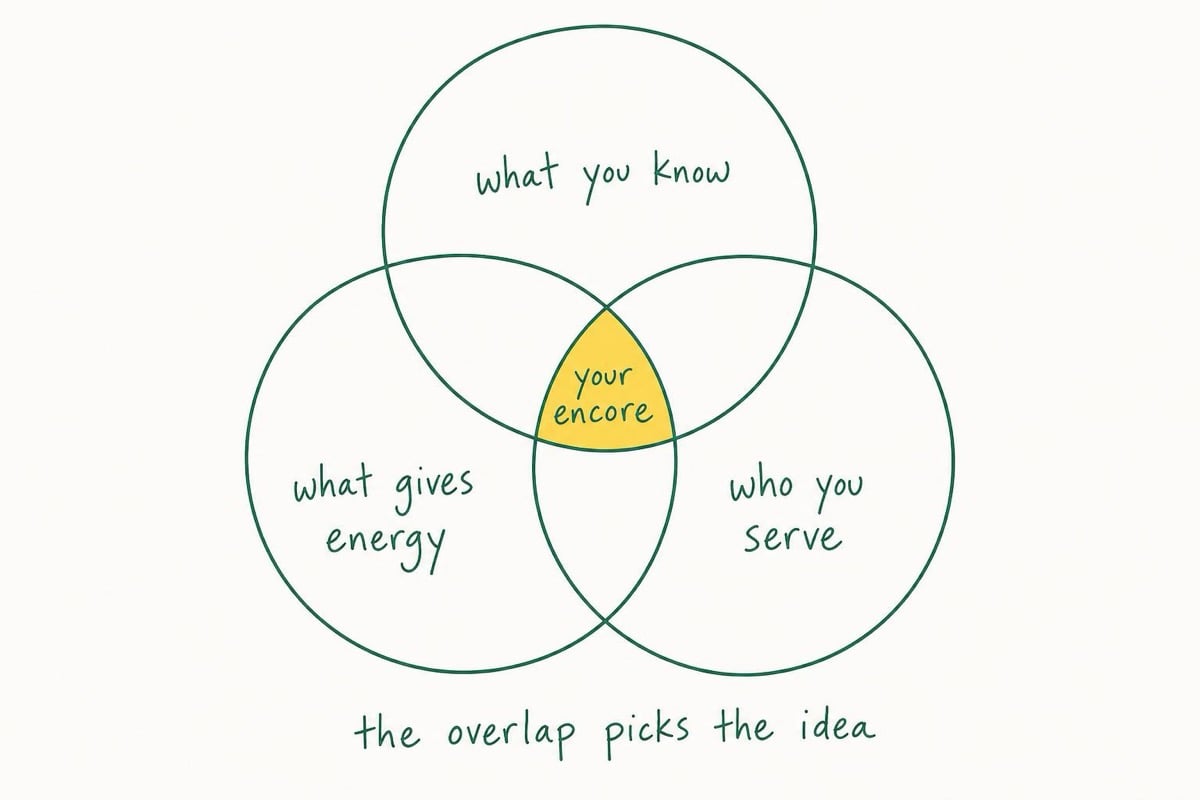
Where your three answers overlap is your encore. Everything outside the overlap is just a job.
Encore career ideas, mapped to the fit test
Now the ideas, but read them through your three answers, not as a ranking. None of these is better than another in the abstract. The right one is whichever sits inside your overlap. Here are the six shapes most encore work takes, and what each looks like in practice.
Sell your expertise back, part-time
The fastest encore is often the one hiding in your old field. Instead of a full-time seat, you sell the expertise back in slices: a fractional role, a few advisory clients, project consulting. Dave, the logistics manager, now advises four small e-commerce shops two days a week and turns the rest off. Same knowledge, a tenth of the meetings. This works best when your industry pays for judgment, and judgment is exactly what thirty years bought you. It routes cleanly into the kind of career change at 40 or later that keeps your capital and drops the grind.
Teach, mentor, or coach what took you decades to learn
If your energy answer was "the part where I helped people get better," teaching is your lane. Susan spent her career as a hospital pharmacist. She now teaches two community-college classes a term and mentors first-generation students into health careers. The pay is modest. The purpose is not. Transferring hard-won knowledge to someone starting out is one of the most reliable sources of meaning in the second half of life, and demand for people who can actually do it rarely runs dry.
Turn a craft or hobby into a small venture
The thing you did on weekends can become the thing you do on weekdays, at your own pace. The retired teacher who has been building furniture in the garage for years starts selling commissioned pieces and running a monthly woodworking workshop out of a shared studio. It will never replace the old salary. It doesn't need to. It gives the week a spine and a reason to get to the shop by nine, which is worth more than the margin.
Move into care, cause, or community work
If your "who" answer pointed at a problem rather than a person, encore work in the nonprofit and community world is built for you. Plenty of people leave corporate roles to coordinate volunteers at a food bank, guide patients through a hospital, or run a local cause a few days a week, taking a planned pay cut in exchange for work where the impact is visible by lunchtime. This is Freedman's original vision of the encore: skill and experience aimed at the common good.
Start the business you shelved
Here's the one the culture tells you is closed to you, and the data says otherwise. Older Americans start businesses at a high rate. Among workers 65 and up, 23 percent are self-employed, more than double the 10 percent rate for workers aged 25 to 64. [5] Mark spent his career in commercial kitchens and opened a small catering company at 61. The experience that felt like a liability on a resume turned out to be his entire advantage.
Build a portfolio, not a job
You don't have to pick one. Some of the best encores are a few strands braided together: a little consulting, a board seat, a class you teach, a market stall on Saturdays. When one strand fades, the others hold. A portfolio spreads both the income and the risk, and it fits a decade where you want variety more than a single title. For the wider version of this, mapped across the whole runway ahead, see life planning in your 50s.
But I didn't retire just to work again
Fair. And an encore isn't a return to the old job, so hold that worry up to the light. The old job claimed forty-plus hours whether the work deserved them or not. An encore claims only the hours you choose, aimed only at work that clears your three-question filter. That's not going back. That's keeping the best 20 percent and leaving the rest behind for good.
The "I'm too old" objection deserves a straight answer too, because it's mostly a myth. When economists studied 2.7 million company founders, the average age of the fastest-growing startups' founders was 45, and success rates kept climbing well past that, not down. [6] Experience is a tailwind, not a liability. [7] And you're not alone out here: roughly one in five Americans 65 and older is working today, nearly double the share of a generation ago, many of them on their own terms. [8] The empty-calendar problem is real, and an encore is one of the cleaner ways to give the decade a shape, the same way a good daily routine after 60 does.
Where to start this week
Don't apply for anything yet. Take one page and write three headings: what I know, what gives me energy, who I want to serve. Fill each with whatever comes, messy and honest. Most people find that the overlap is already staring back at them within twenty minutes, and the "idea" they were hunting for was never the missing piece. The filter was.
Do that this week, before you touch a single job board. The second act doesn't arrive by accident. You build it, one honest answer at a time.