
You know you want out. You still cannot name what you want instead.
You have been telling yourself next year for three years. The job is fine, which is the trap: not bad enough to walk out of, not good enough to stay awake for. Every guide you open says figure out what you want, then go get it. That order is why you are still here. People who change careers successfully do not decide first and act second. They act first, cheaply, and let evidence narrow the answer.
So the weekends fill with research instead. Salary data for fields you will never enter. A personality assessment that returns a four-letter code accurate enough to be useless.
And you are good at your job. That is what keeps the door from closing on its own. If you were failing, the decision would get made for you. Instead you keep choosing not to choose, every Monday. If that is your last few years described back to you, how to stop feeling stuck in your career is about the stall itself. This article is about what to do once you are done stalling.
Why the standard career-change advice leaves you stuck
Most career-change advice is written for someone who already knows the destination. Audit your transferable skills. Rewrite your resume for the new field. Build your network. Every one of those steps sits downstream of a decision you have not made. The advice that does address the decision sends you inward, to reflect until clarity arrives. That works for some people. For plenty of others it returns nothing.
Look at the US results for this query. Harvard Extension School's page is "5 Tips for Changing Careers." The University of Oklahoma's is "How to Change Careers Successfully." CareerOneStop, the Department of Labor's site, offers "Career Changers." Read them together and you get a competent picture of what to do after you have chosen, and nothing about how anyone chose. The question of how to change careers successfully gets answered as a logistics problem when it is not one yet.
You have probably tried the inward version. A list of what you are good at, a list of what you enjoy, and an overlap either empty or too vague to be a job. That is not a discipline failure: you were asked for an answer out of material you have not collected. (Our complete guide to making a career change covers the logistics. This article is about what has to happen first.)
Changing careers is an evidence problem, not a decision problem
A career change is not a decision you make and then execute. It is a question you answer by gathering evidence, mostly about yourself, mostly by doing things. You cannot know how a field feels from the outside, and you cannot introspect your way to information you have never collected. The move that works is small, cheap, and reversible: do a piece of the work, talk to someone who does it daily, and see what the experience tells you.
That runs against the usual sequence. The strongest case for it comes from Herminia Ibarra, who studies career transitions. Her account rests on what she describes as "an in-depth study of 39 managers and professionals who changed, or were in the process of trying to change, careers." [1] Her title states the order of operations: "Re-working our Identities to Reinvent our Careers." Identity work first, career second, and both of them through action.
Two things follow, and both are uncomfortable.
The first is that your confusion is not a fault to repair before you are allowed to act. It is the ordinary condition of someone who has not run any tests.
The second is timing, and it is why we think most attempts get abandoned. Ibarra's estimate is blunt: "Most career transitions take about three years." [2] Not three months. If you measure yourself against a plan that has you re-employed in a new field by spring, you will decide you are failing around week six and quit the only process that was going to work.
Be straight about what this evidence is: a qualitative study of 39 people, not a randomized trial against people who planned first. A strong prior, not a law.
How to change careers successfully: four moves that produce evidence
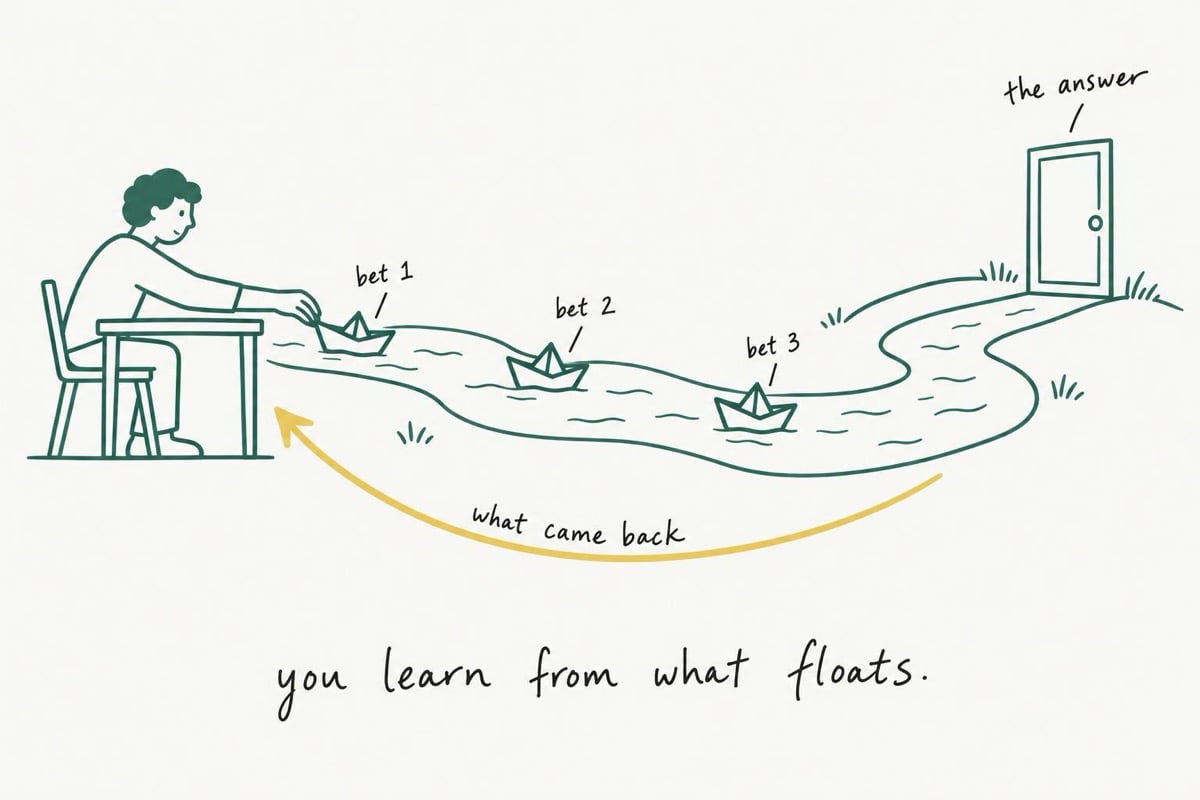
Four moves, in this order: name the constraints you cannot break, turn one vague destination into three specific bets, buy evidence with conversations and real work, and put any credential last. This sequence is ours rather than a published model. The order carries more weight than the content, because the expensive move is the one you cannot take back, and it belongs at the end.
1. Name the constraint before the destination
Before you ask what you want, write down what has to stay true. The lowest monthly income you can land on without wrecking the household. The hours you actually have each week. Whether you can move. Whether a pay cut lasting a year is survivable or fatal.
A destination that breaks a real constraint is not an option, it is a daydream with a nine-month runway attached. Four or five lines, used to kill options early. If you hold every option open, how to make the right decision fast is the habit to fix.
2. Turn one answer into three bets
You are hunting for the right answer. Go looking for three plausible ones instead.
A bet has to be specific enough to test. Not "something in healthcare" but "clinical data analyst at a hospital system." Not "work with my hands" but "residential electrician apprenticeship." We use three because one bet turns into something you defend, and five turns into more research.
Rank them by how cheaply you can test each one, not by how much you like the sound of it. How much you like it is what you are trying to find out.
3. Buy evidence with conversations and real work
Each bet gets two tests: five conversations and one small piece of real work.
The conversations should not be with the people closest to you, who know what you already know. The useful ones sit at the edge of your network. That used to be a sociology argument and now has causal evidence behind it. Researchers ran randomized experiments on LinkedIn's People You May Know algorithm, varying weak-tie exposure for more than 20 million people over five years, a period in which 2 billion ties and 600,000 jobs were created. Weaker ties did move more jobs, up to a limit: "Statistical analysis found an inverted U-shaped relationship between tie strength and job transmission such that weaker ties increased job transmission but only to a point, after which there were diminishing marginal returns to tie weakness." [3] That measured varied exposure on one platform, not every kind of networking.
In practice: former colleagues, people two steps out, the acquaintance who left your industry three years ago. Ask what the work is like on an ordinary Tuesday and who else you should talk to. Finding the key person who can move your career is this move for people who hate the word networking.
We would rank the piece of work above the conversations. Do a real, small version of the job: a volunteer analysis, a weekend build, a paid trial shift, a cheap freelance project. It gives you an honest read on whether you want this every day, and an artifact you can show. Enthusiasm is not evidence. A finished thing is. Sharpening your transferable skills makes that possible sooner than you think.
4. Put the credential last
Our strongest opinion in this article: buy the qualification last. It is the least reversible and least informative move available to you, and most career-change advice puts it first.
Employers say they have dropped degree requirements. Their hiring has barely followed. A 2024 analysis of 11,300 roles at large firms by the Burning Glass Institute and Harvard Business School's Managing the Future of Work project put the real effect at roughly 97,000 workers a year out of 77 million hires, or in the report's own words, "For all its fanfare, the increased opportunity promised by Skills Based Hiring was borne out in not even 1 in 700 hires last year." [4]
Read that in both directions. Credentials still carry weight in plenty of fields, so a portfolio does not replace a licence. And employer announcements about skills-first hiring are not something you can spend tuition against.
So set two numbers before you spend anything. A runway, meaning the months of reduced income you could absorb without touching what you cannot afford to lose. And a checkpoint, meaning a date by which a bet has to have produced something external: a paid piece of work, an interview, a specific person saying yes. Ours is 90 days, a working rule rather than a research finding: long enough for three conversations and one project, short enough that you cannot spend a year being nearly ready.
What 90 days of this actually looks like
Ninety days runs all three bets to a checkpoint. Weeks one and two are constraints and bets on paper. Weeks three to ten are the conversations and the small pieces of work, run in parallel rather than one at a time. Weeks eleven and twelve are the review: what came back, what died, what you want more of. Nobody quits a job inside this window. That is the point of it.
Two composites below, not particular people.
Dana is 44 and runs operations for a hospital system. Her constraints: income cannot drop below roughly eighty percent of current for more than a year, six hours a week is what she has, moving is out. Her three bets: clinical data analyst, quality improvement lead at a smaller provider, healthcare operations consulting.
Weeks three to ten, she sends eleven messages to people two steps out. Four reply. One introduces her to a data manager who says the analyst path needs an evening certification and a portfolio she does not have. So she builds a piece of one: her department's discharge-delay report, rebuilt as a proper dashboard on her own time.
Week eleven she reads the results. Consulting died in the second conversation, on travel, which broke a written constraint. Quality improvement is warm but slow. The analyst bet produced an artifact and a name. Dana has not changed careers. She has two fewer imaginary options, one real one, and a start on the resume rewrite that comes later.
Marcus is 38, an account director at an agency, and his 90 days go differently. All three bets come back cold. That looks like failure and is not. He spent a quarter and no money establishing that his problem is the role he holds, not the industry, which is far cheaper to fix. Ten career change questions worth asking yourself is the better door.
That is what changing careers successfully looks like from the inside: unglamorous, cheap, and mostly a matter of finding which of your three good ideas survives a real Tuesday.
"I tried this and nothing came of it"
Check which version you tried. Most people who say this ran the reading and the reflecting, not the tests. Six months researching a field is a different activity from sending five messages and finishing one small real piece of work inside it. And if you ran the tests and everything came back cold, that is a result too, and it usually points at your role rather than your industry.
The time objection is the honest one. Six hours a week, not twenty: two for messages and replies, four for the piece of work. It is slow on purpose, because three years is the figure to plan against.
On age, here is our view rather than a research finding. Being older changes tactics, not feasibility. The further past 40 you are, the more an introduction and a finished piece of work carry you, and the less the online application does, which is an argument for running the conversations and the artifact earlier. Career change at 40 and career change at 50 are written around those constraints; in your thirties, career change at 30 covers the version where the runway is longer.
Start with one conversation this week
Pick the bet you are least attached to, message one person who does that work, and ask for twenty minutes. That is the entire assignment. The least attached bet is the right place to start because you can afford for the answer to be disappointing, and you get to learn how the test feels before you run it on the option you actually care about.
Write your four constraint lines before that conversation, not after it. When someone describes a role that sounds wonderful and pays sixty percent of what you need, you want to already know it is out. That is how people change careers successfully: one cheap test at a time, with the expensive decisions kept for last.