

You want a test that tells you what to do instead
A career change aptitude test cannot tell you what you should do next, and the honest ones never claim to. Almost all of them measure interest rather than ability. That sounds like a downgrade and is not, because interest is what travels with staying in a field and doing well there. Treat the output as a shortlist to go investigate. Start with the free one the U.S. Department of Labor runs.
You probably have one open in another tab right now. It asks whether you would rather repair an engine or run a committee meeting, you click through the answers, and it hands back a list of job titles. Logistician. Technical writer. Dental hygienist.
The list is not wrong. It is inert. Nothing in it tells you which of those you could reach from where you are, what any of them pays within driving distance of your house, or whether you would still want it in year three. So you close the tab and Monday arrives unchanged, and that is the part that stings, because taking the test felt like doing something.
You are not confused about whether you want out. You have known for a while. If you are stuck at the earlier stage of not being able to name what is wrong, feeling lost in your 40s sits closer to that problem. What you want from a test is for someone with a clipboard to read your answers and say: this one. That is the promise the word "aptitude" is carrying, and it is the one thing none of these tools can sell you.
The tests are real. The job you are handing them is not.
Career tests are not a scam. The better ones publish technical manuals, report how stable their scores are, and show how those scores connect to real occupational data. What no instrument can see is your mortgage, your commute, hiring in your metro area, or how a job feels at three in the afternoon in year two. A questionnaire can rank your interests. It cannot run your life.
You have likely tried several already. A free quiz on a university careers page. A personality type you can still recite. Maybe a long paid report with color-coded charts that sat in your downloads folder until you stopped opening it. Perhaps an evening spent reading how to find a career right for me and nodding at all of it.
None of it moved you, and not because you answered wrong. You were asking a questionnaire to settle a question that only outside evidence can settle. The sequence after the shortlist, the conversations, the trial project and the runway maths, belongs to how to change careers successfully, and that piece owns it. This one stays on the assessment step, because that is where most people start and also where most people stop.
Almost nothing sold as a career aptitude test measures aptitude
Aptitude means capacity to learn something you have not learned yet. Real aptitude batteries do exist, mostly for trades, clerical work, and military placement, and they look nothing like the quizzes you have been taking. The free one published by the U.S. Department of Labor, the O*NET Interest Profiler, describes itself in its own manual as "a vocational interest inventory designed for use in educational planning, career exploration, and career guidance" [1]. It is built on Holland's six interest types. It measures what you would rather spend a day doing.
That single distinction changes what the result is for. The honest reading of any of these outputs is: here are the kinds of activity you are drawn to, and here are jobs that contain a lot of that activity. Whether you can do the job is a separate question, and it gets answered by attempting a small piece of the work, not by a questionnaire.
Here is why measuring interest is worth your evening anyway. A review pooling 60 studies and roughly 568 correlations gathered over six decades found that vocational interests are related to performance and persistence in work and academic settings, and that measures of fit between a person's interests and their environment tracked performance more closely than interest scores alone [2]. Liking the work is not a soft consideration you get to after the practical ones. It rides alongside doing the work well and sticking with it.
So the test is answering a real question. Just not the one you typed into the search bar. It is not telling you what you are good at. It is telling you what you are likely to keep doing, which is harder to learn about yourself and better to build on.
Our position, and some readers will disagree: if you are choosing between a field you would be excellent at and a field you would still care about in year four, take the second one. Competence follows attention. Attention does not follow competence.
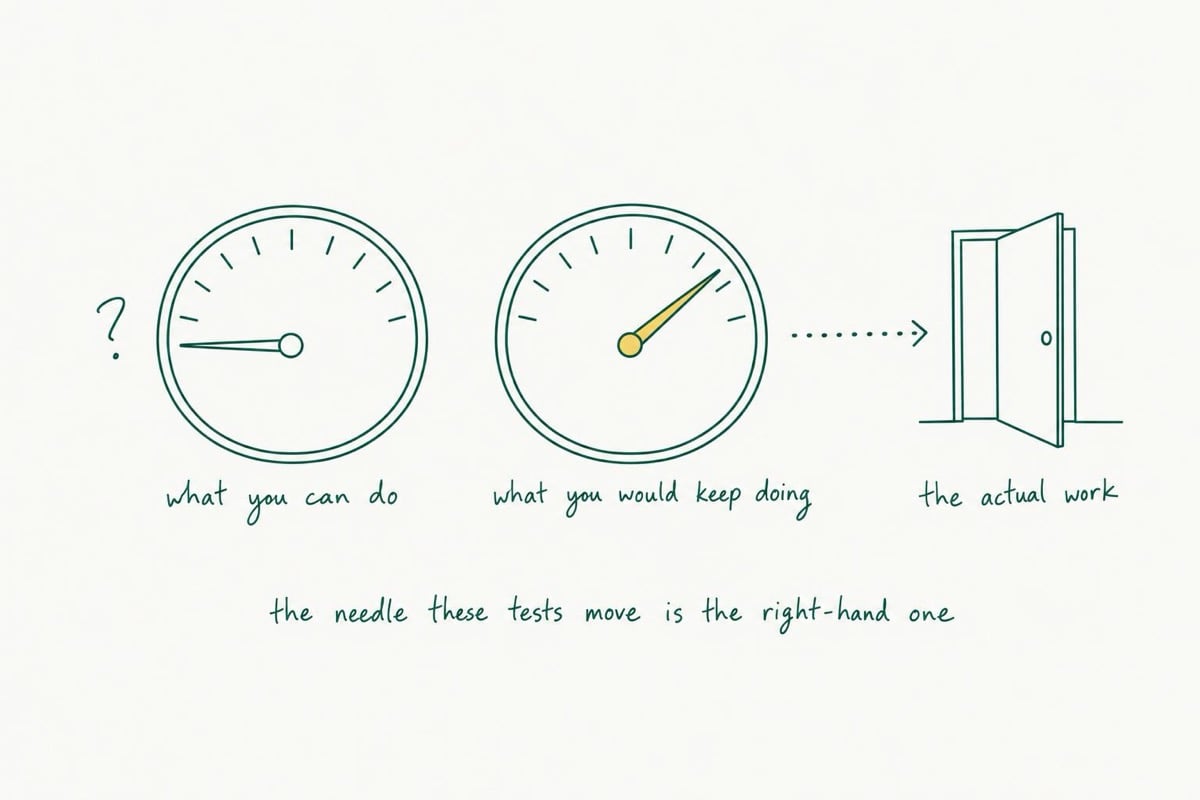
Take the free one, then narrow the list twice
Take the O*NET Interest Profiler first. It is free, the U.S. Department of Labor runs it, and its manual documents its reliability, its validity, and how its scores link to occupations. Then do the two things the test does not do for you: cut its output down by how much retraining each match would demand, and cut it again by what you already have. Most people take a career change aptitude test, skip both filters, and end up holding a list of fifty strangers' jobs.
Keep all six scores, not the top one
The O*NET Interest Profiler frames its own job modestly: you discover your work-related interests, then explore career options that fit them. The output most people remember is the single highest interest. The output worth writing down is the order of all six, because the second and third letters separate two people who share a top interest and belong in completely different rooms. Someone high in investigative and then conventional interests wants structured analysis. Someone high in investigative and then social interests wants to explain the analysis to people. Same first letter. Different Tuesday.
Filter by how much preparation each match needs
Your match list will mix jobs you could enter next quarter with jobs that need a doctorate, and it presents them at the same visual weight. The O*NET site groups careers by how much preparation they take, which it labels Job Zones. Use that grouping deliberately: sort your matches into what you could start with what you have, what needs a certificate or a year, and what needs most of a decade. The decade column is not forbidden. It just needs to be a decision you make with your eyes open rather than a title you fell for on a results page.
Cross out anything that uses none of your last ten years
This filter is ours, not the test's, and no instrument will apply it for you. Your match list is written as though you are 22. You are not. Eleven years of claims processing is not a sunk cost, it is domain knowledge that a dozen adjacent fields pay for, and a match that discards all of it is quietly asking you to start over at entry wages. Keep the matches where your existing record is an advantage rather than an awkward paragraph to explain. If you are restarting with little relevant experience, jobs for 50 year olds with no experience works through that case specifically, and encore career ideas covers the post-60 version.
Should you pay for one?
Paid instruments and a professional to interpret them have a real use, and our view is that it is not better prediction. What you are buying is someone sitting with your result and asking the follow-up questions a report cannot. Prices move, so check the publisher's page rather than believing a figure in an article. Our rule: pay at the point where you have narrowed to two or three options and cannot choose between them. That is when an hour with a career counselor earns its fee. A long paid report at the start mostly buys a better-designed version of the free list.
How to actually read your results
The result worth reading is not the top match. It is the order of all six interests, the gap between the first two, the preparation level sitting behind each suggestion, and the task list on the two or three occupation pages you open. In our view the title list is the least useful part of the output, and it is also where most people stop. Working through the rest is one evening, and it turns fifty suggestions into a shortlist you could defend out loud.
Start with the order and the spacing. Say your result comes back conventional first, investigative second, social third. Conventional before investigative points at work where the structure is the product: compliance, standards, documentation, audit. Reverse those two and you get a person who wants the analysis and merely tolerates the structure. Now look at how far apart the top two sit. If they are nearly level, you do not have one shortlist, you have two, and you should carry both rather than letting the tie break itself alphabetically.
Then open the occupation page behind each surviving title, which is the step most people skip. Read the task list before you react to the name. To illustrate the gap rather than quote any page: a title like compliance analyst can read as authority while the work underneath turns out to be closer to checking documents against a standard and writing findings nobody thanks you for. Technical writer can read as writing and turn out to be mostly interviewing busy people and chasing the detail they left out. Read what your page actually lists, and if the work bores you tonight on screen, it will bore you at three in the afternoon in year two.
Check pay locally too, not just the headline number. What a title pays in your metro area can sit a long way from the national figure, so find a local one before you let a title onto the shortlist. A match you cannot afford to move into is not a match, and you want that known before you start an evening certificate.
What you are holding at the end of that evening is two or three titles whose daily tasks you have read, whose local pay you have checked, and whose entry cost you can name. That is the whole output of an assessment done properly. What happens next, the conversations, the small trial project and the runway maths, is the ground covered by how to change careers successfully, and that is the piece to open next.
"I took one and it told me to be a florist"
When a career change aptitude test returns something absurd, there are usually three causes, and only one of them is the test. You answered as the person on your resume instead of the person who gets tired on a Thursday. The list ignored how much preparation each match needs, so a decade of school sits beside a lateral move. Or you read one strange title at the top of a long list as a verdict, when a single odd match in fifty is noise.
Retake it honestly, which mostly means answering about activities rather than job titles and reading the full order rather than the headline. And before you decide the result is wrong, read the task lists: an interest profile is often right about the activity and wrong about the title it hangs that activity on, which is a different complaint than the test being useless. If the blank is wider than work, 15 questions to discover your life purpose, how to find purpose in midlife, and a plain life audit get at it from angles no vocational instrument covers.
Start here
Tonight, take the free profiler and write down the order of all six interests rather than the top one. Note how close the first two sit. Then open the pages for your top three suggestions, read the task lists rather than the titles, and strike anything whose actual daily work bores you on paper. Check the state wage figure for whatever survives.
That is an evening, it costs nothing, and it leaves you with two or three real candidates instead of fifty titles. Take those to how to change careers successfully for the next moves, and if you want the wider version of the question, how to find the right career and reinventing yourself at 50 carry it further.


