

A good life can go quiet on you. Nothing breaks. The work still works, the bills still get paid, the calendar still fills up. And yet somewhere around the second coffee, a question you can't quite answer starts to surface: what is all of this actually for? You wake up, run the day, and catch yourself asking, is this it? It isn't a breakdown. It isn't a crisis. It's a low, flat hum where a sense of direction used to be.
That quiet question is what most people mean by figuring out how to find purpose in midlife. It rarely shows up as a breakdown. It shows up as drift.
Here's the part nobody tells you. You don't have to blow anything up to answer it. No quitting the job to find yourself in Bali. No dramatic reinvention. The work of finding purpose after 40 is quieter, slower, and a lot more durable than the movies promised.
Why Purpose Goes Quiet in Midlife
Purpose goes quiet in midlife because the goals that organized your 20s and 30s, building a career, raising young kids, proving yourself, mostly got completed or outgrown. Psychologist Erik Erikson called this the central task of midlife: generativity versus stagnation. The pull to contribute, mentor, and build something beyond yourself sharpens around 40, and when it has no outlet, it curdles into a flat sense that life has stalled. [1]
So the flatness isn't a malfunction. It's a signal. The scaffolding you spent two decades building did its job, and now it's empty, and you're standing inside it wondering what the next thing is for. That's why how to find purpose in midlife is the wrong question to ask in a panic and the right one to sit with calmly. It's not the same as a midlife crisis, which gets dramatized as red sports cars and impulse decisions. Most of the time this is much smaller and much more common: a steady loss of meaning that creeps in while you're busy keeping everything else running. It can read as a stalled career, too, even when the job itself is fine.
It overlaps with feeling stuck in a rut, but it's deeper than boredom. Boredom is "nothing to do today." This is "I've done plenty, and I'm not sure what any of it was for."
You're Not Lazy. The Old Engine Just Ran Out of Road
The struggle is real, and willpower was never the missing piece. The achievement-and-acquisition engine that powered your first half, climb, earn, accumulate, simply delivers less meaning as you age. Stanford's Laura Carstensen showed why: as people sense their time horizon shortening in midlife and beyond, motivation shifts away from open-ended future goals toward what's emotionally meaningful right now, relationships and contribution. The old fuel stops working not because you broke, but because you changed. [2]
You've probably already tried to muscle through it. A new job title. A bigger goal. A productivity system, a fresh planner, maybe a coach. And the relief lasted about three weeks before the hum came back. That's the tell. You can't out-achieve a meaning problem. More of the thing that stopped working will not start working.
What makes this especially disorienting in your 40s and 50s is that you're holding so much at once: work, health, money, an aging parent, kids who need you differently than they used to. The question of purpose feels like one more impossible item on a list that's already too long. So you postpone it. Again. To a quieter season that never arrives.
Purpose Isn't Found in a Moment. It's Rebuilt Across Your Life
Here's the reframe that changes everything. Purpose in midlife is not a hidden thing you discover in one shining moment of clarity. It's a through-line you reconstruct by realigning the parts of your life that have drifted out of sync. Five domains carry most adult life: work, health, money, relationships, and identity. When they pull in different directions, you feel purposeless, even when each one is individually fine. Purpose is what you notice once they point the same way again.
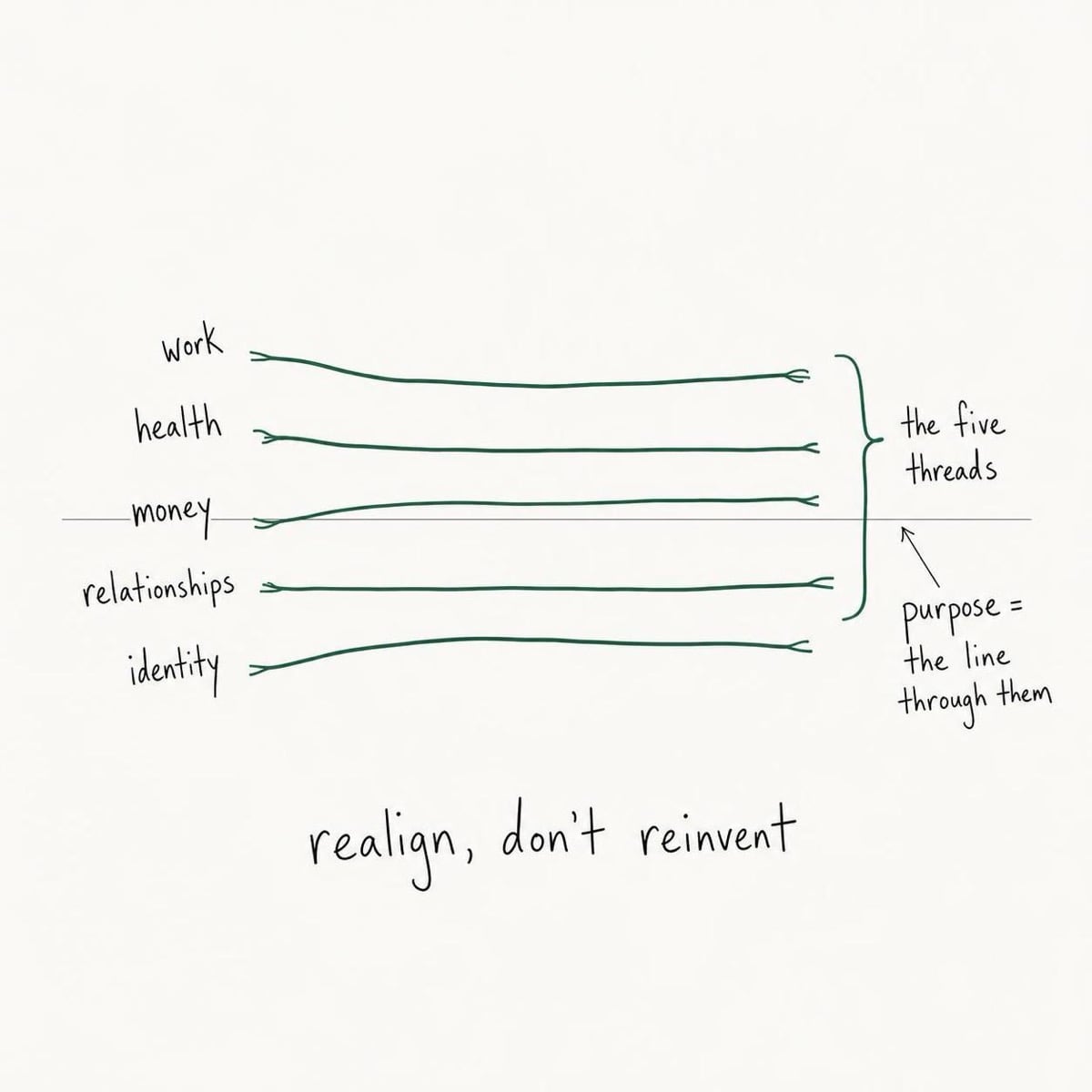
This matters because the standard advice sends you on the wrong errand. "Find your passion." "Discover your why." It tells you to go inward and wait for a lightning bolt. But meaning isn't a buried treasure. The psychologist Roy Baumeister found that a meaningful life is built from four needs working together: a sense of purpose (direction toward the future), values (knowing what's right), efficacy (the sense your actions make a difference), and self-worth. [3] Notice the verb. Built. Not found.
So finding purpose in life at this stage is less archaeology and more carpentry. You're not digging for a buried self. You're realigning threads that already exist. The career still matters, the relationships still matter, your health still matters. They've just stopped reinforcing each other. When you bring them back into line, one at a time, the meaning that felt missing turns out to have been scattered, not gone. That's also why a true midlife reset is rarely a clean-slate reinvention. It's a re-sequencing of what's already there.
The relief in this reframe: you don't have to know your purpose before you start. The direction shows up after the realignment, not before it.
How to Find Purpose After 40, One Thread at a Time
Finding purpose after 40 works best as a sequenced rebuild, not a single leap. Pick the one domain pulling hardest against the others, realign it with small consistent action, and let the renewed sense of meaning fund the next move. Research on generativity, the drive to contribute to the next generation, shows midlife adults who score high on it have stronger cognitive function and lower depression years later. [4] Purpose grows through what you do, not what you decide to feel.
Four moves make this work without burning you out.
Name the drift before you chase the fix. Most people skip straight to "what should I do with my life" and stall. Start narrower. Which thread is most out of line right now? Maybe work pays the bills but means nothing. Maybe your relationships have gone quiet while you chased the career. Maybe your identity is still wearing a role that ended (the parent of small kids, the rising star) two life-stages ago. Purpose drains out wherever your real life and your stated values have come apart. Find that gap first. The answer to "what's my purpose" usually hides inside "what feels off."
Aim at contribution, not passion. The "follow your passion" script fails most people over 40 because passion is an output, not an input. What reliably generates meaning is the sense that you matter to others. Carstensen's work and a wider line of meaning research point the same way: purpose strengthens when it's tied to people and contribution rather than personal achievement. [5] This is the quiet logic behind a second mountain. The first half climbs for the self. The second half is built around something larger: mentoring, craft, community, a person you care for. Mentoring a junior colleague, coaching a kid's team, or rebuilding a friendship you let lapse will move the needle more than a vision board. If your relationships have thinned out, even the simple work to rebuild your social circle is purpose work.
Use small anchored action, not a grand pivot. This is the burnout guardrail. You do not need a midlife career change to find purpose, and trying to force one before you know your direction is how people torch their savings chasing a feeling. Purpose rebuilds through tiny, repeated actions that you tie to things you already do. Research that samples people's daily experience finds that specific small behaviors and events, not big resolutions, drive the felt sense of meaning. [6] One real conversation a week. Fifteen minutes on a craft you abandoned. A standing call with your father. These compound, and here is the part that matters: they keep your income and stability intact while you find your footing. If a bigger change does turn out to be right, you'll make it from clarity, not panic, the way a thoughtful career change at 50 actually works.
Protect the body that carries the meaning. Purpose and health are not separate projects. People with a strong sense of purpose are 24% less likely to become physically inactive and 33% less likely to develop sleep problems. [7] The relationship runs both ways: protecting your energy makes purpose easier to feel and act on, which is one reason the habit of increasing your longevity and a real sense of meaning tend to rise together. You can't rebuild meaning while running on four hours of sleep and a body you've stopped tending. Keeping yourself in shape, even knowing that building muscle is still possible in your 40s, is part of the same project, not a distraction from it.
The order matters more than the speed. Rebuild one thread at a time, in the right order, at a pace you can hold. Calm discipline beats a frantic reinvention every time.
What Finding Purpose Actually Looks Like at 50
In practice, finding purpose after 40 looks almost boring from the outside. No quitting. No epiphany. Just one drifting thread named, then realigned with a small action you repeat until it holds, then the next. Take Ravi, 51, a regional sales director. Good income, solid marriage, two kids in high school, and a flatness he couldn't explain. He kept waiting for a calling to arrive. It never did.
He stopped waiting and named the drift instead. The thread most out of line wasn't his job. It was identity and contribution: he'd spent twenty years selling and zero years building anyone up. So he started small. One mentoring lunch a month with a junior rep, anchored to the first Friday. No title change, no risk, no savings spent.
Two months in, those lunches became the part of his week he looked forward to. The renewed energy spilled sideways. He started walking three mornings a week (the health thread), because purpose, it turns out, makes you want to take care of the body that carries it. That's the documented pattern, not a coincidence. [8]
Six months in, the mentoring had grown into running an informal training program. Ravi did not find a new purpose. He realigned an old life until the purpose that was scattered across it pointed one direction again. Notice he never touched the money thread directly, though steadier finances and better money habits tend to follow once the panic that drives bad spending lifts. Contrast all of this with Priya, 47, who quit her marketing job cold to "find herself," burned through a year of savings, and landed back in marketing more lost than before. Same hunger. The difference was sequence: one rebuilt, the other detonated. If you want a map for the quieter version, this is what building a real life plan in midlife is for.
But You Still Don't Know What Your Purpose Is
That's fine. You're not supposed to know it yet, and waiting to feel certain before you act is the trap. Purpose reveals itself through motion, not meditation. Meaning researchers distinguish between the presence of meaning and the active search for it, and the search becomes productive precisely when it's paired with small purposeful action rather than passive rumination. [9] You find the answer by doing the small thing, watching what gives energy back, and following that.
The other fear is that it's too late, that purpose is for people who figured it out at 25. The developmental research says the opposite. The capacity to resolve identity and purpose stays open across the whole lifespan, and people routinely catch up through later experiences: a career shift, deeper community involvement, a new caregiving role. [10] It is not too late, and it was never going to be. This is exactly the part of the curve where purpose gets built. If you are reading this past 60 rather than in your forties, the shape of the problem changes: the question there is which of the five things your job supplied went missing, which we work through in finding purpose in retirement.
Start With the One Thread That's Pulling Hardest
Don't try to answer "what is my life's purpose" this week. That question is too big, and chasing it is how people burn out. Do something smaller. Pick the single domain that feels most out of line right now: work, health, money, relationships, or identity. Name the gap between what you say matters there and what your week actually shows. Then choose one tiny action inside it and run it for two weeks before you judge anything.
That's the whole start. Not a reinvention. One thread, realigned, repeated until it holds. The strange thing about how to find purpose in midlife is that it was never one decision waiting to be made. It's a hundred small realignments, and you get to make the first one today. Purpose was never going to announce itself. It gets built in the doing, one realigned thread at a time, and the doing starts with whatever you choose in the next hour.


