

You already know how to be disciplined. That is the part nobody says out loud. You have run a launch on four hours of sleep. You held a training plan for six straight weeks in your thirties. Last January you got up at 5:30 for eleven days in a row and you still have the tracker to prove it. Then week three showed up, a parent's scan got scheduled, a client moved a deadline, and by Thursday the whole thing was gone. Not gradually. All at once.
So you start again. And the restart costs more than the first attempt, because now you are carrying the memory of the last collapse too.
Here is what makes this maddening at 47 in a way it never was at 27. You are not less disciplined than you used to be. You are spending the same discipline you always had on a job it was not built to do, and the bill comes due every single morning.
You already have discipline. It keeps getting spent.
The evidence that you have discipline is everywhere in your life, which is why the failure feels so personal. You finished the degree. You kept a business alive through a bad year. You have done hard things on days you did not want to, repeatedly, for two decades. What you do not have is a way to make any of it repeat without your full attention on it.
So you try harder. You set the alarm earlier, add the tracker, tell a friend for accountability, print the habit chart. For a while it works, which is the cruelest part, because it teaches you that effort is the answer and that the collapse was a character problem.
It was not. Look at what you were actually doing. Every morning you were re-making the same decision from scratch: whether to run, whether to open the spreadsheet, whether to write before the inbox. Each of those decisions has a price, and you were paying it in full, daily, out of a budget that in your forties is already committed. More than half of adults in their 40s (54 percent) have a parent over 65 and are either raising a child or supporting a grown one. [1] The discipline is not gone. The surplus is.
Discipline and consistency are two different jobs
Discipline is what you spend. Consistency is what you build so you spend less. Discipline is the cost you pay at the exact moment resistance shows up, in the gap between knowing and doing. Consistency is the structure that removes the need to decide again tomorrow. They are not two words for the same virtue, and treating them as one is why capable people stall for years.
Test it against the research on people who look disciplined from the outside. A meta-analysis of 102 studies covering 32,648 people found that trait self-control predicts automatic, habitual behavior about twice as strongly as it predicts controlled, effortful behavior: r = .36 versus r = .15 for desirable behaviors. [2] Disciplined people show up in what runs on rails, not in what they white-knuckle.
Six studies with a combined 2,274 participants found the same shape. Beneficial habits, not effortful inhibition, carried the link between self-control and real outcomes in eating, exercise, sleep and study. People with higher self-control reported less effortful resistance, not more. [3] A week-long experience-sampling study followed people to a two-month goal check-in and found that acts of effortful self-control were unrelated to whether they hit the goal. What predicted progress was how many temptations they ran into in the first place. [4]
Read that last one again, because it is the uncomfortable one. The people winning are not out-muscling you. They are running into fewer fights. Nobody is more disciplined than you at 6 a.m. They just are not deciding anything at 6 a.m.
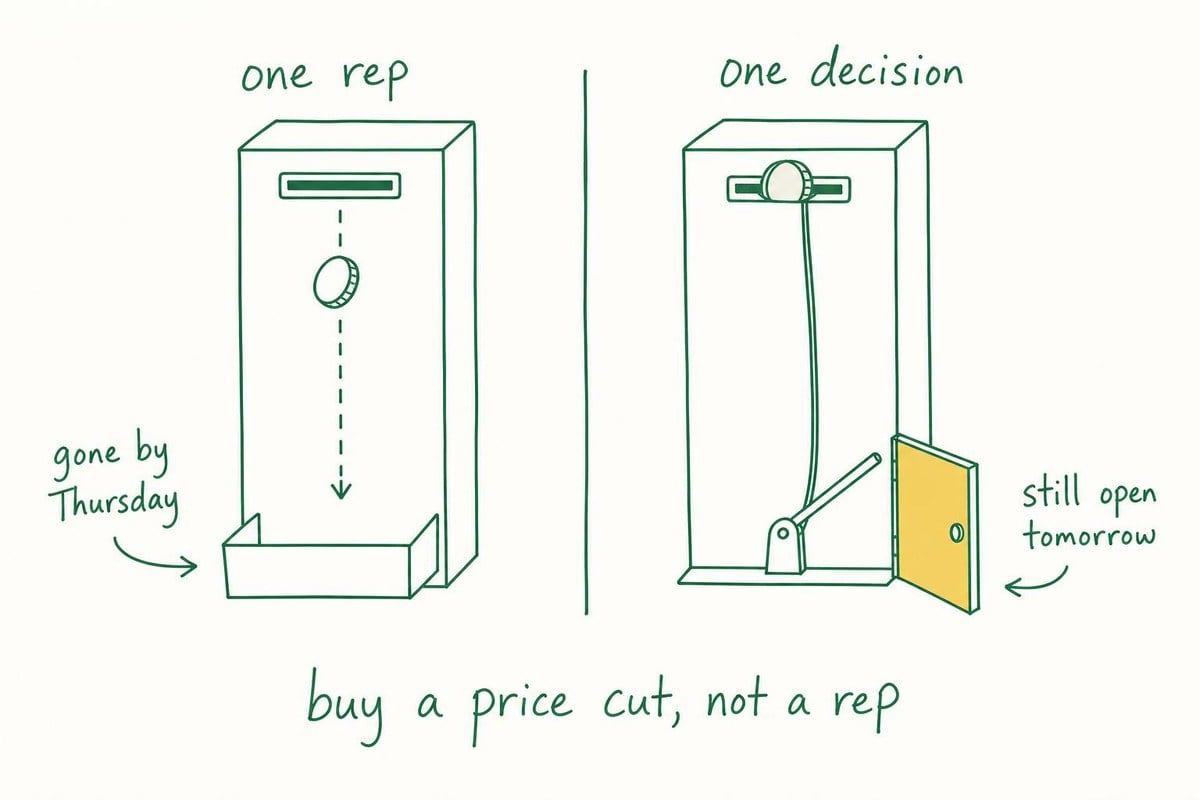
The rule: every unit of discipline should buy a price cut, not a rep
Once you separate the two jobs, the fix stops being "try harder" and becomes an allocation question. You have a small, real, non-negotiable amount of discipline each day. The only question that matters is what you buy with it. Spend it on today's rep and it is gone by tonight. Spend it on a decision, a design, or a lower price, and it keeps paying out on the mornings you have nothing left. That is the whole shift, and it runs on four moves.
Spend it once, on the decision (not on the day)
Decide when and where in advance, once, and stop re-deciding. This is the most tested idea in behavior change and it has a name: an implementation intention, an if-then plan that fixes the when, the where and the how before the moment arrives. Across 94 independent tests with 8,461 people, forming one produced a medium-to-large effect on goal attainment, d = 0.65. [5]
The cleanest demonstration is an exercise study with 248 adults split three ways. The group given a motivational intervention alone raised their intentions but barely moved: 39 percent exercised at least once a week, against 29 percent of controls. The group that also wrote a specific if-then plan hit 91 percent. [6]
Be honest about what that means. A later meta-analysis of 13 randomized trials on adult physical activity found a much smaller, non-significant pooled effect (0.15, CI -0.01 to 0.31), so if-then planning is a lever, not a guarantee. [7] But the direction is consistent, and the mechanism is exactly the one you need: motivation moves intentions, a plan moves behavior. "I'll write more this year" costs you a decision every morning. "When I pour the first coffee, I write for 20 minutes at the kitchen table" costs you one decision, ever. If you keep setting goals that never convert, why you keep failing at goals is usually a decision-design problem, not a wanting-it-enough problem.
Spend it on lowering the price, not raising the effort
The instinct when something keeps failing is to add: more accountability, a bigger commitment, a stricter rule. Do the opposite. Cut the action until it fits your worst day, not your best one, then let it grow only after it has survived a bad week. A 20-minute walk you take on the day the furnace breaks beats a 45-minute run you take nine times and then never again.
This is where most restarts go wrong, because the plan gets sized for the version of you who made it, which is the rested, motivated, Sunday-afternoon version. The Wednesday version is the one who has to run it. We have written the full argument for this in consistent habits in midlife: consistency is an engineering problem, not a character problem, and the floor is the thing you engineer. Done is better than perfect is not a lowering of standards here. It is what keeps the standard alive.
Spend it on the return, not the streak
Your discipline should be pointed at the day after the miss, because that is the only day that decides anything. Missing once is close to free. In the habit-formation study that produced the famous 66-day figure, missing an occasional opportunity did not seriously impair the process. What killed habits was chronic inconsistency. [8] The researchers put it plainly: missing one opportunity did not significantly impact habit formation, but people who were very inconsistent did not succeed in making habits. [9]
What turns one miss into a collapse is the story you tell about it. Marlatt's relapse-prevention work named this the abstinence violation effect: the reaction to a slip, the guilt and the internal, global self-blame, is what predicts escalation, not the slip itself. [10] Later real-time data sharpened it. Among 203 people tracking 1,001 episodes after quitting smoking, guilt and self-blame after the first lapse predicted nothing. What predicted collapse was belief eroding across repeated lapses. [11]
So stop tracking the streak and start tracking how fast you come back. One missed Tuesday is data. Four missed Tuesdays with no return is a broken design. That distinction is the whole basis of the self-discipline recovery loop, and it is why a streak counter can quietly work against you even when the habit-tracking app is good.
Spend it in one place at a time
Discipline spread across five domains buys nothing in any of them. Sandwiched caregivers give the same hours of elder care as everyone else while being far more likely to hold a job (69.4 percent versus 53.9 percent) and reporting measurably higher role overload. [12] If that is the load you are running, a plan that asks you to fix health and money and career in the same quarter is not ambitious. It is arithmetic that does not work.
Pick one domain. Run it until it costs you nothing, which usually means it has survived a properly bad month. Then pick the next one. Sequencing is not a smaller version of the plan, it is what makes the plan finishable, and it is the spine of a proper midlife reset.
What this looks like on an actual Wednesday
Two people, same problem, different starting points.
Marcus is 46, runs a six-person consultancy, and has restarted "get back in shape" nine times since 2020. His old pattern: a Sunday plan, five gym mornings, then a Thursday client fire and three weeks of nothing. What he changed was small and slightly boring. He stopped scheduling gym mornings and wrote one rule instead: when he closes the laptop at the end of the workday, he walks for 25 minutes before he goes inside. One decision, made once, tied to a thing that already happens every day. He missed nine days in the first two months. He never missed two in a row. Eight months on he walks most days and lifts twice a week, and the lifting only got added after the walking stopped requiring anything from him.
Joanne is 51, a hospital administrator with a mother in assisted living and a son at community college. Her version of the failure was different. She was not undisciplined, she was over-committed: a budgeting system, a meditation app, a writing goal and a couch-to-5K, all started in the same February. All four were dead by April. She cut it to one, money, because it was the one leaking into everything else. Fifteen minutes every Sunday at the same kitchen table, the same three accounts, the same order. It took four months before that felt automatic. She has not started the writing goal yet. That is the point, not a failure of it.
Notice what neither of them did. Neither added accountability. Neither waited to feel motivated, which is a separate question we have taken apart in motivation versus discipline. And neither treated a missed day as evidence about who they are.
"I've built systems before and they still fell apart"
Fair, and the honest answer is that some of them will fall apart again. The 66-day median comes with a range of 18 to 254 days, which means a habit that has not gone automatic after two months is not proof of anything except that you are on the slower end of a very wide curve. [13] Most people quit at week three because they expected week nine's ease.
The other reason previous systems collapsed is that they were built out of reps, not decisions. A tracker records reps. A rule removes them. If you look back at the systems that failed, you will usually find you were still deciding, every day, with a nicer interface on the decision. This is also the mechanism underneath procrastinating when you know better and the reason staying consistent with goals has less to do with wanting it than anyone wants to admit.
Where to spend your next unit of discipline
Find the one decision you are re-making every single day and kill it this week. Write it as a sentence with a time and a place attached: when X happens, I do Y, here, for this long. One sentence, one domain, sized for your worst Wednesday. Then measure only one thing for the next month, which is how many days pass between a miss and your return.
If you are not sure which domain to point it at, pick the one that is leaking into the others. That is almost always the right first spend. Discipline was never your problem. You just kept paying retail for it.