

You're in your 40s. You have the experience. You've read the books, run the morning routines, set the quarterly goals. You know exactly what to change across work, health, money, and the people at home. And yet the plan you built in March is already gone, the gym streak died in week three, and the calm you keep promising yourself stays parked in some quieter week that never shows up.
Here's the part nobody warns you about. The methods that built you in your 20s and 30s are the exact reason personal growth in your 40s keeps breaking. More goals. More willpower. More hustle before dawn. That playbook ran on slack you no longer have. You're not failing at growth. You're using the wrong tool for the decade you're actually in.
Why the Self-Help That Worked at 30 Fails Now
Personal growth in your 40s fails for a specific, mechanical reason: the advice assumes a body that bounces back overnight and a calendar with spare hours in it, and in your 40s neither is true. Recovery slows, sleep gets interrupted, and the day is already owned by work, kids, and aging parents at the same time. Personal growth after 40 fails when it asks you to add a project. There's nothing to add it to. The capacity that powered your 20s-style sprint has quietly moved out.
This is not a willpower story. Researchers describe midlife as a genuine capacity shift: recovery time drops because of hormonal changes, disrupted sleep, and accumulated stress, while cognitive load and caregiving demands climb at the same time, the squeeze the "sandwich generation" lives inside. [1] So when you try to bolt a 5am overhaul onto a life that's already full, the overhaul loses. Not because you're weak. Because the math doesn't work.
There's a second tax most people miss. By mid-afternoon, your decision-making is just gone. Mental load from caregiving, career, and the invisible logistics of running a household depletes the prefrontal cortex, leaving executive function unavailable exactly when you'd planned to "be disciplined" after work. [2] The 7pm version of you was never going to win on grit. That's not a flaw to fix. It's a constraint to build around. If you've been reading this as proof you're stuck in a rut, it isn't. It's a design problem.
You're Not Behind. You're at a Different Stage
The shame underneath all of this is the quiet belief that everyone else figured it out and you're the one falling behind. You're not. What's actually happening is a stage change, and almost nobody names it. The old "life begins at 40" slogan was closer to the truth than it sounds, just not the way the posters meant it: in your 40s, growth stops being about adding new things and starts being about renovating what's already there. The frustration is real, but it's the frustration of using construction tools on a house that's already built.
Developmental researchers are blunt about this. By midlife your identity is already constructed, so growth now means recalibrating and renovating an existing self, not building a brand-new one from raw materials. [3] That single fact rewrites the whole project. You're not a blank lot. You're a standing house with good bones, some rooms that work, and a few you've stopped going into.
So the failed plans, the abandoned apps, the gym membership you're still paying for: none of that is evidence you can't grow. It's evidence you kept hiring a demolition crew when what you needed was a renovation. Different decade. Different job.
Growth at 40 Is Subtraction Plus Maintenance, Not Addition
Here's the reframe that changes everything. In your 20s, growth was addition: more skills, more goals, more reps, more rooms. In your 40s, that math breaks, because there's no empty space left to add to. Growth in your 40s is subtraction plus maintenance. You remove what's draining the load-bearing parts of your life, then you maintain a small set of things well, instead of starting ten new ones badly. The renovation decade isn't a downgrade. It's a sharper question: what stays, what goes, what gets repaired.
There's hard developmental backing for this. Stanford research describes midlife as a pivot point where growth shifts away from expansion and novelty-seeking toward emotional meaning and selective goal prioritization, as your sense of remaining time turns from open-ended to finite. [4] That sense of finite time isn't morbid. It's the most useful editing tool you'll ever get. It tells you what to cut.
It also redirects where your energy should go. When time feels constrained, as it does in midlife, motivation naturally moves from exploration and knowledge-chasing toward emotional regulation and deepening the relationships that already matter. [5] Translated: the version of you that wanted to learn everything and meet everyone is being replaced by a version that wants fewer, better things. Stop fighting that. Build with it. This is the difference between trying to reinvent yourself at 40 from scratch and renovating from the foundation you already poured.
The Renovation Map: One Domain at a Time, Built for Your Worst Day
So what does personal growth in your 40s actually look like in practice? It runs on two rules the old playbook ignored. First, build every change for your worst-day floor, not your best-day ceiling, because midlife guarantees plenty of worst days. Second, renovate one domain at a time, in sequence, instead of all at once. This is the answer to how to change your life at 40 without burning down the life you've already built. Below is the whole map across work, health, money, and relationships, kept deliberately calm. This is the overview; each room has a deeper guide of its own.
Build for the floor, not the ceiling. The single biggest mistake in self improvement in your 40s is designing the ambitious version, the hour-long workout, the elaborate budget review, the 90-minute deep work block. It survives until the first bad night of sleep. Define the two-minute floor version instead: the walk you'll still take when everything's on fire, the one-line money check you'll do even on a brutal Tuesday. Health interventions that lean on motivation and intention reliably fail in midlife; only context-based, reward-based, and friction-reduction strategies produce lasting change. [6] The floor isn't lowering the bar. It's what keeps the habit alive between good weeks. This is the spine of how to stay consistent with goals when life refuses to cooperate.
Anchor it to a cue, not a mood. A renovation that depends on remembering, or on feeling like it, won't hold. Tie each new behavior to something you already do every day. After the coffee, the walk. After you close the laptop, two minutes on tomorrow's top task. Habits change through context and environment design, not willpower or motivation, and once a habit forms, motivation barely matters at all. [7] Cues do the remembering so you don't have to. The mechanics live in plain sight in our guide to habit stacking and the broader work on habit formation.
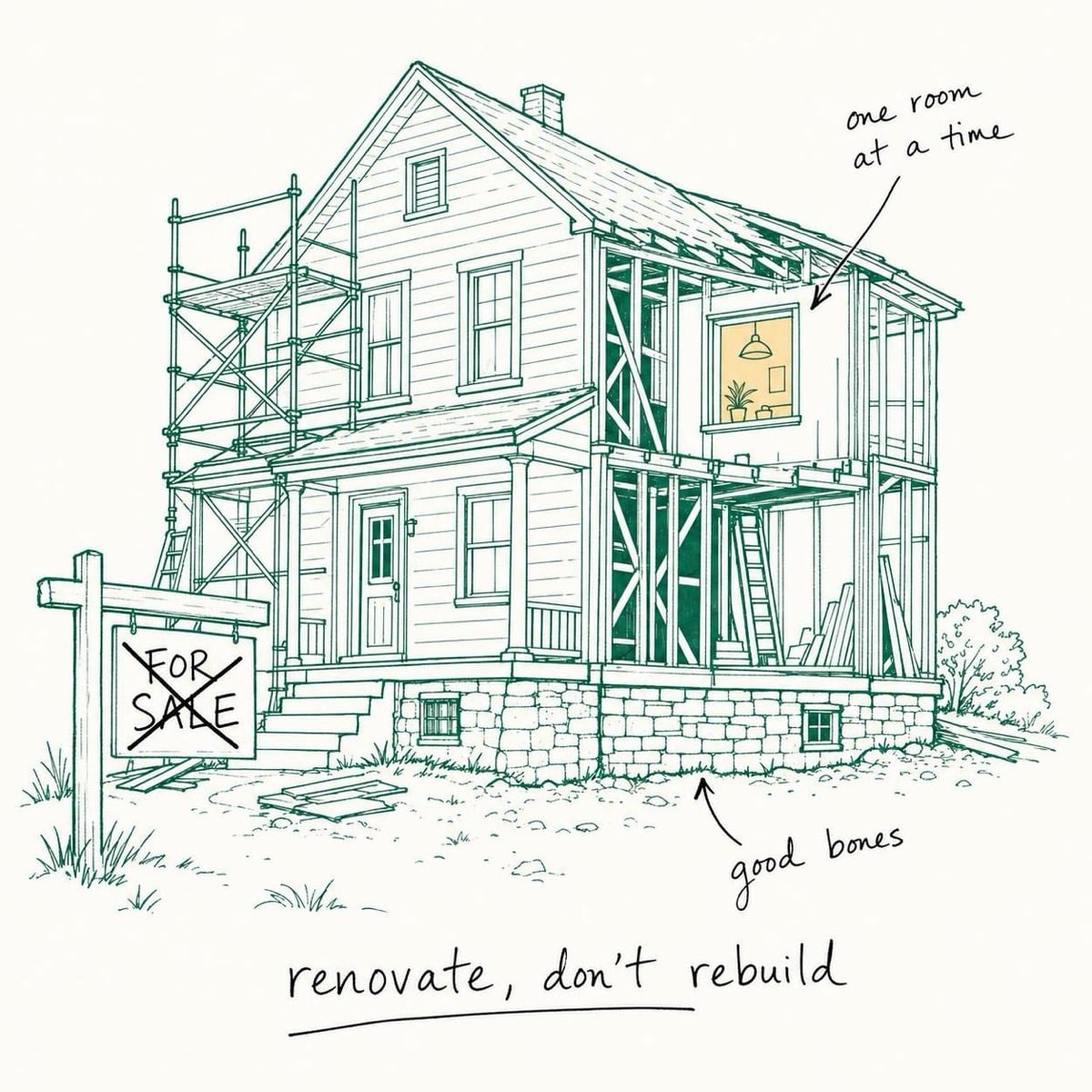
Pick one keystone room first. Don't renovate the whole house at once. Choose the single domain that's hurting most right now, health, money, work, or your relationships, and get one keystone habit holding there before you touch anything else. A keystone habit pays for the next one: rebuild sleep and your focus and patience improve for free. The starter rooms most midlife rebuilders pick are a daily routine for a 40-year-old or a workable morning routine. Whether it's building muscle in your 40s, starting on better money habits, or a career change at 40, the rule holds: one room, fully, before the next.
Set the recovery rule before you need it. A missed day isn't the problem. What you do the day after a miss is the whole game. Decide in advance: miss once if you must, never twice in a row. Missing Thursday is data. Missing Friday too is a decision. That single rule is the difference between a habit that survives a hard week and one that dies in it, and it's why a real midlife reset is measured not by streak length but by recovery speed.
Recover on purpose. This one's specific to the 40s and most people skip it. Recovery is active now, not passive, and different kinds of exhaustion (physical, cognitive, emotional, nervous-system) need different recovery; sleep alone won't restore cognitive or emotional depletion. [8] Building recovery into the week is part of the renovation, not a reward for finishing it. The full version of this sequenced rebuild across all the rooms is the deeper guide; this article is the map that hangs on the wall.
A Real Year, Renovated One Room at a Time
Here's the map turned into a real life. Marco is 44, a project manager with two kids and a father whose cardiology appointments now live on Marco's calendar. His old growth plan was the 20s version scaled up: a 5am block for the gym, a language app, a side hustle, a stricter budget, all starting Monday. It held for nine days, twice, then collapsed. He read that as proof he'd "lost his edge."
He renovated instead. One room first: health, because his energy was tanking everything else. One keystone habit: a 15-minute walk after his morning coffee, with a two-minute floor for the days his dad needed a ride at 7am. Nothing else changed. No app, no 5am, no overhaul.
Week one he walks four days. Thursday his father has a clinic visit, the walk doesn't happen. The old Marco writes off the week. The new rule says walk Friday, no exceptions, because missing twice is how a habit dies. He walks Friday. By the end of the second month the walk is automatic, the thing he does without arguing with himself, which is right in line with what habit research predicts about how long automaticity actually takes.
Only then does he open the next room: a five-minute Sunday money check, anchored to his first coffee of the weekend. Then, months later, the harder renovation, a slow look at whether his work still fits, the kind of question behind a real midlife career change. A year in, Marco isn't a different man who finally found discipline. He's the same man running a renovated house, one room at a time, built for his worst day instead of his best.
But Isn't Midlife Just Decline From Here?
The honest worry sitting under all of this: maybe the 40s are simply where things start going downhill, so why bother renovating at all. The data says otherwise. Yes, recovery slows and some physical maintenance gets non-negotiable, but midlife is also when emotional regulation, perspective, and the ability to prioritize what matters reach their peak. One of the real life lessons of this decade is that judgment compounds while raw output fades. So the "best years of your life" framing isn't naive, it just moves: your 40s can be the best years precisely because you finally know what to cut. Your 40s aren't the start of decline. They're the start of building with judgment you didn't have at 30. The body asks for maintenance. The life asks for editing. Both are growth.
And the renovation premise holds up against the "I've tried everything" exhaustion, because you probably haven't tried this. You tried the addition model, harder. You haven't tried subtracting the drains, building for the floor, and renovating one room at a time. That's not a tweak on what failed. It's a different blueprint for a different decade, which is exactly why the next year can go differently than the last five did. If you're feeling stuck in your career or anywhere else, the move isn't more force. It's a smaller, better-aimed start.
Start the Renovation This Week
You don't need a new system, a 5am alarm, or a personality transplant. You need to pick one room. Look at work, health, money, and your relationships, and name the single domain that's hurting most right now. Choose one keystone habit inside it. Shrink it to a two-minute floor. Anchor it to something you already do every day. Then write down the one rule that protects it: miss once if you must, never twice.
That's the whole start. Not the whole house, one room, this week. Personal growth in your 40s was never about doing more than you did at 30. It's about renovating, on purpose, at a pace you can hold. You already have the experience and the bones. The work now is making the next year actually stick. You're not behind. You're at the renovation.


