

Feeling lost in your 40s rarely shows up as a dramatic collapse. It is quieter than that. On paper the job is fine, the marriage is intact, the bills get paid. And still, somewhere around 44, 45, 46, a flat question starts following you from room to room: is this it? You are not in crisis. You are not depressed. You just cannot point to where the thread came loose, or why the life you built no longer feels like yours.
That feeling has a texture, and it is specific to this decade. The work that took twenty years to earn now runs on autopilot and feels slightly misaligned, like a suit that fit five years ago. Your body is slower to bounce back from a bad night or a hard week. One relationship, with a partner or an old friend, has quietly gone to maintenance mode and you are not sure when. None of it is an emergency. All of it together is the thing keeping you up at 2am.
Here is what we want you to hear first, before anything else. Feeling lost at 45 is not a sign you wasted your life. It is usually drift, not damage. And drift has a fix.
What "Feeling Lost in Your 40s" Actually Means
Feeling lost in your 40s usually means several areas of life slipped out of sync at the same time, not that any single one broke. Work, health, money, and your closest relationships each drifted a few degrees while you were busy holding everything up. No alarm went off because nothing failed. The disorientation comes from the sum. Researchers studying wellbeing across 145 countries found that life satisfaction reliably dips to its lowest point around the late 40s and early 50s, then climbs again. [1]
That dip is one of the most consistent findings in social science, a U-shaped curve that bottoms out almost exactly where you are standing now. It does not mean something is wrong with you. It means you are at the part of the curve where the old structure has worn out and the new one has not been built yet. This is the same flat, drifting feeling people describe as being stuck in a rut, except in your 40s it tends to hit more than one area at once. The phrase "life at 40 for a woman" gets searched constantly for exactly this reason, and so does "45 and feeling lost." It is not a niche problem. It is the decade.
You Are Not Failing, You Are at the Dip
If you have been quietly running the math on whether you are behind, stop for a second. The story that says feeling lost in your 40s means you blew it is almost always wrong. Most people who feel this way are not in crisis at all. They are reacting to specific life pressures stacking up, not to some verdict about their worth. A Cornell study using national survey data found that only about 23% of midlife adults report anything like a "midlife crisis," and just 8% tied it to aging itself. [2]
So the "I'm 40 and wasted my life" script you keep hearing in your head is, statistically, not your situation. The same research found that when people did feel destabilized at midlife, it usually traced to a concrete event (a layoff, a divorce, a parent's illness), not to a sudden realization that time is short.
There is a structural reason this hits hard in your 40s specifically. This is the decade where the demands overlap: kids who still need you, parents who are starting to, a mortgage, peak career load, and a body sending its first real notices. Research on the middle years describes this group as the "engine room" holding families and communities together, carrying overlapping demands all at once. [3] Of course you feel scattered. You are running more concurrent processes than at any other point in your life, on less sleep. The worry that you might be one of the "signs you're a loser at 40" is the load talking, not the truth.
The Reframe: It Is Drift, and You Fix Drift One Floor at a Time
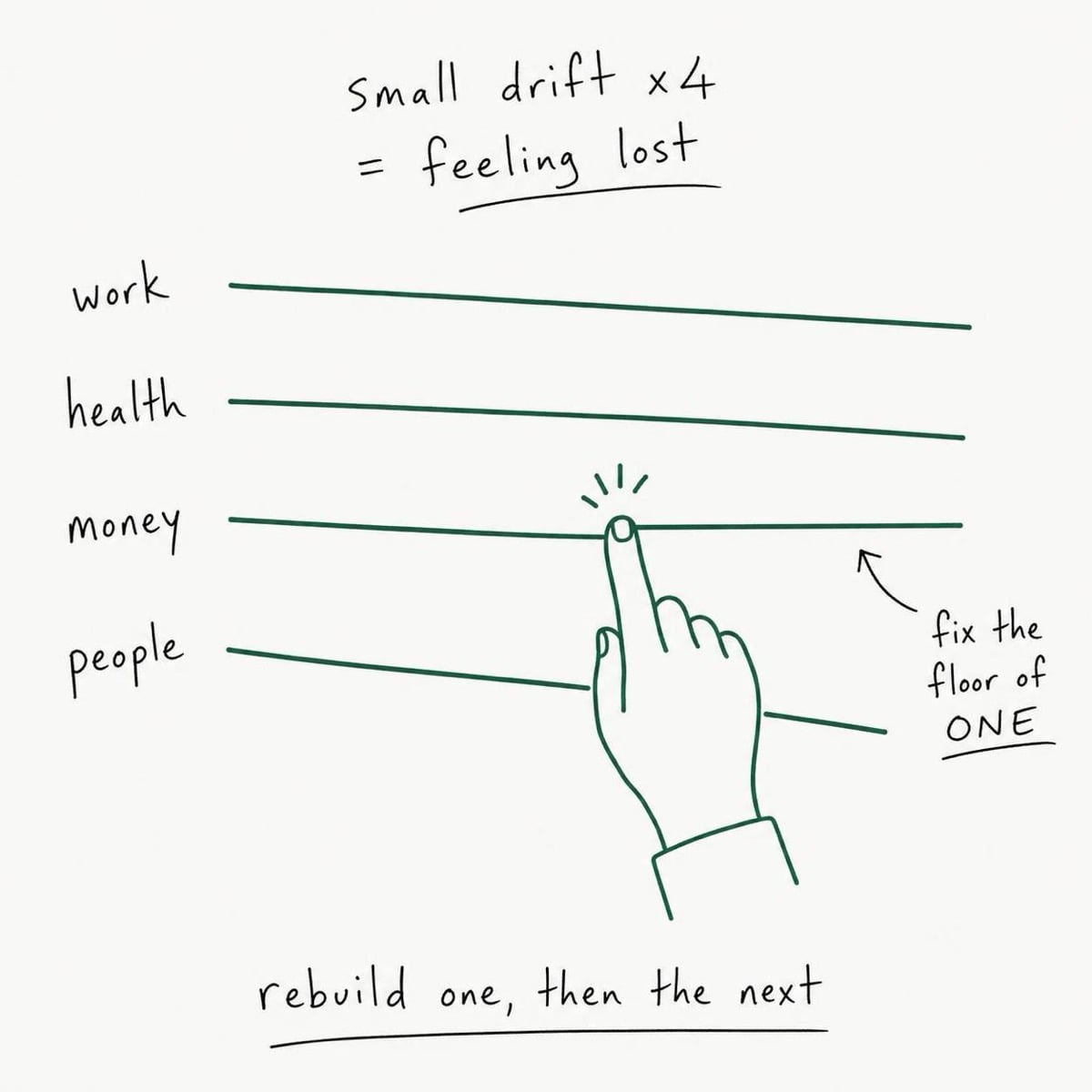
The reframe that changes everything: feeling lost in your 40s is not a calling to make one big leap. It is a signal that the floor has dropped a little in several areas at once, and the fix is to rebuild the floor in one area first, not to overhaul your whole life this weekend. Most advice gets this exactly backwards. It tells you to quit the job, find your passion, blow it up. That impulse, the dramatic clean slate, is the most common way people make the lost feeling worse.
Here is the distinction that matters. A "ceiling" goal is the impressive version: run a marathon, hit a number in the bank, become a totally different person. A "floor" is the version that holds on your worst day: a ten-minute walk, a five-minute look at your accounts, one real conversation a week. When you feel lost, your ceilings are intact. It is your floors that quietly fell out. The lights are still on upstairs, but the foundation slipped, and that mismatch is what reads as drift.
This is why "finding purpose in your 40s" so often stalls. People go looking for a grand new purpose when what actually steadied them was rebuilding a stable daily floor in one domain. Purpose tends to show up after the floor is solid, not before. The developmental research backs this up: the midlife transition is described as a normal period of reassessing and making modifications, not a mandate to detonate everything. [4] Modifications. Not demolition.
And there is a quiet advantage hiding in the lost feeling. The very fact that your old routines stopped firing means the cues that used to run your days on autopilot have weakened, which is exactly the window when intentional change is easiest to install. The lost feeling is uncomfortable. It is also the opening.
How to Stop Feeling Lost: Rebuild One Domain First
To stop feeling lost in your 40s, pick the single domain that is dragging hardest right now and rebuild its floor before touching anything else. Trying to fix work, health, money, and relationships at the same time is the reason most midlife resets stall within a couple of months. A meta-analysis of multi-behavior interventions found that targeting one behavior at a time tends to succeed, while trying to change three or more domains at once shows weak and mixed results. [5] Sequence beats simultaneity.
Do the 5-second drift read. Before you fix anything, name where you actually are. Run through four areas quickly and rate each one as steady, drifting, or cold. Work: does it still fit, or do you feel lost in your career at 40 and just going through the motions? Health: are you recovering and sleeping, or running on fumes? Money: is there a system, or are you avoiding the numbers? People: is the closest relationship alive, or on autopilot? Whichever one you flinch at, that is your first floor. You do not need a spreadsheet. You need an honest five seconds.
Rebuild the floor, not the ceiling. Take that one domain and define its smallest holding version. If it is health, the floor is not a gym membership, it is a short walk after your morning coffee. BJ Fogg, who has coached more than 60,000 people through behavior change, found that habits stick when you make them small enough to do even when you are tired or distracted, then anchor them to something you already do. [6] Small is not a compromise here. Small is the mechanism. A floor you can hit on a bad day is worth more than a ceiling you abandon by Thursday. If health is your pick, our guide to building muscle in your 40s and our piece on healthy sleep habits both start from this floor-first idea.
Wire it to a cue, not to willpower. Do not rely on remembering or feeling motivated. Use an if-then plan: "after I pour my first coffee, I step outside for ten minutes." This single move does most of the work. Implementation intentions like these have been shown across hundreds of studies to raise follow-through with medium-to-large effects, precisely because they hand control to a situational cue instead of your fluctuating mood. [7] When you feel lost, your motivation is the least reliable thing you own. Anchor the floor to a cue and you stop needing it. The same logic applies whether you are rebuilding a daily routine, a morning routine that holds, or a weekly better money habit.
Let the first win fund the next. Do not add domain two until domain one runs on its own. This is the part people skip, and it is why they end up feeling stuck in a career and a body and a budget all at once, fixing none of them. One floor holding for a few weeks gives you proof you can rebuild, and that proof is what carries you into the next domain. We mapped the full sequence across all five areas in our midlife reset system, but you do not need the whole map to take the first step today.
What Rebuilding the First Floor Looks Like
Here is what the first floor looks like in practice, so it stops being abstract. Picture Devon, 46, a regional ops manager. On paper, fine. Inside, lost: the job feels like a rerun, he is up at 2am, and he and his wife have not had a real conversation in months. His instinct is the big leap, quit and "find something meaningful." That is the trap. He picks one floor instead.
He runs the 5-second drift read on a Sunday night. Work: drifting. Health: cold, he is sleeping badly and hasn't exercised since spring. People: drifting. Money: steady. The one he flinches at is health, because the bad sleep is poisoning everything else. So that is floor one. Not a transformation. A floor.
His floor version is a ten-minute walk after his morning coffee, anchored to the cue, never the clock. On a brutal day, the floor shrinks to stepping out the front door and back. That is the whole commitment. Week one he walks four days. Wednesday gets blown up by a work fire and he skips. The old Devon would have read that skip as proof he "can't stick to anything." The new rule is simpler: miss once if you have to, never twice. He walks Thursday.
By week three the walk runs itself, and something he did not plan for happens. The walks clear his head enough that he starts sleeping better, and the better sleep makes the 2am spiral quieter. He has not touched the job or the marriage yet. But he no longer feels lost in the fog of exhaustion, which means he can finally think straight about them. Around week five he adds floor two: a Friday evening walk with his wife, the relationship floor, anchored to the end of the work week.
A few months in, Devon has not become a different man who found his passion. He rebuilt two floors in sequence, and the lost feeling drained out as the foundation came back. The job question is still open. But now he is asking it from solid ground instead of from the floor of a bad night. This is the everyday shape of a midlife crisis that turns into a quiet rebuild instead of a blowup.
But I Have Felt This Way for Years
Maybe you have felt lost for longer than a season and you are skeptical that one ten-minute floor changes anything. Fair. The honest answer: the floor is not meant to fix the lost feeling directly. It is meant to give you one stable place to stand, and standing somewhere solid is what makes the bigger questions answerable. You cannot think clearly about your career from inside chronic exhaustion. The floor buys you the clarity, then the clarity does the rest.
The other doubt is usually about time. You are stretched across kids, work, maybe aging parents, the whole work-life balance squeeze. But the floor is two to ten minutes. That is not another obligation, it is the one thing on your list scaled small enough to survive the weeks when everything else explodes. And if the lost feeling comes with real signs of depression, not just drift, that is a different problem and worth a conversation with a professional. Floors help with drift. They are not a substitute for care when something clinical is going on.
A Calm First Step
You do not have to figure out your whole life this week. Feeling lost in your 40s is not the question "what is my purpose," it is the smaller, kinder question "which one floor do I rebuild first." Run the 5-second drift read tonight. Name the one domain you flinch at. Define its floor, the version that holds on your worst day, and anchor it to a cue you already have tomorrow morning.
That is the entire first step. One floor, one domain, one cue. Not a clean slate, not a new identity, not a leap. The thread did not snap. It came loose in a few places at once, and you get to pick up one end and start there. You are not behind. You are at the part of the curve where the rebuild begins.


