

Doug can name the year the trade stopped paying. He cannot explain why he kept making it.
He is 49, seventeen years into a sales career built on 60-hour weeks and a phone that never went face down. The weeks still happen. The raises got smaller, then stopped. He needs two days to recover from what used to cost him one, and what he says out loud at a kitchen table at 11pm is that he no longer knows how to want a Saturday.
Every article about hustle culture is written for someone twenty years younger, warning them not to start. You already started. You bought the whole package, and some of it delivered. That is the version nobody writes.
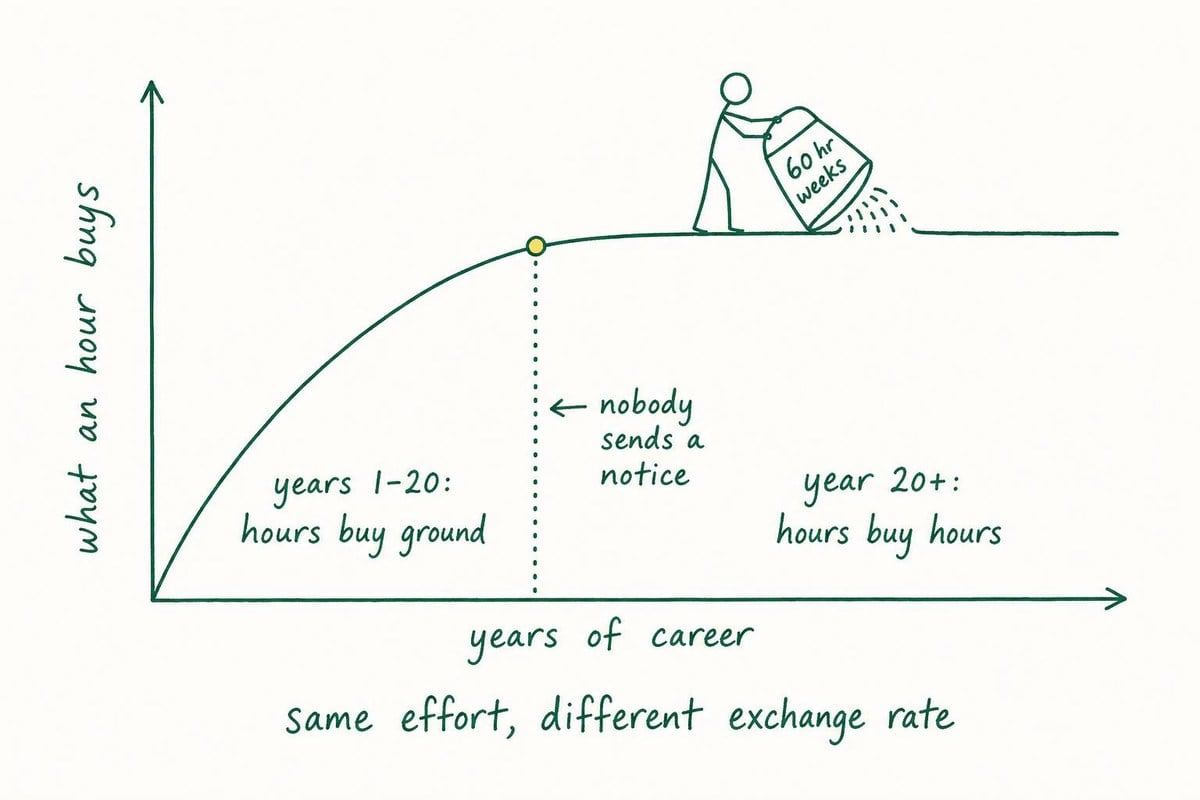
Hustle culture is the belief that your work should absorb whatever time is left, and that visible strain is proof of ambition. The rules come from outside you: employers, branding, the people you were competing with. Leaving is not a personality change. Call it a re-pricing. You paid in hours because hours used to buy the most, and around year twenty they stopped.
What hustle culture actually is, and where it came from
Hustle culture is an ideology about time, not about effort. It holds that ambition is measured in hours visibly given up, that rest is a debt you service later, and that any gap in your calendar is a gap in your character. The word is older than the ideology. "Hustle" arrived in English in the 1680s from the Dutch hutselen, to shake or toss, and picked up its American commercial meanings in the 1800s: to sell goods aggressively by 1887, and "pushing activity, activity in the interest of success" by 1891. [1]
The version you lived through got assembled between 2014 and 2019. By mid-2014, "rise and grind" was already a mass daily ritual online, with nearly 30,000 tweets in a single scraped week. [2] In January 2018 it became a book jacket, when Daymond John published Rise and Grind: Outperform, Outwork, and Outhustle Your Way to a More Successful and Rewarding Life. [3]
The backlash named it almost immediately. On 6 November 2018, on the main stage at Web Summit in Lisbon, Reddit cofounder Alexis Ohanian popularized the term "hustle porn" in front of an arena. "This is one of the most toxic, dangerous things in tech right now," he said. "This idea that unless you are suffering, grinding working every hour of every day, you're not working hard enough." [4] Ten weeks later, Erin Griffith put "hustle culture" into general circulation in the New York Times, tying it to WeWork wall slogans and Nike's "Rise and Grind" campaign. [5]
None of that invented anything. David Spencer, who heads the economics division at the University of Leeds, put the long view plainly in that same article: "There has been an ongoing struggle by employers to venerate work in ways that distract from its unappealing features." [6] The sociologist Tressie McMillan Cottom names what the 2010s repackaging actually moved: risk, off institutions and onto individual people, dressed up as personal ambition. [7]
You did not fall for a fad. You accepted a deal that a lot of institutions had good reasons to offer you.
The part nobody concedes: it worked
Here is where most anti-hustle writing loses you specifically. It insists the hours were always wasted. They were not. For roughly the first two decades of a career, the hours bought real ground, and the earnings data says so.
Across 18 countries, wage profiles rise for at least the first 20 years of work experience and only then flatten or turn down. In the US, wages at 20 years of experience run about 75% above where they started. [8] Across 57 years of Social Security records and 27 birth cohorts, the difference between one cohort's lifetime earnings and another's traces almost entirely to where people landed on entry, not to what they added later. [9]
So when you were 29 and took the extra account, the extra shift, the flight on a Sunday, you were buying at the bottom of a steep curve. Say it once without irony: that was a reasonable bet, and it paid.
Nobody sent a notice when the curve changed shape.
Why the trade goes bad around year twenty
The return on an extra hour drops on three separate clocks at once, and all three are running against you at 49 in a way they were not at 29. The output clock: past roughly 50 hours a week, hours stop converting into work. The earnings clock: the window for big gains narrows through your forties. The health clock: the bill for long weeks arrives on a delay measured in decades, which means it lands now.
Take them one at a time.
John Pencavel of Stanford found the output relationship is not a straight line. Below a threshold of 49 hours a week, output rises in proportion to hours. At and above it, output rises at a decreasing rate, and past about 60 hours, more hours barely move it at all. [10] That is a century-old munitions dataset, so the obvious objection is that it says nothing about knowledge work. A modern replication in call centres, where schedules were assigned rather than chosen, found a 1% increase in hours produced only a 0.9% increase in output. [11] You are busy rather than productive, at a worsening exchange rate.
The recovery finding from the same research is blunter. Weeks where the same total hours were spread across seven days instead of six produced roughly 10% less output. Seven days of labor bought six days of work. [12]
Then the earnings clock. In administrative records for millions of American workers, the chance of a large earnings gain shrinks steadily between 25 and 45, and after 45 the risk of a sharp fall starts rising instead. [13] Matched tax records put peak median earnings in the forties for most education groups, holding flat for over a decade, with one honest exception: graduate-degree holders keep climbing into their mid-fifties. [14]
And the health clock, which is the one hustle culture never prices. The WHO and ILO estimate that in 2016, 488 million people worked 55 or more hours a week, and that this exposure was behind 745,194 deaths from stroke and heart disease. [15] The threshold matters more than the headline. Pooling 22 studies and 839,680 people, weeks of 55 hours or more carried a 35% higher stroke risk against a 35 to 40 hour week. Weeks of 49 to 54 hours carried 13% more. Weeks of 41 to 48 showed no clear effect. [16] The heart disease analysis followed people for eight to 30 years. [17]
Read that last sentence again with your own decade in mind. The hours you worked at 32 were not free. They were financed.
The culture is outside you. The compulsion is not.
This is the distinction that decides whether leaving works. Hustle culture is external: the norms, the employer, the peer group, the branding. The compulsion to keep producing after the pressure lifts is internal, and it does not resign when you do. People quit the 60-hour job, take the calmer role, and find themselves inventing work by Wednesday.
Occupational psychologists split heavy work investment into two separate things: working excessively, which is behavioral, and working compulsively, which is cognitive. The measure was validated on 7,594 Dutch and 3,311 Japanese employees, and the researchers are direct about the error most people make. "Conceiving workaholism exclusively in terms of the number of working hours is misleading because it neglects its addictive nature." [18]
The evidence for that separation is stranger than it sounds. In a study of 1,246 Dutch employees, the group that spent the most time working of anyone was not the group with the highest burnout. The people who were both driven and engaged worked the longest weeks and did not pay the highest price. [19] A critical review of the whole hours-and-health literature reaches a compatible conclusion: the direct causal effect of hours on wellbeing is far weaker than everyone assumes. [20]
Which gives you a better diagnostic than counting hours. Not "how many did I work" but "could I have stopped." If the honest answer is no, cutting your week to 45 hours will produce a very productive, very anxious 45 hours. That internal half has its own map, and we wrote it separately: toxic productivity is about what you do in the gap after the pressure lifts. This piece is about the gap the culture never let you have.
Linda, 52, ran into this the hard way. She left a firm that ran on visible strain and joined one that does not, then spent four months finding things to worry about at 9pm because the quiet felt like slipping. Changing the culture around her removed the demand. It did not remove the habit, and neither will a calmer job if the yes is reflexive people-pleasing.
The exit is four moves, not a resignation letter
What replaces hours is not fewer hours. Detachment does it: being mentally off, not merely physically away. That is the mechanism with the strongest evidence behind it, and the one most people skip, because it looks like doing nothing and hustle culture trained you to read that as decay.
A meta-analysis pooling 91 samples and 38,124 employees found detachment during non-work time associated with less exhaustion (r = -0.36) and less fatigue (r = -0.42), plus better sleep and higher life satisfaction. Its effect on task performance was small, r = 0.09. [21] That asymmetry is the point: switching off protects your capacity far more reliably than it boosts your output. Do it for the first reason.
One: put a hard end on one day, not on the week. Sabine Sonnentag's diary work found the cruel pattern early. High workload predicts worse evening detachment, and the fatigue benefit of detaching is strongest on exactly the days with the highest time pressure. [22] The days you most want to skip are the days it pays most. Pick one, make it non-negotiable, leave the rest of the week alone for now. This is slow living built for a demanding week: one block gets a clean turn while the rest waits. This is slow living built for a demanding week: one block gets a clean turn while the rest waits.
Two: pick the evening activity for what it does, not what it looks like. Across five days and 74 employees, social, low-effort and physical evening activities predicted next-morning vigor, and the reason was that they produced detachment and relaxation. [23] The activity is a delivery vehicle. A walk that you spend rehearsing tomorrow's meeting delivers nothing.
Three: stop treating recovery as the reward for the sprint. In a 30-day study of 110 cadets, daily work pressure produced higher task performance only when people had recovered between shifts. [24] Recovery is an input to the pressure, not a prize for surviving it.
Four: decide what a good week is before it starts. Hustle culture never defines enough, which is what makes it inexhaustible. Write down the two things that must be true by Friday. Everything else is optional by definition. If that feels impossible, the problem is priorities rather than time, and a life audit is the wider version of the same exercise.
Four moves, not twelve. Someone working 58 hours does not need a system, they need three of those hours back with their brain off.
What the first month actually looks like
Doug started with Thursday. Laptop shut at 6:30pm, phone in a drawer in the hall, and a rule he wrote down because he knew he would negotiate with himself: nothing gets reopened, and anything urgent gets handled at 7am Friday instead. Week one, he checked the drawer twice. Week three, he forgot the phone was in it.
He did not cut a single hour off his total in month one. He moved them. Thursday evening went to a 7pm basketball league he was worse at than he expected, and Friday morning absorbed the work he used to spread thinly across Thursday night. Sales did not drop. The two days of recovery he needed after a hard week became one.
Month two, he added the definition of enough: two outcomes on a card every Monday. On the weeks he hit them by Thursday, he stopped, which felt wrong for about six weeks and then stopped feeling like anything.
What did not happen: he did not downshift, move to the country, or discover he had never really cared about his career. He still likes winning. The re-pricing did not require him to become a different person, which is the part the exit-from-hustle genre keeps getting wrong. If the wider rebuild is what you are after, that is work life balance after 40, and if you are running on empty already, start at burnout recovery stages instead.
"My industry doesn't work like that"
Sometimes true, usually less true than it feels. The version worth taking seriously: you are afraid that easing off means losing ground you cannot get back at 50.
The data does not support the fear in its strongest form. Following the same workers over four decades, hourly wages do not decline with age for most cohorts. Late-career earnings fall mainly because hours fall as people ease toward retirement, not because the market suddenly pays a 55-year-old less per hour. [25] Your rate is holding. The volume is what you are choosing.
And the ground is shifting underneath everyone anyway. US full-time employees averaged 44.1 hours a week in 2019 and 42.9 in 2024, with under-35s cutting roughly twice as much as older workers. [26]
Meanwhile the people still absorbing the old norm are the ones your age. In Pew's 2024 data, 84% of workers 50 and over say they do more than what is expected of them, against 64% of workers 18 to 29. [27] You are not holding a line. You are holding a line that has already moved, which is a specific kind of expensive.
Start with Thursday
Do not write a manifesto about balance. Pick one evening this week and put a hard end on it.
Shut the laptop at a time you decide in advance. Put the phone somewhere that requires standing up. Then notice what your mind does at 8pm, because that reaction is the real diagnostic: relief means the culture was the problem, and a low-grade panic means the habit outlived the culture and toxic productivity is the piece you need next.
Doug is still competitive. He still works more than most people. He just stopped paying 1891 prices in 2026.
If the whole decade feels like it needs re-pricing rather than one evening, that conversation starts at midlife transition, or at starting over at 50 if the job itself is what has to change.
Frequently Asked Questions
Is hustle culture still a thing?
The branding faded and the behavior did not. In a survey of more than 26,000 workers across 35 markets, work-life balance outranked pay as the top job motivator for the first time, 83% to 82%, and that shift ran across all ages rather than one generation. But the group still reporting the highest discretionary effort is workers over 50, so if the culture feels alive to you at 48, that is because it mostly persists in your own cohort.
Is Gen Z rejecting hustle culture?
Partly, and less than the headlines claim. In Deloitte's survey of 22,595 Gen Z and millennial respondents across 44 countries, only 6% say reaching a leadership position is their primary career goal, though 76% of Gen Zs want to lead at some point. They are deferring the ladder, not refusing it. And they still out-hustle every older cohort on second jobs: 34% of Gen Z report a side hustle against 23% of Gen X and 22% of boomers.


