
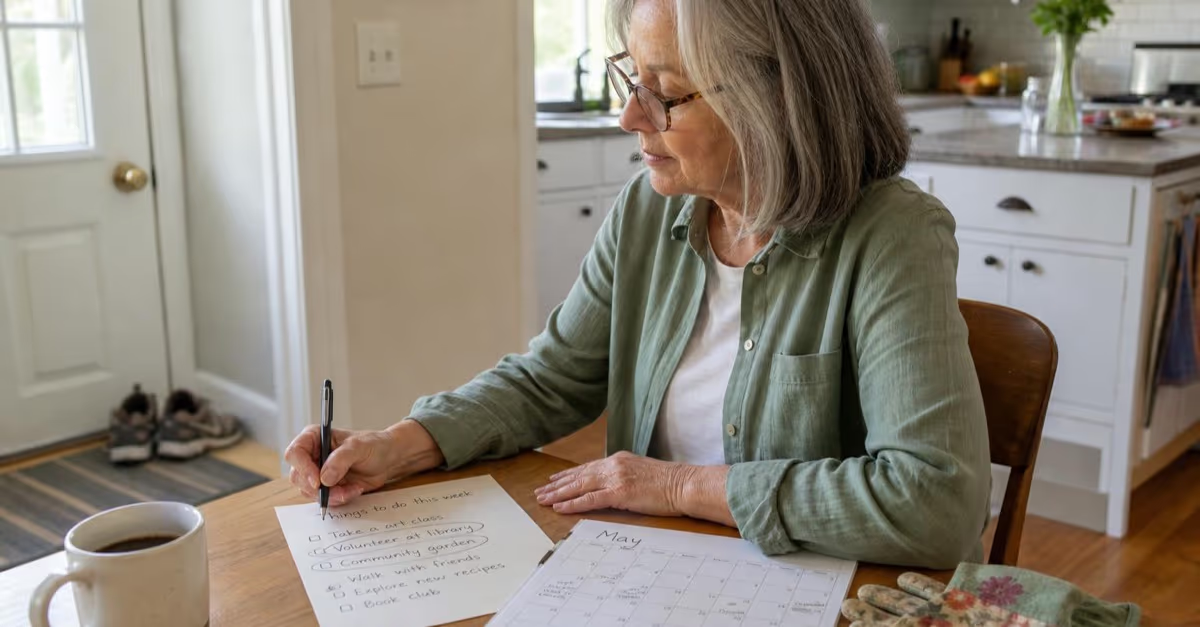
Ellen has been retired for six weeks. Her browser holds 19 tabs: pottery classes, volunteer roles, pickleball lessons, and a walking tour she is not sure her knee can handle.
She closes all of them and waters the tomatoes.
The problem is not a lack of things to do when you retire. It is the distance between an appealing idea and a Tuesday you would repeat. Every option stays perfect because none has met your budget, energy, calendar, or actual interest.
These 101 things to do when you retire give you a way to stop browsing.
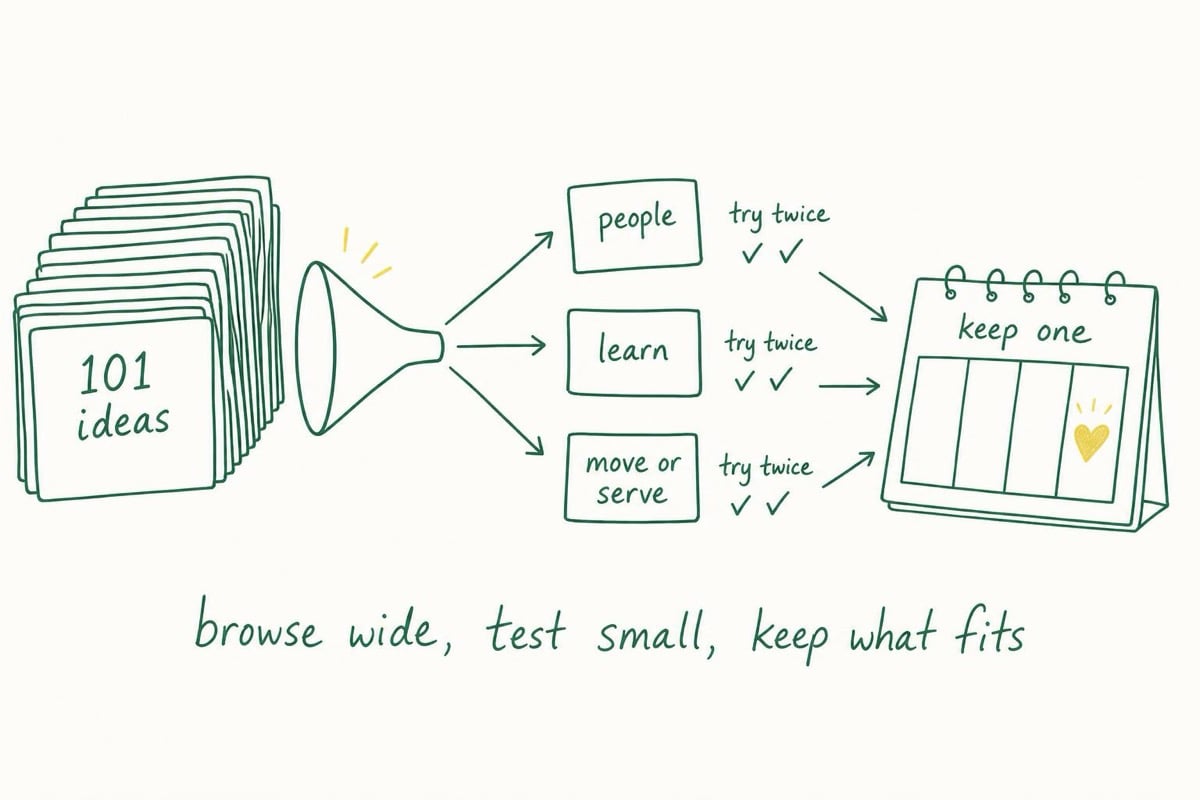
Choose three. Try each twice. Keep one for a month.
That is the 3-2-1 Retirement Trial. The numbers are an operating rule, not a tested formula. They turn a wish list into evidence from your week.
Why 101 good ideas can still leave you stuck
A long retirement list is useful for discovery but poor at making the decision for you. “Learn pottery” says nothing about the drive, fee, grip strength, social setting, or whether you enjoy being a beginner. The answer is not to find the perfect item on paper. Narrow the field with real constraints, then let two small trials tell you more than another hour of comparison.
More choice does not always make decisions worse; the effect depends on the task and stakes. But extra options can raise comparison work. In one randomized experiment, 192 adults reviewed 3, 10, or 20 hypothetical Medicare drug plans. More plans and older age were associated with fewer correct answers. [1]
A Medicare plan is not a watercolor class. Set criteria before comparing.
Run each idea through four filters:
- Access: Can you reach it, enter it, hear it, see it, or do it from home?
- Energy: Does it fit the body and attention you have now, including a lower-energy day?
- Money: Can you test it without buying the identity first?
- Return: Are you looking for connection, challenge, contribution, calm, or plain fun?
A good option fits your life before it improves your life.
Use the 3-2-1 Retirement Trial before you commit
The 3-2-1 Retirement Trial is a short decision sequence: select three activities with different returns, try each one twice within two weeks, then keep one recurring commitment for the next month. Two attempts prevent one awkward class or rainy morning from making the decision. Keeping one prevents retirement from becoming another overloaded calendar. This is an editorial test, not a validated treatment or promise.
Choose three different returns
Pick one activity that gets you around people, one that asks you to learn or make, and one that brings movement, service, or outdoor time. Overlap is fine. Avoid choosing three solitary screen-based ideas or three options that need perfect weather.
No universal “best first thing” exists. Test an ordinary week before a dramatic reinvention. Our best retirement advice from retirees makes the same Tuesday-level distinction: retirement has to work between the highlights.
Try each one twice
Keep the first trial small. Borrow supplies, attend as a guest, walk the first mile, or volunteer for one shift. For medical, balance, heat, or fall risks, ask a clinician what fits before testing. On the second try, change one variable: time, place, pace, partner, cost, or difficulty.
Keep one for a month
Choose the activity you want to return to, not the one that sounds best. Put four dates on the calendar. Let the rest of these 101 things to do when you retire wait.
If open time still has no shape, build a daily routine after 60 around a few fixed anchors before adding more. An activity without a place in the week remains a tab.
101 things to do when you retire
These 101 things to do when you retire are grouped for practical use, not as a ranking. Mark ten options that fit your access, energy, money, and desired return. Cut them to three, then run the 3-2-1 Retirement Trial. The groups help you scan for at-home, outdoor, creative, social, paid, service, and unusual options without treating one category as better.
At home and easy to start
- Create a family recipe archive.
- Record short audio stories from your life.
- Grow herbs on a windowsill.
- Learn one new dinner each week.
- Restore a piece of furniture.
- Build a family photo index.
- Host a monthly film night.
- Read through one author's work.
- Join an online book discussion.
- Learn basic drawing from library books.
- Start a jigsaw-puzzle swap.
- Write letters to old friends.
- Map your family history.
- Learn conversational phrases for a future trip.
- Make a seasonal bird log.
- Start a neighborhood tool library.
- Repair clothes instead of replacing them.
- Build a personal music history playlist.
- Take a free virtual museum tour.
- Finish one abandoned home project.
See our 50 low-cost hobbies for more inexpensive options.
Move and spend time outdoors
- Join a beginner walking group.
- Try a water-aerobics class.
- Learn tai chi with a qualified instructor.
- Walk every street in your neighborhood.
- Train for a charity walk.
- Volunteer in a community garden.
- Learn local bird calls.
- Take a park photography walk.
- Try adaptive cycling.
- Join a gentle hiking group.
- Learn lawn bowling or bocce.
- Take a beginner dance class.
- Walk shelter dogs.
- Help maintain a local trail.
- Plan one transit-only day trip.
Fit movement to your health, not an internet age label. Ask a clinician what is safe for your condition.
Learn and make something
- Take a ceramics class.
- Learn digital photography.
- Study local history.
- Build a simple bench.
- Learn basic sewing.
- Join a community choir.
- Take piano lessons again.
- Learn watercolor painting.
- Make a short documentary about your town.
- Study astronomy and attend a star party.
- Learn to sharpen kitchen tools.
- Build a small website.
- Take an acting workshop.
- Learn sign language.
- Make a neighborhood field guide.
- Join a writing workshop.
- Learn chess well enough to teach it.
- Take a college course without pursuing a degree.
- Earn a practical certification you want.
- Apprentice informally with a local craftsperson.
A 2024 longitudinal analysis of 8,771 Health and Retirement Study participants found different patterns across physical, creative, cognitive, and community engagement. Physical activity had the most consistent positive associations, while other domains were mixed. The evidence was observational, not causal. [2]
Meet people and build recurring contact
- Start a standing Tuesday coffee.
- Join a library reading group.
- Host a rotating neighborhood lunch.
- Attend a faith or reflection group.
- Join a community theater crew.
- Organize a monthly board-game table.
- Become a museum member and attend talks.
- Join a local language exchange.
- Start a grandparent-and-grandchild project day.
- Attend city council meetings.
- Join an amateur radio club.
- Start a walking interview project with neighbors.
- Plan a cousins' reunion.
- Offer a spare seat for local events.
- Join a travel club before booking a trip.
Contribute, mentor, or earn
- Tutor an adult learner.
- Mentor someone entering your former field.
- Staff one weekly food-bank shift.
- Help a nonprofit improve its bookkeeping.
- Coach interview skills at a workforce center.
- Serve as an election worker.
- Translate for a community organization.
- Repair items at a repair cafe.
- Deliver library books to homebound readers.
- Foster an animal.
- Teach one workshop at a community center.
- Help preserve a local archive.
- Join a nonprofit advisory committee.
- Offer respite help through a vetted organization.
- Lead a school career-day session.
- Consult two days a month.
- Turn a craft into a small seasonal business.
- Work part time at a place you already enjoy.
- Start a service with a fixed client limit.
- Build a legacy project someone can use.
In a longitudinal study of 3,740 people at or above pension age in England, volunteering was associated with better outcomes across several measures, though relationships shrank after health and demographic adjustments. The study did not prove causation. Feeling appreciated and sustained participation mattered, so test the role as carefully as the task. [3]
If paid contribution fits better, explore our encore career ideas or a tightly bounded way to start a business at 60. Retirement does not fail because useful work remains in it.
Try something unusual or local
- Sleep one night in a nearby historic inn.
- Take a behind-the-scenes factory tour.
- Ride the full route of a local bus line.
- Attend a public court session.
- Enter one item in a county fair.
- Learn a traditional dance from your region.
- Visit every branch of your library system.
- Take a dawn nature walk.
- Exchange homes with a trusted friend for a weekend.
- Design a self-guided tour of your town.
- Let a grandchild or younger friend choose the day.
What to do when a retirement activity does not stick
An activity can fail for four different reasons: the logistics were wrong, the difficulty was wrong, the social setting was wrong, or the activity answered a need you do not have. Do not convert one bad fit into “retirement is boring” or “I never follow through.” Change one variable and test again. If the second attempt still feels flat, release it without buying more equipment.
Use the diagnosis that matches the miss:
- You wanted to go but did not: reduce travel, cost, setup, or calendar friction.
- You went and felt underused: raise the standard, add a teacher, audience, deadline, or progression.
- You liked the task but not the room: change the group, time, or level.
- Nothing about it mattered: stop. A popular activity does not need to become your activity.
A cross-sectional study of older air-volleyball players associated sustained engagement with social support, flow, and measures the authors grouped under successful aging. Its selected sample and design cannot show causation, much less that one hobby cures boredom. [4]
The modest lesson: progression and a social world may help an activity hold attention. If your week is full but everything feels too easy, our article on retirement boredom handles that challenge gap directly. If the deeper issue is “none of this counts,” start with our finding purpose in retirement instead of adding another class.
Test before buying. A failed activity is evidence, not a verdict on retirement.
What the 3-2-1 trial looks like in a real week
A useful retirement trial fits around the life you already have. Ellen chose a library writing group for people, a beginner ceramics session for learning, and a Saturday park walk for movement. She tried each twice across two weeks. Then she kept the writing group for a month, not because it sounded most impressive, but because she was thinking about the next meeting on the drive home.
Her trial looked like this:
- Writing group: quiet and uncertain once; two pages, three learned names, and anticipation the second time.
- Ceramics: painful grip once; better with an adapted tool, though the drive still felt wasteful.
- Park walk: rain-shortened once; pleasant with a neighbor, but not a weekly pull.
The second attempt changed the evidence. She did not delete travel, gardening, or pottery from retirement. She stopped asking all of them to begin this month.
What if money, mobility, or caregiving narrows the list?
Constraints change the version worth testing. Replace distance with local access, equipment with borrowing, long sessions with shorter ones, standing roles with seated or remote roles, and weekly commitments with twice-monthly work. Name the constraint before choosing so an inaccessible option does not look like a motivation problem. Good fit begins by respecting the life and body doing the activity.
For local US support, the federal Eldercare Locator connects older adults and families with Area Agencies on Aging and nearby services. It cannot guarantee that a program has space, but it gives you a real place to ask about transportation, senior centers, classes, volunteer roles, and caregiver support. [5]
The “$1,000 a month rule” is a savings rule of thumb, not an activity budget. One version estimates roughly $240,000 for each $1,000 of monthly portfolio income using a 5% withdrawal assumption. Kiplinger reports that some planners consider that rate too aggressive. It cannot replace a plan covering taxes, inflation, health costs, location, and time horizon. [6]
Use your own safe-spending amount to filter the list. Our guides to how much money you need to retire and why retirement planning matters can prepare questions for a qualified financial professional.
The cited evidence does not identify one “happiest age to retire.” A 2024 study of 532 retirees in Singapore found three life-satisfaction paths: declining, stable, and increasing. It cannot predict an American reader, but it does not support one universal optimum. [7]
If activities that used to appeal no longer register, the flat feeling crosses work, relationships, sleep, or daily function, or ordinary tasks feel impossible, do not treat that as a list problem. Talk with a doctor or mental health professional. A 3-2-1 trial cannot diagnose grief, depression, cognitive change, medication effects, or illness.
Start with three, not 101
Circle three ideas now: one around people, one that asks you to learn or make, and one that adds movement, service, or outdoor time. Check access, energy, money, and the return you want. Put two small trials for each on the next two weeks of your calendar. After each, write one line about what pulled you back or pushed you away.
Then stop browsing.
After the sixth trial, keep one for a month. If none earns a return, use the six results to sharpen your next three.
A list of 101 things to do when you retire does not demand 101 commitments. It needs one part of next Tuesday that you would willingly meet again.