

The three-hour museum shift sounded easy. Then came the commute, ninety minutes standing, a school group, and a request to cover Saturday. By dinner, the "little retirement job" had taken the day.
Most lists of low-stress jobs after retirement miss that problem. Stress lives in the match between a job's demands and your energy, body, schedule, income needs, and tolerance for urgency.
A pleasant role can drain you. Bookkeeping carries accuracy pressure. Dog walking changes when weather, pulling, and a sore knee enter the shift.
So we are not going to crown one "best" job. We will build a shortlist that fits your week. That is enough to change the search entirely.
The Lowest-Stress Job Is the One That Fits Your Load
The easiest job for a senior is not a universal role. It is work whose physical, social, cognitive, and time demands fit your capacity, with enough control over how and when you do it and support when something goes wrong. Start by defining the load you can repeat, then compare duties. A calm title cannot rescue a bad match between the work and your week.
A three-year follow-up of older employees treated job demands, control, and support as separate factors associated with mental health. It did not prove causation, but it shows why "easy job" is too blunt. [1]
In a six-year English panel, people working beyond pension age for enjoyment or activity reported higher quality of life than those working from financial pressure. That is association, not proof; health, money, and prior quality of life shape who keeps working. [2]
A seven-wave Swedish study separated post-retirement motives into money, social contact, and personal meaning. One job may meet one motive and fail the others. [3]
Before browsing job boards, picture the daily routine you want after 60, then finish this sentence:
I want work to give me ______, without costing me ______.
"Some income, without losing three recovery days" is useful. "People to talk to, without being responsible for a team" is useful. "Something meaningful" is too vague to screen a schedule.
Use the Five-Gate Stress-Load Filter
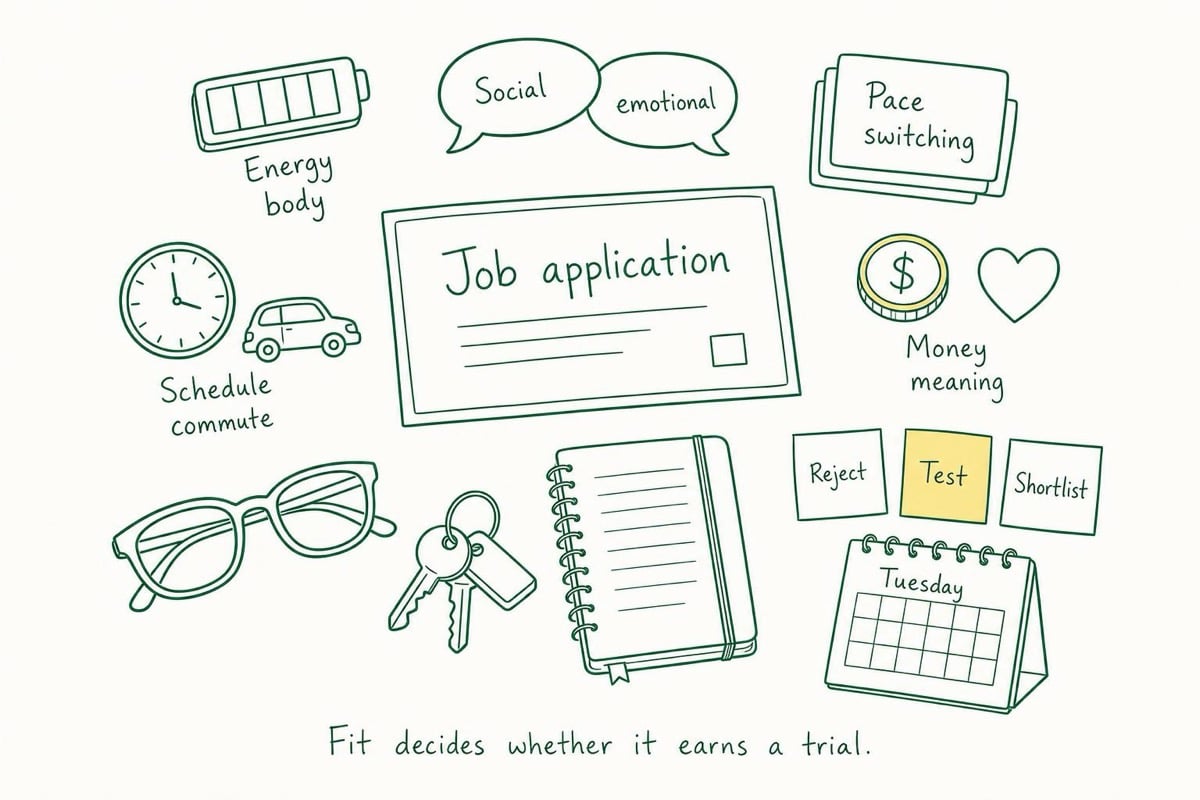
The Stress-Load Filter tests a role against five parts of your real week: energy and body, social and emotional load, pace and switching, schedule and commute, and money and meaning. A job reaches your shortlist only when it clears all five. One red constraint can outweigh several appealing features, while a yellow constraint needs a written limit before you agree to the work.
1. Energy and body
List what an ordinary shift asks of you: standing, sitting, lifting, driving, screens, noise, stairs, temperature, and recovery.
Use a red, yellow, green rule:
- Red: a demand you cannot safely or sustainably accept.
- Yellow: a demand you can accept only with a limit, such as two hours of standing or no night driving.
- Green: a demand that fits without special recovery.
Do not negotiate with a red item because the role sounds fun. If a job is safety-sensitive or you are unsure how a health condition affects the work, discuss the duties with a qualified health professional.
2. Social and emotional load
"People-facing" can mean one student, a line of impatient customers, or a distressed client. Those are different jobs.
Choose one-to-one contact, small groups, a public counter, phone work, or solitary tasks. Set limits on conflict, complaints, caregiving, and responsibility for other people's outcomes.
3. Pace and switching
Some work is demanding because it moves fast. Other work is demanding because it requires long concentration and punishes small errors.
Ask how often the role interrupts you, how quickly you must respond, and what happens after a mistake. "Remote" says nothing about these conditions. A quiet home office can still hold back-to-back calls, monitoring software, and an inbox that never closes.
4. Schedule and commute
Control is more than working fewer hours. A fixed four-hour shift, a self-scheduled project, an on-call slot, and a seasonal rush all place time differently. If pace is the main constraint, use the same boundary logic as slow living: fewer claims, held deliberately.
Count the whole work window: getting ready, travel, waiting, the shift, and recovery. A three-hour job with a one-hour commute each way is a five-hour claim on the day before recovery enters the math.
5. Money and meaning
Set an income floor, not a fantasy number. Then name the return you want besides money: contribution, contact, mastery, routine, or variety. If unstructured days are the real problem, address retirement boredom before turning a job into the only source of structure.
This is where people accidentally rebuild the career they retired from. A familiar title and respectable pay can smuggle back deadlines, status pressure, and open-ended responsibility. Retirement gives you permission to choose a smaller role on purpose.
Compare Low-Stress Jobs After Retirement by Shape
Compare low-stress jobs after retirement by job shape, then inspect the employer's version of the work. Quiet, one-to-one, accuracy-based, public-facing, active, and seasonal roles each carry a different load. No shape is automatically easy. Use the table to identify two or three possibilities, then ask about the duties, pace, schedule, and responsibility that a short title leaves out in practice.
| Job shape | Examples | Often offers | Load to inspect before saying yes |
|---|---|---|---|
| Quiet and predictable | Library assistant, records work | Routine, clear tasks, familiar location | Standing, shelving, public questions, fixed shifts |
| One-to-one | Tutor, mentor | Bounded contact, visible contribution | Preparation, travel, cancellations, difficult student needs |
| Accuracy-based | Bookkeeping, proofreading | Independent focus, possible remote work | Deadlines, error cost, screen time, client revisions |
| Bounded public contact | Museum or tour guide, event usher | Social contact, local knowledge, short shifts | Walking, crowds, public speaking, weekends, weather |
| Animal or outdoor | Pet care, garden-center work | Movement, variety, less desk time | Lifting, pulling, cleaning, heat, cold, unpredictable animals |
| Seasonal expertise | Tax preparation, election work | Defined season, skills use, clear finish line | Deadline spikes, training, accuracy, anxious clients |
O*NET's job descriptions make the hidden work visible. A library assistant may shelve materials, register patrons, handle cash, and provide customer service. [4]
Tutoring can involve individuals or small groups, but it may also require travel, preparation, and customer service. [5] Bookkeeping combines records, forms, office work, accuracy, and client contact. [6] Proofreading trades live customer traffic for sustained concentration, turnaround times, and revision conversations. [7]
The same honesty applies to jobs that look playful. Tour guiding can mean public speaking, walking, weather, and crowd management. [8] Animal care can include feeding, grooming, exercise, cleaning, records, and unpredictable behavior. [9] Tax preparation can bring client service, training, seasonal deadlines, and responsibility for accurate returns. [10]
Build a Shortlist From Non-Negotiables
To build a useful shortlist, start with constraints and let them remove bad fits. Imagine Rita, 67, wants $800 to $1,000 a month, two weekdays of structure, and regular conversation. She does not want evening driving, more than an hour of continuous standing, or responsibility that follows her home. Those limits matter more than the number of appealing titles she can find.
A generic list might send Rita toward tour guiding because it sounds social and fun. The filter catches two red items: standing and variable timing. Remote proofreading passes the body and schedule gates but fails the contact goal. Small-group tutoring at a nearby library may survive all five gates, provided preparation time and cancellations are clear.
That is a shortlist: not the job you love on paper, but two or three roles worth testing. If none survives, explore other things to do when you retire instead of forcing paid work to fit.
Use the same logic to filter low-stress jobs after retirement by common search qualifiers:
- No experience: Favor paid, bounded training. Ask what day one requires and who helps when you get stuck.
- No degree: Check licensing, background, software, and physical requirements. No degree does not mean no entry friction.
- Remote: Ask about call volume, monitoring, response time, equipment, and guaranteed hours.
- Pays well: Compare net income with training, preparation, commuting, taxes, and recovery.
- Near me: A modest local role may beat higher-paid remote work if it brings firmer boundaries and a clean stop.
If your real question is broader than stress, use our guide to choosing an encore career that fits. That article starts with purpose and work shape. This one starts with load.
Check the Money Rules Before Accepting Hours
Before accepting hours, compare gross pay with benefit rules, taxes, Medicare premiums, unpaid preparation, travel, and equipment you must buy. The same monthly income can land differently for an employee, contractor, or person already claiming benefits. Do not copy a threshold from an old article. Write down the questions, take them to the right agency or qualified professional, and decide with current information.
The strongest retirement advice from retirees starts with protecting choices. Before accepting work, write down four questions for the right agency or adviser:
- How could these earnings interact with Social Security benefits at my age and claiming status?
- What taxes or estimated payments might apply to employee, contract, or self-employment income?
- Could added income affect Medicare premiums?
- Which work costs will I pay myself?
Medicare uses modified adjusted gross income from the tax return two years earlier when deciding whether an income-related monthly adjustment amount applies. The rules and thresholds can change, so check the current handbook and your own situation rather than copying an old figure from a listicle. [11]
For Social Security, ask the agency about current work rules before setting a monthly target. For taxes or Medicare, a qualified professional can explain your case. This article cannot do that calculation for you.
Screen the Opportunity, Not Just the Job
A good job shape can still arrive through a bad offer. Screen the employer, recruiter, pay method, duties, and hiring steps before sharing personal information or spending money. Upfront fees and reshipping requests are hard stops, not quirks to explain away. A legitimate employer can name the legal company, describe the work, identify a supervisor, state the schedule and pay, and provide verifiable hiring paperwork.
Treat these as hard stops:
- You must pay a fee to get the job.
- The employer sends a check and asks you to buy equipment or return part of the money.
- The work involves receiving, repackaging, or forwarding merchandise.
- The recruiter will not name the legal employer, explain the work, or use a verifiable company address.
- The pay is unusually high for simple remote tasks and the recruiter pushes you to act immediately.
The U.S. Postal Inspection Service states plainly that job offers requiring fees to get started are scams. [12] It also warns that reshipping schemes may recruit people to receive and forward packages bought with stolen cards or counterfeit money orders. [13]
A legitimate employer can answer specific questions about duties, supervisor, schedule, pay method, and hiring paperwork. If the details stay foggy, walk away.
Run the Tuesday Test
The Tuesday Test checks whether a job fits an ordinary week, not whether the interview or first day felt promising. Where the employer and role allow it, ask for a limited start: two weeks, two shifts, one small client, or one short project. Track the load and recovery, then apply a stopping rule written before the trial. Tuesday has no first-day novelty and no Friday relief.
After each work period, record five things from 1 to 5:
- Dread before: How much resistance appeared before the shift?
- Load during: Which demand used the most energy?
- Recovery after: How long until you felt like yourself again?
- Spillover: Did work take time promised to health, family, or rest?
- Return: Did the money, contact, meaning, or routine justify the load?
Set the stopping rule before the test. If the decision is tangled with health, money, family, or purpose, do a quick life audit first. For example: "If recovery takes the next day after both shifts, I will reduce the hours or decline the role." A rule written in advance is harder to bargain away because you like the people or hate disappointing them.
Do not ask whether the job was perfect. Ask whether the week is repeatable.
Choose One Shape, Then Test It
The best low-stress jobs after retirement do not share one title. They share a fit: manageable demands, enough control, a clear reason for working, and a week you can repeat. Choose one shape that passes your five gates, verify the employer and money rules, then test a bounded version. The right role earns a place in your life by leaving room for the rest of it.
Pick one job shape. Ask about the hidden load. Run a bounded Tuesday Test. Keep the role only if it leaves room for the life retirement was meant to hold.