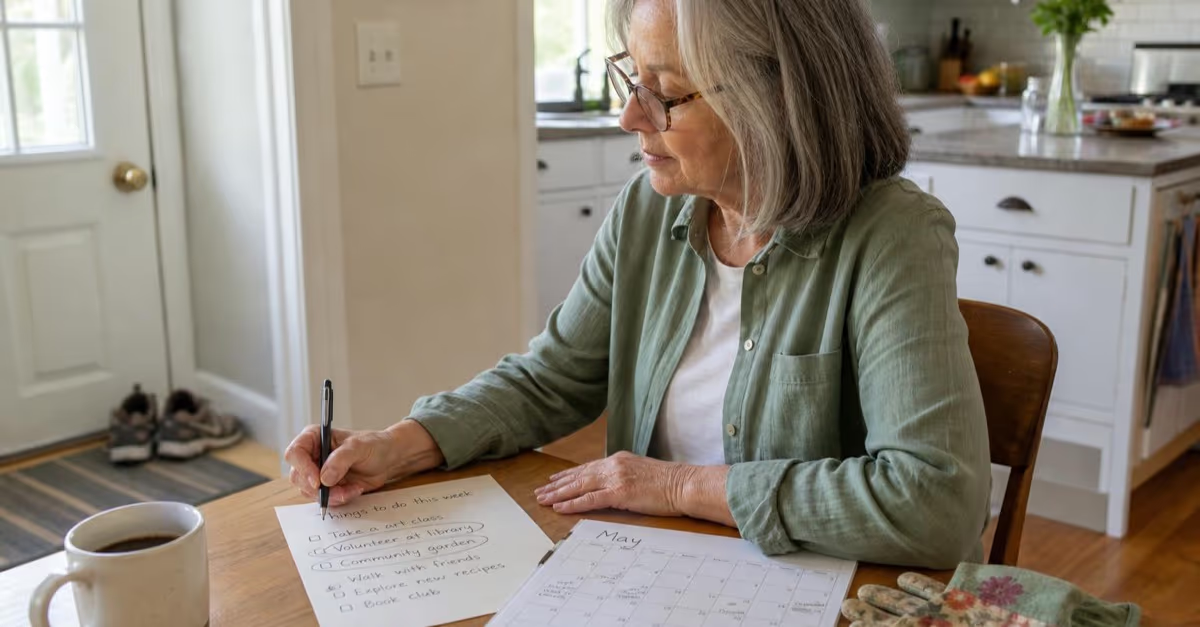

Somewhere in your house, there is a kit.
A watercolor set with three colors used. A guitar with one broken string. A telescope that cost more than you tell people. Each arrived with real intent. Each is now storage.
The usual explanation is that you lost interest. We think that reads it backwards. Almost nobody over 70 has an ideas shortage. Lists of hobbies for seniors over 70 are everywhere, and most repeat each other. What is missing is a way to tell, before the money leaves your account, whether a hobby fits the life you have: your hands on an ordinary morning, your ride across town after dark, your patience for a loud room.
Pick by fit, not by appeal. A hobby that looks wonderful and fits badly ends up in the closet with the telescope.
What are good hobbies for seniors over 70?
Good hobbies for seniors over 70 are the ones that match four things: what your body can do on an average day, how easily you can reach the activity, how much company you want while doing it, and what a single session leaves behind. Gardening, walking groups, card clubs, choir, birding, woodworking, quilting, photography, genealogy, language study, and volunteering all qualify for somebody. Our view is that category matters far less than fit.
Having a hobby does track with feeling better. A 2023 study pooled five longitudinal surveys covering 93,263 adults aged 65 and older across 16 countries and found hobby engagement associated with fewer depressive symptoms and with higher self-reported health, happiness, and life satisfaction. Those are associations across whole populations, not a promise. What no study can tell you is which hobby is yours. [1]
Why hobby lists stop working after 70
Hobby lists tend to fail after 70 because they are written for an average body and an empty calendar. They rarely price in arthritic hands, a hearing loss that turns a busy craft room into work, a driving limit that ends at dusk, or a spouse who needs care at four. The idea is rarely the problem. The gap between the idea and an ordinary Tuesday usually is.
A 2024 systematic review of 37 studies covering 26,961 adults aged 70 to 101 found concerns about health and fitness among the most commonly reported barriers, alongside environmental and practical obstacles, and could not rank them into one universal order. [2]
Those constraints are common, not exotic. About half of US adults aged 65 and older have arthritis. [3] In a nationally representative audiometric sample, hearing loss was present in 63.1% of adults aged 70 and older. [4] Neither number rules anything out. Plenty of people with arthritis quilt, and plenty with hearing aids sing in choirs.
Those numbers explain why "just join a pottery class" lands differently at 74 than at 44, and why the abandoned kit was never a character failure. It is the trap we described in retirement boredom: adding activities to an empty week does not fix it.
The Four-Fit Check: body, access, company, payoff
The Four-Fit Check is our test for whether a hobby survives past the novelty. Can you do this on an average day rather than your best one? Can you start it this week without a favor or a big purchase? Does the amount of company match what you want? Does one session leave something behind? Our rule of thumb: fail one filter and a hobby can usually be adapted, fail two and it goes back on the shelf.
Run all four before you buy anything. Five minutes might save you the $260 telescope.
Body fit: an average day, not your best day
Score the hobby against a normal Tuesday, stiff morning included. How long must you stand? What does it ask of grip, knees, balance, eyes, and ears? Can you stop halfway through without ruining the work?
Federal guidance for older adults sets a target of 150 to 300 minutes of moderate aerobic activity per week plus muscle-strengthening and balance work, then adds a provision worth quoting: "When older adults cannot do 150 minutes of moderate-intensity aerobic activity a week because of chronic conditions, they should be as physically active as their abilities and conditions allow." [5] Match the load to the body you have. Balance earns extra weight: in 2018, 27.5% of US adults aged 65 and older reported at least one fall in the previous year. [6] Ladders and icy trails are not off the table, but they should be a decision rather than an accident. If you are unsure whether a hobby's physical demands suit you, ask your doctor before you start rather than after.
Access fit: could you start it this week
Access is the filter we watch people skip, and in our experience it ends more hobbies than boredom does. How will you get there, and can you get home? What does the first month cost, and can you quit without wasting it? Do you need a favor to attend? A hobby needing a 30-minute drive after sunset, a $400 starter purchase, and someone else's schedule has three fragile points. A library genealogy session two blocks away has none. Start where friction is low.
Company fit: how much of this needs other people
Some people want a room. Others want a workbench and a closed door. The research is honest about it. A critical review of leisure activity in later life found social activities carried the most associations with wellbeing, health, or survival, with solitary activities also represented. It does not cleanly compare matched social and solo hobbies, so treat this as a preference to design around rather than a rule. [7]
Connection still deserves weight. A meta-analysis of 16 longitudinal datasets linked poor social relationships to a 29% higher risk of coronary heart disease (95% CI 1.04 to 1.59) and a 32% higher risk of stroke (95% CI 1.04 to 1.68), and a National Academies review reached the same broad conclusion for early death and dementia without one universal figure. [8] [9] Those are associations, not orders to join a club. They justify one design choice: if your week already contains almost nobody, give at least one hobby a built-in reason to be near people, even if that means a shared woodshop instead of your garage.
Payoff fit: what one session leaves behind
A hobby that returns nothing inside a single session runs on willpower, which is poor fuel at any age. Look for a session that ends with something finished, something learned, or someone spoken to.
In one controlled study, novelty and difficulty mattered more than comfort. Synapse Project participants who spent three months learning quilting, digital photography, or both, averaging 16.51 hours a week, showed improved episodic memory compared with people assigned to social clubs or low-demand activities. That was an intensive program measuring one kind of memory, so read it as a direction rather than a dose. [10]
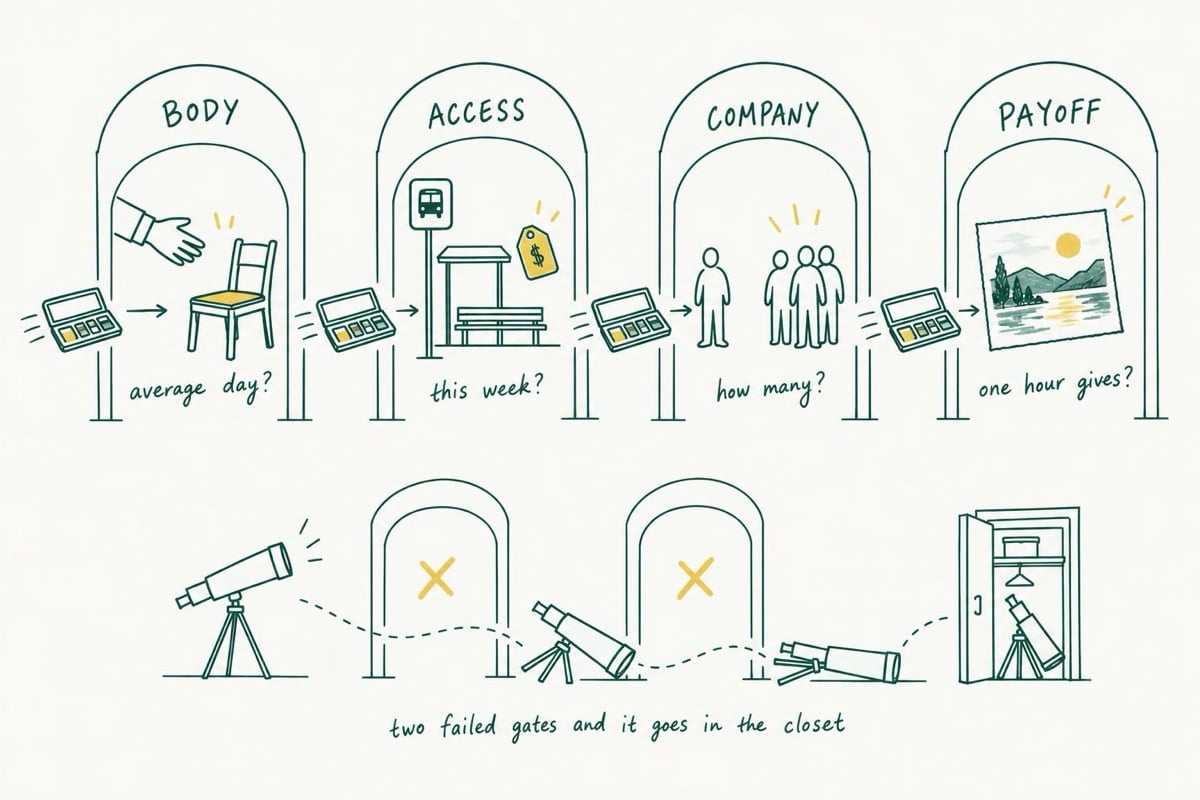
Illustration generated with ChatGPT image generation using the gpt-5.6-sol model.
Hobbies for seniors over 70 with limited mobility
For limited mobility or low energy, pick hobbies that work seated, stop cleanly at any point, and need no transportation. Container gardening, watercolor and drawing, knitting with larger needles, model building, genealogy research, letter writing, audiobooks paired with a reading group, chess or bridge online, ham radio, bird identification from one window, and any instrument you can play seated all qualify. Adapted tools often matter more than the category.
Two adjustments help most. Raise the surface, so wrists and shoulders are not fighting a low table, and cut the session into 20-minute blocks, so a bad day costs a block instead of a project. If the standing version of a hobby does not fit, look for the seated variant first. Chair yoga exists. So do raised beds.
Low-cost hobbies you can start at home this week
The cheapest hobbies for seniors over 70 use what a library, a park, a kitchen, or a phone already gives you: library book clubs, walking and birding with a borrowed field guide, drawing with a $6 pencil set, bread and soup cooking, seed-grown houseplants, memoir writing, free language apps, jigsaw puzzles swapped with neighbors, and volunteering. Spend money in the second month, not the first.
Buying equipment first turns a test into a commitment, and the commitments we regret end up in the closet. Our list of 101 things to do when you retire is a good place to shop; run candidates through the four filters before you spend.
Hobbies that put you in a room with other people
If your week is short on faces, choose hobbies with the company built into the format instead of relying on yourself to socialize afterward. Choirs and community bands, bridge and mahjong clubs, bowling and pickleball leagues, community garden plots, pottery co-ops, walking groups, faith and civic groups, museum docent work, and adult-education classes all come with a scheduled time and a room. A recurring weekly slot tends to survive better than an open invitation.
In a loud room, sit near the front or pick a smaller group; straining to hear turns a pleasure into work. And if walking in cold feels awkward, take a job. Handling the sign-in sheet gives you a reason to be there and a script for the first twenty minutes, which is the logic behind our guide to encore career ideas: a defined role is easier to enter than an open room.
Unusual hobbies worth a look
We like unusual hobbies for seniors for a practical reason: a small group is easier to walk into than a full class, and easier to be taught in. Consider beekeeping, mushroom foraging with a local club, letterboxing, urban sketching, home fermenting, model railroading, stained glass, geocaching, or restoring one specific object such as clocks or fountain pens. Foraging and beekeeping carry real safety considerations, so learn those through an organized group rather than a video.
Run a two-week trial before you buy the equipment
Give every serious candidate a two-week trial: four sessions, borrowed gear, at the real time of day you would do it. Then score three things. Did you go without talking yourself into it? Did your body feel worse the next morning? Did you want to book the next session before this one ended? Two yeses and one no is a keeper. Three noes is information, not failure.
Ray, 74, ran this after his shed filled with abandoned starts. He tested woodturning at a community shop and birding on Saturday mornings with borrowed binoculars. Woodturning failed access fit: a 25-minute drive and a scheduling favor from his daughter. Birding did not. After four Saturdays he had 31 species listed and two people who noticed when he missed one.
Joanne, 71, wanted something that would not stop when her knees hurt. Watercolor at her kitchen table cleared body and access fit and left something finished every session. A Wednesday-night choir cleared company fit and failed access on the drive home in the dark, so she moved to a daytime chorus.
Neither went looking for passion. They ran a test and let the enjoyment show up later. Our bias: one workable weekly slot is worth more than a brilliant idea you never start, which is the principle behind building a daily routine after 60.
What if nothing sounds appealing?
When nothing on any list appeals, do not force a choice. Start with a person or a place instead of an activity: ask one friend what they do on Tuesdays and go along once, or walk into the library, senior center, or community college and read the board. In our experience interest often follows contact rather than arriving first. A life audit can show whether empty hours are the problem or a symptom.
Take the flatness seriously if it persists. Weeks of finding nothing appealing is a conversation for your doctor, not another project. No article can tell a dull month from something that needs care.
You may also meet the "5 hobbies rule" while searching. It is tidy internet advice with no research behind it and no identifiable origin. We would rather you found one hobby that fits than five that sound balanced. And if the restlessness is about the whole week rather than a free afternoon, our retirement advice from retirees is the better starting point, leaving a legacy covers wanting contribution rather than pastime, and low-stress jobs after retirement treats money pressure as its own decision.
Book the first session, not the whole hobby
Pick one candidate and run it through the Four-Fit Check tonight. If it clears three filters, put four sessions on the calendar over the next two weeks using borrowed gear. Do not buy anything yet. Book the first session and let an ordinary Tuesday decide. Choosing among hobbies for seniors over 70 is a testing problem, not a taste problem.
The kit in your closet was not a mistake. It was an untested guess.