

When work stops taking up most of the week, leaving a legacy can feel like a question wearing a funeral suit: What will be left when you're gone?
That framing feels remote and slightly grim. You start thinking about money, a memoir, a foundation, or a speech someone might give about you.
But the better test happens while you're here.
Can one person use what you know? Can a family practice hold because you started it? Can a younger colleague make a better decision because you showed them where the hidden cost sits?
A legacy does not need to make you unforgettable. It needs to make something useful repeatable.
What leaving a legacy means while you are still here
Leaving a legacy means passing forward something that can shape another person's choices, capabilities, or care. Money and property can do that, but so can teaching, mentoring, stories, standards, community work, and traditions. The useful question is not only, “What will people remember?” It is, “What can someone do, understand, or continue because you passed it on?” That makes legacy a living practice, not only an end-of-life plan.
Psychologist Erik Erikson called the wider impulse generativity: concern with establishing and guiding the next generation. A modern scoping review shows how broad that can be, including parenting, teaching, mentoring, maintaining institutions, and caring for natural resources. It also warns that contribution is not automatically good just because it survives. What we pass on still deserves scrutiny. [1]
That distinction matters after 60. You may no longer have a job title that makes your contribution obvious, but the capacity did not disappear with the title. Research following 861 adults from ages 40 to 84 found that generative concern stayed relatively stable from 50 to 70 before declining after 70. The study measured concern, not completed contribution, and it does not say age causes the decline. Still, it cuts against the lazy idea that legacy will somehow take care of itself later. [2]
Your legacy starts when another person can use it, not when a future audience praises it.
Why legacy plans stay abstract
Legacy plans stay abstract when they begin with identity instead of usefulness. Wanting to be remembered as generous is about reputation. Teaching two neighborhood teenagers how to prepare for a first job interview names people, a transfer, and an action. The second creates evidence that your values have reached someone beyond you. Until a recipient and use are named, nothing can be tested.
Most guidance on leaving a legacy leans toward three familiar answers: pass down values, organize family assets, and write what matters. Those are reasonable. They are also incomplete because they often skip the recipient.
A letter no one wants to read is an artifact, not a successful handoff. Advice that ignores the learner's problem is a monologue. A recurring volunteer shift that exhausts you within a month is not durable simply because it sounds noble.
This is where purpose and legacy separate. Purpose answers, “What gives my life direction now?” Legacy answers, “What useful pattern can continue beyond this moment?” Our guide to finding purpose in retirement explains what work may have been supplying before retirement. Leaving a legacy begins one step later: turn one part of that contribution into something another person can receive and repeat.
The reframe is simple:
Do not start with the mark you want to leave. Start with the person you want to help.
That moves legacy out of the future and into a real relationship, project, or practice today.
Build your Contribution Loop
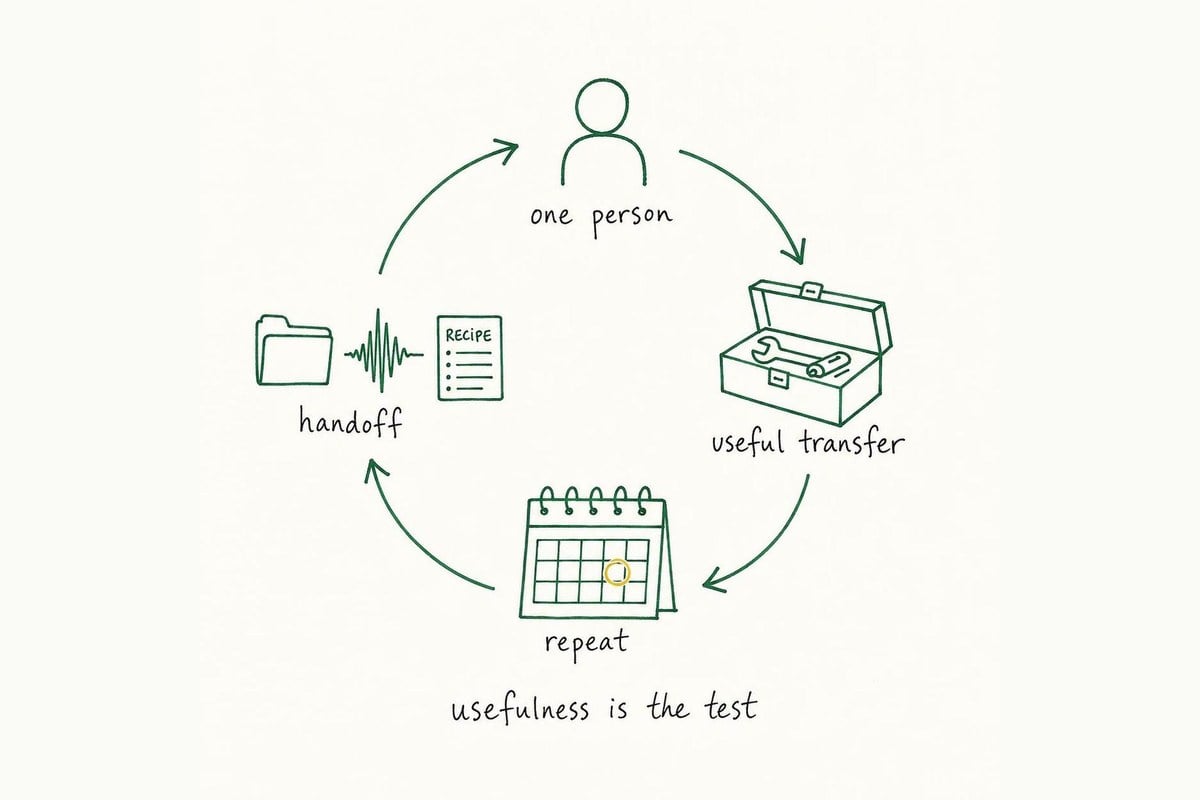
The Contribution Loop turns a legacy intention into four connected decisions: choose one person or group, transfer one useful thing, repeat the contribution on a schedule, and create a handoff that can survive your absence. The loop stays small enough to test and concrete enough to improve. If the recipient gets no value or the practice drains you, adjust it before trying to make it permanent.
The Contribution Loop is a LifeHack editorial framework, not a clinically tested intervention. Its parts draw on research about generativity, intergenerational programs, implementation intentions, and legacy artifacts. Use it as a way to think and test, not as a promise that every act of service will create meaning.
1. Name one person or group
“Future generations” is too large to plan for on Tuesday morning. Pick someone close enough to understand:
- one new manager in your former field
- one grandchild who wants to learn the family recipes
- one local group struggling with a process you know well
- one caregiver who needs practical relief
- one community workshop that could use your craft
Intergenerational programs can create opportunities for connection, knowledge sharing, and mutual understanding. A 2023 evidence map found a broad mix of observational and mixed-methods studies, not one guaranteed effect. The design and relationship matter. [3]
If paid work is the right channel, our encore career ideas can help you separate contribution from job-title nostalgia. Building a small company is another route, but starting a business at 60 carries different risk, money, and energy demands than mentoring one person.
2. Transfer one useful thing
A value becomes easier to carry when it has a form. “Be resourceful” is vague. Ellen, 71, could turn that value into a one-page guide to handling a difficult client. A recorded cooking lesson, a repair checklist, or a monthly conversation also gives someone something to use.
Ask the recipient two questions:
- What problem are you trying to solve?
- What would make this useful next week?
Their answer may bruise your original plan. Good. Legacy is not self-expression alone. It is transfer.
3. Put it on a repeatable schedule
The action needs a home in your week. If-then plans specify when, where, and how you will act, which can help narrow the gap between intention and behavior. “If it is Tuesday at 10 a.m., spend 30 minutes reviewing one apprentice's work” is stronger than “mentor more.” [4]
Build the practice into a daily routine after 60, but do not confuse frequency with virtue. Weekly may work. Monthly may fit your health, caregiving load, or access better. A longitudinal study of 19,821 adults in 15 European countries found reciprocal links between frequent volunteering, emotional well-being, and daily functioning. It also found that loneliness, health conditions, and activity limits could impede participation. Capacity shapes contribution, not just the other way around. [5]
4. Make a handoff
A handoff lets the value travel without requiring you to be in the room. It might be:
- a story with the lesson stated plainly
- an instruction sheet with the common mistake marked
- a recurring family or community ritual
- an introduction between two people
- an audio or video demonstration
- a nonlegal ethical will that records values and hopes
A scoping review of ethical wills screened 1,948 publications and included 51, yet only six were research articles. That is a useful warning against grand claims. The literature does support text, audio, and video as ways people express values, lessons, history, hope, apology, or forgiveness. It does not prove that recipients will preserve or act on them. [6]
Do not seal the artifact and declare victory. Give it to someone. Ask what was clear, what was missing, and what they would actually keep.
Choose a legacy lane that fits your actual life
A sustainable legacy fits your relationships, skills, money, energy, and access. You do not need to cover every lane. Choose one: family and values, community and service, craft and knowledge, or financial support. These are practical planning buckets, not a validated scientific taxonomy. Their purpose is to stop comparison and help you find a contribution you can begin without pretending every form requires the same resources.
Family and values might mean recording the story behind a decision, teaching a recipe, or starting a gathering others can host. Ellen could ask the new manager who used her client guide to add the mistake she missed, then pass the revised page to the next hire. A qualitative study of 16 adults age 65 or older found that values legacies could be created in the community, before a life-limiting diagnosis, through reflection, instruction, and sharing. The sample was small and already engaged in legacy work, so it shows feasibility, not a universal preference. [7]
Community and service might mean one recurring volunteer role, a neighborhood resource, or quiet administrative help for a small organization. Regular volunteering has been associated with purpose and several psychosocial outcomes in older adults, but association is not causation. A systematic review of 40 papers found favorable cohort results that experimental studies did not confirm, and no clear best type or dose. [8]
Craft and knowledge might mean mentoring, documenting a process, teaching a class, or repairing something alongside a learner. The durable part is not the object alone. It is the judgment hidden in the process.
Financial support can matter, from an education fund to a local donation. Keep it bounded by a real retirement plan. Our overview of why retirement planning matters is a starting point, not a substitute for legal, tax, or financial advice.
Run a seven-day legacy test
A seven-day legacy test is one small transfer to one real recipient, followed by direct feedback. Do not launch a foundation, draft a 200-page memoir, or promise a year of service. Choose a problem you understand, give one useful piece of help, and ask whether it worked. The aim is not to prove your life's significance in a week. It is to replace fantasy with information.
Suppose Ray, 68, spent three decades managing building projects. He says he wants to “give back,” but that phrase has sat untouched for two years.
On Monday, he texts a former colleague who now supervises younger staff: “What mistake costs new project managers the most time?” She replies that they commit to a schedule before checking who controls the dependencies.
On Wednesday, Ray makes a one-page dependency checklist from memory. On Friday, two new managers use it against a live project. One step confuses them. Another catches a supplier risk they had missed.
Ray revises the page and offers a 30-minute review on the first Friday of each month. His legacy project is no longer “share my experience.” It is a checklist, a conversation, and a schedule with named users.
The same test works with a family story, a recorded sewing lesson, a food-bank guide, or a garden routine. If the first version does not help, change it. If the schedule does not fit, change the frequency. If the recipient does not want it, listen.
This also keeps contribution from becoming another attempt to fix retirement boredom by packing the calendar. Our article on the best retirement advice from retirees uses an ordinary-Tuesday test for the same reason. A plan has to work between the highlights.
What if your contribution feels too small?
A small contribution is not a lesser legacy if someone can use it. Scale can even hide weak transfer: a public audience may applaud an idea without adopting it, while one person quietly uses a checklist for years. Judge the work by usefulness, fit, and continuity. Then let it grow only when the next recipient, not your ego, creates a reason to expand.
Leaving a legacy can become another achievement trap. You may compare your family recipe to a scholarship fund, your monthly mentoring call to someone else's nonprofit, or your community garden bed to a famous book.
Stop grading different lanes on one scale.
Money measures financial capacity. Audience measures reach. Neither tells you whether the contribution reached the right person or whether they could carry it forward.
Nor does service guarantee health or happiness. A small randomized study of 73 healthy women age 60 or older found that six weeks of writing life experience and advice produced some short-term social and psychological improvements compared with neutral writing. The authors called the evidence preliminary, and the study did not test whether recipients benefited or whether the legacy lasted. [9]
Contribution should fit the life you have. If fatigue, low mood, pain, or loss of interest is limiting you across daily life, talk with a qualified health professional rather than treating a legacy project as medical care.
Start with one useful handoff
Leaving a legacy starts with one recipient and one question: “What could you pass on that would make something easier, wiser, or more humane?” Listen before you build. Make the smallest useful version. Put the next exchange on the calendar only if it fits both lives. Then create a handoff another person can understand, use, and share without you beside it.
The Full Life Framework maps the wider health, family, work, money, purpose, and leisure context around that choice. But do not map your whole life today.
Send one message. Make one useful transfer. Let another person's use, not your future reputation, tell you what deserves to last.