

The Advice Says "Just Say No." Your Calendar Says Otherwise.
Most advice about setting personal boundaries at work assumes you can decline. You often can't, or the cost of declining lands somewhere you won't see until review season. The request shows up as a calendar invite nobody asked you about, a thread with your manager's manager on it, or a 5:40pm message that says no rush. So you absorb it. Again. And the cost arrives later, in a reply that came out sharper than you meant.
You already know what you want. An evening that stays yours. A Thursday that still has the two clear hours you blocked on Monday. A weekend where nobody needs a quick look at the deck.
What you don't have is a version of this that survives contact with a real job. You put your working hours in the calendar, and three people booked over them in a week. You stopped answering anything after seven, and made it four days before a launch pulled you back in. The advice wasn't wrong. It was written for someone with more control over their week than you have.
Why Work Boundaries Fail Even When You Word Them Well
Work boundaries fail for structural reasons, not personal ones. Three of them: the person making the request often has a say in your raise, so a flat no carries a price you can't see. Most requests arrive through systems rather than people, so nobody on the other end experiences it as an intrusion they chose. And the bill comes late, at 4pm or at 9pm, long after the moment you could have said something.
One more thing separates work from home. At home, a boundary mostly has to hold with one person. At work it has to hold against a dozen people who don't coordinate with each other, half of whom are also underwater.
Worth saying plainly, because the usual diagnosis is that you lack confidence. Sometimes that's part of it. If the yes is out of your mouth before you've thought about it, the problem sits upstream of any script, and our guide to the people-pleasing reflex is the better place to start. But plenty of people who are perfectly able to say no still lose their evenings, because what they're up against is a set of defaults nobody ever consciously set.
Setting Personal Boundaries at Work Means Changing a Default, Not Having a Conversation
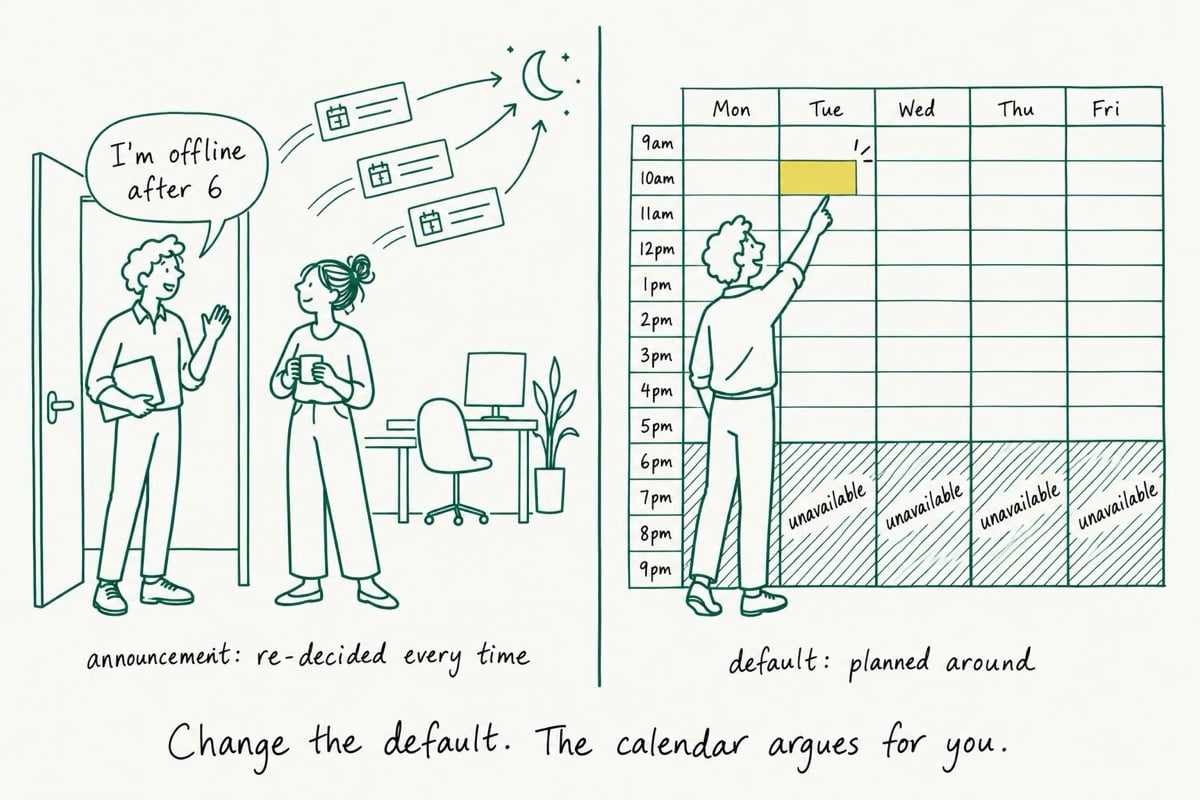
A work boundary is a standing default that settles the ordinary case before anyone asks: when your day ends, what a meeting has to include to get booked, how fast a message gets answered, and what comes off your plate before something new goes on. An announcement gets re-argued every time a request lands. A default gets planned around, because people route around what the system shows them.
That's the one real advantage you have at work. You can't stop your manager from needing things. You can make the ordinary case visible, in the calendar and in writing, so the only conversations left are about exceptions.
We've made a related argument about boundaries outside work: there, the boundary is your own pre-decided response rather than the sentence you say out loud, and that piece covers what to do on the second crossing. Work differs in one useful way. Your calendar, your working-hours setting and your team's written norms do part of the enforcing for you, which is why the written version matters more here than the spoken one. If you want the general definition first, we have a separate explainer on personal boundaries.
Most people reach for the evening first, and protecting it is a reasonable instinct: the recovery research on mentally switching off after hours is real, and we walk through it in our piece on toxic productivity. The limitation is that the evening is downstream. By the time you are guarding it, the demands that filled it have already been set, by a calendar nobody questioned and a norm nobody wrote down. So this piece stays inside working hours, where those two things get decided.
How to Set Personal Boundaries at Work in Five Steps
Find out which demand is actually driving the load, change one default rather than five, and answer requests with a tradeoff instead of a refusal. Then put the new default where the work happens, and run the count again in two weeks. The order matters. Most people start at step three with a script, then have the same conversation every week because nothing underneath it changed.
1. Count the demand for one week instead of rating your stress
For five working days, tally four things: messages you answered after your stated end time, meetings booked with no gap on either side, requests that landed after 4pm, and tasks added to your plate with nothing taken off. Four marks on a sticky note. Nothing else.
A tally beats a feeling for one practical reason. You can put a tally in front of a manager. "I'm stressed" invites sympathy and changes nothing. "Eleven of my meetings last week had no gap, and six requests arrived after 4pm" starts a scheduling conversation instead.
Swap in whichever four things are actually eating your week. The count is the point, not these four. If the result comes back ambiguous, two related reads: what a two-minute reset can and can't change, and why the tiredness shows up at a particular hour.
2. Change one default, not five
Pick the single default your tally points at, and hold it for a month. Candidates, in rough order of how little permission they need:
- Working hours set in your calendar, so booking outside them takes a deliberate click.
- Phone notifications off after a fixed time, with no change to your actual hours yet.
- A standing block that has a name and a purpose, not an empty hold.
- A rule that meetings with no agenda get a reply asking what decision needs making.
- A response-time norm you state once: same day during hours, next morning after.
Five defaults changed at once reads as a protest. One holds, and the next is easier because the first is still standing.
3. Answer requests with a tradeoff, not a refusal
The format has three parts: yes, what moves, who decides. "I can take the audit this week. The vendor review would slip to the 14th. Which do you want first?"
That does three things a refusal can't. It keeps you cooperative, which protects a relationship you still have to work inside. It makes your real constraint visible, which is usually news to the person asking. And it hands the decision to the person who owns the priorities, which is where it belonged.
We should be straight about the status of this one. We looked for research testing whether a tradeoff lands better than a flat no and didn't find any we'd stand behind. It's our practical position, not a finding.
4. Decline the work nobody counts
Some requests cost hours and earn nothing. The note-taking, the onboarding doc, the committee that meets forever. There is real evidence about who ends up holding that work: in an experimental study in the American Economic Review, Linda Babcock, Maria Recalde, Lise Vesterlund and Laurie Weingart (2017) found that women, more than men, volunteered for, were asked to do, and accepted tasks described as low in promotability, and they point to a belief that women are likelier to say yes as a driver. It is an allocation experiment rather than a measured promotion penalty, so treat it as a pattern worth checking against your own team rather than a number.
The move isn't to refuse it. It's to name the work as recurring and propose a rotation, in writing, where the team can see it. Deciding what actually moves first helps when someone asks you to choose.
5. Put the new default where the work lives
A boundary that exists only in a conversation lasts until the next reorg. Put it in the calendar, in your status, in the team doc, in the thread. Not as a manifesto. One line, stated as a fact: "I'm offline after 6:30. If something's urgent, text me."
Five Scripts, and What One Week of This Looks Like
Scripts are the easy part, which is why most articles stop there. Five situations cover most of what a working week throws at you: the after-hours message, the last-minute request, the agenda-free meeting, scope creep mid-project, and the recurring task nobody wants. Use the wording below as a starting point and then make it sound like you. All five have the same shape: acknowledge, state the constraint, hand back the decision.
The 5:40pm message that says no rush. "Got it. I'll pick this up first thing tomorrow. If it has to be tonight, call me and I'll jump on."
The last-minute request. "I can have this Thursday. Today would mean the pricing doc slips. Your call which one."
The meeting with no agenda. "Happy to join. What decision are we making, so I can bring the numbers? If it's a status update, I can send mine instead."
Scope creep mid-project. "Good addition, and it's about two days of work. Do we move the date by two days, or drop the comparison page?"
The recurring office housework. "I've taken the notes for six weeks running. Can we rotate it from here? I'll go last in the first round."
Here's one week, as a composite rather than a real person. Megan, a product marketer, carries 22 meetings a week and answers messages until ten most nights. Her tally comes back lopsided: 31 after-hours messages answered, nine meetings with no gap, six requests after 4pm, three tasks added with nothing removed.
She changes one default. Calendar hours end at 6:30, notifications off after that, and anything arriving after 4pm gets answered the next morning. Her manager, Warren, pushes back on exactly one point, the East Coast client who sometimes needs a same-day answer. They settle on a named exception: Warren flags those himself, and Megan answers them. Everything else waits.
Nothing dramatic happens next. The after-hours count drops, mostly because what she was answering at nine never needed answering at nine. Two people book over her calendar hours anyway; she lets the first go and declines the second. The nine no-gap meetings are still there, because that one isn't hers to fix alone, so it goes on the list for her next conversation with Warren instead.
"My Manager Will Just Say No"
Sometimes they will. Three things to do with that. If your manager agrees and then forgets, send the tradeoff again in writing and let the written version carry it. If they refuse outright, ask which current commitment moves and let them pick, because a priority call is theirs to make and making them make it is the point. If nothing moves and the hours stay long, you are not looking at a boundary problem.
Hold onto that last one, because the honest limit of everything above is that a personal boundary is a reasonable response to an unreasonable load, not a cure for one. The World Health Organization's guidance on mental health at work names excessive workload and low job control as workplace risks, and recommends organizational change alongside individual support, which is a polite way of saying this was never supposed to be entirely your job. A tally helps here too, for an unglamorous reason: a count of what arrived and what moved is the kind of thing a manager can take to their own manager. One person's limit is a preference. Six weeks of the same numbers is a staffing problem.
If the real answer is that the hours themselves are the problem, that is a different article, and we have written about what a long-hours habit costs and how to re-price it.
If the stress is persistent, or it's interfering with your sleep, eating or how you function day to day, that's worth a conversation with a qualified health professional rather than a better script. What recovery actually looks like in stages is a reasonable next read, and it is not a substitute for that conversation.
Start With One Default This Week
Pick the default your week keeps breaking, and change only that one. Working hours in the calendar, or notifications off after a set time, or the 4pm rule. State it once, in writing, where your team will see it. Then keep the tally running two more weeks, because the only evidence that matters here is whether the count goes down.
If the harder part is that the yes happens before you can think, start with the people-pleasing reflex instead. The scripts work much better once that pause exists.


