
Fourteen things on the list. Eleven marked high. Two arrived from your boss this morning, three came out of a customer escalation, and one is the strategy memo you have moved four Mondays in a row.
Every item on that list is defensible. That is the problem.
Priority levels are supposed to sort this out. Most of the time they rename it. You add a field with P1, P2 and P3 in it, and within a month every request that matters to anyone shows up pre-stamped P1. The labels are tidier, and you are still at 7pm on Thursday choosing which promise to break.
Labels are not the mechanism. A priority level only works when it takes something away: a slot, a day, another task's place in line. A level that costs nothing gets spent freely, and a scale where everything is level one is a list with extra steps.
Here is what the levels mean, how to build a scale that forces a choice, and what to do when someone else assigns them.
What priority levels for tasks actually are
Priority levels for tasks are a fixed set of labels that rank work by the damage it prevents and how fast it must move. In IT service management the label comes out of a matrix: impact, the scale of business loss, combined with urgency, the speed of resolution expected, and the highest combination maps to Priority 1, Critical. [1] On a personal task list the label does the same job: what you do now, and what you drop to do it.
That heritage matters: incident teams write their top level down in painful detail. One network vendor defines a Priority 1 as a major business outage affecting critical sites, multiple sites, multiple VPN users, or critical applications. [2] Notice what that definition does not mention: who asked, how loudly, or how recently the request landed in your inbox.
How many levels should you have? There is no standard answer, and anyone who says exactly five is describing a house rule. One software provider's support terms run three: P1 Urgent, P2 High, P3 Normal. [3] Cisco runs four severity levels, from Severity 1 for critical business impact down to Severity 4 for requests with no business impact. [4] PagerDuty says schemes commonly run P1 through P5 or SEV-1 through SEV-5, lower numbers meaning greater impact, with labels configurable per account. [5]
Three, four, five. All real, all in production at serious companies. The count is not what makes a scale work. The written entry test for each level is, and that is the part almost nobody ports over to their own list. For the wider view of sorting work before labels, our guide on how to prioritize covers the ground underneath this one.
Why priority labels stop meaning anything by week three
Labels inflate for a boring structural reason: the label is free and your Tuesday is not. Anyone can mark a request urgent at zero cost, including you, so the top level fills until it stops carrying information. By week three P1 no longer means critical. It means recent, or loud, or asked for by someone senior. The scale did not fail because people abused it. It failed because nothing in it was scarce.
Urgency cues do real work on our choices. Across five experiments, people more often picked objectively lower-payoff tasks when those tasks carried a merely urgent or expiring cue, even when the alternative paid better. [6] The researchers named it the mere urgency effect. Those were consumer choice experiments with manufactured deadlines, not a study of your inbox, so treat it as a tendency to design around rather than a law. It still describes what happens when eleven things are marked high and one has a red flag on it.
The urgent-versus-important distinction every prioritization article leans on is older than the grid it appears in. Speaking in Evanston, Illinois on August 19, 1954, President Eisenhower introduced the line as a quotation from a former college president: "I have two kinds of problems, the urgent and the important. The urgent are not important, and the important are never urgent." [7] The two-by-two grid now called the Eisenhower matrix is a later adaptation, taught in university handouts as Covey's four quadrants. [8]
None of that makes the distinction wrong. It makes it incomplete. A grid sorts your tasks into four boxes and hands them back, and you still have eleven things in the important box and one Tuesday. Re-sorting is not free either: in a laboratory study of task switching, the time cost of alternating between tasks grew with the complexity of the rules and shrank when a cue identified the next task. [9] Deciding what matters forty times a day is its own tax, which is why decision fatigue shows up at 4pm as a list nobody has touched since lunch.
A four-level scale that forces a choice
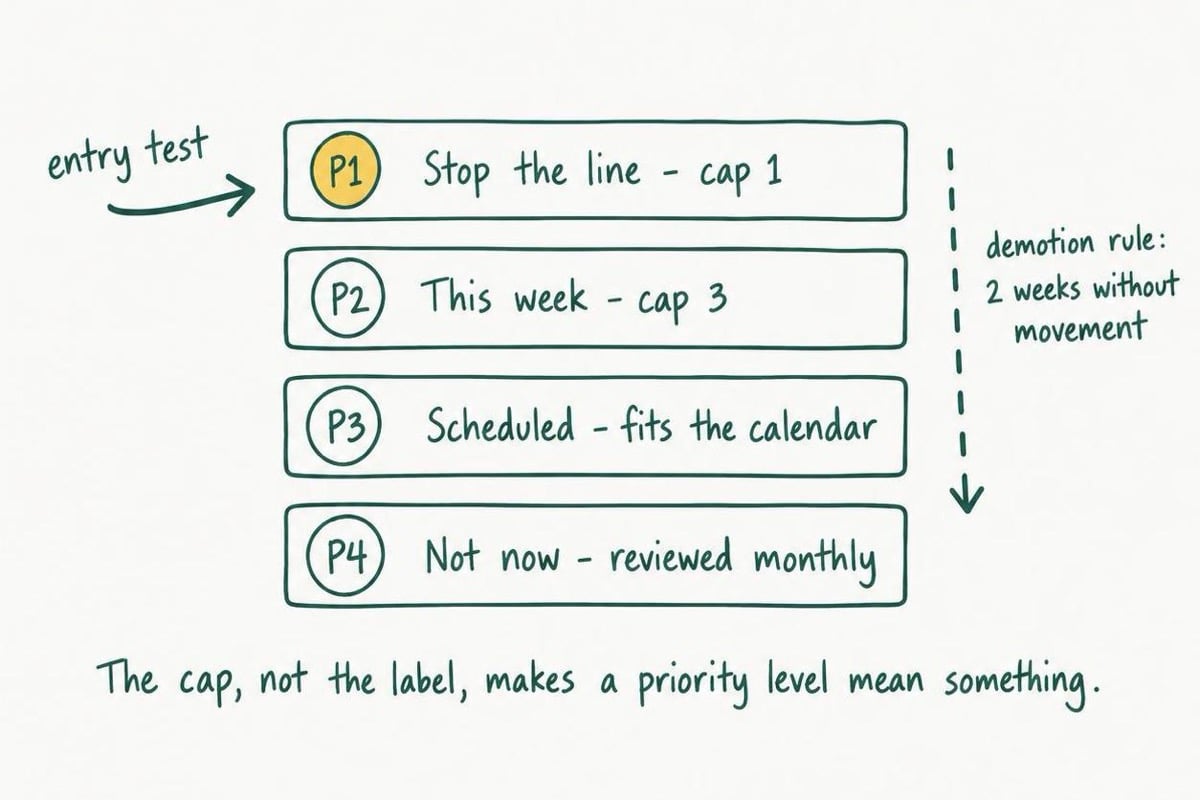
The scale below is LifeHack's own construction, not an industry standard, and no research validates it as a package. It borrows the impact-and-urgency logic from incident management and adds the two parts personal task lists skip: a cap on how many items sit at each level, and a stated cost for putting one there. Read the cost column as the promise you make.
| Level | What it means | Entry test (must be checkable) | Cap | What it costs you | |---|---|---|---|---| | P1 Stop the line | Work that prevents damage today | Someone outside your team is blocked now, or a dated commitment fails today | 1 | Everything else moves a day, and you say so out loud | | P2 This week's promise | Dated commitments you have made to a named person | It has a due date inside this week and you can name who is waiting | 3 open | No new P2 enters until one closes | | P3 Scheduled | Real work with a slot, not yet this week's problem | It has a calendar block or a date you would defend | Whatever fits | Reviewed weekly; it moves up or moves out | | P4 Not now | Everything else, held honestly | It survived "would I trade a P2 slot for this?" | None | Reviewed monthly, deleted at 90 days |
The cap column is what makes the rest of it work. Little's Law, stated as L equals lambda times W, holds that the average number of items in a system equals the arrival rate multiplied by the average time each item spends in it. [10] The law describes averages under stated conditions, so keep the reading modest: with roughly steady throughput, holding more items open stretches the average time each one takes to finish. Four open P2s do not get done sooner because you labelled them all P2. They get done later, one at a time, while you carry the weight of four.
Writing the entry test in advance, rather than judging each request as it lands, is the other half. A meta-analysis of clinical versus mechanical prediction found formal mechanical prediction about 10 percent more accurate on average, and substantially better in 33 to 47 percent of studies against 6 to 16 percent the other way. [11] Those studies are about prediction, not task lists, so take the narrow point: a rule you wrote on Sunday is harder to talk yourself out of at 4pm on Tuesday than a judgment made while someone stands at your desk.
Write the entry test before the week starts
Setting up the scale takes about twenty minutes once, then five minutes a week. You are writing four sentences, two caps, one tie-breaker and one demotion rule, and the whole point is to finish all eight of them on a quiet Sunday while nothing is on fire. Rules written under pressure bend under pressure. Rules written in advance are the ones you can point at when a request arrives already stamped urgent.
- Write each level's entry test as one checkable fact. Not "very important." Something a colleague could verify without reading your mind: a named person is blocked, a dated commitment exists, a calendar slot exists.
- Set the caps and write them next to the levels. One P1, three P2s is a starting point, not a law. If your week really runs on interrupts, one P1 and two P2s is more honest.
- Decide the tie-breaker now. When two items pass the same test, ours goes: whichever unblocks someone else first, then whichever gets costlier if delayed, then whichever is older. Any consistent order beats deciding in the moment.
- Add a demotion rule. Anything that sits at P2 for two full weeks without moving is not a P2. Either it drops to P3 with a real date or it goes to P4. Levels that never go down stop being levels, and a stalled P2 is usually avoidance wearing a deadline rather than a scheduling problem.
- Price the work from the last one like it. People underestimate how long their own tasks take, and prompting them to consider previous similar performances reduced that underestimation in the task-duration research. [12] Before promoting something to P2, ask how long the last memo of that size actually took, not how long a clean version should take.
One warning about step 2. Caps only bind if the overflow goes somewhere visible. A P2 that cannot enter lands on the P3 list with a date attached, not in the space behind your eyes where cognitive overload lives. Pair the levels with time blocking, because a level with no slot on the calendar is a wish.
What this looks like on an ordinary Tuesday
Here is a hypothetical to make the trade concrete. Marcus runs operations for a mid-size logistics company. Ellen, his CFO, is one of the people who can reach him any time. On Tuesday morning his board memo is the P2 with a Thursday deadline and a named reader. His P1 slot is empty, which is how a Tuesday is supposed to start.
At 9:12am a warehouse integration breaks and two customers cannot see their shipments. That is a P1 by the written test: people outside his team are blocked right now. The memo does not get downgraded and it does not quietly rot. It moves to Wednesday, and Marcus tells Ellen it moved. The announcement is the mechanism. A promise broken silently costs more later.
At 11:40am Ellen asks for a pricing analysis "as soon as possible, today if you can." The P1 slot is taken. Marcus says the sentence that the whole system exists to make sayable: "I can start it at two if the integration is closed, or I can take it now and the integration waits. Which do you want?" That is not pushback. It is a capacity statement with two real options, and it lands differently than "I'm slammed." If saying it makes you wince, our piece on setting boundaries at work is the better place to start.
At 4:30pm three new requests have arrived. All three pass the P3 test and none passes the P2 test, because P2 is full. They get dates, not adjectives. Marcus closes the laptop with the integration fixed and the memo moved by agreement. That is a completely ordinary day, which is the point: the scale exists to stop ordinary days from turning into busy work that looks like progress.
When someone else sets your priorities
The most common objection to any priority scale is that you do not control the inputs. Your CEO marks everything P1, your biggest customer escalates by volume, and a scale you invented on Sunday has no authority over either. That is true, and the scale still helps, because its real output is not a sorted list. It is a visible trade that someone else has to approve or decline.
When a request arrives already labelled urgent, you are not arguing about the label. You are asking one question: what moves? "Happy to make that the P1. The integration work slips to tomorrow and the board memo slips to Thursday. Confirm and I'll start now." Most senior people answer honestly, because it is a resourcing question, not a complaint. The ones who will not have told you something useful about your week.
If your organization already runs a scale, map yours to it once and never argue vocabulary again. Their P1 and P2 land in your P1 and P2; their P3 through P5 land in your P3 and P4. The rule worth defending is the cap, because it carries the actual promise. A list where everything is a priority is the fastest route to feeling too overwhelmed to start anything.
What to check after two weeks
Do one thing today: write the entry test and the cap for your top level on a single line, and put it where you file tasks. One sentence, one number, nothing else. That single line is the smallest version of the whole system, and it is the part that starts working immediately, because it forces the first honest no. The other three levels can wait until Sunday.
Then measure two things over two weeks. Count the P1s you declared. More than two a week and the entry test is too loose; tighten it until the label hurts to use. Then count how many P2s you closed compared with how many you opened. If you opened more than you closed, the cap is not binding and the level is decorative.
Those two counts are the only real test of whether your priority levels for tasks are doing work or decorating a list. They tell you something a task list never does: not what you meant to do, but what your system actually allowed. If the answer is uncomfortable, that is information, and it gets easier to act on once it is written down.