

To streamline business processes in a small business, stop trying to perform each step faster and start measuring how long the work sits still between steps. Time one repeated job end to end and split the total two ways: the minutes you actually touch it, and the hours or days it spends waiting on an approval, a document or a reply. Then cut the waiting and delete whole steps, in that order, before you buy anything.
That is rarely where anyone starts. You start on a Tuesday, three weeks behind, with a job that should take two days and has taken eleven. So you buy the project tool with the nice board view, spend Sunday night moving columns around, and promise yourself you will keep it current this time.
Then the next job takes eleven days.
The frustrating part is that you are not slow. You are fast at the actual work, faster than anyone you could hire this quarter. Which is exactly why buying more speed does nothing.
Why working faster did not make the job shorter
Working faster shortens only the minutes you personally touch the work. It does nothing to the stretches when the job is sitting somewhere: in your inbox, in the client's court, in a folder waiting on a decision only you can make. Whether that waiting is a small or a large share of the job's total is an open question until you time it, and speeding up your part only gets you to the waiting sooner.
You have probably already tried the standard moves. A new app, so everything lives in one place. A longer checklist, so nothing gets missed. Taking a task back from a contractor because explaining it took longer than doing it. Working an extra hour at night, which does work, briefly, and then costs you Wednesday.
None of that failed for lack of discipline. It failed because every one of those moves targets the same ninety minutes of hands-on work, and the length of the job may have almost nothing to do with those ninety minutes. The advice that ranks for streamline business processes mostly treats effort, or missing software, as the enemy. Delay is the candidate it skips, and delay has completely different fixes. If the whole thing feels like being busy without getting anywhere, that is the signal: busy is a touch-time word, and your problem is measured in days.
The waiting is the process
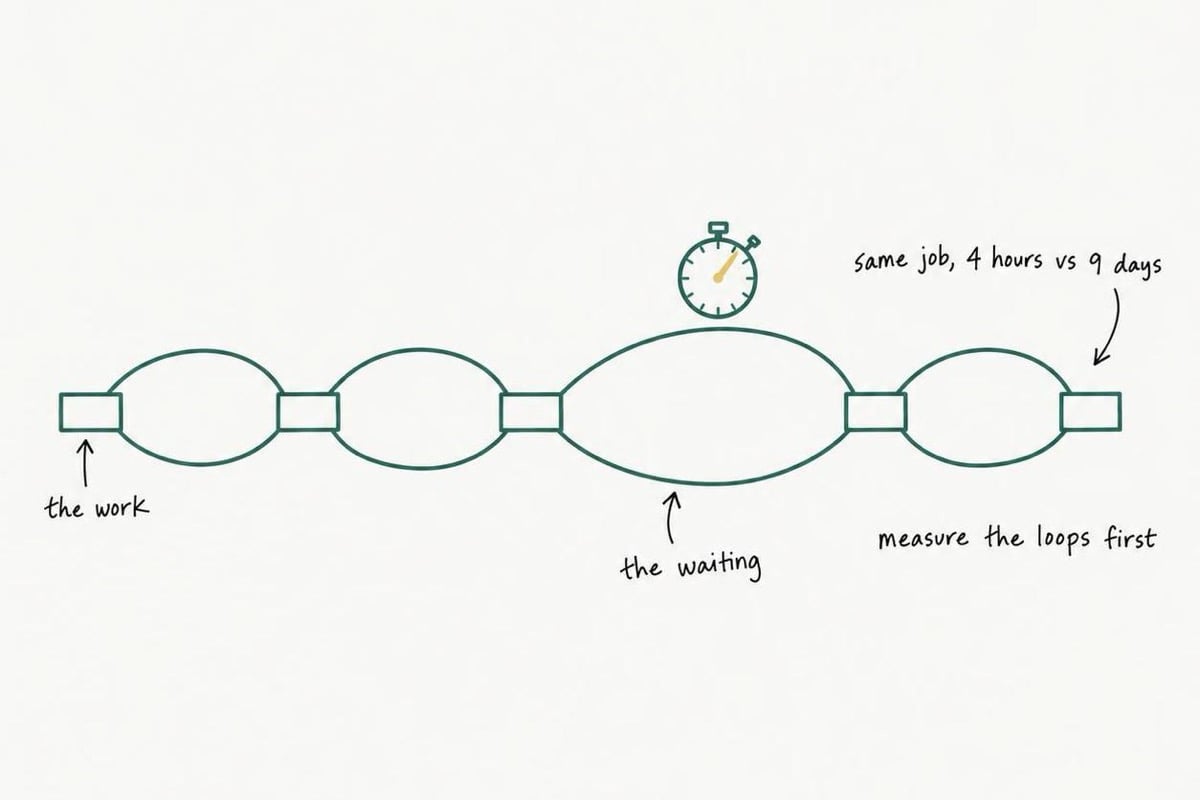
Your process is not only a sequence of tasks. It is tasks separated by queues, and the queues are the part almost nobody times. Streamlining a business process means removing steps and waiting from the path a job takes, not performing each step faster. So the first thing to measure is not how long a step takes. It is how long the job sat between steps, and how many times it came back.
That gap can be enormous. A published value stream mapping case study of an axle beam housing line mapped 4.6 days of total lead time against 408.27 minutes of total processing time. [1] That is one manufacturing line rather than a law about your business, and the authors do not label every remaining minute as waiting. We are not claiming your ratio looks like that one. We are claiming you probably do not know your ratio, and that is cheap to fix.
Guessing it is easy to get wrong, and not because anyone is careless. You feel the minutes you work. You do not feel the four days the file sat in a folder called Pending, because during those four days you were busy with something else, which felt like progress.
How to streamline business processes in five moves
The sequence matters more than any individual fix: pick one process by what it costs you, time one real run of it, find the step where work piles up, then work a fix ladder that ends with software instead of starting there. Five moves, in order. Jumping straight to the software is the move we argue against hardest, and it is the one the first page of search results keeps recommending.
1. Pick the process by cost, not by irritation. The loudest process is not always the expensive one, so do the arithmetic before you pick. Multiply how often a job runs by the minutes you personally spend on it, then add a penalty for every time it comes back for correction. Monthly invoicing that takes you forty minutes and never bounces costs less than a weekly quote that takes fifteen minutes and gets revised twice. If several jobs look equally bad, a priority scale that forces an actual choice beats ranking by how much each one annoys you, and the same logic applies when two processes are competing for the same week.
2. Time it, do not remember it. Next time the job comes up, keep a note with two columns: touch time and wait time. Every time you start working, note the clock. Every time you hand the job to someone, or to your future self, note the clock again and write what it is waiting for. Mark returns separately, because rework charges you twice and it hides inside the touch column. A second timing of the same job is worth having, since one measurement cannot tell a standing delay apart from a bad week. Note the scope here: this article assumes you can already list the steps. If you cannot, writing the procedure down is a different job and it comes before this one.
3. Find the longest wait, then test whether it is a constraint. Read your wait column and find the longest entry. That is not automatically your bottleneck. It is the delay worth investigating first, and a single long wait can be an event rather than a pattern. Two tests separate them. Does work stack up in front of that same step on run after run, and does the step need more of somebody's limited time or capacity to clear faster? Two yeses and you are looking at a constraint. One long wait caused by a client's vacation is a story, not a bottleneck. The distinction earns its keep because operations teaching ties output to the real bottleneck: when capacity is not available there, it "directly reduces the throughput of the company and thus its output, its performance." [2] Read the implication in reverse and you get the reason your new invoicing tool changed nothing: speeding up a step that was never the limit mostly delivers work to the pile sooner. That is a Theory of Constraints implication rather than a promise that improvement elsewhere is always worthless.
4. Work the fix ladder in order. Delete, default, batch, hand off, automate. Delete first: every recurring process carries steps that exist because of one client two years ago. A status email nobody reads is a step. A second review you added after one bad week is a step. Then default: for every decision point that made the work wait on you, write the rule once and let it run without you. "Under 500 dollars, book it, tell me after" removes a two-day wait permanently, which no software does. Third, batch the work that shares a setup, since switching between different kinds of work carries a measurable cost; a task-switching experiment found both switch costs and mixing costs relative to single-task performance. [3] That was a lab study of task switching, not a trial of business batching, so treat it as support for the instinct rather than proof of a schedule; the practical version is in our guide to task batching techniques. Fourth, hand off, which only works if you ship a definition of done with the work. Handing off a process without one is how the fear of delegating gets confirmed; the four steps in the process of delegation and the types of delegation are worth reading before you assign anything, and if the honest answer is that nobody exists to hand it to, that is a separate decision about when to hire in your small business.
Automate last. This is the contrarian part, and we will defend it: software applied to a process you have not simplified buys you a faster version of the mess, with a subscription. A 2024 case study of a healthcare claims process is a good model of the right order, because the team used lean analysis to find the wasteful and non-value-added steps first and introduced robotic process automation second, reporting a 380-minute reduction in process time and process cycle efficiency rising from 69.07% to 95.54%. [4] That is one before-and-after case in a Taiwanese hospital claims department, not evidence about your business, and it does not prove automation always fails when the order is reversed. What it shows is a sequence worth copying: diagnose, delete, then automate what survives.
5. Cap how many jobs you have open at once. Work in progress is the hidden lever. Little's Law, stated in an MIT operations problem set, gives "the fundamental relationship between the average flow time, T, the throughput rate, R, and the average inventory I." [5] In small-business terms: if you hold ten jobs open and finish two a week, each job sits in your shop for weeks regardless of how hard you work. Take on five at a time and the same output makes each one finish sooner. The law assumes throughput holds steady, so this is not a trick for doing more, it is a trick for making each job shorter. It is also the rung with a real cost, because saying "not yet" to a client feels like losing work and sometimes it is, and time management for entrepreneurs is mostly a series of those refusals.
What this looks like on a real Tuesday
Here is the arithmetic on two composites we use to show the shape, not clients: Bridget, who runs a two-person bookkeeping practice, and Todd, who installs commercial flooring alone. Both timed one run of their worst repeated job. Both found the same shape: a modest amount of work spread across a lot of calendar. Their figures are illustrative; the two columns that produced them are not.
Bridget's month-end close ran nine calendar days. Her touch time was about four hours. The longest wait was three days, sitting on a client who had not sent one bank statement, and her old fix was a reminder email on day four. The new version: the request goes out on the 28th, before the month even ends, and a standing rule says the close proceeds without that account and flags it, rather than stopping. Nine days became four. She automated nothing.
Todd's quote-to-scheduled-job process ran six days, with about seventy minutes of touch time. His pile was himself: quotes waited for evenings because he priced everything from scratch at the kitchen table. He deleted the custom pricing for his three standard room sizes, wrote the numbers on a card in the truck, and now quotes those on site in four minutes. The complicated jobs still wait for an evening. Six days became two for most of the work, and his revision rate dropped, because a price written on a card does not drift depending on how tired he is.
Notice what neither of them did. Neither hired anyone. Neither bought a workflow platform. Neither one worked longer, which matters, because the reflex to solve a slow process with more of your own hours is how toxic productivity gets a foothold in a business that looks fine from outside.
"My business is too small for this to matter"
Small is where this can pay quickly, because a very small business has few places for work to pile up: a person, a supplier, or a client. The timed run tells you which one, and when the answer turns out to be you, the fix is a standing rule rather than a tool. You do not need a department to streamline business processes.
You need one timed job and the willingness to delete something. The measurement is a note you keep open during work you were doing anyway, not a project you schedule.
The honest limits: none of this helps work you do once, and none of it helps if the real problem is that you have no capacity at all rather than badly ordered capacity. Administrative load is also real and partly not yours to delete. In a survey of 322 small manufacturing business owners in the Midwest, roughly half reported spending more than an hour a week just filling out government compliance forms. [6] That is compliance paperwork among Midwestern manufacturers rather than a general figure for every entrepreneur, and it makes a narrow point: some steps cannot be removed, only batched and scheduled. Know which of your steps are those before you spend a weekend redesigning them.
One more objection worth answering: this sounds like it needs a quiet week to do properly, and you do not have one. It does not. It needs one job, one note with two columns, and enough focus to finish the one pass.
Start with the job that came back
Think of the job that came back last week, the one that needed redoing. That is your candidate. The next time it runs, keep the two columns, then find the single longest wait and ask one question about it: can this step go away, or can a standing rule make the decision without me? One pass through one job hands you a real number, which is more than any dashboard has given you so far.
Fix that one wait before you touch anything else, and re-time the job on its next two runs. The way to streamline business processes is not a project you schedule for January. It is one measured job, one deleted step, and the discipline to leave the software for last.


