

You Can Calm Down in Two Minutes. Then It Comes Back.
A nervous system reset is a short practice, usually some form of slow breathing, that lowers your physical arousal for a stretch of time. It works, inside limits. What it does not do is change where your body settles back to. That is why the calm you found at 2:40pm is gone by 3:05, and why the problem is almost never that you picked the wrong technique.
You know the sequence. Something lands badly in a meeting. Your chest tightens, your jaw sets, and you run the thing you read about: four in, seven hold, eight out. It helps. For roughly as long as it takes to open the next tab. By the time the 3pm starts you are back where you were, and now you also feel like the breathing failed.
It didn't fail. It did the only thing two minutes can do. The gap between what these practices deliver and what readers expect of them is where the frustration lives.
Why Every Technique You've Tried Keeps Wearing Off
Nothing you tried was wrong. Deep breathing, relaxation techniques, and breathwork all have real evidence behind them, and all of them are built for one job: lower arousal now. None of them were ever built to carry you through six more hours of the same conditions. Asking them to is what turns a working tool into a personal failure.
The advice around this topic makes the confusion worse. Almost nobody tells you how long the effect is supposed to last, so you have no way to judge whether it worked. Two minutes of calm followed by a return to baseline looks identical to failure if nobody told you that returning to baseline is the expected result.
So you collect. A new reset every few weeks, a new breath count, a new video. The drawer fills up and the week stays the same shape. The one thing that would tell you something, how often the same feeling comes back and on which days, is the thing nobody asks you to look at.
"Reset" Is the Wrong Word for What's Happening
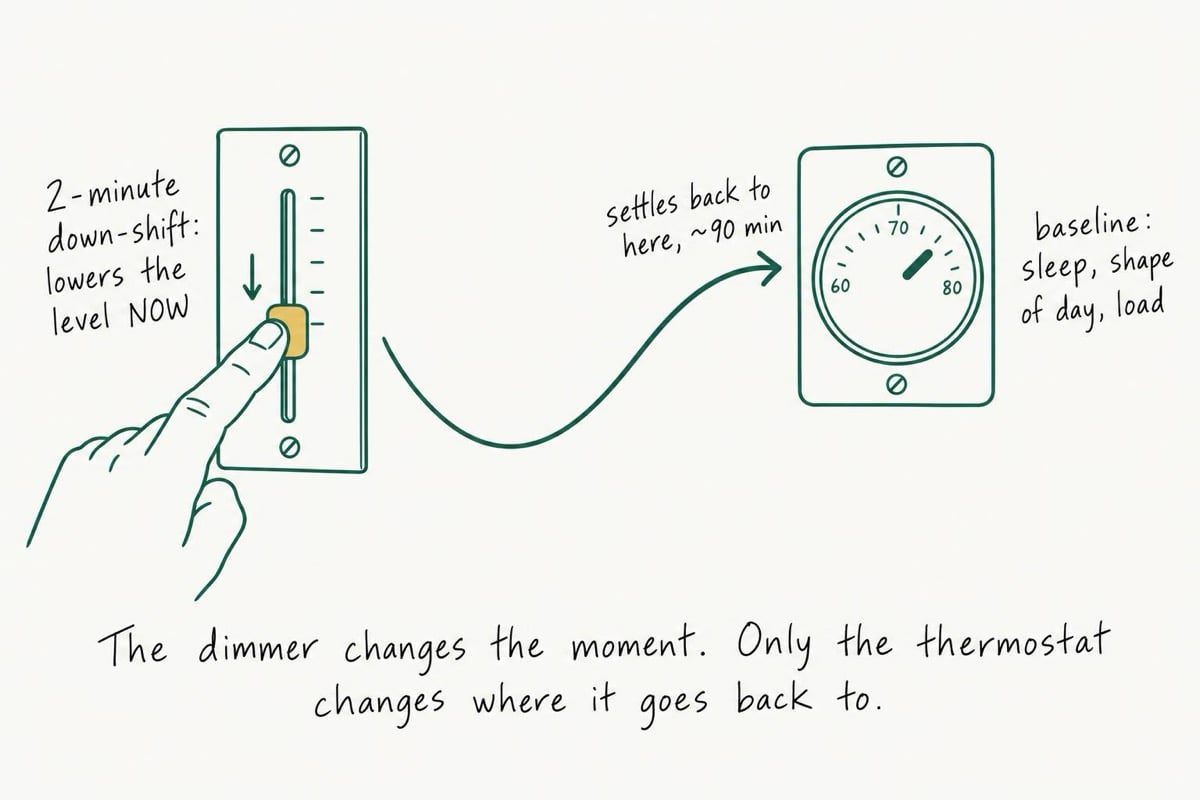
Reset is borrowed from electronics, and it smuggles in a promise the body does not make. Nothing reboots. You have an arousal level right now, and you have a baseline that level returns to. A two-minute practice moves the level, sometimes a lot, for a window measured in minutes. It does not touch the baseline, and no two-minute practice ever will. Once you separate those two things, most of the advice in this category sorts itself into useful and overclaimed.
Think of a dimmer switch in a room with a thermostat. The dimmer changes the light this second. The thermostat decides what the room goes back to once you stop touching anything. Most stress advice sells you dimmers and then blames you when the room warms up again.
The word sells well for an obvious reason. A reset is free, private, and needs nobody's permission. Changing the thermostat means declining something, going to bed when you planned to answer two more emails, or saying out loud that a workload is too big. Those are expensive and visible. So the market keeps producing dimmers, and both sides get to skip the harder conversation.
Stress physiology also runs slower than the advice implies. In laboratory studies, cortisol typically peaks 10 to 30 minutes after the stressor has already ended, and takes around 90 minutes to come back toward baseline (Giles et al., 2014, PLOS ONE). That is a lab time course rather than a universal timer for every person and every bad meeting, but the shape matters. When you start breathing at 2:40, the wave is often still rising. You are not undoing it. You are riding it with a lower heart rate, which is worth doing and is not the same as cancelling it.
This is also why we are careful with the phrase "dysregulated nervous system." Researchers use dysregulation as a description that cuts across conditions rather than a defined clinical entity (Paulus et al., 2021, Frontiers in Psychiatry). It is a useful word for how a week has felt. It is not a diagnosis you can hand yourself, and we are not using it as one here.
The useful question is not which reset works. It is whether calm holds, and how often it doesn't.
The Two-Minute Down-Shift, and What Sets the Baseline
Three steps, in order. Run the breathing pattern that was actually tested, which takes two to five minutes. Check once the stress wave should have passed, roughly ninety minutes later, and count how often that check fails across a working week. Then change an input rather than a technique: sleep, the shape of your day, or the size of the load. Step one is the cheapest and step three is the only one that moves the baseline.
1. Do the version that was actually tested
The best trial here compared four five-minute daily practices in 108 participants over 28 days. Cyclic sighing beat mindfulness meditation on mood improvement and on lowering respiratory rate (Balban et al., 2023, Cell Reports Medicine). We walk through that trial and four other patterns in deep breathing exercises for stress, so here we will name what it tested and move on.
The tested pattern, as run in the study: inhale through the nose, add a second shorter inhale on top of it to fill the lungs, then let a long slow exhale out through the mouth. Repeat. Five minutes a day, every day, for four weeks.
Two minutes once, in the moment, is our extrapolation from that trial rather than the dose anyone measured. We say so because the difference is the whole point of this article. Separately, a review of 15 studies of breathing below ten breaths a minute found autonomic changes during the practice, including increased heart rate variability (Zaccaro et al., 2018, Frontiers in Human Neuroscience). Useful background, with one caution: HRV moving is not a stress level being measured, and a watch reading shows what your body did, not a stress score.
2. Check at ninety minutes, then count across five days
After the breathing, go back to work and forget about it. About ninety minutes later, ask two questions. Is the feeling still here? And did anything new cause it?
Ninety minutes is not arbitrary. It is roughly where that laboratory cortisol curve has run its course, so it is the earliest point at which "still here" means something other than "the wave is still arriving." Checking at twenty minutes tells you almost nothing, which is why a reset that wears off in twenty minutes is not evidence that the reset failed.
One check proves little either way. Run it for five working days and count. If the feeling had passed at the ninety-minute mark most days, you are having spikes, the breathing is the right tool, and you can stop reading. If it had not passed on three or more of those five days, with no new trigger each time, you are not having spikes. You are describing a standing condition of your week, and no breathing pattern treats a standing condition.
Both numbers are ours. The ninety-minute check comes off the cortisol curve above. Three out of five is just a plain majority of a work week, not a validated threshold, and we would rather say that than dress it up.
3. When calm won't hold, change an input
Sleep. In a crossover study of 18 healthy adults, laboratory sleep deprivation impaired how accurately people's brains and bodies told social threat apart from non-threat, with a heightened amygdala response to threatening stimuli (Goldstein-Piekarski et al., 2015, Journal of Neuroscience). That was enforced lab deprivation rather than one mediocre Tuesday night, and 18 people is a small sample. The direction is still worth respecting: on short sleep, ordinary workplace friction reads as threat, and no breathing practice outruns that.
The shape of your day. Density is a real input, and we have covered it elsewhere rather than reprinting it here. The micro-break evidence is in why you're wiped out after work, and the importance of breaks at work is the general case. The line worth carrying across is that density is a property of a calendar, not a fact about your character, and calendars are editable more often than people assume. Taking an actual break and the late-afternoon crash cover the tactical end.
Load. A meta-review of 72 literature reviews links psychosocial work exposures, job demands and job strain among them, to health outcomes (Niedhammer et al., 2021, Scandinavian Journal of Work, Environment and Health). The association runs across heterogeneous exposures and outcomes, so read it as a direction rather than a dose. The direction is the point: sustained demand is a condition, and conditions change through decisions, not exhales. Some of those decisions are yours, in what you decline and what you stop volunteering for. Some are not, which is its own useful information about the job.
What This Looks Like Across One Real Week
The work is unglamorous. Breathe when something spikes, wait, check at the ninety-minute mark, and record one word: passed, or still here. Five days of that produces a count rather than an impression, and the count tells you which of the three inputs to touch. The technique never tells you that, which is why collecting more of them changes nothing about the week you are having.
Here is a hypothetical, written to show the shape rather than to report anyone's week. Brett sits on a two-day escalation rota. He runs the down-shift five times in a week. Two of the five have passed by the ninety-minute check: a blunt client email on Monday, a surprise budget question on Thursday. Three have not, and all three land on his rota days, when the escalation channel fires on and off from 8am onward. So he does not have five stressful days. He has two, plus a rota, and a breathing pattern was never going to fix a rota.
He changes the input. He asks for the rota to stop landing in the same week as his own release deadline, and he turns the channel's alerts off outside his rota hours. Next cycle, one of the three is gone and another is shorter. The third holds, because the rota is the job, and that is a conversation with his manager rather than a breathing exercise.
This is a close cousin of the week-long energy log in why you're wiped out after work, and if you already keep that log you can read this off the same notes. The difference is what gets recorded: that piece tracks depletion across a day, this one records one fact per episode.
Keep it to one word per check. The moment this becomes a tracking project with a spreadsheet and a score, it joins the pile of systems you abandon, and it turns into the kind of self-monitoring that makes a stressful week worse. Five days, one word each time, then throw the notes away once you have decided what to change.
A different constraint produces a different answer. Someone with no say over their week still has one input of their own, which is sleep. So the experiment becomes a fixed wake time and a hard stop on the laptop, and the five-day count becomes a way to see whether the failures drop from four to two over a fortnight.
If almost nothing passes the check, take that result seriously instead of optimizing it. Read it alongside the signs you need a break and what sustained stress does over time. If it has been months rather than weeks, the honest next step is the recovery sequence after burnout or a clinician, not a better exhale.
"I've Tried Breathing. It Didn't Work."
Then it probably worked and nobody told you what success looks like. Success here is a lower arousal level for a short window, not a day that stops being hard. If you judged breathing by whether 4pm disappeared, you judged a dimmer by the thermostat's job and reasonably concluded the dimmer was broken. The practice was fine. The scoring was wrong, and the scoring is what sent you looking for the next technique.
The second objection is sharper: this sounds like being told your job is the problem, and you cannot change your job this afternoon. True. But the count does not require changing your job. It requires five checks and five one-word notes. What it buys you is the end of a loop people stay in for years, cycling through techniques for something that was never in the techniques. Knowing which days do the damage is useful even in a week when you can't touch them.
If it still sounds like one more thing to monitor, note that the ninety-minute gap runs while you work and the check costs two seconds. Run it on a single day if five feels like too much.
And if you have been feeling overwhelmed at work for long enough that it feels like weather rather than events, skip the measuring entirely and look straight at the load.
Start With One Down-Shift Today
Pick the next moment something spikes. Inhale through the nose, add a second short inhale on top, then a long slow exhale through the mouth, for two minutes. Then go back to work and let ninety minutes pass. Write one word: passed, or still here.
Five working days gives you something no reset video can: a count. Mostly passed means you have the right tool and should keep using it. Mostly still here means the tool was never the question, and one of three inputs is. Change one of them, and keep the breathing for what it is good at.
One plain limit: none of this is medical advice, and the check notices a pattern rather than assessing a condition. If nothing ever passes, if you are having panic attacks, or if sleep has been broken for weeks, that is a conversation for a clinician. Unwinding properly helps with a hard week. It is not a substitute for care when a hard week has become a hard year.


