

Your shoulders are up near your ears, a call starts in ten minutes, and someone has told you to "just breathe." Fair enough. But which breath, and for how long?
Here is the short answer. To bring stress down with breathing, slow your breathing well below its normal pace, to about six breaths a minute, breathe into your belly rather than your chest, and keep it up for two to five minutes. Keep each breath gentle. The five exercises below are different routes to the same place, and each one suits a different moment.
One note before the steps. Breathing exercises help, but less dramatically than most articles promise. A 2023 meta-analysis of 12 randomized trials with 785 adults found that breathwork lowered self-reported stress by a small to medium amount, and its authors warned against the hype around it. [1] That is still a good deal. It costs nothing, it takes a few minutes, and you can do it at your desk without anyone noticing.
Why slow breathing calms you down
Your heart speeds up a little every time you breathe in and slows down every time you breathe out. When you slow your breathing to around six breaths a minute, those swings get bigger and fall into step with your breath. Researchers who study heart rate variability (HRV) biofeedback think this pace exercises the reflex that keeps your blood pressure steady. [2]
A systematic review of 15 small studies found that breathing slower than 10 breaths a minute tended to raise HRV and went along with feeling more relaxed, though the studies were short and too different from each other to combine. [3]
So slowness is the active ingredient. Most of the counting schemes you will see, from 4-4-4-4 to 4-7-8, are ways of getting you to breathe slowly without watching a clock.
Before you start
- Sit upright or lie down, and loosen anything tight around your waist.
- Breathe in through your nose if you can. Breathing out through your nose or your mouth both work.
- Keep it gentle. Breathing too hard or too fast lowers the carbon dioxide in your blood and can leave you lightheaded or dizzy. [4] If that happens, stop and breathe normally for a minute.
- If you have asthma, COPD or another lung condition, check with your doctor before starting a new breathing practice. [5] Slow, deep breathing may also not suit people with heart failure. [6]
- These exercises are for everyday stress. If you are dealing with panic attacks, anxiety that gets in the way of daily life, or chest pain, talk to a doctor rather than relying on breathing alone.
1. Belly breathing
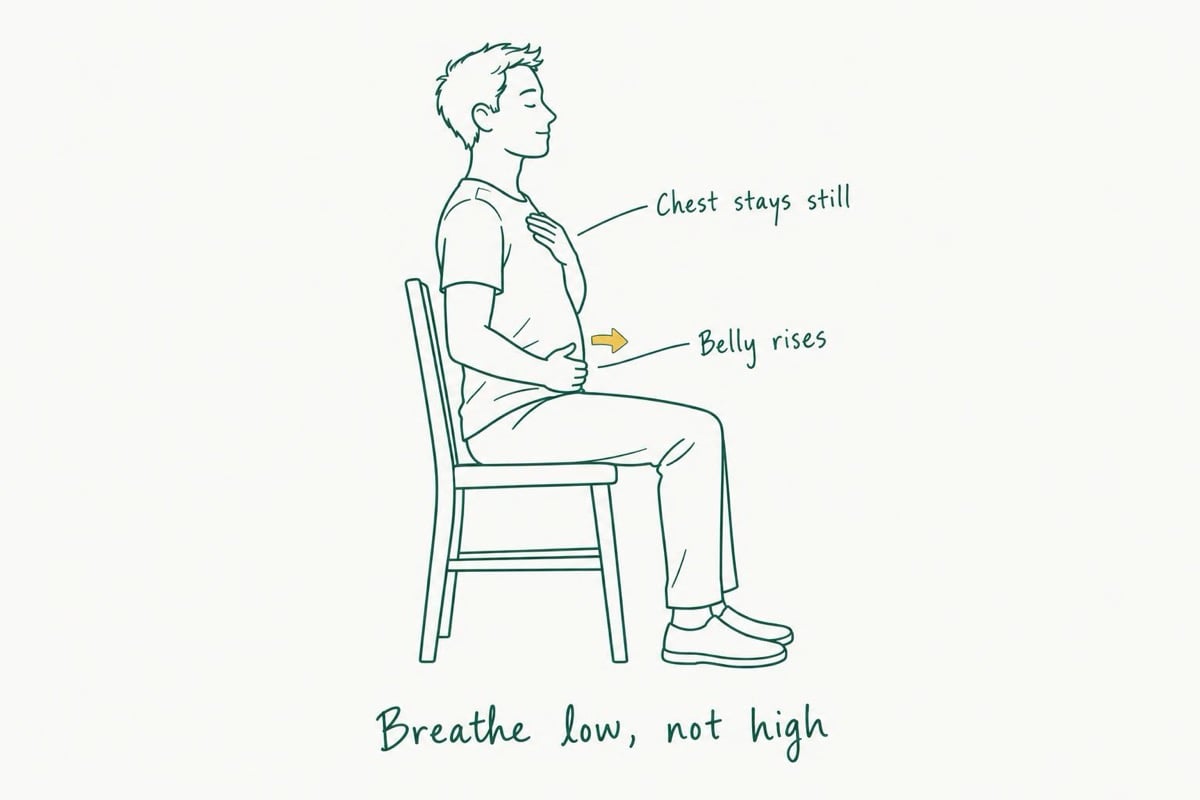
Belly breathing, also called diaphragmatic breathing, is the base skill for every exercise that follows. Under stress, most of us breathe high and fast into the chest. Belly breathing moves the work down to the diaphragm, the dome-shaped muscle under your ribs.
- Put one hand on your chest and the other on your belly.
- Breathe in slowly through your nose and let your belly push your lower hand out. The hand on your chest should barely move.
- Breathe out slowly and let your belly fall back.
- Keep going for one to two minutes without forcing the breath deeper.
In a small eight-week trial with 40 employees at a Beijing company, people who practiced coached slow belly breathing reported less negative mood afterward and did better on a sustained-attention test than a group that did no training. [7] Those sessions were 30 minutes long and guided, so read it as a sign the skill is worth practicing, not a promise for a two-minute version.
If anxiety is the main reason you are here, our guide to breathing exercises for anxiety covers that use in more depth.
2. Slow breathing at six a minute
This is the exercise with the best physiological support behind it, and the one to practice on ordinary days.
- Settle into belly breathing.
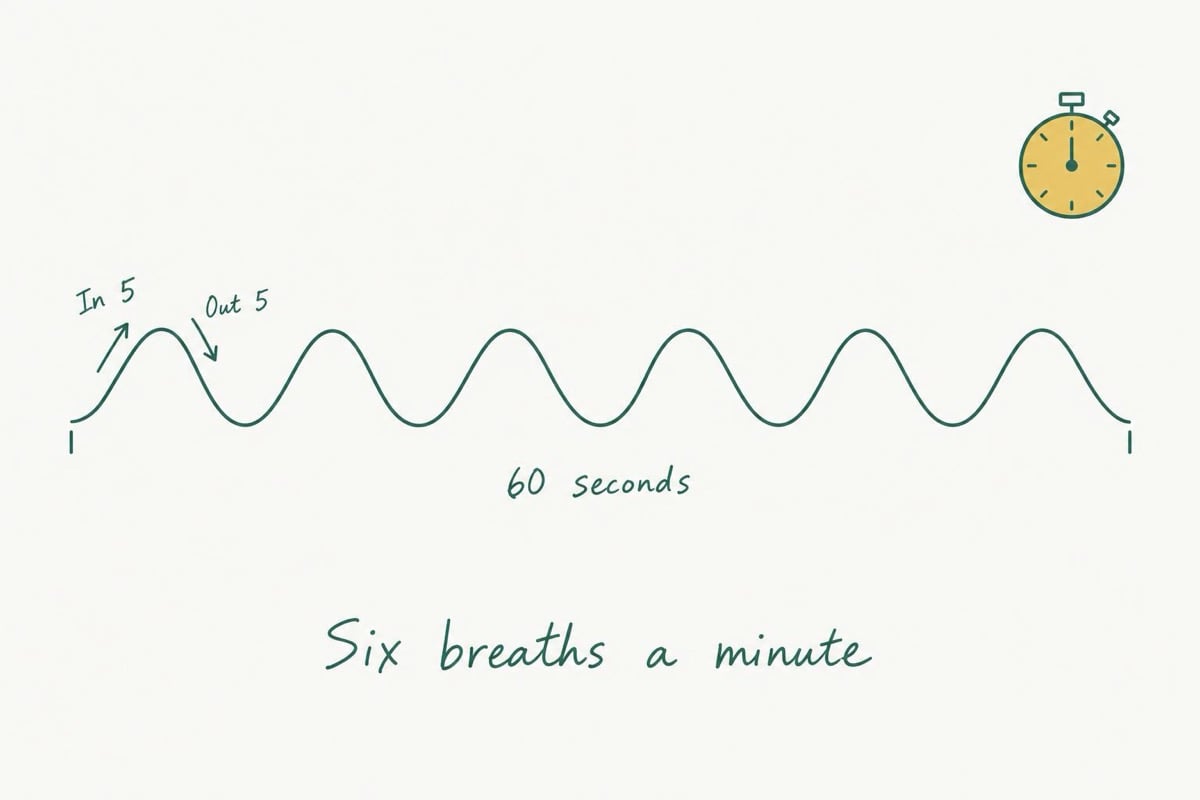
- Breathe in for a slow count of five.
- Breathe out for a slow count of five.
- That is one breath every 10 seconds, or six a minute. Keep it going for five minutes, or ten if you have the time.
A timer or a breathing-pacer app takes the counting off your hands. If five and five feels like a strain, start with four in and four out, which is still slow. Watch the size of each breath too: in a study of 84 college students, breathing at six a minute led to mild over-breathing. [8] Breathe softer, not deeper.
3. Cyclic sighing
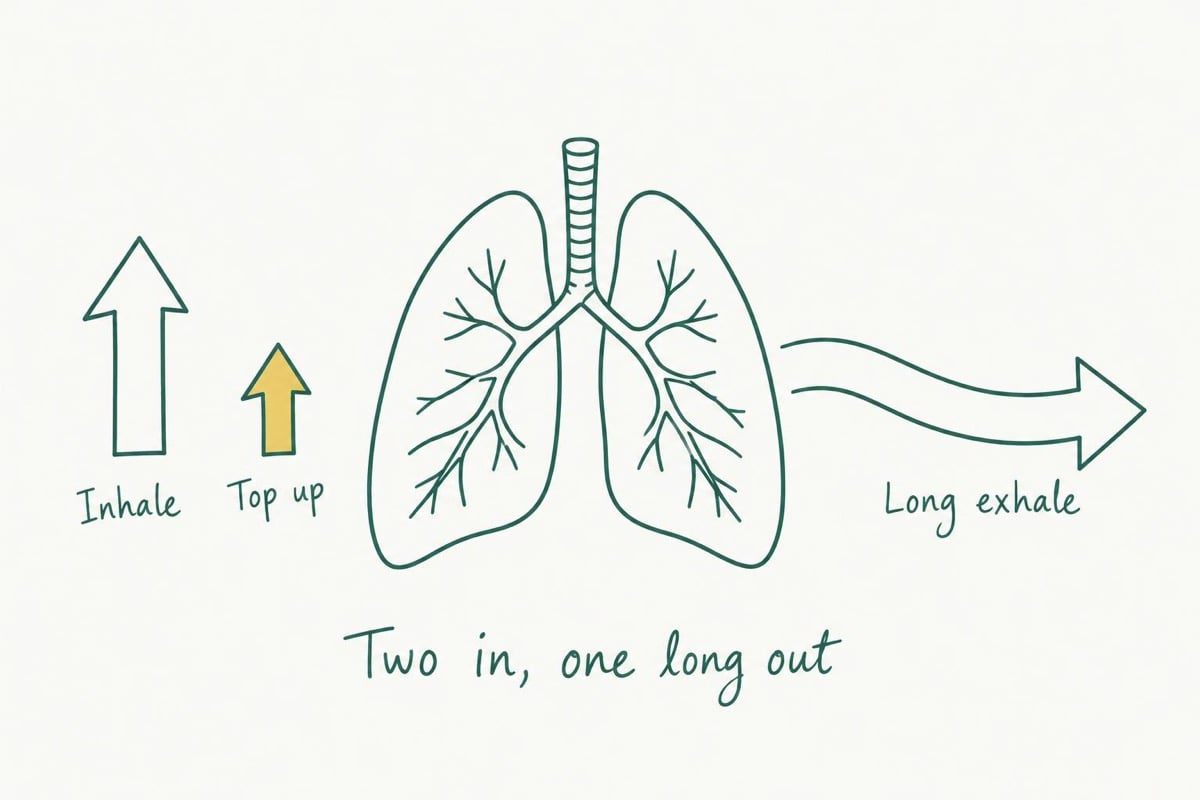
Cyclic sighing is a slowed-down, deliberate version of a sigh: two breaths in, one long breath out.
- Breathe in slowly through your nose until your lungs feel full.
- Take a second, shorter sip of air through your nose on top of the first.
- Breathe out slowly and completely through your mouth.
- Repeat, keeping the breath out long and unhurried, for up to five minutes.
In a month-long Stanford study, 108 people spent five minutes a day on cyclic sighing, box breathing, a fast breathing technique, or mindfulness meditation. Cyclic sighing raised positive mood more than mindfulness did and lowered people's resting breathing rate. [9] It is one of the better studies of breathing exercises, but it has limits: it ran remotely, most participants were students, anxiety improved just as much in the mindfulness group, and HRV did not change.
Because it needs no counting, cyclic sighing is a good choice when stress is spiking and you cannot think straight.
4. Longer-exhale breathing
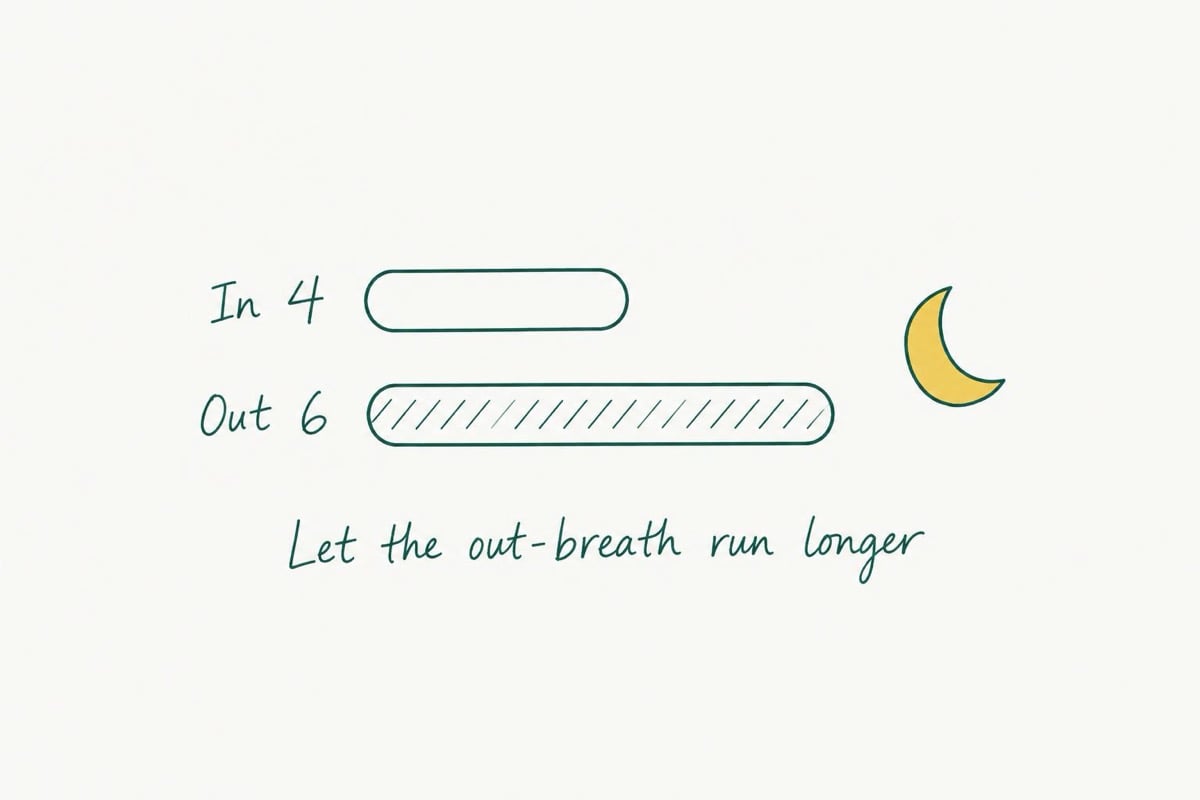
Many teachers suggest making the breath out longer than the breath in, often four counts in and six or eight out. It is a comfortable way to slow down, and it feels like letting go, which makes it a natural fit for winding down at night.
- Breathe in through your nose for four.
- Breathe out slowly for six. If that feels easy, try eight.
- Keep going for three to five minutes, lying down if you are in bed.
The research on the ratio itself is split. A 12-week trial of 100 adults found that slow breathing reduced anxiety, but making the exhale longer than the inhale added no extra stress benefit over an even breath. [10] A review of nine studies on the question found no clear answer on the best ratio. [11] Use a longer exhale if it feels calming, and do not worry if five and five suits you better. Slowing down does most of the work.
5. Box breathing
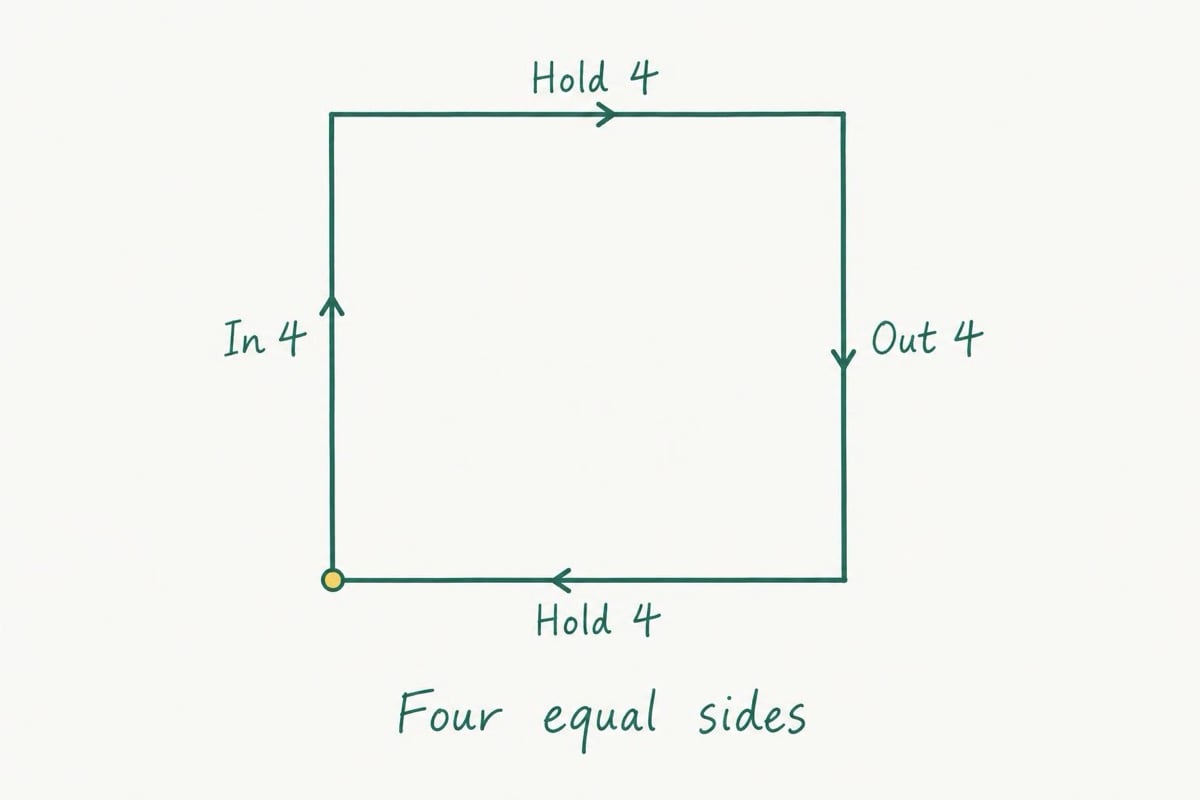
Box breathing gives you a simple shape to follow: four equal sides.
- Breathe in for four.
- Hold for four.
- Breathe out for four.
- Hold for four, then repeat for two to five minutes.
It is popular, and the counting gives a busy mind something to hold on to, which is why people reach for it before a presentation or a hard conversation. The evidence for it is thin. In a 2026 study of 76 resident physicians who used breathing exercises over four weeks, box breathing's average effect on daily stress was close to zero, though a small number of people did respond to it. [12] If the holds make you tense, drop them and you are back to slow breathing. Box breathing and 4-7-8 breathing are both covered in our beginner's guide to breathwork.
Which exercise to use when
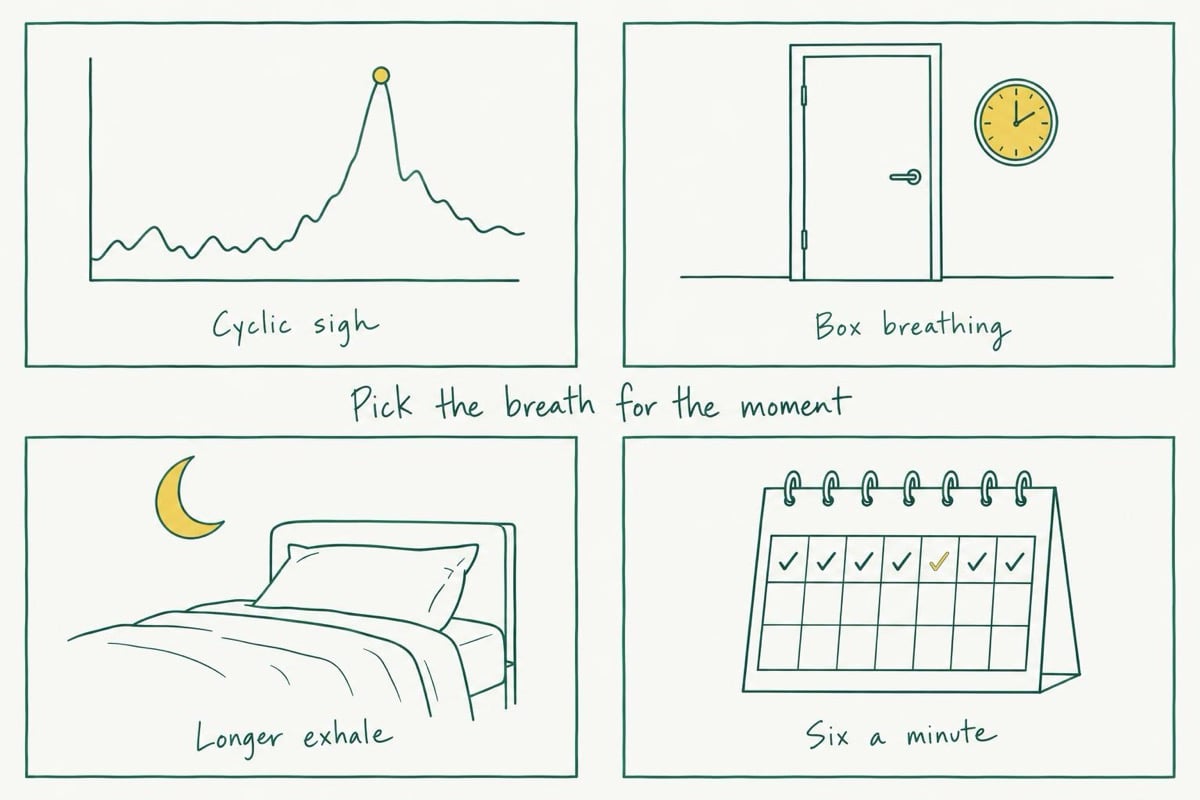
| Your moment | Try this | How long |
|---|---|---|
| Stress spiking right now, after a tense email or mid-argument | Cyclic sighing | 1 to 5 minutes |
| A few minutes before a hard meeting or call | Box breathing, or four in and four out | 2 minutes |
| Lying awake and unable to switch off | Longer-exhale breathing | 5 minutes |
| Daily practice to build the habit | Slow breathing at six a minute | 5 to 10 minutes |
| The gap between back-to-back meetings | Belly breathing with a slow breath out | 1 minute |
None of these pairings is a rule. If one exercise works for you, use it everywhere.
How to tell it's working
The first signs are physical. Your shoulders drop, your jaw unclenches, breathing feels easier, and your thoughts slow down a little. Your heart rate should drift down during a slow session, and a smartwatch makes that easy to see.
If you wear an Apple Watch, it already records heart rate variability, which Apple treats as an indicator of stress and recovery. We are building StressBucket at Lifehack Media, the company behind LifeHack: an iPhone and Apple Watch app that reads that data to show stress building and draining through your day, including after breaks like these. It is a wellness tool, not a medical device, and it is on a waitlist at stressbucket.app.
Expect the change during a session to be clearer than any long-term number. In the Stanford study above, a month of daily practice lifted mood without changing resting HRV.
Common mistakes
- Breathing too big. Deep does not mean forceful. Huge breaths at a slow pace can still leave you dizzy and tingly. Make the breaths smaller.
- Saving it for emergencies. A skill you only use at your worst moment is hard to find when you need it. Five minutes on a calm day makes it easier to reach for on a bad one.
- Chasing the perfect count. The studies do not agree on a best ratio. Pick a count you can keep without strain.
- Expecting breathing to fix the cause. Breathing brings a spike down. It does not change the back-to-back meetings or the short nights that keep refilling your stress. For those, start with the most common stressors in life and these ways to reduce stress quickly.
Fitting it into a workday
The easiest time to practice is a gap you already have: the minute before a call starts, the walk back from a meeting, the wait while a file uploads. Tie one exercise to one cue, such as a minute of slow breathing every time you close a video call, so you do not have to remember. Short breaks between tasks help on their own as well, as our piece on the importance of breaks at work explains, and these stress management techniques pair well with a daily breathing habit.


