

Nobody searches this at noon. They search it at 10:40 on a Tuesday night, after a day spent handling everything and finishing nothing that was theirs.
Somebody said it at a birthday party. Or it turned up on a mug. And some part of you wanted to know whether it is actually true, or whether it is what people say to each other at 40 the way they say a funeral was lovely.
Here is the answer, starting with the part nobody quotes. "Life begins at 40" was never a claim about the number 40. It was a claim about conditions. The man who put the phrase into the language in 1932 was arguing that a specific set of circumstances had shifted and handed ordinary people years they used to spend simply staying alive. Change the conditions, get the years. Leave them alone, and the birthday does nothing at all.
That distinction is the whole article.
The decade where everything arrives at once
Your 40s are the statistical peak of being needed by other people. Pew Research found that 54% of Americans in their 40s have a parent aged 65 or older and are either raising a child under 18 or financially supporting a grown one, the highest share of any decade of life. By the 50s it falls to 36%. [1]
The hours are not abstract either. US family caregivers now average 27 hours of care a week, and 57% are in high-intensity roles handling medical tasks that used to belong to professionals. [2] Money peaks in the same window: household spending across the American life cycle is hump-shaped, rising to its highest point in the 45 to 54 band before it falls away. [3]
So the decade the culture markets as a fresh start is, on the numbers, the decade with the least uncommitted anything. Not the least capability. The least room. Most people reading a phrase like this conclude the problem is them. It is usually arithmetic. If your routines keep falling apart in your 40s, the schedule is a better suspect than your character.
Where "life begins at 40" actually came from
Walter B. Pitkin, a Columbia journalism professor, published a book called Life Begins at Forty in 1932. It sold enormously: Publishers Weekly recorded it at number two on the nonfiction list in December 1933. [4]
Read his opening and the modern version of the phrase falls apart:
Life begins at forty. This is the revolutionary outcome of our New Era. This is the supreme reward of the Machine Age, the richest blessing of science.
That is an economics argument wearing a self-help jacket. Pitkin's mechanism was mechanization: labor-saving invention, he wrote, "shortened the hours of toil so that men had more leisure." Longer lives at one end, shorter working days at the other, and the gap between them was the new second half. The historian Mark Jackson, writing in a Royal Society journal, reads the book's appeal the same way: its message was that modern populations "could now progress from 'making a living' to 'living'." [6]
Pitkin popularized the phrase rather than coining it. Versions were in print before him, and the explosion in newspaper use dates from his book. [7] [8]
And Carl Jung never said it. The line circulating under his name, usually "life begins at forty, everything before that is just research," has never been traced to any essay, lecture, letter or volume of the Collected Works. No source has ever been produced. The error has travelled far enough that a Jungian studies centre prints it as an epigraph on its own programme brochure, uncited, exactly like every other printing of it. [9]
What Jung did write about this age is harder and considerably more useful. He asked whether there were "colleges for forty-year-olds which prepare them for their coming life and its demands," answered no, and continued:
Thoroughly unprepared we take the step into the afternoon of life; worse still, we take this step with the false presupposition that our truths and ideals will serve us as hitherto. But we cannot live the afternoon of life according to the programme of life's morning.
Two men, same decade, opposite temperaments, and they agree on the only thing that matters here. Something has to change. Pitkin believed the machines had already changed it for you. Jung believed you were walking in unprepared. Between the two of them, the optimist has aged worse.
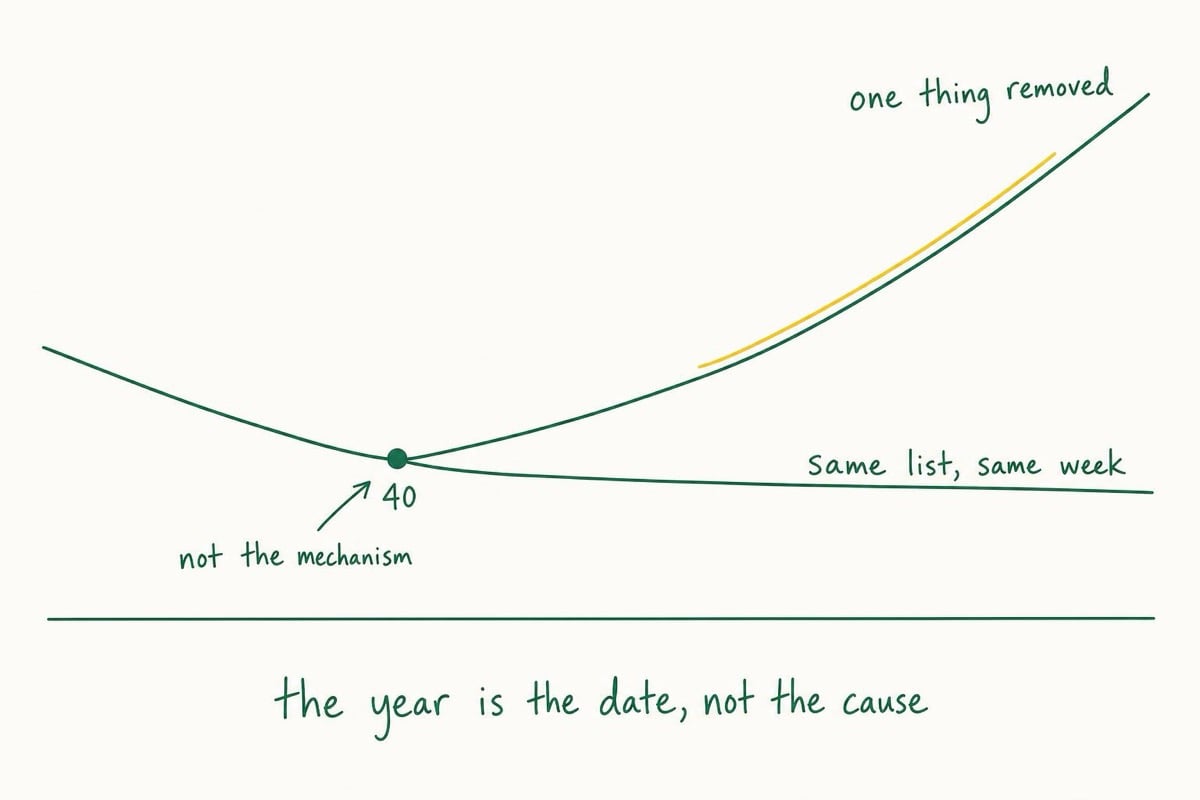
The curve does turn up. It does not turn up on its own.
For most of the last twenty years, the best-measured fact about age and happiness was that it sagged in the middle. David Blanchflower and Andrew Oswald, working with roughly 500,000 Americans and West Europeans and controlling for birth cohort, found that "well-being reaches a minimum, on both sides of the Atlantic, in people's mid to late 40s." [11] [12] A later replication across 145 countries confirmed the shape with a nadir "in midlife around age 50," and put the US minimum at 45. [13]
Now the part most articles quoting that research have not caught up with. In 2025 the same lead author published evidence that the curve has gone. Using US and UK micro-data, Blanchflower, Bryson and Xu report that the old hump in ill-being by age "has been replaced by a monotonic decrease in ill-being by age," confirmed across 44 countries. [14]
Midlife did not improve. The young collapsed. As co-author Alex Bryson put it, "mental ill-being is highest among the young and declines with age." [15] A companion paper across six English-speaking countries finds that since 2020, happiness and life satisfaction simply rise with age across the lifespan. [16]
Developmental psychologists have a standing objection: these are cross-sectional studies comparing different people, not the same person tracked for forty years. Nancy Galambos and colleagues call the first half of the U "premature, and possibly wrong," while conceding that "there is better evidence of a rise in happiness after midlife." [17]
Put the whole pile together and one claim survives every challenge: well-being rises through the second half of adult life. What does not survive is any story in which 40 is a hinge that swings by itself. The direction is real. The mechanism was never the birthday, and no machine is handing you the hours this time.
Three things have to change before the second half starts
Pitkin's claim only worked because something concrete moved: hours came off the working day and landed in ordinary people's laps. Nothing does that for you now. So the second half starts when you move three specific things yourself, and the order matters, because the first one is the one almost nobody does.
1. Subtract before you add
In a 2021 Nature paper, Gabrielle Adams and colleagues ran eight experiments and found that people "systematically default to searching for additive transformations, and consequently overlook subtractive transformations," especially under cognitive load. [18]
The cleanest version was a Lego structure that needed stabilizing. Adding pieces cost ten cents each; removing one block was free and was the right answer. Without a hint, 41% removed the block. Given an eight-word reminder that removal was allowed and free, 61% did, and they went home with about 10% more money. [19]
The researchers' explanation is the part that should sting: "Additive ideas come to mind quickly and easily, but subtractive ideas require more cognitive effort. Because people are often moving fast and working with the first ideas that come to mind, they end up accepting additive solutions without considering subtraction at all." [20]
A caveat we would rather print than hide: a preregistered 2024 replication found mixed results across the same two tasks, so read this as a strong tendency rather than a law of the brain. [21]
The tendency is enough. Notice what you reached for the last time you decided things had to change at 40: a course, a side business, a 5am alarm, a new app, a coach. Every one of those is an addition to a week that Pew has already told you is full. Nobody sells you the removal, so the reflex to add is the one thing worth distrusting.
2. Free an actual block, not an intention
Pitkin's mechanism was hours. Not attitude, not perspective, not gratitude. Hours.
So the subtraction has to produce a specific recurring block on a specific day, and that block has to inherit the status of the thing you removed. If you dropped the Thursday committee, Thursday 7pm is now yours and it defends like a client meeting defends. An intention to "make time" produces nothing, because it competes with everything, and in a 45-to-54 household everything wins.
Most people cannot name what to cut, which is a different problem and a solvable one. Working out which part of your life is actually load-bearing comes before cutting anything, and if the honest answer is that several areas need rebuilding at once, the sequenced version of this work is the place to go next.
3. Point part of it past yourself
The freed block gets spent on something, and what you spend it on changes the return.
Researchers at MIDUS followed 2,252 American adults, average age 55 at baseline, and measured them again a decade later. People who felt they were contributing to others reported better positive affect, sense of self-worth and social connectedness ten years on. The sharper finding is the other half: 46% of the sample fell short of their own expected level of contribution, and that shortfall predicted lower life satisfaction, most strongly among the middle-aged. [22]
This is observational and self-reported, on a sample that was 93% white, so treat it as an association rather than a lever. But the shape of it is worth sitting with. Intending to mentor, teach, coach or build something for people coming behind you, and then never doing it, tracks worse than the people who simply never formed the intention. Almost half of them are carrying that gap. If you have been telling yourself for three years that you will finally do something that outlasts you, that sentence is not neutral.
What this looks like on a Tuesday
Ray is 45, runs a regional sales team, and has spent two years planning to get back into shape, start the consulting thing, and see his father more than once a month. His January move was to buy a rowing machine and a project management app. By March both were furniture.
His actual move, when he finally made it, took ten minutes. He resigned from the industry association board he had joined in 2021 and had not enjoyed since 2022. That gave him back a Wednesday evening and roughly six hours a month of email he had been answering at 11pm. He did not fill it with the rowing machine. He put his father in it: dinner, every other Wednesday, standing.
The consulting thing started nine months later, out of a conversation at one of those dinners.
Tessa, 51, went the other way. She subtracted nothing and added a 5:30am wake-up, a language app and a Saturday morning class. Six weeks in she was more tired, further behind, and privately certain that the failure was hers. That is not a discipline problem. Her week was already at capacity before any of it, and adding to a full week just relocates the shortfall.
What worked was giving up the Saturday class and handing the household finances to a fee-only planner she had been meaning to hire since 2023. Two hours a week returned. She spends one mentoring two junior colleagues, which is the only part she describes as having changed how the year feels.
Neither of them found more energy. Both of them found the same thing: a slot that used to belong to someone else. Rebuilding at this age is not a motivation problem, and it is not usually a knowledge problem either. It is a capacity problem wearing a motivation costume.
"There is not enough runway left"
There is more than the number in your head. On 2023 US mortality data, a person at exact age 40 has 40.7 more years ahead on average, 38.6 for men and 42.7 for women. At 50 it is 31.8 years. [23] That is a period life table, not a forecast for you personally. But the figure people quote is the one measured at birth, and it understates what someone already standing at 40 has left.
The second-half evidence is better than the culture's picture too. Analysing Census records for 2.7 million US founders, Pierre Azoulay and colleagues found the mean age at founding was 41.9, and among the fastest-growing one in a thousand ventures it was 45.0. "Conditional on starting a firm, a 50-year-old founder is 1.8 times more likely to achieve upper-tail growth than a 30-year-old founder." [24] Compare that with the image: TechCrunch award winners averaged 31 at founding, and the founders on Inc.'s 2015 fastest-growing list averaged 29. [25]
That evidence is about starting companies, not about changing careers in general, so we will not stretch it. It does dispose of the specific fear, which is that the window shut while you were busy.
Start with the subtraction
Open your calendar to the next four weeks and find the recurring commitment you would not join today if you were asked fresh. Not the hardest one. The one you have outgrown and kept out of politeness.
Leave it. This week, in writing, with a date.
Then look at the block it releases and give it a name before anything else claims it, because something will try by Friday. That single removal is the closest thing anyone has to the machinery Pitkin was writing about, and it is the only part of this you control. The rest of the rebuild can be sequenced later. The hours have to exist first.
Frequently Asked Questions
Is it true that life begins at 40?
Who said "life begins at 40"?
Are the 40s the hardest years?
What changes when you turn 40?
Physically, less than the internet suggests. Muscle mass declines roughly 3% to 8% per decade after age 30, and aerobic capacity falls only about 3% to 6% per decade in the 20s and 30s before the rate accelerates much later in life. A meta-analysis of 47 resistance-training studies in adults over 50 found mean strength gains of 24% to 33% over roughly 18 weeks, which dwarfs the per-decade loss.
Is 40 too late to start over?
No, and the administrative data is unusually clear on it. Among 2.7 million US founders, the fastest-growing ventures were started at an average age of 45, and a 50-year-old founder was 1.8 times likelier than a 30-year-old to reach upper-tail growth. The harder question is not whether you can start, it is what you are willing to stop doing to make room, which is a very different kind of decision.