

How to Stop Self-Sabotaging: The Short Answer
To stop self-sabotaging, find the exact moment you keep falling off the plan, work out what that moment protects you from, and change what you do right there. A better plan rarely helps. Most people who self-sabotage already know what to do. They stall at the same spot each time, and your last three attempts will usually show you where that spot is.
You probably know the scene. It's late on a Sunday and you're promising yourself this week will go better. The plan is fine. You've had some version of it for a year: go to the gym three times, send the proposal, stop opening the laptop after dinner. By Thursday it's gone, and you can't point to the moment you decided to drop it.
That's what makes this so irritating. Self-sabotage is any repeated behavior that gets in the way of a goal you still want. You aren't confused about the goal, and nobody else is stopping you.
Below is how to find your spot, five common patterns, and one small fix for each.
Why Knowing What to Do Doesn't Stop It
Knowing what to do doesn't stop self-sabotage because wanting something more only moves your behavior a little. A meta-analysis of 47 experiments found that a medium-to-large jump in people's intentions produced only a small-to-medium change in what they did. So another dose of motivation, a stricter plan or a more inspiring book mostly raises the intention, and much of the gap between intending and doing stays where it was. [1]
You've probably tried those already. The new app. The third self-help book, half highlighted. The routine ChatGPT wrote for you, which was a good routine. None of it stuck, and the usual conclusion is that you lack discipline.
We don't buy that as the whole story. Someone with no interest in the goal doesn't keep restarting it for three years. Consistency can be built, but pushing harder on the whole goal won't help much if the trouble lives in one specific moment. It's the same gap that makes people procrastinate when they know better.
What Self-Sabotage Is Protecting You From
Most self-sabotage does a job. In the short term it protects you from something: finding out you can't do it, feeling like a beginner, or dealing with what changes if it works. Psychologists have studied one version of this for decades under the name self-handicapping, which means putting an obstacle in your own way so that a failure comes with a built-in excuse.
The classic study dates from 1978. College students were told they'd succeeded on a set of problems, and for some, the problems were unsolvable, so the success felt like luck. Before a retest, they could choose a drug they'd been told would help their performance or one they'd been told would hurt it. Men whose success felt accidental were the only group who preferred the one that would hurt. [2]
It's an old lab study, and the effect didn't hold for the women in it. But the logic will feel familiar. If you stay up all night before the big presentation, a bad presentation says nothing about your ability.
The cost shows up later. Across four studies, researchers found that self-handicapping and poorer adjustment reinforced each other over time. People who did it more also reported rising substance use and less inner motivation for their jobs. So the excuse helps on the day and costs you afterward. [3]
This changes the question worth asking. "Why am I so weak?" has no useful answer. "What would I have to face if this worked, or if it failed?" usually does.
Find Your Spot in Your Last Three Attempts
You can usually find your spot in about ten minutes. Write down the last three times you tried this goal. For each one, note the last thing you did, what happened in the two days before you stopped, and what was coming next that you never reached. Then look for the repeat. Self-sabotage tends to feel random while it's happening, and written side by side, it often isn't.
That third question does most of the work. What you were about to do is often the thing you were avoiding.
Say Gwen has restarted a gym routine three times this year. She assumed she got bored. Written down, all three attempts ended the same week as a work trip. She doesn't need more motivation. She needs a plan for the weeks she travels.
Say Terry keeps preparing to go out on his own as a consultant. He has rewritten his website twice and finished three courses. Written down, every attempt ended right before he'd have to send a price to a real person. Terry has plenty of preparation. What he hasn't done yet is risk hearing no.
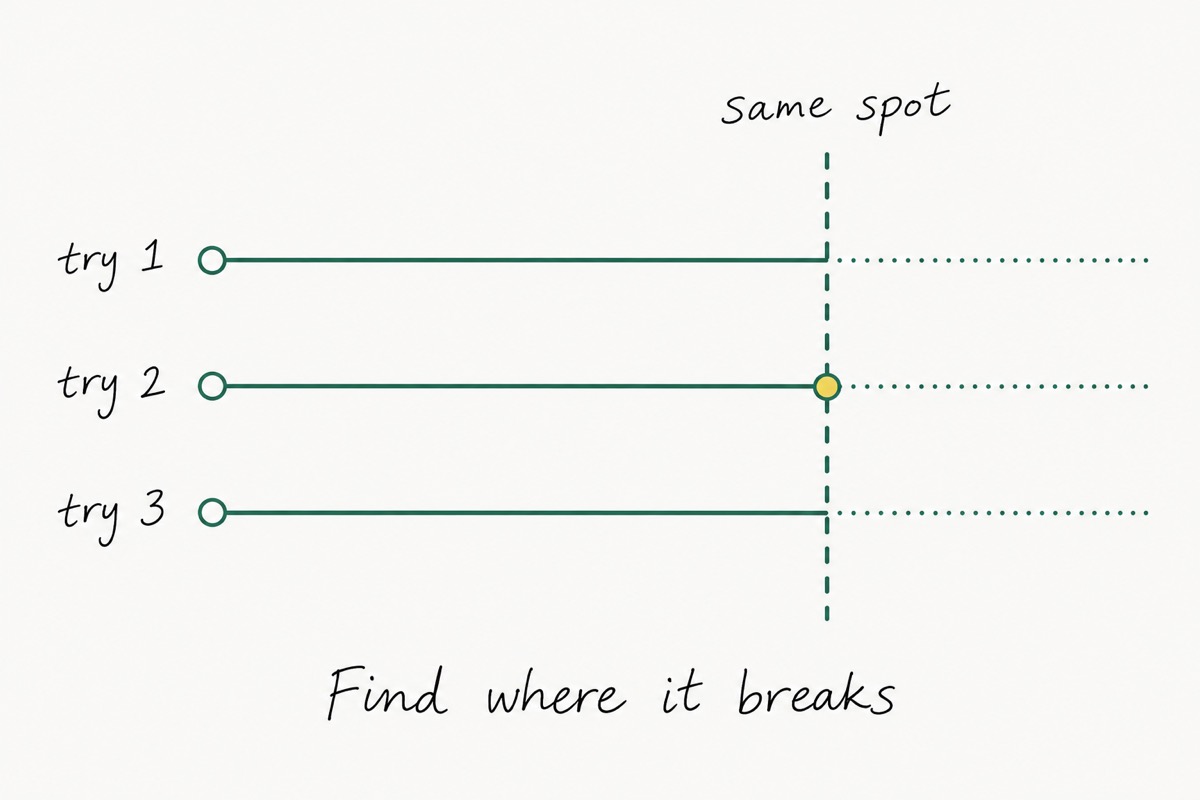
Five Common Self-Sabotage Patterns and One Fix for Each
Five patterns cover a lot of what people call self-sabotage: waiting for a clean start, treating one slip as the end, preparing instead of doing, holding back so failure doesn't count, and wrecking things when they go well. You may recognize more than one. Start with the pattern that sits at your spot, because each fix below is aimed at that one moment and asks for very little willpower.
1. Waiting for a Clean Start
"I'll start Monday" feels like a decision. New beginnings can lift motivation, as the research on the fresh start effect shows, so the instinct isn't silly. The trouble is what the plan does tonight. It gives you permission to skip today, and it leaves everything for Monday's version of you to carry.
The fix: do the smallest real version today, before the new date arrives. Two minutes counts: shoes on, document open, one line written. Monday can still be the big start. It just won't be the first step.
2. Treating One Slip as the End
You eat the cookie at lunch, so the rest of the day is written off. Researchers call this the what-the-hell effect. In one study, everyone was served the same size slice of pizza, but some were led to believe theirs was bigger than another person's. Dieters who thought they'd had the bigger slice tended to eat more cookies afterward, while non-dieters tended to eat fewer. Nothing had actually gone wrong, and it still changed what the dieters did. [4]
The slip itself costs very little. When researchers followed 96 people building a daily habit, missing one opportunity didn't materially affect the process. What costs you is what you decide the miss means. [5]
The fix: write one rule before you need it: after a miss, tomorrow is the smallest version, with no catching up. Go easy on yourself too, for practical reasons. In one experiment, people prompted to treat a failed test with self-compassion studied longer for the next one than people in the comparison groups. [6]
3. Preparing Instead of Doing
Another book, another course, a better app, one more chat asking for the perfect plan. Preparing feels like work, and it can't fail. We don't have a clean study to point to here. This is our read of the pattern, and it overlaps with perfectionism. The tell is simple: you're still preparing long after you had enough to start.
The fix: no new input until you've done one visible thing with the last one. Visible means another person could see it: a sent email, a booked session, a published page. For Terry, that means one price goes out with the website as it is today.
4. Holding Back So Failure Doesn't Count
Starting the night before. Skipping the practice run. Telling everyone you barely tried. This is self-handicapping in ordinary life. If it goes badly, you have your excuse. If it goes well, you're a natural. Either way, you never find out what your full effort would get you.
The fix: decide what full effort means before you start, and tell one person. Keep the stakes small enough that a bad result won't hurt much: one pitch, one 5K, one hard conversation. Even a bad result tells you something once you've really tried.
5. Wrecking It When It Starts Going Well
Three good weeks, then you stop tracking, pick a fight or say yes to everything. Gay Hendricks gave this a popular name in The Big Leap: the upper limit problem, the idea that each of us has a limit on how much good we're comfortable with. We haven't found strong research behind it, so treat it as a useful description, not a diagnosis. It can do real damage in close relationships too, which we cover in signs you may be sabotaging your relationships.
The fix: work out your usual stopping point, whether that's a number of days, an amount of money or a stage in a relationship. When you get near it, set up a check-in with someone you trust, and put off any big decisions until the next week.
Change What Happens at That Moment
The most reliable tool for a predictable moment is an if-then plan: "If this happens, I will do that." A review of 94 tests found a medium-to-large effect on whether people followed through. It helps because you make the decision ahead of time, so you don't have to win an argument with yourself when you're tired. Write one plan for your spot, based on what you found in your last three attempts. [7]
Here's what that looks like:
- Gwen: "If I have a work trip this week, I'll do ten minutes of bodyweight exercises in the hotel room before I unpack."
- Terry: "If I catch myself opening the website editor, I'll send one price to one person first."
- The Sunday-night restarter: "If I start planning to begin again on Monday, I'll do two minutes of it right now."
Keep it to one plan and try it for two weeks. When it fails, and it may, go back to the paper and look at where it failed. If your spot keeps moving between work, health and home, the trouble may be bigger than one moment, and a life audit can show you the whole picture. If everything feels too tangled to pick a starting point, begin with how to get your life together.
"I've Tried Everything. Why Would This Be Different?"
It may not work on the first try, and we won't promise otherwise. What changes is the target. You aren't trying harder at the whole goal, which is why so many goals fail. You're changing one moment you've already seen break several times, so you can tell quickly whether the fix worked.
Give it longer than feels fair. In that same habit study, people took anywhere from 18 to 254 days for a new behavior to become close to automatic. So don't judge this by week two. Judge it by whether you got past your spot this time, or got back on sooner than you did before.
When to Get More Help
Some self-sabotage needs more than an article. If the pattern comes with lasting low mood, panic, heavy drinking or drug use, the effects of trauma, or a lifelong struggle with attention and finishing things, talk to a doctor or licensed therapist. The same goes if it's costing you a job or a relationship. These things can be treated, and an if-then plan won't treat them. The US government has a guide to finding help.
If you're thinking about hurting yourself, that's different from everything above. In the US, you can call or text 988 at any hour.
Do This Tonight
Get a piece of paper. Write down your last three attempts at the goal you keep circling, and where each one stopped. Don't fix anything yet.
If the same spot shows up twice, write one if-then plan for it. That's the whole job for today.


