

The interview’s over, and you’re pretty sure you aced it. Now how do you seal the deal, and convince a prospective employer to follow their hunch and hire you? The answer may be simpler than you think: A well-written thank-you.
Opinions are hotly divided on the topic of the post-interview email. Some hiring managers say they’re a waste of time. Others say a job candidate’s failure to send a thank-you email is grounds for immediate disqualification. What all can agree on, at least, is that a good follow-up email probably won’t hurt your chances — but a bad one most certainly will.
Make sure you recognize that fact, and treat it with the same amount of respect and attention you would ask of them. You need to be confident without being cocky, polite without being sycophantic, and most of all, you should aim to improve upon the impression of you they already have from the interview. Today many businesses are seriously considering their options on whether they want to hire an employee or a contractor, full-time or part time. It's important to remind your interviewer why they should seriously consider you for the open position - based on your terms.
Phew! That’s a lot to manage.
Luckily, the example below provides a perfect template to start from, according to Dr. Deborah Good of the University of Pittsburgh’s Katz School of Business.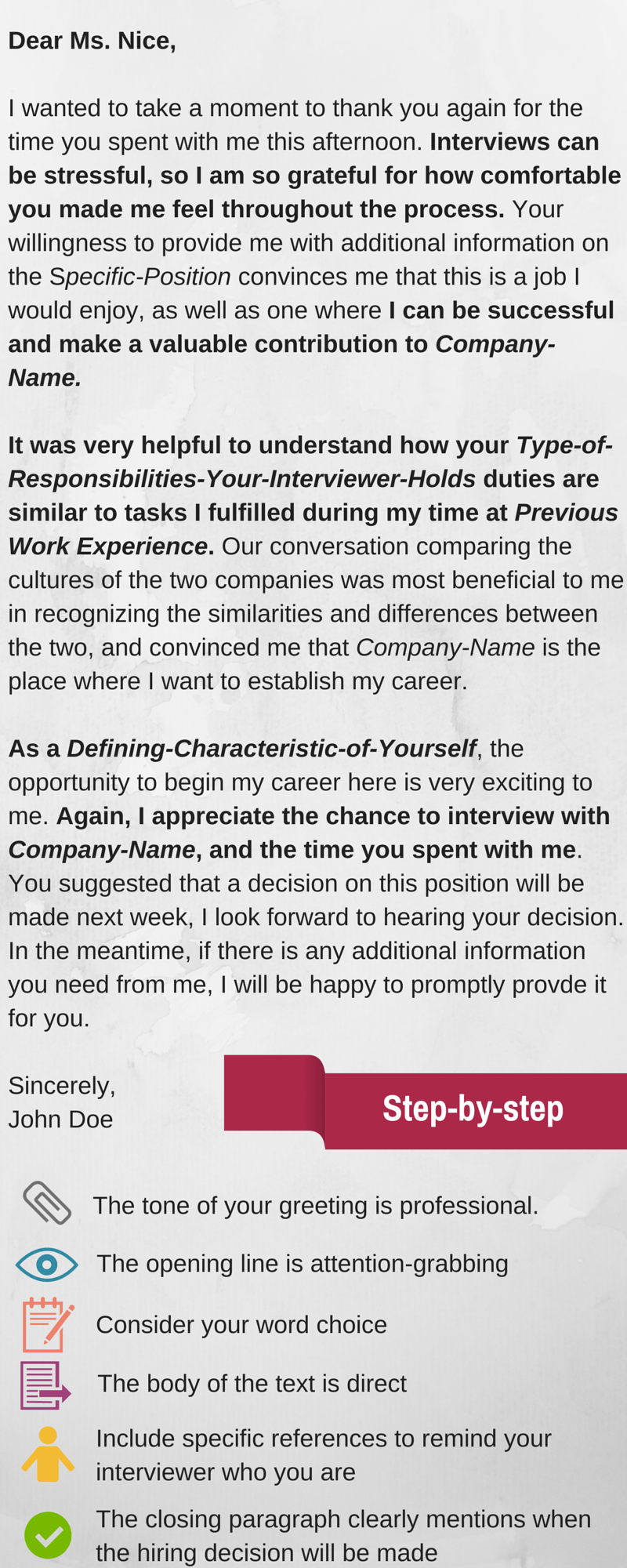
Opinions are hotly divided on the topic of the post-interview email. Some hiring managers say they’re a waste of time. Others say a job candidate’s failure to send a thank-you email is grounds for immediate disqualification. What all can agree on, at least, is that a good follow-up email probably won’t hurt your chances — but a bad one most certainly will.
Improve Their Impression of You
In sending a post-interview thank-you, the most important thing to remember is to treat it like an extension of the interview itself. By sending a hiring manager or recruiter one last message, you are essentially asking them to step back into the room with you, even if that room is a Gmail inbox.Make sure you recognize that fact, and treat it with the same amount of respect and attention you would ask of them. You need to be confident without being cocky, polite without being sycophantic, and most of all, you should aim to improve upon the impression of you they already have from the interview. Today many businesses are seriously considering their options on whether they want to hire an employee or a contractor, full-time or part time. It's important to remind your interviewer why they should seriously consider you for the open position - based on your terms.
Phew! That’s a lot to manage.
Luckily, the example below provides a perfect template to start from, according to Dr. Deborah Good of the University of Pittsburgh’s Katz School of Business.


