

Self-discipline isn't a trait. It's not a muscle you build. It's not a streak you keep. It's a recovery loop: the cadence of returning to the practice after you miss. If you've been searching "how to build self-discipline" for fifteen years and keep arriving at the same answer (more willpower, better routines, fewer distractions), you already suspect the model is wrong. It is. Here's the one that works at midlife: a 90-second practice you can do on the worst Wednesday of your life, because the worst Wednesday is when self-discipline is actually being trained.
I've rebuilt how I work more than once: first when I started LifeHack, then again a few years ago around AI. Neither change held because I gritted my teeth harder than before. They held because on the days it fell apart, and plenty did, the return was small enough that I'd actually do it. That's the whole reframe in one sentence. What follows is the long version.
Why "More Willpower" Stops Working at Midlife
The standard advice treats discipline as a quantity. You have a tank of willpower, you spend it on hard things, and when it runs dry you cave. This is the willpower model, and it has a respectable origin. In 1998 Roy Baumeister and colleagues published the ego-depletion studies, arguing that self-control draws on a limited resource that depletes with use and recovers with rest. [1] The muscle metaphor comes straight from there.
Here's what most articles won't tell you: the effect didn't hold up. In 2016 a registered replication across 23 labs and more than 2,000 participants found the ego-depletion effect was tiny, with a confidence interval that ran right through zero. [2] Translation: the idea that you "run out" of willpower like a phone battery is, at best, far weaker than a generation of productivity advice assumed.
So if willpower isn't a tank, why does discipline feel so much harder at 45 than it did at 25? Not because your tank shrank. Because your life got loud. At 25 you had spare room, few competing obligations, and a body that recovered from a bad week by Tuesday. At midlife your decision budget is gone by mid-morning, spent on work, money, kids, and parents who now need you. The willpower model limped along when the load was light. The load is no longer light. That's the real reason the old approach stopped working, and it's good news, because it means the fix is structural, not a character upgrade you failed to earn.
What Self-Discipline Actually Is: A Recovery Loop, Not a Trait
Open a dictionary and self-discipline reads like a static virtue, the ability to control yourself and make yourself do things. Useful as far as it goes. Useless the first time you miss, because the definition has no room for the miss. It describes a person who never breaks, and that person does not exist.
Self-discipline isn't a trait. It's a recovery loop.
Replace the trait with a loop. Most habit advice describes formation: a cue sets off a craving, which drives a response, which delivers a reward, which wires the cue tighter for next time. That explains how a habit gets built. It says almost nothing about the day the loop breaks, when the cue fires and you do nothing. That broken day is where midlife discipline lives or dies, and it needs its own loop: Action, Miss, Return, smaller Action. Not a straight line you defend. A circle you keep closing.
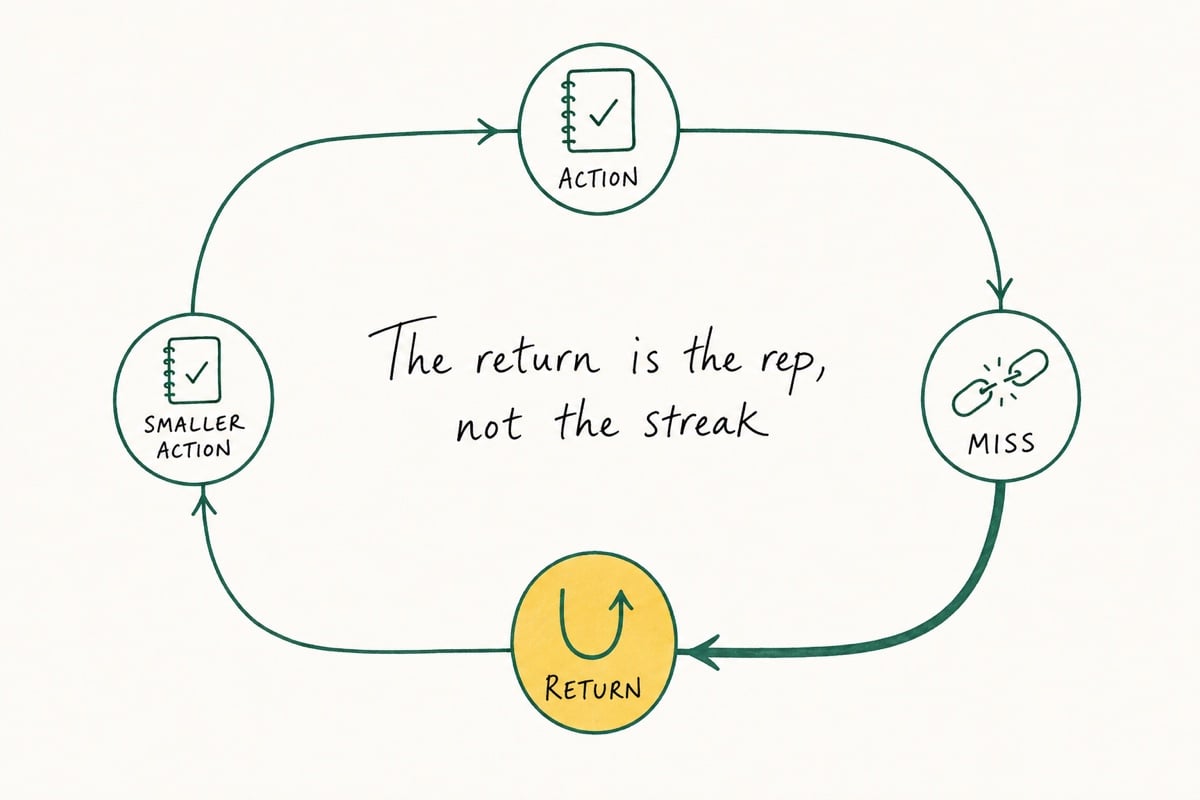
The shift this forces is the whole point. A disciplined person is not someone who never misses. It's someone whose gap between the miss and the return is short. By that definition discipline stops being a thing you have or lack, and becomes a number you can move at any age. Which means the question changes from "how do I never break again" (impossible) to "how do I make the return so small I'll actually take it" (trainable this week).
The "7 Ways to Build Self-Discipline" and Why Most of Them Backfire at Midlife
Search the head term and you'll hit a dozen "7 ways" lists. The most credible one comes from psychologist Ellen Hendriksen, writing in Scientific American, and it's grounded in how the prefrontal cortex actually manages impulses: remove temptation from your environment, use if-then plans, start smaller than feels meaningful. [3] Those are good tactics. I'm not here to dunk on them.
The problem isn't the advice. It's the assumption underneath it. Almost every item on every version of the list is addition: add a system, add a plan, add an environment tweak, add a morning routine. Addition assumes the bottleneck is not knowing what to do. At 25 that assumption usually holds. At 45 it almost never does. You've read the books. You own the journals. The honest sentence from people in this spot is the one we hear most: "I keep buying habit books and journals." Knowledge was never the gap.
When the bottleneck is recovery, not information, more advice makes things worse. Each new system is one more thing to break, one more streak to lose, one more piece of evidence that you're the problem. The midlife move is to do the opposite of the listicle: subtract until one practice is left, and put your effort into returning to that one fast instead of stacking six you'll abandon by Thursday.
The "5 C's" Are Real Enough. None of Them Is the Metric.
The other question that haunts this search is "what are the 5 C's of self-discipline?" Here's the quiet truth: there's no single agreed-on answer. One popular coaching version lists Clarity, Commitment, Consistency, Control, and Compassion. [4] Look further and you'll find versions that swap half the words for different ones. That variation is the tell. A framework that changes depending on who's selling it is a mnemonic, not a law of behavior.
But set the inconsistency aside, because there's a deeper issue. Notice what every version of the C's has in common: they're all traits or virtues. Clarity. Courage. Commitment. You're meant to cultivate them and somehow become disciplined. None of them is a measurement. You can't tell whether your discipline improved this month by rating your Courage out of ten.
The metric isn't the streak. It's the recovery time after the miss.
When we looked at the goals our most engaged LifeHack members actually write for themselves, the words that showed up across nearly every life area weren't virtues. They were "build," "establish," "consistent," "daily," "routine," threaded through more than three-quarters of goals regardless of whether the goal was about health, money, or family. People don't want to feel more disciplined. They want a practice that holds. Virtues don't tell you if it's holding. Recovery time does. Use the C's as language if you like the words. Just don't mistake the vocabulary for the gauge.
The 90-Second Check-In: The Smallest Practice That Survives a Bad Week
If the metric is recovery time, the job is to make the return cheap. The cheapest return is one you can complete in the worst ninety seconds of your worst day. That's the entire design spec.
This is why, inside LifeHack, the practice we lean on isn't a grand morning routine. It's a daily Check-in: a short, fixed prompt you answer in under two minutes about how the one thing that matters is going. The point isn't the data. The point is that it's small enough to survive a day that's already on fire. A 5 AM cold-plunge routine is a streak waiting to snap. A 90-second Check-in is a loop you can close even from a hospital waiting room, which means you'll close it tomorrow too.
Smaller than you think is doing the work. The instinct at midlife, especially after a bad stretch, is to come back bigger to make up for lost ground. Wrong direction. After a miss, the return has to be smaller than the resistance, or the resistance wins again and the gap grows. One push-up. One paragraph. One Check-in. The size of the return is the only variable you fully control, so it's the one to engineer.
You've known what to do for fifteen years. The thing you haven't tried is making the practice smaller than the resistance.
What You're Actually Avoiding When You Say "I Lack Discipline"
"I just don't have the discipline" is usually a misdiagnosis. Resistance isn't a moral failure. It's information. Daniel Kahneman's split between System 1, the fast automatic mind, and System 2, the slow effortful one, is useful here: most of your reaction to a task is generated by System 1 before deliberate thought gets a vote. [5] When you flinch away from the thing you "should" do, System 1 is flagging something: the task is vague, it's too big, it threatens an identity, or it's the wrong thing entirely.
So before you recruit more willpower, ask what the resistance is telling you. If the task is vague, the fix is to define the next physical action, not to push harder. If it's too big, shrink it. If you've rested and the resistance is still total, the problem may not be discipline at all. Persistent inability to start, paired with low mood and disrupted sleep, can be burnout rather than a willpower gap, and burnout doesn't yield to more pressure. If that's the pattern, and especially if it's lasted weeks, treat it as a signal to rest and, if it persists, to talk to a clinician, not as a character flaw to muscle through.
The reframe is simple and it removes the shame: you're not lazy. You're getting accurate feedback from a system designed to protect you. Read the feedback, then adjust the practice.
Self-Discipline at Midlife vs. at 25: What Actually Changed
People benchmark their current discipline against a younger version of themselves and conclude they've gotten weaker. They haven't. Three things changed, and none of them is willpower.
Your decision budget shrank in availability, not size. The same capacity now gets claimed by mortgage decisions, a teenager's crisis, a parent's health, and a job with more responsibility than the one you had at 25. By the time you reach the thing you "should" do, the easy fuel is gone. Recovery also slowed: a disrupted week used to cost you a day, and now it costs you several. And the stakes got heavier, so a miss feels like proof of decline instead of a normal Tuesday.
Every one of those changes argues for the recovery loop over the willpower model. Smaller decision budget means the practice has to be cheap. Slower recovery means the return has to be frictionless, because you'll be returning from deeper holes. Heavier stakes mean you have to drain the drama out of a miss, or the shame spiral eats the comeback. The approach that worked at 25 didn't fail because you aged. It failed because it was never built for load, and midlife is load. This is the same engine underneath the larger life rebuild: change isn't a willpower problem, it's a sequencing problem, and consistency is the dimension everything else rides on.
The Minimum Viable Streak: One Return After a Miss
Here's the close, and it's deliberately anticlimactic. The goal is not thirty days. It's not a perfect month or an unbroken chain. Those targets quietly make the streak the metric again, and the streak was never the metric.
Forget "30 days to a new you." The research on how habits actually form is blunt about it: in one well-known study, reaching automaticity took a median of 66 days and ranged from 18 to 254 depending on the person and the behavior, and, crucially, missing a single day didn't measurably hurt the process. [6] One miss doesn't break anything. Quitting after the miss does. The whole ballgame is the return.
So the minimum viable streak is a streak of one: today's return. That's it. Leo Babauta has been making a version of this case for years over at Zen Habits, that discipline is built through small, repeated actions rather than heroic effort. [7] The recovery loop just names the part that matters most for people rebuilding at midlife: the return after the break is the rep. Not the streak. The return.
If you do one thing this week, don't start a new system. Pick the practice you already know you should keep, the one you've started and dropped a dozen times. Shrink it until it's almost embarrassingly small. Then, the next time you miss, and you will, time how fast you come back. That number is your discipline. Make it smaller. You haven't run out of discipline. You're one return away from it.