

A widespread picture represents two individuals standing on either side of the number 9 that has been drawn on the floor. For one person, it appears as the number 6 and for another, it's the number 9.
Who is right and who is wrong? Obviously, they both are right yet they both are wrong in the eyes of another individual because of the viewing perspective. This is the simplest example showing perspective meaning.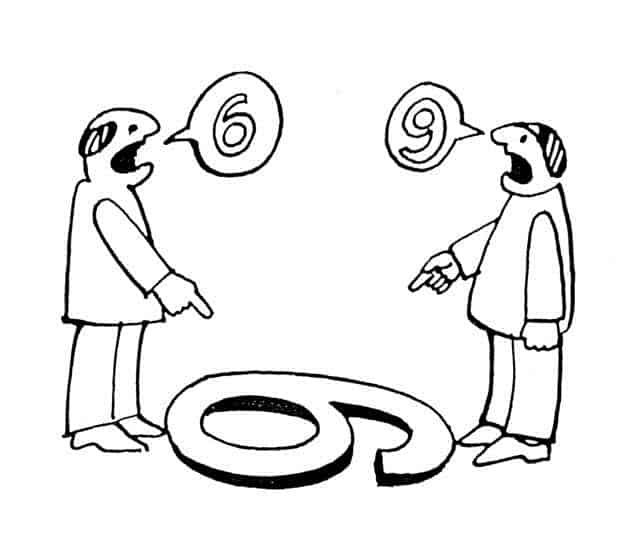 Both of them consider themselves to be right; here, they must understand the other perspective by changing their sides.
If people simply understand that a life perspective can be changed, molded, and explained, the world can be a better place for all. It can put end to fights, wars, daily quarrels, and much more. The only requirement is to see things from another person’s perspective.
We can make a perfect society with responsible adults if we teach our children about the perspective and its importance.
To learn how to see things from another person's perspective, you must first learn the fundamentals of perspective. You need to first know what a life perspective is.[1]
Who is right and who is wrong? Obviously, they both are right yet they both are wrong in the eyes of another individual because of the viewing perspective. This is the simplest example showing perspective meaning.
Both of them consider themselves to be right; here, they must understand the other perspective by changing their sides.If people simply understand that a life perspective can be changed, molded, and explained, the world can be a better place for all. It can put end to fights, wars, daily quarrels, and much more. The only requirement is to see things from another person’s perspective.
We can make a perfect society with responsible adults if we teach our children about the perspective and its importance.
To learn how to see things from another person's perspective, you must first learn the fundamentals of perspective. You need to first know what a life perspective is.[1]
Understanding the Perspective Meaning
What does perspective mean in reality? The above-mentioned example of 6 and 9 is the best way to understand how you take your life perspective. It's a way how you see life and approach it.In this life, few things are absolutely right or wrong. Mainly, we have two different perspectives on one thing. For instance, for one person, something extremely bad is just something normal for another.
It's easy to come across a lot of different debates online. There are a lot of polarizing debates around politics, relationships, and anything that has two sides to the story or binary thinking. Social media makes it easy to pick a side and find opinions that line up with what you believe.
As a neutral person who has not picked a side yet, you can see that both sides of this argument have concrete reasons to support their answers. They have different choices, and all of the choices are valid.
While one side sees life from the perspective of "anything goes as long as it makes you happy," another side sees life as "there are boundaries you should not cross."
You see now that there are two valid perspectives here. Both of them are right in their choices, and saying one is wrong is an unsupportable stance.
When we define perspective, it is always important to consider others as well. There are more than 7 billion people in the world and there are people who see things in a different light. This complicates life because instead of seeing the similarities we share, we often focus on what is different, which leads to disagreements and fights.
Simply making a switch and attempting to see things from a different perspective could help solve many of these problems.
Importance of Seeing Things Differently
Your perspective on life determines how you relate to people, how you handle relationships and troubles, and how you live day-to-day. You may not realize how important your perspective on life is because we often feel that as long as other people’s opinions and decisions do not affect us, ours should not affect other people.However, the fact is that our perspective on life does affect the people around us.
Going back to the 6 and 9 analogy we began with, what we also have are two different scenarios that can play out here.
We can end up having two adults who refuse to agree to disagree and separate after a heated argument, destroying the chances of building a relationship.
We can also end up having two adults who swapped positions and perspectives and looked through each other’s eyes for a minute to see that this could either be a 6 or a 9, depending on where they stood. This could graduate into handshakes, drinks later, and the start of a friendship. All they had to do was view things from a different perspective.
Your perspective on life can either make or break a relationship.
If you have a bad or negative perspective on life, it affects everything and everyone around you negatively. You find yourself constantly being angry and not being able to accept other people’s perspectives.
Other times, you find yourself complaining and stressing over things that simply require a small shift in your perspective.
Having a good perspective on life gives you an advantage. First of all, you are a lot more open to seeing from other people’s perspectives, thus making it easy for you to create meaningful relationships.
It also gives you a lot more reasons to be grateful and happy. If you live a life where you are constantly showing gratitude and being happy, then you have lived a fulfilled life.
How to Change Your Perspective on Life
Changing your perspective is an active decision you have to make intentionally. First, you must come to terms with the fact that your current perspective on life is not absolute and can be changed. Then, you have to understand the importance of having a different perspective from the one you already have.Once you have dealt with these, here are some active steps you can take to change your perspective on life.
1. Stop Complaining
Whatever the issue is, whenever you feel like complaining, fold your thumb, bite your tongue, do something and make sure it stops you from letting out that complaint. When you stay silent and listen, you can start seeing things from different perspectives.2. Find What Makes You Happy
A happy person is more understanding with a clear vision of things. Happiness adds positivity to life. Seek happiness if it is not coming your way naturally to clear the fog.When you are constantly brooding and thinking negatively, your perspective will never change, and soon all that negativity will begin to spread around you like wildfire. Staying positive can be challenging at first but will ease with time.
One great way to train your mind to focus on what you love in life is to create a gratitude journal. The way it works is every time something good happens, you write it down in your journal.
Then when a negative situation occurs, you can flip open your journal to change perspective. Remind yourself how blessed and fortunate you are when you feel you have nothing to celebrate in life.
Read about your successes when you feel you can’t do anything right. Creating a gratitude journal will significantly change your perspective about yourself and your life.[2]
3. Reduce the Social Media Vitriol
Often times on social media, people will post a thing and followers will take on a different perspective regarding its meaning.When different phrases in a post hit social media, some people misunderstand them, which can increase online conflicts. Responding to critical or negative posts with a sense of maturity and lightheartedness will lessen any vitriol spills and keeps anyone from receiving blocks.
If you feel like you may need some time to unplug from social media, read: How to Unplug from Social Media For a Mental Energy Boost.
When you are on social media, always seek the other angle of the person disagreeing with you. Your opinion is not alpha, it is just an opinion and can change.
The beautiful thing about perspective is that it is subject to change. It is not static, and the decision to alter it rests on you.
4. Keep Your Head Up
Someone with a fixed mindset believes there are a lucky few who are blessed with the right genes to become successful.Studies show someone with a fixed mindset is ill-equipped to tackle many of life’s challenges.[3] They see failure and difficulty as a sign that they are doing the wrong thing.
You may have heard someone explaining why something was not meant for them by talking about how it didn’t come naturally. This perspective cripples the ability of many from reaching their full potential.
Someone with a growth mindset has a different perspective on life. They believe everyone can learn and build the skills necessary to achieve their goals.
They see failure as a sign that their approach was wrong, not as a sign they were wrong. As a result, they will regularly try new things until they achieve their goal.
Inventors are a classic example of a growth mindset. Their perspective on negative situations is that it is nothing more than a problem they have yet to solve. They see each negative event as being one step closer to success.
5. Change Negative Perspective from the Inside-Out
For you to change your perspective about negative events in your life, you first need to change the way you talk to yourself. What you say to yourself regularly will have an impact on the actions you take.Consider someone who unexpectedly had their employment terminated. If their mind is full of negative self-talk, then they are telling themselves how inadequate they are.
Negative self-talk has a domino effect; it's triggers stress and anxiety, which also leads to self-criticism. That self-criticism then results in diminished goals.[4]
6. Stay Away from Negativity
If you believe your boss has a negative opinion about you, then you think they are being fake when they are nice to you. You think they are nitpicking or complaining about small things when they offer constructive criticism. What does perspective mean to you here?By continuing to interpret events negatively due to negative self-talk, you will continue to produce undesired results.
Now imagine if you told yourself your boss has your best interests at heart and is only trying to bring the best out of you. That simple change in your perspective better equips you to deal with the perceived negative events in your life.
When your boss offers you constructive criticism, you believe they are investing in your growth. When your boss is nice to you, you welcome the behavior because you see them as your friend and colleague.
When you change perspective, the same events that could have led to failure now work to your benefit.
7. Focus on What Matters
Your brain can only focus on so many things each day. As a result, your mind will automatically filter out information it believes is unimportant to you.[5]A common example of this is when you purchase a new vehicle, and you suddenly notice that vehicle everywhere. It is not that everyone purchased the vehicle the same day you did, it was that your mind was blocking the information.
To have a better life perspective, you must change your daily focus. Just like when you purchase a new vehicle, you can alter the events your mind recognizes.
Instead of focusing on negative events and how bad things are in life, focus on the things you are grateful for.
8. Focus on the Needs of Others
The final way to change life's perspective is to help others. An amazing thing will happen when you spend more time focusing on the needs of others.First, you will feel better about yourself because of how positively others view you. Next, you will realize that while everything is not perfect in life, it could always be worse.
Have you ever heard the phrase “first world problems”?
It is a funny way to help put negative situations into the proper perspective. While all negative events are unpleasant, there is most certainly a difference.
If you have an inconsiderate boss, while that can make work unpleasant on many occasions, it is still a blessing to have employment. Others feel that their spouse is irresponsible with money, but at least you have a spouse who loves you.
Final Thoughts
The moment your perspective on life comes to play, always remember that it is not the alpha perspective and that the other person’s perspective matters as well.Practicing shifting your perspective can be an important skill to develop— understanding perspective meaning can improve your life.


