

Best Books for Decision Making
You have an actual decision in front of you. A job offer with a Friday answer, a house at the top of what you can carry, a side business you have been propping up for two years. And every reading list hands you the same stack in the same order: Kahneman first, then nine more, with nothing about which one helps with the thing you are deciding.
So here is the short version, sorted by your situation instead of by sales rank.
- Choosing between options right now: Decisive, Chip and Dan Heath.
- Stuck in something you already started: Quit, Annie Duke.
- Still replaying a past call that went badly: Thinking in Bets, Annie Duke.
- Deciding for a team or an organization: Noise, Kahneman, Sibony and Sunstein.
- You want a plain step-by-step method: Smart Choices, Hammond, Keeney and Raiffa.
- You want the psychology underneath: Thinking, Fast and Slow, Daniel Kahneman.
- Your decisions are really forecasts: Superforecasting, Tetlock and Gardner.
Below is what each one does to your decisions, the single drill worth running from it this week, and where it stops working. We also name two famous titles we would not hand to someone with a decision to make, and why.
How We Graded Them
We judged the best books for decision making on three questions. They are ours, not an established rubric.
- Does it hand you a procedure you can run on a real decision, or only a vocabulary for describing decisions?
- Does it say where it stops working?
- Does the evidence behind it still hold up?
Question one carries most of the weight, and the reason is what the research has actually measured. It has measured practice. Across four years of geopolitical forecasting tournaments sponsored by the US intelligence community, a training module that took under an hour improved forecasters' accuracy, measured by Brier score, by 6 to 11 percent against the control condition (Chang, Chen, Mellers and Tetlock, Judgment and Decision Making). Under an hour of structured drills, with a number attached. What reading a book does to your decisions is not something those studies set out to measure.
Which is why we score each book by the drill you can pull out of it. If you finish one without running anything, you have watched a nature documentary about your own mind.
The Seven Worth Your Time
1. Decisive: How to Make Better Choices in Life and Work
The Heaths' complaint is that most of us decide inside a frame somebody else drew. You ask "should I take this job?" rather than "what are the three best things I could do with the next two years?" That narrowing shows up in the research on how organizations decide: Paul Nutt's profile of 78 decision case studies found that most processes were solution-centered, starting from a favored answer, which held down both innovation and the number of alternatives anyone looked at (Nutt, Types of organizational decision processes). Their WRAP sequence is built against that habit: widen your options, reality-test your assumptions, attain distance before deciding, prepare to be wrong.
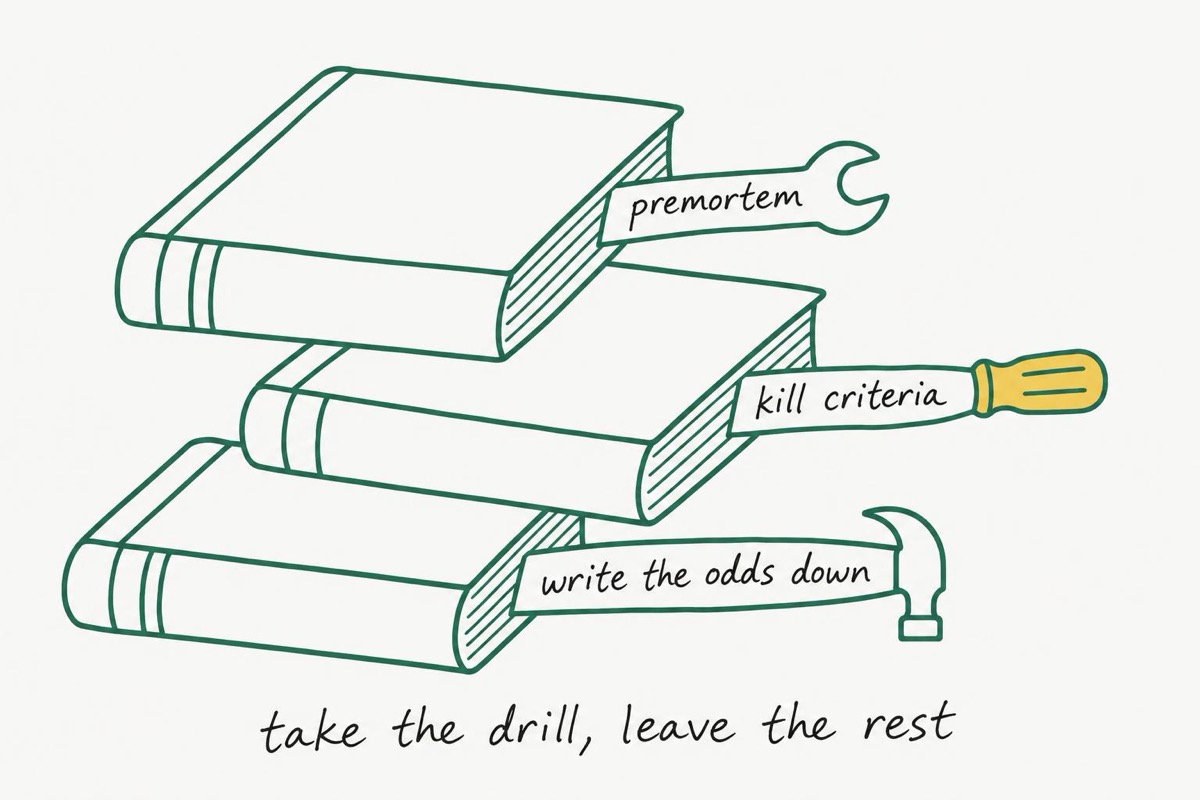
The prepare-to-be-wrong step is the one readers skip and the one we would keep. Run a premortem: assume the decision has already failed, then write down why. Gary Klein, whose work the Heaths draw on here, reports that this kind of prospective hindsight raises people's ability to name reasons for a future outcome by about 30 percent (Klein, Performing a Project Premortem, Harvard Business Review). Discount the number if you like. The habit stands on its own.
The catch: the examples are corporate and the distancing trick is borrowed. Its best-known distancing tool is Suzy Welch's 10/10/10, which we have already walked through step by step in this piece on the 10/10/10 rule, so we will not repeat it here.
2. Quit: The Power of Knowing When to Walk Away
Almost every decision book is about choosing. This one is about stopping, which is the harder half and the one nobody schedules. Duke's useful move is to set the exit conditions while you are still calm: if the business has not cleared 2,000 dollars a month by March 31, it closes. If the certification has not led to one paid piece of work in six months, it is a hobby. Written in advance, those lines stop you from negotiating with yourself at the point when quitting feels like losing.
The catch: if your problem is choosing rather than stopping, this is the wrong book first. And the poker framing travels less well than it reads. Walking away from a hand costs you chips. Walking away from a career, a marriage, or a town costs other people something too, and Duke's cost accounting is thinner there than her logic is.
3. Thinking in Bets: Making Smarter Decisions When You Don't Have All the Facts
Duke's central idea, and the reason this book earns its place next to Quit, is "resulting": judging a decision by how it turned out. You took the job, the company folded, so you decide you chose badly. But you chose with the information you had, against the odds you faced, and the folding may have been in the 20 percent branch all along. Separating those two judgments is what keeps a bad year from teaching you a false lesson.
The catch: the drill above is our suggestion, not a validated intervention. We could not point you to research showing that keeping a written decision record improves later judgment or reduces hindsight bias. Keep one to stop grading yourself by outcomes, which is reason enough on its own, and do not expect the notebook to do more than that.
4. Thinking, Fast and Slow
This is the book that gave a generation its vocabulary: the fast, automatic system and the slow, effortful one. It explains anchoring, availability, loss aversion and overconfidence better than anything written since. It is also, deliberately, not a manual: it is an account of how judgment works, and it leaves the question of what to do about it mostly open.
The catch: some of the research in it has not survived. Asked about a detailed critique of the social-priming chapter, Kahneman replied, "What the blog gets absolutely right is that I placed too much faith in underpowered studies," and called his handling of that evidence a mistake (Retraction Watch, 2017). That is one chapter, not the book, and the two-system frame and the prospect-theory work are not in question. Read it as the best available account of how judgment goes wrong, with chapter 4 treated as history.
5. Noise: A Flaw in Human Judgment
Bias points in one direction. Noise is the scatter: two underwriters pricing the same risk differently, two interviewers rating the same candidate differently, the same radiologist reading differently on a Monday. The practical contribution is decision hygiene, and the piece you can apply tomorrow is breaking a judgment into separate parts, assessed independently and combined afterwards, instead of letting one impression swallow the rest.
The catch: this is a book for institutions. If you are deciding between two apartments, almost none of it applies to you.
6. Smart Choices: A Practical Guide to Making Better Decisions
The oldest book here and the most procedural. Work the problem, then your objectives, then alternatives, consequences and tradeoffs. The table is the part that pays. It forces you to admit which objectives you are trading against which, and it usually exposes an option that is worse on every dimension, which you can then stop thinking about.
The catch: it is dry and the examples show their age. It gives psychological traps one chapter, then runs the rest of the method on the assumption that you can state your own preferences accurately. You often cannot, which is what the newer books spend whole chapters on. Pair it with any one of them.
7. Superforecasting: The Art and Science of Prediction
Most hard choices hide a forecast. Will this role still exist in two years? Will the neighborhood hold its value? Tetlock's forecasters were good because they put numbers on beliefs, broke questions into pieces, and updated in small steps as evidence arrived. Scoring yourself stings, and it is the part that teaches.
The catch: the measured improvement in those tournaments came from the training module and the practice, not from reading a book about the people who did them. And personal decisions rarely resolve as cleanly as a tournament question, so expect to argue with yourself about whether your own forecast came true.
The Table
| Book | Best for | The one drill | The catch |
|---|---|---|---|
| Decisive (2013) | The decision in front of you now | Force a third option, then premortem it | Corporate examples; borrows 10/10/10 |
| Quit (2022) | Stopping something already started | Write kill criteria with a date and a number | Thin on what quitting costs other people |
| Thinking in Bets (2018) | Judging your own past calls | Record the decision before the outcome lands | The record is our drill, not a validated one |
| Thinking, Fast and Slow (2011) | Understanding why judgment fails | Treat instant certainty as a slow-down signal | Chapter 4's priming research did not hold up |
| Noise (2021) | Group and organizational decisions | Independent written judgments before discussion | Little use for personal choices |
| Smart Choices (1999) | A plain procedure | Build a consequences table | Dry; dated examples; assumes you know your preferences |
| Superforecasting (2015) | Decisions that are forecasts | Write a probability with a resolution date | The gains came from training, not reading |
Two We Would Not Hand You
The Art of Thinking Clearly, Rolf Dobelli (HarperCollins). Ninety-nine short chapters, one bias each. It is a glossary, and a good one for browsing, but naming survivorship bias is not a method for choosing between two offers. Buy it as a reference, not as help with a decision.
Predictably Irrational, Dan Ariely. We covered its argument years ago in this piece on the hidden forces that shape our decisions, and it is still a good tour of the ways people act against their own interests. It is not a procedure, which is why it is not on the list: nothing in it tells you what to do on Tuesday with two offers in hand.
One warning for anyone planning to put this whole genre into practice. A much-quoted applied finding from Ariely's later work on dishonesty, that signing a form at the top rather than the bottom makes people more honest, was retracted by the Proceedings of the National Academy of Sciences in 2021 after the validity of the data was questioned, and the notice states that signing at the beginning does not decrease dishonesty (PNAS retraction notice). That retraction covers one study in a different book, not this one. Treat it as a reason to check a striking behavioral finding before you build a policy on it.
How to Choose, by What You Are Deciding
You have one decision and a deadline. Decisive. Read the first half, widen your options, run the premortem, decide. Skip the rest for now. If the deadline is tomorrow, skip the book too and use our walkthrough of a decision-making process or the shorter how to make the right decision fast.
You cannot stop something that is clearly not working. Quit, and only Quit. Write the kill criteria before you finish chapter three.
You decide fine, then torture yourself afterwards. Thinking in Bets. The resulting chapter is worth the price alone.
You are the one who has to get a group to a decision. Noise, with Smart Choices beside it for the table.
You want to understand yourself, not just decide faster. Thinking, Fast and Slow. Pair it with our explainer on decision fatigue if what is wearing you out is the sheer volume of small calls rather than one big one.
You freeze on big ones. None of these first. Freezing is usually about what the choice would mean rather than which option scores higher, and our pieces on making hard decisions easier and tough decisions in life are closer to that problem than any book on this list.
You want a wider shelf, not a decision-specific one. Start from our 20 best books on personal development instead. Only three of the seven here would survive on that list, and that is the point of a narrower one.
Start With One Drill, Not One Book
Tonight, before you order anything: write the decision you are facing as a question at the top of a page. Underneath it, write a third option that nobody has suggested yet, even a bad one. Then assume you chose and it went badly, and give yourself five minutes to list why. That is twenty minutes of work and it is the premortem from the first book on this list.
If that twenty minutes helps, buy Decisive. If it tells you the real problem is something you should have stopped a year ago, buy Quit instead. The best books for decision making are the ones you read with a specific decision open on the table. Books are cheap. The decision is not.


