

What family estrangement is, and the question underneath it
Family estrangement is the deliberate loss of contact between relatives who are both still alive: a parent and an adult child, two siblings, an in-law who took half the family with her. It runs from thinned-out contact to a complete cutoff, and it is usually one person's decision that the other person has to live inside. That second half is what the definitions leave out.
You are probably not here for the meaning of the word. You are here because a birthday went by without a call, or the message you sent has been sitting unread for eleven days, and you want someone to tell you whether this is permanent.
Nobody can tell you that. Not us, not a therapist who has met one of you, not the forum thread you read at 1am. What we can do is separate what research on family estrangement actually supports from what gets repeated anyway, and then hand you something to do with the next month, which arrives whether or not your phone rings.
Why estrangement is hard to carry
Estrangement breaks the usual machinery of loss. A death comes with a date, a service, and people who know to bring food. A cutoff from a living relative comes with none of that and adds a question that never closes: they are out there, maybe fifteen minutes away, choosing this. Friends run out of things to say by about month three. So you stop bringing it up, and the whole thing goes quiet.
Then there is the explaining. The holiday table with an empty chair, the neighbor asking whether your daughter still lives nearby. If your loss did come with a date, our piece on coping with a parent's death covers that ground and we will not repeat it here, because the two are not the same problem.
One honest note about the psychological effects you will see quoted around the web. We went looking for solid numbers and could not find US evidence strong enough to print. The studies we found were mostly small, mostly not American, and measured association rather than cause. Read that as a hole in the research, not as evidence that you are fine.
If the weight of this has you thinking about hurting yourself, call or text 988 in the US, or use the chat on the Lifeline site. It is staffed around the clock and it is not only for people in immediate danger. [1]
The reframe: estrangement is a status, not a verdict
Most people treat family estrangement as a verdict to appeal. Build the case, send it, wait for a ruling. The strongest evidence we found treats it as something closer to a status, a state that relationships move into and sometimes out of. A 2022 analysis of a national US cohort measured both when estrangement from a parent began and when it ended, which tells you the plain thing: these ties are not all frozen. Roughly 26% of that cohort had been estranged from their father at some point in the years the study followed them, and roughly 6% from their mother. [2] Both figures come from that same cohort, and both count whether a break ever happened across years rather than who is estranged today. They are two different relationships, so they do not stack into one total, and neither one is your odds.
For the present tense, the same paper describes a separate 2020 web survey of 1,340 Americans, in which 10% said they were currently estranged from a parent or a child. [3] Different sample, different question, much smaller number.
Here is what all of that does and does not mean. It does not mean reconciliation is likely. Anyone quoting you a reconciliation rate is extrapolating past the data. What it does mean is that from inside month four you cannot tell whether you are looking at a door or a wall. Some of these ties open again. Plenty never do. The research cannot tell you which one you have, and neither can anyone who has read it.
Which is why the appeal strategy fails on its own terms. You cannot win a case whose verdict has no date. So, an opinion, clearly labelled as ours: stop drafting the letter that explains your side. That letter is for you. It feels like action and it is rehearsal, and it can absorb two years.
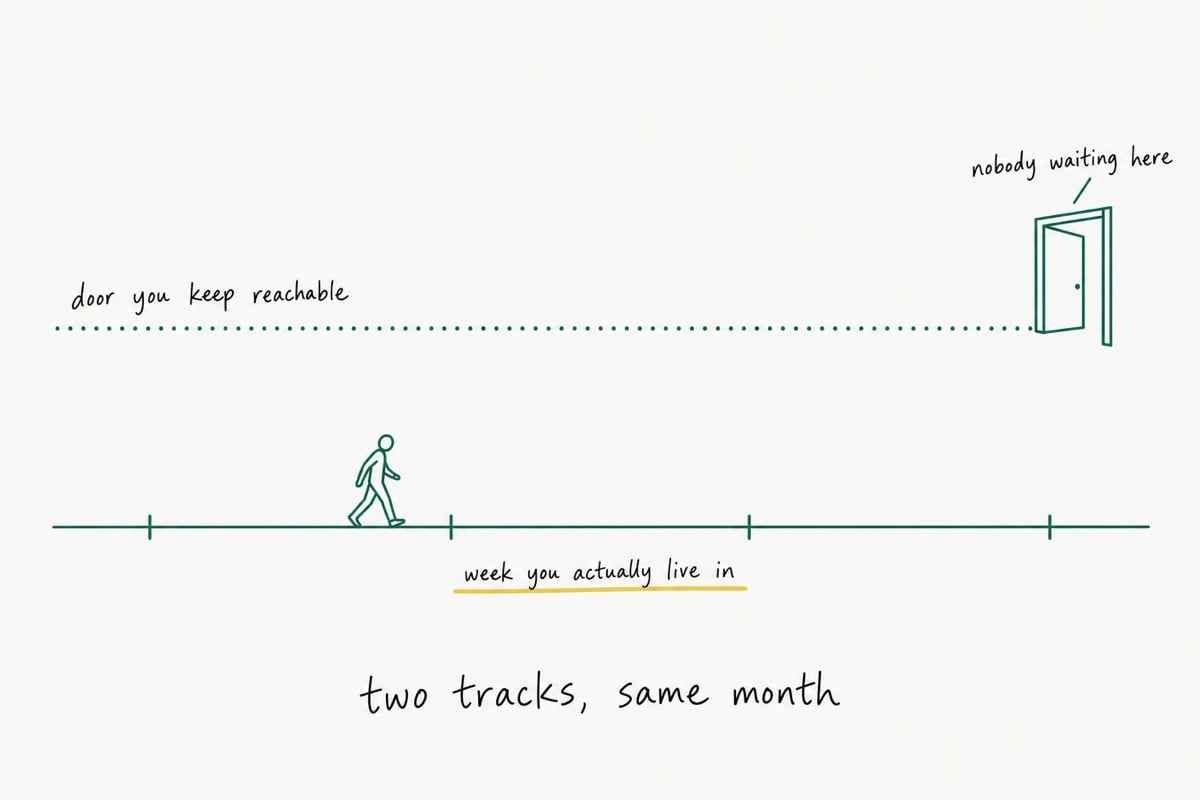
Two tracks to run at the same time
A plan that survives an open-ended wait runs two tracks at once: keep exactly one door reachable, and rebuild the week that is currently on hold. Most people pick one. All-door people spend two years in a holding pattern, checking a phone. All-week people slam it shut, feel strong for about a month, then cannot explain why February hurts. The two-track framing is ours, not a clinical model, and it works mainly because the tracks stop competing for the same hour.
Track one: keep one door reachable
Reachable is not the same as loud. Pick one channel on purpose, the one they are most likely to tolerate, and leave it unblocked. Everything else goes quiet. Six channels is not six chances; it is pressure, and pressure is the thing most likely to get you blocked everywhere.
Then the branch most repair advice skips. If they have told you in words that they want no contact, that request is the whole instruction, and nothing in the rest of this section applies to you. Keep the one channel open so it is there if they ever want it, and send nothing through it. Honoring that literally is not surrender and it is not a tactic. It is the only move that leaves the door usable later. For the reader on the other side of this, the one deciding whether to state a boundary at all, setting boundaries in relationships is the better starting point.
What follows is for the more common situation: silence, with no request attached.
In that case you get one message. Say the hard part once, and say it about the specific thing. Joshua Coleman, a psychologist who works with estranged parents, argues that acknowledging the other person's account of what happened matters more than defending what you meant, and that sometimes the better choice is to stop pursuing contact at all. [4] Treat that as clinical judgment from someone who sits with these families, not as a tested result. We found no trial that scores apology wording, and anyone who tells you otherwise is selling something. If you want the mechanics of the acknowledgment itself, we have written about how to apologize and about difficult conversations in general terms.
Three things to leave out of that message: a defense of your intent, a request, and a deadline. "I know what I did at your wedding and I am sorry for it" lands. "I know what I did at your wedding, though you have to understand the pressure I was under, and I hope we can talk soon" is three moves, two of which cancel the first.
After that, pick an interval you could hold for a year rather than a week. One short message at their birthday and one in December is a real pattern. Something every Sunday is a campaign, and it reads like one.
Then write the rest somewhere nobody receives it. A file, a notebook, the back of the drawer. The things you most want to send are usually the things that would cost you the channel.
Track two: rebuild the week that is on hold
The second track is the one people skip, and it is where the question of how to move on actually gets answered. Moving on does not mean deciding they are gone. It means noticing how much of your week is currently a waiting room.
Start with the inventory. Write down what you stopped doing when this began: the Sunday dinner you no longer cook, the friends you stopped calling because explaining was exhausting, the trip you will not book in case something changes. Then put two of them back on the calendar this month, with a date and a time, not as intentions.
The thin social calendar is usually the most urgent item, because a cutoff tends to shrink a life quietly rather than loudly. Our piece on making new friends as an adult treats that as a scheduling problem rather than a personality one, which is the right way around. If the silence has you thinking further ahead, about hospitals, paperwork and who shows up, growing old alone with no family handles the practical version of that fear. And if you were also the one doing the driving and the pharmacy runs before this, caregiver burnout may be a bigger part of your exhaustion than the estrangement is.
Sibling estrangement follows the same shape, with one difference worth naming: there is often no obvious senior party to make the first move, so both sides wait, and the wait can run for decades. The two tracks still apply. Somebody has to decide to stop auditing who owes whom.
What this looks like in a real week
Two versions, both composites rather than real people. Darryl is 62, a retired postal supervisor, nineteen months out from his daughter's last reply and with no request from her either way. Lorraine is 49 and stopped contact with her mother three years ago, deliberately and after a long time thinking about it. They are on opposite sides of the same silence, and the plan is not symmetric.
Darryl's first month of the two tracks looks like this. He picks text as the single channel and takes himself off her Instagram, which he had been reading daily and which was costing him most of his evenings. He writes one message, four sentences, naming the thing she actually told him the last time they spoke, and not his reasons for it. He sends it on a Tuesday. He does not send a follow-up asking whether she got it.
Then the other track, in the same month. He puts the Sunday roast back, for himself and for his brother, who was never the problem. He goes back to the Thursday bowling league he dropped a few months into the silence. He books the Arizona trip he had been putting off rather than keeping the spring open for a reunion that has no date. A year later the phone has still not rung, and the only message he has sent since was four lines on her birthday. His week is no longer empty, which is the part he controls.
Lorraine's version is quieter and often skipped by articles like this one. She is not trying to repair anything right now. Her work is to stop re-litigating the decision every time an aunt sends a photo. She writes down what would have to be different for contact to be safe, specifically, and puts the list away. She tells two cousins what she will and will not discuss, once, without a case attached. She keeps one channel technically open, an email address she checks monthly, which is how she can say she is not hiding without being reachable at 11pm.
If you recognize yourself in Lorraine, the question of whether the relationship was harmful rather than merely difficult is a separate one, and the signs of a toxic parent is a better place to start than any repair guide, including this one.
"I have tried. They do not want me."
Sometimes that is exactly right, and an honest article has to say so. Distance is the correct answer for some families, and a repair guide that treats every reunion as the goal is doing the reader harm. If the relationship involved abuse, the person who left is not a puzzle to be solved.
The more common case is subtler: you have tried loudly, for eighteen months, in every channel, with a timeline attached, and it has not worked. That is not evidence that nothing works. It is evidence that pressure does not. The two tracks are deliberately low-volume because low volume is the only version you can sustain for the years this may take.
A therapist who works on family estrangement is a reasonable next call, and it is a real specialism rather than a euphemism for general family counseling. If you want reading first, Stand Alone, a secular UK charity, publishes free guides for estranged parents and for estranged adults. It is a UK organization, so treat it as material rather than a program you can join from the US. [5]
Where to start this week
Pick the channel. One. Then write down two things you stopped doing when the silence started, and put one of them in the calendar before Sunday with an actual time on it.
That is the whole first move. Not the letter, not the family meeting, not the decision about whether to forgive. If you want the longer version of the forgiveness question later, it is here, and later is fine.
Family estrangement does not resolve on a schedule you can set, and that is the part people lose years to. If the honest answer is that it is only one of four things currently drifting, that work, health and money have all been on hold alongside it, the free Life Rebuild Score will show you which one to touch first. The relationship may change on a timeline you do not control. The week does not have to wait for it.


