

Life can take many unexpected turns. From experiencing the death of a loved one, to feeling burnt out in your career, to getting a divorce from someone you once thought you’d spend the rest of your life with. These life-altering events can cause immense pain and confusion, leaving many to wonder: what is the meaning of life, anyways?
What Is the Meaning of Life: Definition of Meaning
Understanding the meaning of life is a universal concept that people around the world question. Interestingly, both the Eastern and Western worlds have differing philosophies, with Easterners focusing on the “we” or the meaning behind humanity as a whole, while Westerners are more individualistic, focusing on the “I” or their personal sense of meaning.Countless schools of philosophy suggest varying answers for the meaning of life. While there is no concrete answer to the meaning of life, all these philosophies regarding the meaning of life can be divided into four categories; each category with varying philosophies throughout humanity listed below:
1. Life Has an Objective Meaning
Natural Pantheism dates back to 1675 by Baruch Spinoza, who referenced the philosophy in their book “Ethics” This philosophy believes that God is in everything, so all life itself is interconnected.Existentialism was termed by Martin Heidegger in his work “Being and Time” in 1927 and is the belief that humans are all born with this innate urge to understand their own meaning and values in life.
2. Life Has an Subjective Meaning
Hedonism originated back around the 4th century by Democritus, who was a Greek philosopher. This belief of life is simply to avoid suffering and seek out pleasure.3. Life Has No Meaning
Nihilism was termed by Friedrich Nietzsche back in 1862 and is the belief that simply there is nothing, or no meaning, to life itself.4. Life Has a Supernatural or Unexplainable Meaning
Theism originated in prehistoric times and was lived out through the varying gods humans believed in. The belief is that God, or a divine being/entity, is the meaning of life.The four above groups of meaning provide insight into how people around the world may justify life itself. No concept is right or wrong; therefore, it is the responsibility of the individual to learn and grow through their life experiences to better understand the meaning behind life itself.
Why Do Humans Pursue the Meaning of Life?
Humans may ponder the question “what is the meaning of life” for a variety of reasons.First, meaning provides a sense of purpose to our lives. According to a research study that looked at meaning in life, the study expressed the positive psychological and physiological benefits[1] linked to humans feeling meaningful. For instance, meaning reduces the risk of mental health problems and improves physical health. Besides the concept that meaning boosts one’s general well-being, the sense of purpose and that life matters and is significant are other reasons why humans look for meaning.
However, it’s important to make the distinction between finding meaning in life and happiness. Although happiness and meaning are correlated, they are not the same. This is because seeking meaning and purpose isn’t always easy, carefree, and happy. However, seeking happiness doesn’t necessarily mean you’re living a purposeful life and fulfilling your true life’s potential.
For example, someone born into a wealthy family may feel happy and comfortable; however, if they lack the initiative to experience life to their fullest potential, take risks, make mistakes, and discover their purpose besides living a well-off lifestyle, they may lack a sense of meaning.
Meanwhile, many artists that are famous today, such as Vincent Van Gogh, struggled with mental illness and/or financial security while alive. And yet, these artists pursued their passion and purpose (art) and were willing to sacrifice the potential for a comfortable, “happy” life in pursuit of providing their creative talent to the world, which is still admired years after their death.
While life isn’t necessarily choosing between meaning vs happiness, it’s essential to realize it is impossible to pursue any and everything in life. This is where you must decide and select your core values, or the guiding principles that you center your life around.
For instance, if you value creativity, self-care, learning, and your health, these are all examples of self-growth values that benefit your personal development. Yet, if you value family, community, animals, and other relationships outside of yourself, these are more service values that benefit relationships or other people outside yourself.
While core values aren’t black and white, they can be contradictory. That’s why it’s essential to be aware of your own core values. Otherwise, you risk not knowing what you want out of life and thus will struggle to make decisions. This is because core values are like a compass that can help guide your decisions to focus more on what you value, and spend less time and effort on things you don’t value.
The Three Meanings of Meaning in Life (By Frank Martela and Michael F. Steger)
A research conducted by the philosophy researcher Frank Martela and the psychology professor Michael F. Steger suggests a three-dimensional approach[2] to understanding the meaning of life: purpose, coherence, and significance.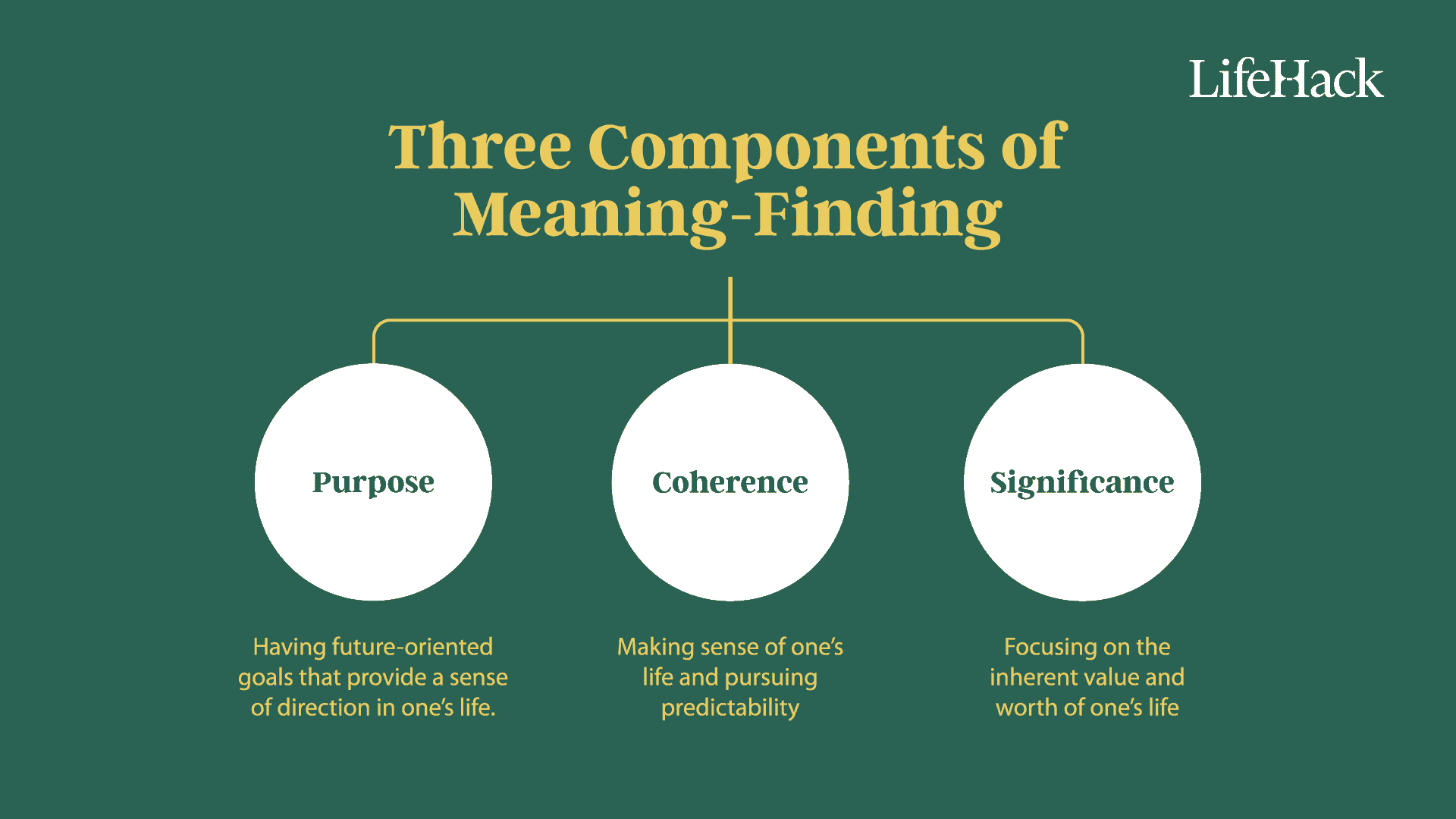
Purpose
Purpose refers to when one has future-oriented goals that provide a sense of direction in their life. People can pursue many purposes in life. The distinction between purpose and the other two facets of meaning in the model is that purpose seeks to achieve high-value goals that guide your future.Purpose and meaning are often synonymously used, or interchanged. Yet, the two are different constructs. Researchers measured both purpose in life and the general personal meaning that people felt in life. In the study, they found both were strongly correlated, but two separate measures with differing predictors.
For example, in one instance the researchers found that spirituality was linked to meaning, but not a sense of purpose. Meanwhile, optimism or essentially having motivation was connected to purpose, but not a general meaning of life.
Having a sense of purpose is a driving motivator that helps direct your life. The great thing about purpose is that once you clarify what your purposes in life are, you can take action via goal setting to make progress towards achieving your purpose. Goal setting is essential as it directs your actions and life to focus on what matters most in your life. Plus, goals are actionable steps you can continually work on and improve upon.
If someone’s purpose is to serve their community, that individual can seek out opportunities to live out their purpose. For instance, volunteering in the local community. Then, the individual can take actionable steps like volunteering a couple of times a week, providing personal donations, and more ways to live out their purpose of serving others.
Coherence
Coherence refers to making sense of one’s life. It is a common desire for humans to want to make sense of the world and their life. The uncertainty and unpredictability of life can make people feel stressed and anxious. From a biological perspective, humans like to observe predictable patterns and trends to learn and adapt accordingly. This is because understanding predictable patterns in the world around us is a sort of innate survival mechanism, and humans used patterns years ago to adapt to changes in their environment to survive.This pursuit of predictability of the world by humans is a survival tactic, which is elaborated in-depth in the Meaning Maintenance Model,[3] where this model suggests humans have an innate desire to make sense of the world and their environment. And, when this continuity is disrupted, this inevitably triggers a sense of stress in humans.
Coherence is an innate urge for humans to build a greater understanding or meaning for life through patterns and other predictable experiences they may observe in their own life. Therefore, humans will adapt and change to find and follow such patterns to feel a heightened sense of predictability in their life.
Routines are a great example of coherence. Consider the example of working out. At first, when you start learning how to exercise and workout for the first time, you may feel uncertain and uneasy because you may be unsure what to do and/or how to improve your physical fitness.
Yet, with a consistent routine and following a predictable workout regime, you’ll start seeing predictable results and be more knowledgeable about how to adapt your workout routine to improve your physical health even more.
Significance
Significance is the third dimension of meaning that focuses on the inherent value and worth of one’s life. Essentially, the significance of life could be an evaluation of one’s own life and how much one feels it is valuable, or worthwhile.This “life-worth-living” concept is related to eudaimonia,[4] which can be defined as living well or flourishing in life. However, it’s important to understand the distinction between significance and eudaimonia. Eudaimonia is focused on what specifically forms experiences in life that make life worth living. Meanwhile, significance is focused on understanding the experience of a life worth living.
Life is short and precious; thus it is essential people understand the value time has in their lives. If an individual wastes time, either through procrastination or a lack of awareness, this can increase the feeling that their life is insignificant, or not worthwhile. This is because, rather than pursuing value in your life and using your time wisely, some people may voluntarily choose to waste time. For example, sitting in front of the TV rather than pursuing experiences that will bring value to your life, such as learning a new skill or working on a passion of yours.
However, by focusing on living a life of significance, one can make choices to invest their time in something worthwhile. For instance, raising and providing for your family could be a worthwhile reason for living.
Another example could be excelling in your career and working hard to your greatest potential. Although there’s a fine balance between achieving your greatest potential and burnout, working hard to add value and not just work for a paycheck gives value to both the organization and makes your life feel more worthwhile from a career perspective.
Signs You Lack Purpose, Coherence, or Significance in Life
Here are some questions to consider whether you lack one or more of the three dimensions of meaning in life. These questions are designed to challenge whether you are aware of your meaning in life. Depending upon your answers, or if you are unable to provide an answer for any of them, these are signs you may lack purpose, coherence, and/or significance in your life.Questions to Know If You Lack Purpose
- Do you have specific goals you are working towards?
- Where do you see your life in 5 years?
- Do you struggle to follow through with the goals you set for yourself?
- Do you live a comfortable and happy life, but feel something is still missing in your life?
- Do you find yourself facing an existential crisis?
- Do you live life day by day?
- If you could achieve anything, what would it be and why?
- Do you feel lost or stuck in life?
- Are you excited about what the future holds?
Questions to Know If You Lack Coherence
- Do you avoid uncertainty?
- Do you fear the unknown and always stay within your comfort zone?
- Do you hate change?
- Do you follow consistent routines and habits, or not?
- Is this what you expected your life to look like at this point in time?
- Are you just “going with the flow of life”, or being intentional with your actions?
- Do you take risks?
- Do you question the trajectory of your life?
Questions to Know If You Lack Significance
- What reasons make your life worth living?
- Are there people that rely on you? (ie. family, career, friends)
- Do big life events cause you to feel insignificant? (ie. death or divorce)
- Do you feel you benefit or provide value to society?
- Do you consistently waste time when you could be doing something productive?
- Do you feel as if you haven’t reached your potential in life?
- Do you struggle with feelings of unworthiness?
Which Dimension of the Meaning in Life Fits You?
If you’re struggling to understand the question “what is the meaning of life”, you’re not alone.Everyone at some point in their lives constantly wrestles with this idea. Yet, it’s important to understand which one of the three dimensions of the meaning in life you value most and why.
Are You Finding a Purpose?
If you strive to pursue core goals that will help guide your decision-making and direct your life, you may desire to live a purposeful life. One can have many purposes that help direct their life. For example, personal aspirations as well as goals to better help their community.Is your purpose to live a healthier lifestyle?
To achieve this purpose, you’ll want to break down actionable items you can pursue to lead a healthy lifestyle. For example, endurance, speed, nutrition, cognitive functioning, and mental health are all areas you can work on to pursue a healthy lifestyle.
From there, you’ll want to create goals to live out your purpose. For example, part of living a healthy lifestyle is eating nutritious foods, consider goals like eating a certain amount of fruits and vegetables, reducing your intake of unhealthy foods, and more to live out your goal of living a healthy lifestyle.
Another example is if you want to feel physically stronger and have more endurance, exercising your body consistently can be an actionable step you can take towards achieving a healthier life.
Is your purpose to serve your community?
To achieve the purpose of serving your community, first, consider ways in which you can help others. For example, volunteering is one way in which you can live out this purpose. From there, you can create actionable steps like deciding where you’d want to volunteer (i.e. dog shelter, food kitchen, etc.) and actively work towards helping those in your community.
Are You Striving For Coherence?
If you strive to make sense of life, you may desire to live a coherent life and try to eliminate the uncertainty of life.In what ways can you build coherence in your life?
Habits and routine are physical ways in which you can build a greater sense of coherence in your life, and even work towards fulfilling your purpose. Consider what you value in life and try to create predictable routines you can consistently follow.
For instance, if you desire to live a healthy lifestyle, routines such as going to the gym consistently or eating three meals per day are great predictable routines.
Feedback or asking for constructive criticism at work from your boss if you are uncertain about your work performance is another example of seeking out coherence in your life.
Or, you may read to learn more about the world and help make sense of life, little by little.
Are You Looking For Significance?
If you strive to live a worthwhile life of value, you may desire to live a life of significance.How have positive and negative experiences shaped my life?
Having a child, getting a job promotion, mastering a difficult skill, and experiencing cultural differences while traveling are all positive experiences that can add value to your life.
Meanwhile, a near-death experience, the death of a loved one, getting diagnosed with a disease, and the loss of a job are all negative experiences that can make you question if you are truly living a life worth living.
How to Progress with your Life's Meaning
Want to progress with your life’s meaning? There’s no time like the present to do so!Time is limited; therefore, you shouldn’t take time for granted when you could be spending it chasing your meaning in life. Furthermore, you should learn to understand how to maximize the time you have to efficiently live a fulfilling life.
Life multipliers are core skills of life you can use to essentially work smarter, not harder, to better pursue your meaning in life. These 8 life multipliers, when combined, can help you make progress towards making the most of your time to live a more meaningful life.
Learn more about life multipliers and how to live a full life here.
Final Thoughts
What is the meaning of life? Although there’s no concrete answer to this all-encompassing question, there are three dimensions in which one can strive to pursue meaning in life: purpose, coherence, and significance.Understanding your meaning in life can be overwhelming. However, contemplating what you want in life (purpose, coherence, or significance) and taking actionable steps toward fulfilling that meaning will help you live a more meaningful life.


