Here’s a scenario that might sound familiar: you are listening to a speech or presentation, or perhaps you are reading an article, an essay, or a report, and it becomes clear that the writer is using words without communicating. Some essays, articles, and books might be pleasant to read because the language is colorful, and a speaker might make pleasant, sincere-sounding noises. No doubt some of your my writing or speaking can be described this way. If you don’t think yours can, just wait. As you improve, you will expect more of yourself. One way to improve is to practice writing with word or character limits.
This matters in the idea-driven economy. Consider George Orwell’s 1946 essay “Politics and the English Language.” Words mean something. Words are important. Orwell argues that language should be “an instrument for expressing and not for concealing or preventing thought.” Much could be accomplished with better writing, and yet quantitative social scientists, for example, try to earn status by one-upping one another with technical and mathematical sophistication. Humanists try to out-jargon one another. Important ideas are obscured by the impenetrable clouds of unclarity.
What can you do about it? Try writing with hard word limits. Give yourself a lower word limit than you might find comfortable. Allow yourself to write a rough draft that is as long as you want it to be. Then, when you’re editing, try to cut it down below the maximum word count. If you’re writing a 10,000 word article, try to cut it to 9,000 words. If you’re writing an 800-word op-ed, aim for 700 words. Trim an essay with a 1500 word limit to 1200 words.
There are a couple of reasons for this. First, your readers’ time is valuable. Second, it forces you to confront trade offs in every sentence. If you’re trying to trim a 1500 word essay into a 1200 word essay, you have to ask yourself at every juncture whether you can make the point with fewer words. You will be shocked at how much you can tighten your prose without losing anything. Indeed, tighter, punchier prose will improve the quality of your exposition.
An exercise might help. Consider that last sentence: “Indeed, tighter, punchier prose will improve the quality of your exposition.” I wrote it on a plane from Omaha to Memphis while my brain was toast, and it shows.
Let’s improve it. First, drop “Indeed” because it adds nothing. “(I)mprove the quality of your exposition” is a long way of saying “make you write better.” So let’s try some revisions:
“Tighter, punchier prose improves your writing.” (better)
“Tighter, punchier prose makes you write better.” (awkward and clunky—it sounds like a lesson plan for the Derek Zoolander Center for Kids Who Can’t Read Good and Who Want to Learn to Do Other Stuff Good Too)
Perhaps this: “Punchy prose makes good writing.”
There’s no objective right answer. You have to play around with it, but as the cliché says, easy writing makes for hard reading.
You might also want to experiment with character and syllable limits. Orwell said to avoid using big words. In the sentence we were critiquing above, “exposition” was a clunky, four-syllable way of saying “writing.” Always use the easier word.
To write well requires dedicated effort. I don’t claim to have mastered it. Approach it like topiary. Or bonsai gardening. Or sculpture. Or painting. Or whatever. As a writer, you are a skilled artisan. Words are your medium, and you use hem to communicate information, evoke passions, and stir the consciences of your readers. Get to work. Change the world. And take heart: you’re always improving.
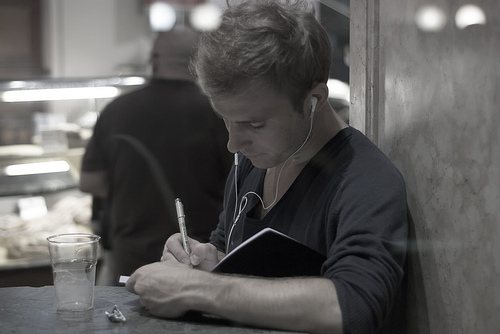
Image: neropercasso
Follow Lifehack on Twitter Here










This is good advice. A similar approach I’ve taken when not faced with a specific word limit (or an idea of how long an article or post should be) is to try to cut 25% of the words from the first draft to the final version. This makes it easier to get the first draft done without taking too much time to edit as you go, but still helps meet the objective of being more concise.
Art – solid advice here. Thank you. Limited response to twelve words.
Phil
I always learn something from this site. 68 and never to old to learn.
When getting warmed up to write something that requires word limits, I write haikus. I don’t follow the rules of subject or tradition, but having to convey an idea in the 5-7-5 syllable format is guaranteed to make you choose your words carefully!
When you’re gearing up
to write some crisp clean prose, you’ll
find haiku is best.
Tighter, punchier prose is also easier to understand from a reader’s perspective. Using longer or more complicated language can be off-putting. Best to keep things simple! Loved this post.
I’ve been a full-time writer since 1994.
Say what you need to say with as few words as possible, as long as you are clear and the writing reads well.
Never have a problem with staying under word count. Usually, I have trouble making word count.
Great article. Yay brevity!!
Great advice. “Easy writing makes for hard reading”: that should be on my wall. Thanks for the example too. Btw, I am a great fan of Orwell…
Nice post. Title says all though.
I have to try this excercise because I am terrible at writing.
I believe it was Mark Twain who once wrote, “I haven’t the time to write you a short letter, so instead I’ll write you a long one.”
How true, through seemingly contradictory, that writing at length can ultimately do your work more of a disservice than if it was written in fewer words.
There are some writer chats and groups on Twitter, one of them being #writegoal in which people make note of the number of words they wish to write for the day and strive to write that many. I often try to Tweet to those writers, high word count doesnt mean what you’re writing is good. Forget the word count and write words of quality over quantity.

Great advice in this post. Happy to have found your blog!
Best,
Dave
Another one from Twain:
To get the right word in the right place is a rare achievement. To condense the diffused light of a page of thought into the luminous
flash of a single sentence, is worthy to rank as a prize composition just by itself… Anybody can have ideas—the difficulty is to
express them without squandering a quire of paper on an idea that ought to be reduced to one glittering paragraph.
Letter to Emeline Beach, 2/10/1868
From http://www.twainquotes.com/Writing.html
If you make your words count, you won’t worry about word counts.
I have oversea experience. For me I just read whatever I wanna read just keep reading as much as I can.
As an English teacher preparing overseas students for English exams, I just want to say yes, yes, yes. Simple clear language = good communication = high marks.
good post ,is helpful to me
Paring down word count can be a difficult task. I start wondering if there is enough description, or would the one sentence suffice? How much paring down is too much versus not enough? It isn’t an easy thing, but engaging in this type of exercise does serve to hone the writing skills.
Time to shave off some words on my rough drafts.
A 623 word article to say “Be pithy.” Just playing. Good article.
I can sum up your entire post in four words:
Keep It Simple Stupid.
Actually three words:
Keep It Simple.
To write well requires dedicated effort. I don’t claim to have mastered it. Approach it like topiary. Or bonsai gardening. Or sculpture.
To write well requires dedicated effort.
Humanists try to out-jargon one another. Important ideas are obscured by the impenetrable clouds of unclarity.
Humanists try to out-jargon one another.
utowns
Important ideas are obscured by the impenetrable clouds of unclarity.
mini
dellskl
hp lapotp
sony
acer
apple
asusa
ivmb
toshiba
Perhaps this: “Punchy prose makes good writing.”
There’s no objective right answer. You have to play around with it, but as the cliché says, easy writing makes for hard reading.
Let’s improve it. First, drop “Indeed” because it adds nothing. “(I)mprove the quality of your exposition” is a long way of saying “make you write better.”
Nice piece! Reinforces the lessons I learned reading “The 10% Solution” by Ken Rand
I do agree to be a good writer you have to be dedicated.