

Breaking down human behavior into rules might seem like a gross simplification. But even with the complexities, it is easy to fall into the same mistakes. I’d argue that many heated fights, lost sales and broken hearts are caused by a few critical errors. If you make the wrong assumptions, you’ve lost before you begin.
By keeping in mind these rules, you can avoid repeating the same mistakes.
Rule One: People Mostly Care About Themselves
People aren’t thinking about you. A damaging myth to buy into is believing the amount of time you think of yourself compares to the amount of time others think of you. In reality they are nowhere close. Take a look at this chart:
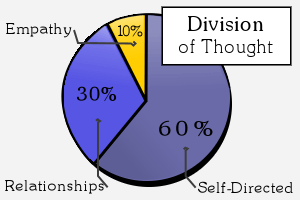
I’ve used this example before but I believe it deserves repeating. Take a look at the different slices of this chart. The biggest is the time you spend thinking about yourself. The second is the time spent thinking about relationships, but how they affect you. What does Julie think of me? Will my boss give me a raise or fire me? Do my friends respect me or just tolerate me?
Only a tiny sliver is devoted to empathy. Empathy is the rare occasion where you think through the perspective of another person. When I’ve discussed these ideas previously, many people argue I’m being far too generous with my chart. In reality that sliver is probably even smaller.
This means that you occupy only a tiny percentage of a persons thoughts. Waiting for people to invite you, becoming embarrassed at a minor faux-pas or emphasizing what others think of you come from failing to use this rule. Almost all people are far too self-absorbed to notice.
Rule Two: People are Motivated by Selfish Altruism
To say all behavior is strictly selfish would be misleading. It fails to account for acts of charity, ethics and why people don’t just cheat, swindle and lie all the time. Selfish altruism is a broader category that covers why people do nice things as a way to get what they want.
By studying primates, researchers noticed four main categories of selfish altruism. I believe they are the same categories we use, even if slightly more sophisticated:
- Dominance - Some primates will give help as a way of asserting dominance in the group. It is as if they are saying, “Look at how powerful I am that I can give some of my resources to help you.”
- Reciprocity - You scratch my back, I’ll scratch yours. The idea is that I do a favor for you with the assumption it will be returned one day. If the cost to me is less than the benefit towards you, I might help you even if I can’t predict an immediate payback.
- Trade - If we both have something the other person wants, we have a reason to interact. While reciprocity is vague on the details of a payback, trade is direct.
- Familial - It makes sense, from an evolutionary perspective, to help those who might share your genes.
By looking through this lens of selfish altruism, you can better make decisions. Viewing people as completely uncaring or selfish is incomplete. But expecting people to think of you constantly and do nice things for free is dangerous.
Rule Three: People Don’t Think Much
I believe we drastically overestimate what we do intentionally. Subconscious patterns, environmental stimulus and programmed reflexes occur frequently, even if we later take credit for them.
The conscious mind is a relatively new addition to the human operating system. And it’s been designed to cleverly take credit for a lot of decisions it doesn’t really make. If someone asks you to be unbiased in making a decision, it is probably best to just laugh.
The implication of this is that appealing entirely to thoughts won’t work. Since a bulk of decision making is made in the background, you need to target that background if you want to be influential. You don’t need to be manipulative, just smart enough to recognize that snap judgments mean a lot and your communication is more than just words.
Rule Four: Conformity is the Norm
You become your environment. Uniqueness and individuality tend to warp to fit the people around you. This is true of other people as it is for yourself. It means you should be careful who you pick as friends, partners and colleagues.
This is why I believe it is important to keep a varied social group. When you interact with people from completely different backgrounds, beliefs and behaviors on a regular basis you are more likely to see different perspectives. This also means you have more control in picking who you want to be.
Applying the Four Rules
Here are some applications of these rules you might want to consider:
- What layers are you communicating with? If people are selfish, self-absorbed and fail to think much, just working on the words you use isn’t enough. Everything about you is communicating something, and unless you get that message straight, the most persuasive argument won’t win anyone over.
- Give reminders. Although some people are meticulously organized, most aren’t. Give people the reminders they need so you don’t get left out unintentionally.
- What’s your social value? This isn’t your worth as a person, but what you have to offer in terms of other peoples needs and wants. It is easy to get depressed about human issues, if you don’t see the calculations behind it. Improve the value you offer and you can access the selfish altruism in us all.




“And it’s been designed to cleverly take credit for a lot of decisions it doesn’t really make. ”
The rationale can come in so quickly after the decision is made, that it may seem ‘simultaneous’. We are feeling machines.
[...] Four Rules to Understand What Makes People Tick – lifehack.org Breaking down human behavior into rules might seem like a gross simplification. But even with the complexities, it is easy to fall into the same mistakes. I’d argue that many heated fights, lost sales and broken hearts are caused by a few critical errors. If you make the wrong assumptions, you’ve lost before you begin. [...]
Putting a child picture at the beginning of the article and writing on the selfish side of all humans with no mention to parenting seems to me like trolling…;-)
On the other hand, your article is very accurate for workplace relationships.
Hermano
[...] Four Rules to Understand What Makes People Tick – LifeHack [...]
Interesting chart, but it lacks references. Simply stating “take a look at this chart” means nothing if we don’t know how the chart was researched.
It really annoys me to see data trotted out as fact. Where did the chart come from? How was this research conducted? By whom? Stats and charts mean nothing at all if they are not referenced. It just destroys a good posting and makes me want to hit the unsubscribe button.
[...] 4. Four Rules to Understand What Makes People Tick – lifehack.org [...]
[...] Four Rules to Understand What Makes People Tick – lifehack.org Breaking down human behavior into rules might seem like a gross simplification. But even with the complexities, it is easy to fall into the same mistakes. (tags: career lifehacks psychology relationships people social) [...]
There are some self-evident truths here, at least from my frame of reference. I don’t necessarily need a long scientific dissertation in this case. Looking at my own experience and thought patterns tells me that this is reasonably accurate.
I could not disagree with this any more than I already do. None of this theory truly explains the phenomenon of minds such as Martin Luther King Jr. Absolutely he was protesting actively for his rights, but he was doing it more so for other people than himself.
There are a significant number of people in society that place other’s injustices before their own worries.
I think one of the best things to realise is we all use attribution – we attribute the world with our own knowledge, experience and thought processes.
Realising someone is doing that to you and you to them can be quite liberating (re motives especially).
Narcisists beware – I’m onto you! Or one of you lol… :)
[...] unknown wrote an interesting post today onHere’s a quick excerpt [...]
[...] and commenters. Any rules you’d add to this list? Shout ‘em out in the comments. Four Rules to Understand What Makes People Tick [...]
Steven, I think the human mind is creative enough to apply selfish altruism in all sorts of ways. Maybe MLK wanted to be remembered and this ego-drive was greater than risk or discomfort. Maybe he wanted to the big-payoff in heaven. Etc.
Besides, I think this article is truly speaking in averages. Although references to statistics would be nice ;) it still wouldn’t make this rule work across the board. I’m sure some rare freaks empathize a lot more than average, in fact I think there’s a clinical name for that ‘disorder’….
Oops, I misread the comments. That was in reply to Jacki, not Steven.
[...] Sh00k…. ppl in this thread should read this blog entry: Four Rules to Understand What Makes People Tick – lifehack.org ttyl, FINALBOSS [...]
[...] Four Rules to Understand What Makes People Tick By studying primates, researchers noticed four main categories of selfish altruism. (tags: lifehack) [...]
[...] #1 to understand what makes people tick: People Mostly Care About Themselves It’s an important note to be applied in our relationships if we want to be successful in [...]
[...] Four rules to understand what makes people tick [...]
[...] to understand people October 5, 2007 Posted by gmcfly in psychology. trackback This article sums up, in 4 rules, how to understanding people. They range from the obvious (”Conformity is [...]
[...] – Four Rules to Understand What Makes People Tick “You become your environment. Uniqueness and individuality tend to warp to fit the people [...]
sounds vaguely Dr Phil. I wonder how practical the advice is?
That has got to be one of the most ridiculous things I’ve ever heard. Martin Luther King Jr. striving forth throughout the entire Civil Rights Movement just so he’d get a big payoff in heaven? If going to heaven was his first and foremost priority, he could have just as easily lived a peaceful life. He saw and experienced injustice and decided to act out against it so that no one else would have to suffer. THAT is why he took a stand.
I agree references need to be attributed, or at least say this is your own thoughts or generalisations, but come on Jacki!! That’s a completely emotive and illogical argument. Do you really believe you know with any certainty the exact reason why Martin Luther King did anything? The blog is obviously dealing with generalities, but you have only isolated the relatively few (albeit important) decisions Martin Luther King made out of the millions of minor decisions a person makes in a lifetime. In respect to Martin Luther King, there are a handful of decisions in a lifetime that make a person great, but this is not what the blog is talking about.
OK article, but its all in “How To Win Friends and Influence Others”. If this article seemed interesting to you, read that book.
[...] Four Rules to Understand What Makes People Tick – lifehack.org (tags: psychology relationships advertising business marketing people) No Comments Leave a Commenttrackback addressThere was an error with your comment, please try again. name (required)email (will not be published) (required)url [...]
Wow, thanks a lot for this. This information is very pertinent to some of my current problematic altercations.
[...] Ostracism can ‘force’ those that have been ostracized to really question what it means not to be ostracized—this leads to examining what it means to be cared for—what it means to truly “love” in an organized and constructive manner. It can make you evaluate how people treat each other like how a connoisseur of fine wine evaluates wine. This can make you (like me) a very critical person—which causes more people (cowards) to ostracize you. Sadly ironic but under these fascist circumstances, there are not many viable alternatives—what Basquiat might call “no mundane options.” You can see just how abysmal the modern situation is in “Four Rules to Understand What Makes People Tick.” [...]
To hades with references. A person shares his opinion, let anyone who wanta to take it take it, tohse who don’t can take a hike.
I admit the childs photo is a little misleading but the substance is present in the blog even if it is alrady an obvious truth to all enlightened adults in their own words ot not.
not half bad at all.
These are wrong, of course.
Everything every human does is based on three primes.
Food. Sex. Adventure.
[...] What Makes People Tick [...]
Relax: They Aren’t Thinking About You!
It may be comforting to realise that most people, most of the time, are far too self absorbed to notice any of the myriad ways in which many of us convince ourselves that we are doing something wrong (on a long continuum from something foul and inexcus…
[...] straipsnyje apie tai, kas žmonėms iš tikrųjų svarbu, yra iš pirmo žvilgsnio sukrečianti diagrama. Joje pavaizduota, kad 60% visų žmogų [...]
[...] Read the rest of this great post here [...]
Understanding Others
Four great presuppositions for your daily interactions can be found in the Lifehack.org article, Four Rules to Understand What Makes People Tick. The high points:
People Mostly Care About Themselves
People are Motivated by Selfish Altruism
People Don…
[...] I remembered a post from a while ago, a simple breakdown of how people think – ‘Four Rules To Understand What Makes People Tick‘ that divides thought into four slices – a rough 60% self-directed, 30% for relationships and [...]
I think the Martin Luther King reference (or Gandhi as another example) succeeded to transform themselves and their environments by being a cause in the matter of their missions. MLK for one knew that he would probably encounter death at some point in his mission, and Gandhi probably knew that too.
I think the article speaks of a human “default” but not necessarily the template that MLK used to drive his life. We as humans can transcend the default by being something remarkably different. If we do nothing, this is what we have, but if we transform ourselves into making a difference, we are the difference. Living a “default” life is what I see being described here.
It is not my way of being — but it is the way of being for many I know.
[...] #1 to understand what makes people tick: People Mostly Care About Themselves It’s an important note to be applied in our relationships if we want to be successful in [...]
[...] ceva vreme am citit o insemnare numita ‘Four Rules To Understand What Makes People Tick‘ care nu e foarte documentat dar ne da o idee vaga despre cum functioneaza creierul. 60% ganduri [...]
[...] ceva vreme am citit o insemnare numita ‘Four Rules To Understand What Makes People Tick‘ care nu e foarte documentat dar ne da o idee vaga despre cum functioneaza creierul. 60% ganduri [...]
Facinating article! Many thanks.
[...] mismas; otro 30 % lo destinan a sus relaciones, y solo el 10 % a sentimientos realmente empáticos (explicación, en inglés). Conclusión: la mayor parte del tiempo, solo prestan atención a su entorno en la [...]
Very good article i completely agree with this. As far as the martin luther king thing goes he wanted to do something important and be remembered as a great person or at least be remembered as someone who tried to make things right. I mean if you knew that people would honor you and thought of you almost sain like as much as martin luther king was would you do it? I know i certainly would
Very good article i completely agree with this. As far as the martin luther king thing goes he wanted to do something important and be remembered as a great person or at least be remembered as someone who tried to make things right. I mean if you knew that people would honor you and thought of you almost saint like as much as martin luther king was would you do it? I know i certainly would
[...] the greatest human behavior and communication hack is an awareness of what makes people tick. If you can offer someone something they want, they’ll give you what you want in [...]
More and more eloquence in stating the problem doesn’t help or lead to solving the problem-
The problem is ego-
That chart is accurate and the evidence for that is found the second you start interacting with people-
[Especially with people who don't know you]
I don’t like this:
“What’s your social value?
This isn’t your worth as a person, but what you have to offer in terms of other peoples needs and wants”
Not my worth as a person?
That’s what more people need to want-
The problem is most people chase after ‘toys’ or become obsessed with how many ‘toys’ they aren’t winning-
To gather social value to one’s self is an application of the authors rules
but
She is offering a solution to the problem that won’t work
…because her solution is being pulled from the exact cause of the problem in the first place
[...] to detect bullshit. Perhaps the greatest human behavior and communication hack is an awareness of what makes people tick. If you can offer someone something they want, they’ll give you what you want in [...]
[...] but this is obviously clearer and more concise. And in any case, the article is worth a read. Four Rules to Understand What Makes People Tick – Stepcase Lifehack Rule Two: People are Motivated by Selfish [...]
[...] Four Rules to Understand What Makes People Tick – Stepcase Lifehack Rule Two: People are Motivated by Selfish Altruism [...]
I wish to make a point in reference to the Martin Luther King (MLK) issue that is being discussed, as a more neutral, middle of the ground view needs to be forwarded.
First of all, I don’t wish to single out MLK as it is unfair. Let’s just be more general. I don’t think anyone can tell with certainty what was going through the minds of these “great” people. Therefore, it is neither right to assert whether their actions were completely altruistic or had some ulterior motives. Saying that these “saintly” people are totally selfless, or claiming they are doing for glory and a place in heaven is both totally naive and far too simplistic, respectively.
Personally, I believe many of these people work for sincere altruistic reasons. Altruism fits well into the model described by the article. The fourth category of selfish altruism is Familial, and it is this form of selfishness that is exhibited by these people. They fought for their race, their caste, their belief systems and their core values, and at times, their ego. All very noble, and all beneficial to those with whom these people identify themselves with. Although they might lose their own lives, what they fight for is a world that is tilted in their favour.
[...] the greatest human behavior and communication hack is an awareness of what makes people tick. If you can offer someone something they want, they’ll give you what you want in [...]
Even if acts are altruistic, the motives are not. MLK (to go with the given example) was certainly motivated by his beliefs in what rights him and everyone should have. Those are HIS beliefs, and even if those beliefs are held by everyone, they are still his thoughts and his beliefs, and his actions are based on that. In the end, it’s “selfish,” for lack of a word without negative connotations.
[...] [Psychology] Four Rules to Understand What Makes People Tick [...]
[...] Four Rules to Understand What Makes People Tick is fascinating reading. What can this tell us about reaching out to [...]
[...] to detect bullshit. Perhaps the greatest human behavior and communication hack is an awareness of what makes people tick. If you can offer someone something they want, they’ll give you what you want in [...]
[...] came across this article the other day and I think it’s a sad but true fact that people really almost always [...]
I’ve given out large sums of money to people I’ll never meet in person and engaged in large scale projects by request for people I don’t know. I’m a student that’s currently unemployed.
I dispute the claims of this article and, whether I am part of the minority or otherwise, would motion that the content here is severely introspective; Mr. Young may wish to reassign some of his time to personal betterment activities in order to combat his clearly selfish and jaded nature. =)
You’re super sweet. :)
However, the kind of people you’re likely to see on this blog are different from people that you might meet on, say, the Huffington Post. LifeHack is about personal gain, whether in time, money, or getting more for yourself out of a relationship — it makes sense that the people here are more likely to believe that almost everything you do is about personal gain in some calculated sense.
This view certainly has it’s place — who doesn’t want to get more out of life? But if you find it tiring, you can always go somewhere where more idealistic views are the norm. Internet freedom can be a wonderful thing!
Tactikool, your view on the author seems biased, that is exactly what the author is telling you not to be…when you really think about it, its easy to see how self absorbed we really are in order to further ourselves in society. By calling the author selfish and jaded, you have just voiced a biased opinion based on what YOU think is right, but then again, what is right?
Saying that these “saintly” people are totally selfless, or claiming they are doing for glory and a place in heaven is both totally naive and far too simplistic, respectively.
[...] Stepcase Lifehack — Four Rules to Understand What Makes People Tick "#Rule One: People Mostly Care About Themselves. People aren’t thinking about you. The biggest is the time you spend thinking about yourself. The second is the time spent thinking about relationships, but how they affect you. Only a tiny sliver is devoted to empathy. Empathy is the rare occasion where you think through the perspective of another person. This means that you occupy only a tiny percentage of a persons thoughts. Waiting for people to invite you, becoming embarrassed at a minor faux-pas or emphasizing what others think of you come from failing to use this rule. Almost all people are far too self-absorbed to notice." people empathy psychology [...]
[...] the greatest human behaviour and communication hack is an awareness of what makes people tick. If you can offer someone something they want, they’ll give you what you want in [...]
[...] 4. Four Rules to Understand What Makes People Tick – lifehack.org [...]
great article, thank you so much =)
[...] What Makes People Tick (Lifehacker) (tags: Bookmarks) [...]
True that 60% is directed to one’s self. People tend to be self concious and would always want to know what others think of them.
[...] People aren’t thinking about you. A damaging myth to buy into is believing the amount of time you think of yourself compares to the amount of time others think of you. In reality they are nowhere close. Take a look at this chart” (http://www.lifehack.org/articles/communication/four-rules-to-understand-what-makes-people-tick.html). [...]
GREAT PIECE SCOTT.. I find that the 10 percent empathy rule is especially true pertaining to relationships in the workplace.
There is a personality type theory that you may find useful in determining what makes people tick. It is called “the Wakefield Doctrine: the theory of clarks, scotts and rogers.” With an understanding of the three types (clarks, scott and rogers) you can see the world ‘through the eyes’ of another and behavior becomes understandable. It is a simple yet useful tool. How cool would it be to answer the age-old question: “Why do people act the way they do?”
Check us out at http://www.wakefielddoctrine.com and you’ll quickly be able to understand why the people around behave the way they do!
From life experience people care most about the human body because they simply will not be bothered to take the time needed to care about the human mind. Selfishness; complete selfishness. Fill the needs of the “flesh” is what it is about.
You migt as well say that most don’t believe in the human spirit and therefore God/Jesus Christ; the Holy Spirit.
A frighening concept, but the truth.
I believe that Jesus Christ would agree with me.
A simplistic view….