

Why You Reach the Bottom of the Page With Nothing
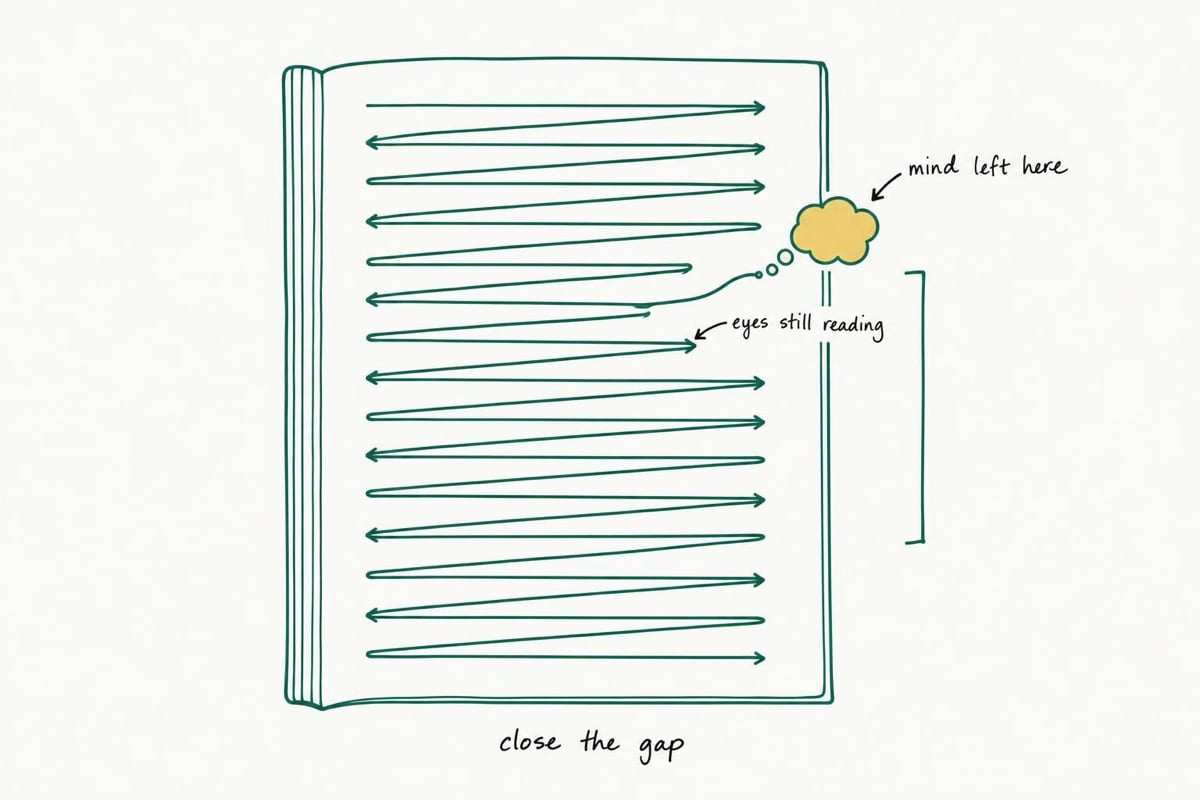
You reach the bottom of the page with nothing because your attention left the text somewhere in the middle and your eyes kept moving without it. The reading continued. Your grip on the meaning didn't. Most advice on how to focus in reading treats this as a willpower shortage and hands you a quieter room. What helps more is a reading session that expects the drift and gives you a way to catch it.
You know the exact moment. Halfway down page four you surface, and you can't say what the last two paragraphs argued. So you back up to the top of the page and read it again, slower this time, and the same thing happens. Twenty minutes in, you've covered six pages and kept one.
It's worse with the things you actually need to read. The chapter for the exam. The thirty-eight-page grant report due before the board meets. The book you chose yourself and want to finish. You're not bored, exactly. You're somewhere else.
You Have Already Tried the Obvious Fixes
The obvious fixes aren't wrong. They're just aimed at the room instead of the session. Silence the phone, find a quiet corner, make coffee, hold a highlighter, promise yourself thirty pages. Each one removes an external interruption, and that's worth doing. What none of them touches is the interruption that starts inside your own head, which is where most of a reading session falls apart.
Moving the phone out of reach earns its reputation. In one experiment, people performed worse on an attention-demanding task simply because a notification arrived, even when they never picked the phone up. [1] Our guide to protecting your focus from notifications covers that part well.
But you've probably done all of it and still lost page four. The distraction you need to handle isn't in the room, and it doesn't announce itself.
The Problem Is Not That You Drift. It Is That You Do Not Notice.
Your attention drifting during reading isn't the failure. Everyone's does. The failure is the stretch of time between the drift and the moment you notice, because during that stretch your eyes keep tracking lines and your hands keep turning pages. Researchers call it mindless reading: the mechanics carry on while your processing of the actual words thins out. Catching the drift two paragraphs sooner beats trying to prevent it.
In one study, adults read a detective novella while researchers tracked episodes of zoning out, meaning mind wandering the reader hadn't realized was happening. Those unnoticed episodes interfered with building a working model of the story, which is the part that lets you follow who did what and why. [2]
Eye-tracking shows what that looks like mechanically. During mindless-reading stretches, fixations get longer and stop being shaped by the words on the page the way they are in ordinary reading. [3] Your eyes are still working the lines. Less of the text is getting through.
Be careful how much you make this mean. A 2023 meta-analysis put the average association between mind wandering and reading comprehension at r = -0.21, a small effect. [4] A wandering mind isn't wrecking your comprehension outright. It charges a steady, modest tax, session after session, and the tax is largest in the minutes you don't know you're paying it.
Which is why the lever is noticing. You can't decide to stop having thoughts. You can shorten the gap between leaving the page and realizing you left.
How to Focus in Reading: Build the Session to Expect Drift
A reading session that survives your own attention has five parts: a target small enough to finish, one question to carry into the text, a moving marker under the line you're on, a recall check at every section break, and somewhere to park stray thoughts. The session shape below is ours, assembled from the research in this article rather than taken from any published method.
1. Make the target a section, not a book
"Read chapter seven" has no edge you can feel. "Read to the next subheading, then stop" does. A section-sized target gives you a checkpoint every few minutes, and checkpoints are where drift gets caught. If the text has no subheadings, mark your own: four pages, two columns, whatever gives you a line to stop at.
This is also the honest answer to how long a reading session should be. There's no validated number. Pick the smallest unit you can finish without a break, and let the checkpoint tell you when to stop.
2. Carry one question into the text
Before you start, spend thirty seconds on the headings and write down one thing you want the section to answer. "Why does the author think the 1970s policy failed?" Now you're reading for something, and you've got a test to run at the bottom of the page: "Did I get it?"
3. Keep a moving marker under the line
Run a finger, a pen, or an index card along the line as you read. It sounds like a children's technique and it's the most useful item here, because it turns an invisible problem into a visible one. When your attention leaves, the marker stops moving, or it drifts far ahead of what you actually processed. Either way you get a physical signal, and it arrives well before the vague feeling of being lost does.
4. Check recall at the section break, not the page top
At each checkpoint, look away and say the section back in one sentence. If you can't, don't restart from the top of the page. Restart from the last thing you can actually say, usually a paragraph or two back, and read forward from there.
Saying it back does more than test you. When people studied prose and then either reread it or practiced recalling it, rereading won on an immediate test, but a week later the recall group remembered 61% against the rereaders' 40%. [5] The check that catches your drift is also what makes the reading stick. If retention is the main goal, our guide to remembering more of what you read goes further on that.
5. Park stray thoughts instead of chasing them
Keep a single sheet beside the book. Every intrusive thought goes on it in three words, then you go back to the line. It's not a to-do system and it's not a note-taking method, just a parking space. Students have done a version of this for decades with a reading journal. Our read on why it works: a thought you've written down stops demanding to be rehearsed.
One note on breaks. Brief pauses during a long vigilance task did keep laboratory performance from decaying. [6] That was button-pressing, not reading, so treat it as a reason to take a real thirty-second pause at a checkpoint, and nothing more.
What One Reading Session Actually Looks Like
Here's the whole thing on a thirty-eight-page grant report you have to summarize for the board on Tuesday. Twenty-five minutes, phone in another room, index card in hand. You skim the headings, write one question, and read to the first subheading. At the break you look up and say the section back. You miss it, back up two paragraphs, get it, keep going.
By minute nine you've written two stray thoughts on the sheet: "renew parking permit" and "ask if the match is cash or in-kind." Neither got chased. By minute twenty you've covered eleven pages and you can say what each of the four sections argued, which beats reading all thirty-eight and remembering the first one.
Studying works the same way with a harder checkpoint. Instead of saying the section back, answer the end-of-chapter question without looking. It's slower, it feels worse, and it's the version that survives until the exam. Anyone working through dense academic material can borrow more of this from our notes on reading like a scholar.
Screens change the setup, and the method holds. One 2020 study found reading medium affected attention and comprehension when readers were working under time pressure, so the finding that transfers is narrow: keep your screen reading away from a clock. [7] Closing the tabs and going full screen is our own suggestion on top of that, untested but free.
Pleasure reading gets the light version. Marker, yes. One-sentence recall at chapter ends, sometimes. A question in advance, no, because nobody's examining you on it. If a novel keeps losing you after four pages, the book might be the problem before your attention is. Experienced readers will tell you to consider abandoning a book that stopped working, and making time to read does more for you than reading faster.
What About the Times This Does Not Work
The honest limits: a marker and a recall check won't fix four hours of sleep, a text far above your level, or a week where everything is on fire. They work on one specific failure, losing the page without noticing. If your reading has been hard across the board for a while, start somewhere other than the session design.
If timers have failed you before, notice that nothing here runs on willpower held across a whole block. The checkpoint breaks the session into pieces small enough to finish, and finishing one is what carries you into the next. If focus is falling apart everywhere and not only on the page, the four checks in our guide to focusing and concentrating better are the better starting point. If you can't start the reading at all, that's a different problem, covered in why overwhelm turns into doing nothing.
ADHD comes up constantly here, and this article can't assess anyone's attention. Our focus tips for people with ADHD are practical rather than clinical. A persistent or worsening change in your ability to read, or new trouble with the words themselves, is a reason to see a clinician or an optometrist rather than to buy a better index card.
Read One Section Today
Pick the thing you've been failing to get through. Skim the headings, write one question on a card, put the card under the first line, and read to the next subheading. Then look up and say it back in a sentence. If you can't, back up to the last thing you can say and go again. Nothing else changes: same book, same chair, same attention. Any straight edge works for the marker: a receipt, an envelope, the spine of a second book. If the first checkpoint lands three paragraphs in and you can say it back, you're already reading differently than you were this morning. One section, one checkpoint, and that's how to focus in reading without waiting for an attention span you don't have yet.


