

For a lot of people it shows up on an ordinary weekday, some months after the last day. Not grief. Not anything you could point at and name. The house is quiet, the coffee is fine, and nothing in the day is pulling hard enough to get you out of the chair.
Look for an explanation and you land on the phrase retirement depression, attached to either a symptom checklist or a list of hobbies.
We would start somewhere else: how much of this retirement did you actually choose?
That sounds like an odd first question when the problem is mood. It happens to be the line the research keeps finding. People who set their own last day and people who had it set for them report different things afterward, and the gap is wide enough to change what you do this month. Nothing below is a diagnosis. We describe what people report, and we say plainly when to hand it to a professional.
What people mean by retirement depression
Retirement depression is not a separate diagnosis. It is the everyday name for low mood and depressive symptoms that turn up after leaving work: flatness, loss of interest, broken sleep, no appetite for things you picked yourself. Some of it settles as the new life takes shape. Some of it is depression that needs treatment, and from the inside, on any given Tuesday, the two are not distinguishable.
So we are not going to hand you a test. Where that line sits is a clinician's call, and our article on retirement boredom lists the warning signs if you want them in one place. What this article does instead is sort the two situations that the symptom lists and the hobby lists lump together. If you have any thought of harming yourself, skip all of it: the 988 Suicide and Crisis Lifeline in the US takes calls and texts. [1]
The split that sorts it: who set the date
The clearest pattern in the retirement and mental health literature is not that leaving work makes people low. It is that an unchosen exit does, and a chosen one mostly does not. Pooling 25 longitudinal studies, a 2021 meta-analysis found depressive symptoms rose after involuntary retirement (d = 0.180, 95% CI 0.061 to 0.299) and barely moved after voluntary retirement (d = 0.086, with a confidence interval crossing zero). [2]
A second meta-analysis, eight longitudinal studies and 14,604 people, put it in risk terms. Compared with people still working, involuntary retirement carried a pooled relative risk for depression of 1.70 (95% CI 1.28 to 2.25). [3] An Irish longitudinal study that compared each person with their own earlier self found the same shape: forced retirement had a negative, statistically significant effect on mental health, while the voluntary effect was smaller and not significant in all models. [4]
Hold those numbers loosely in one respect. They are symptom scales and risk ratios across populations, not a verdict on your Tuesday, and d = 0.180 is a small effect. What they are good for is sorting. The question "was this my decision" separates two groups that the symptom checklists lump together.
Whether retirement in general raises or lowers the risk of depression is a separate and much messier argument, with large credible reviews pointing opposite ways. We worked through that evidence in our piece on finding purpose in retirement. The choice split holds either way.
Three things that usually arrive with an unchosen exit
An unchosen exit rarely arrives alone. Three things tend to travel with it: the health problem that set the date, an income drop nobody modelled, and the loss of any say in the timing. Each has its own evidence trail. Working out which of the three is loudest tells you what to handle first.
The health reason. In a German population study of 4,808 adults, retiring early for health reasons was linked to higher depressive symptom scores among women (b = 4.68 on the CES-D scale, 95% CI 1.71 to 7.65), while voluntary early retirement was linked to lower scores among men (b = -1.83). [5] That design is cross-sectional, so it settles no direction of cause, and the health-reason finding is a women-only result in one German cohort rather than a rule about men and women. The broader point, that exits you did not choose land harder, comes from the meta-analyses above and not from this study. Our reading is that it extends to the exit nobody counts as retirement, the one where you left to look after a parent or a spouse, which has its own well-documented cost.
The income drop. A systematic review of 40 studies found financial stress consistently associated with depression, with the association generally stronger among people with lower income or wealth. [6] A forced exit usually shortens the earning window and the planning window at once, so "it is only money" understates what is actually pressing on you.
The lost say. Nobody asked. Saying so out loud sounds like pride rather than a problem, which is our reading of why it tends to go unmentioned. The studies above do not isolate it: what they label involuntary retirement bundles health-forced exits, layoffs, and buyouts together. Our reading is that having no say is part of why those exits land harder, and it is worth naming out loud rather than apologising for.
What to do in the first month when the date was not yours
Separate the losses, then take back one decision, then get a professional opinion earlier than feels justified. The five moves below are ours rather than a protocol from the research. We built them around what the involuntary-retirement evidence points at as the damage: a loss you did not agree to, a plan that went with it, and no say in the timing. None of them is a treatment.
- Write down everything that ended on the same day. The work. The income. The eight people you spoke to daily without arranging it. The five-year plan. The sentence you used when strangers asked what you do. Five separate losses read as one mood is why the whole thing feels unfixable.
- Take back one decision this week, and keep it small. Which day the week turns on. What time you eat. Which room becomes yours. The research cannot promise this lifts your mood. What it does show is the worse outcomes clustering in exits people did not control, which is our reason for starting here rather than with a hobby.
- Book the appointment now, and start the notes today. Three lines a day: how you slept, whether you ate normally, whether anything was worth getting up for. Do not hold off on the call until you have a fortnight of them. Book first, write as you go, and bring whatever you have by the time you are sitting there. Not to score yourself. To hand the person who can assess it something better than "I have felt off since the spring."
- Anchor one weekday to other people. Not an activity, a slot with names attached: a standing breakfast, a shift with a crew that notices when you miss it, a volunteering commitment with a roster. A full calendar of solo errands can still leave a week with nobody in it.
- Give the money its own scheduled hour. With real numbers, on a day you picked, away from the flat part of the morning. If the arithmetic says income rather than cuts, that is a plan too: work that trades income for a lower stress load, or the housing question handled on its own terms rather than as a panic move.
If you chose the date and still feel flat
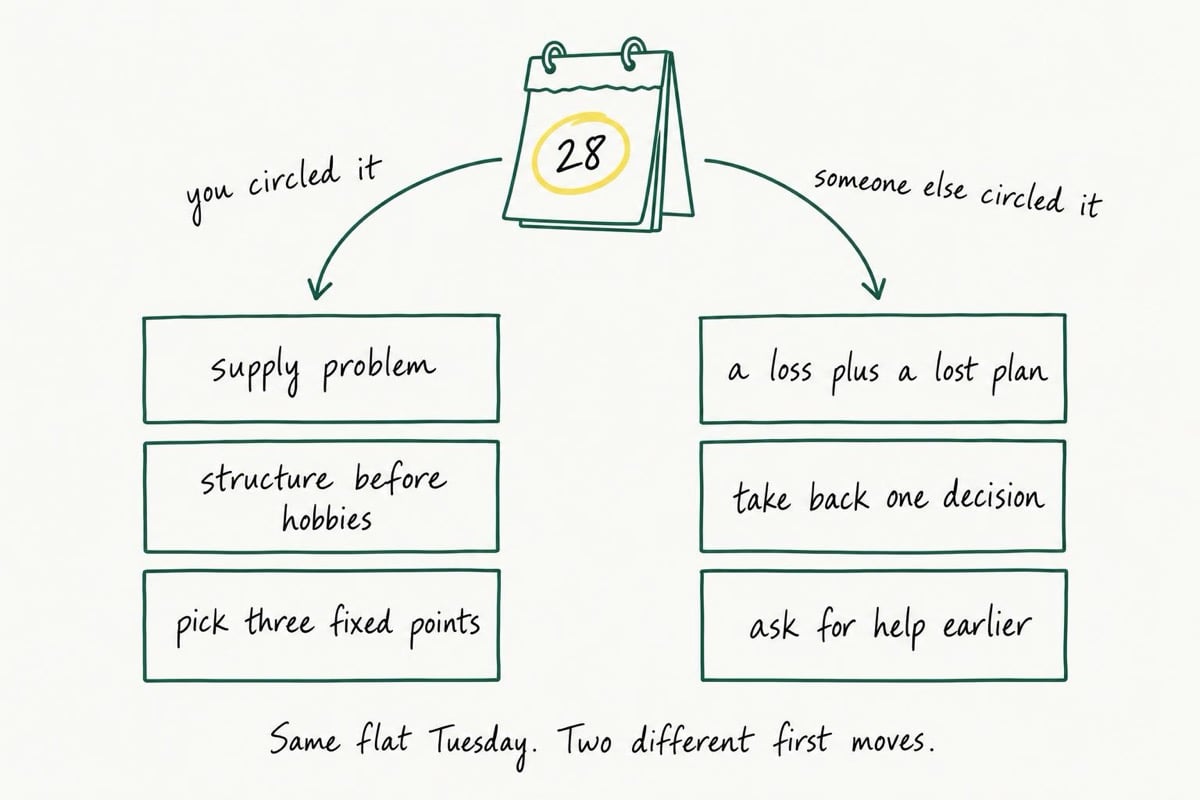
The choice split is a risk concentration, not a rule. Plenty of people retire exactly when they meant to and still hit a flat stretch once the first free months stop feeling like a holiday. Our reading of that version is a different problem: not a loss you never agreed to, but a supply problem. Work had been handing over structure, contact, and a reason to be somewhere specific, and none of it got replaced on schedule.
The first move is the same for everyone in that position, and it is not a new interest. Pick the three fixed points of your week and write them on the calendar: one morning that starts at a set time with somewhere to be, one slot that belongs to other people with names attached, and one piece of work that would be noticed if you stopped. Three is enough to give a week a shape. Hobbies fill the gaps afterward, and our view is that they struggle when they arrive first.
The rest is well-covered ground here. Our article on finding purpose in retirement takes apart what the job was quietly delivering and how to rebuild it in order. Retirement boredom handles the restless version of flat. And if the day has no shape at all, a daily routine after 60 is the place to start rather than a new hobby.
"I am just tired, that is all"
Tiredness is an easy way to explain this away, and on fatigue specifically the evidence runs the other direction. In a French occupational cohort followed for years either side of retirement, mental fatigue dropped sharply in the year after leaving work (odds ratio 0.19, 95% CI 0.18 to 0.21), and physical fatigue followed at 0.27, comparing the year after retirement with the year before it. [7]
Sleep tends to get longer rather than shorter. In a US cohort tracked annually, retirees slept 15 to 22 minutes more and woke 63 to 78 minutes later than they had while working. [8]
Both are single cohorts relying on self-report, and one is a French utility company, so treat them as direction rather than destiny. The direction is still useful. If you are more tired a year after retiring than you were while working, that is not what the average retiree reports, and "I am sixty-three, what do you expect" is doing a lot of work in that sentence. Fatigue that will not lift is worth a doctor's attention, whether the answer turns out to be thyroid, sleep apnea, medication, or mood.
When this needs a professional, not a plan
No sequence of calendar moves is treatment, and nothing in this article can tell you what you have. The tools that sort it out, short screening questionnaires and a proper assessment, are clinical work, and a review of depression in later life describes them as exactly that. [9]
The practical version: book your regular doctor, say "I have been low since I stopped working" in the first minute rather than the last, and take whatever notes you have with you. Bring the date question too, because "I did not choose to leave" is relevant history, not a complaint. If you are thinking about harming yourself, or you feel you cannot carry on, the 988 Suicide and Crisis Lifeline in the US takes calls and texts and has done since July 2022. [1] You do not need to wait for a bad enough day to use it.
Start with the date
The question that gets you unstuck is not whether what you feel counts as retirement depression. It is who set the date. If you picked it, you are probably looking at a supply problem, and the rebuild starts with structure. If someone else picked it, you are looking at a loss plus a lost plan, and the first moves are to separate what ended, take one decision back, and get a professional involved sooner than feels warranted.
Either way, pick one line from this article and do it today, in the flat part of the morning, before the day decides for you.